Integrating Tongue and Dental Biometrics Using Improved PSO for Enhanced Forensic Evidence
DOI:
https://doi.org/10.12928/biste.v8i4.15039Keywords:
Multimodal Biometrics, Improved PSO, Forensic Identification, Tongue Prints, Dental BiometricsAbstract
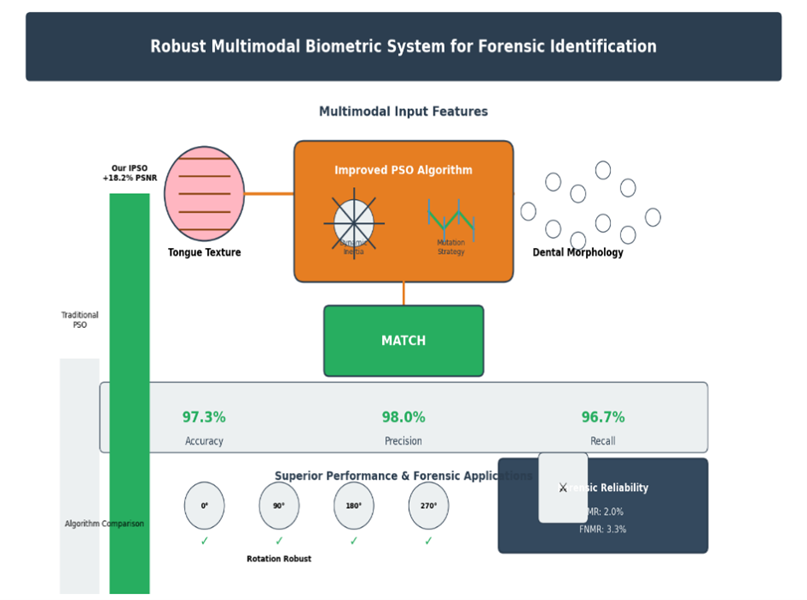
Reliable human identification is a challenging area in forensic science especially where conventional biometrics are not available. This is addressed in this study by coming up with a new multimodal system. The study contribution is the Adaptive Convergence-Triggered Mutation Particle Swarm Optimization (ACTM-PSO) algorithm of optimal fusion regarding tongue and dental biometrics. The combination leverages durability regarding dental structure as well as the specialized texture of tongue prints, which in most cases preserved in post-mortem cases. The technique extracts the texture and morphological features of tongue and dental images. The proposed ACTM-PSO, which has non-linear adaptive inertia weight and stagnation-triggered mutation, optimizes the weighting of features for fusion before classification using an SVM. Experimentally, the system attains accuracy of 97.3% and low Equal Error Rate (EER) of 2.1% in comparison to traditional PSO (88.3% accuracy) and unimodal systems. It has an accuracy of more than 95% in rotations of the image (0°, 90°, 180°, 270°), which is forensically practical. The False Match Rate (FMR) and the False Non-Match Rate (FNMR) are 2.0% and 3.3%. This paper provides a strong optimization based backbone that goes ahead to develop multimodal biometric integration to be used in a forensic application to increase the reliability of evidence in legal contexts.
References
I. V. Borysenko, O. Y. Bululukov, V. D. Pcholkin, V. V. Baranchuk, and V. O. Prykhodko, “The modern development of new promising fields in forensic examinations,” Journal of Forensic Science and Medicine, 7(4), 137-144, 2021, https://doi.org/10.4103/jfsm.jfsm_66_21.
N. S. Mohammad and R. F. Dalool, “Contemporary M ethods of Criminal Evidence: Examining Modern Scientific Techniques and Their Legal Implications,” Kutafin Law Review, vol. 11, no. 4, pp. 788–809, 2024, https://doi.org/10.17803/2713-0533.2024.4.30.788-809.
M. A. Ulkareem Naser and A. H. Hassin Al-Asadi, “Image Denoising Using Generative Adversarial Network by Recursive Residual Group,” Journal of Robotics and Control (JRC), vol. 6, no. 2, pp. 514–526, 2025, https://doi.org/10.18196/jrc.v6i2.24302.
P. M. Than and H. Nguyen, “Efficient Multimodal Biometric Identification via Gabor-Enhanced Attention Networks,” Journal of Robotics and Control (JRC), vol. 6, no. 3, pp. 1175–1186, 2025, https://doi.org/10.18196/jrc.v6i3.26490.
W. Anees, F. Riaz, and A. Franco, “Use of artificial intelligence in Forensic Dentistry: a review of literature. Revista Brasileira de Odontologia Legal, vol. 11, no. 2, 2024, https://doi.org/10.21117/rbol-v11n22024-546.
E. M. Hameed, H. Joshi, and Q. K. Kadhim, “Advancements in Artificial Intelligence Techniques for Diabetes Prediction: A Comprehensive Literature Review,” Journal of Robotics and Control (JRC), vol. 6, no. 1, pp. 345-365, 2025, https://doi.org/10.18196/jrc.v6i1.22258.
N. Sriwiboon and S. Phimphisan, “A Transformer-Enhanced CNN Framework for EEG Emotion Detection with Lightweight Gray Wolf Optimization and SHAP Analysis,” Journal of Robotics and Control (JRC), vol. 6, no. 4, pp. 1768–1776, Jun. 2025, https://doi.org/10.18196/jrc.v6i4.26725.
T. Radhika, N. Jeddy, and S. Nithya, “Tongue prints: A novel biometric and potential forensic tool,” J. Forensic Dent. Sci., vol. 8, no. 3, p. 117, 2016, https://doi.org/10.4103/0975-1475.195119.
I. G. S. M. Diyasa et al., “Improving Classification Accuracy of Breast Ultrasound Images Using Wasserstein GAN for Synthetic Data Augmentation,” Journal of Robotics and Control (JRC), vol. 6, no. 4, pp. 1962–1971, Jun. 2025, https://doi.org/10.18196/jrc.v6i4.25075.
B. N. Jyothi and M. A. Jabbar, “Enhanced Xception Model for Deepfake Detection: Integrating CBAM, Contrastive Learning, and a Stacking Classifier,” Journal of Robotics and Control (JRC), vol. 6, no. 4, pp. 1849–1859, Jun. 2025, https://doi.org/10.18196/jrc.v6i4.25811.
P. Chotikunnan et al., “Noise-Reduced 3D Organ Modeling from CT Images Using Median Filtering for Anatomical Preservation in Medical 3D Printing,” Journal of Robotics and Control (JRC), vol. 6, no. 4, pp. 1600–1611, Jun. 2025, https://doi.org/10.18196/jrc.v6i4.26665.
A. R. Hassoon, A. Al-Naji, G. A. Khalid, and J. Chahl, “Tongue Disease Prediction Based on Machine Learning Algorithms,” Technologies (Basel)., vol. 12, no. 7, Jul. 2024, https://doi.org/10.3390/technologies12070097.
S. M. Taher and C. Soong der, “ARI-ORB: Adaptive Rotation-Invariant ORB for Enhanced Feature Matching in Dental X-Ray Imaging,” IEEE Access, vol. 13, pp. 143020–143030, 2025, https://doi.org/10.1109/ACCESS.2025.3590077.
Garg, K., Sachdev, R., Shwetam, S., Saxena, S., Mehrotra, V., & Srivastava, A. (2020). Evaluation of morphological characteristic and varieties of tongue prints for personal identification in Kanpur communities: An impression-based analysis. The Saint's International Dental Journal, 4(1), 54-59, 2020, https://doi.org/10.4103/sidj.sidj_19_20.
S. B. Khanagar et al., “Application and performance of artificial intelligence technology in forensic odontology – A systematic review,” Legal Medicine, vol. 48, p. 101826, 2021, https://doi.org/10.1016/j.legalmed.2020.101826.
M. Almania, A. Zainal, F. A. Ghaleb, A. Alnawasrah, and M. Al Qerom, “Two-Level Feature Selection for Enhanced Accuracy and Reduced Computational Overhead in Intrusion Detection Systems Using Rough Set Theory and Binary Particle Swarm Optimization,” Journal of Robotics and Control (JRC), vol. 6, no. 1, pp. 262–271, 2025, https://doi.org/10.18196/jrc.v6i1.23649.
A. Sakhi, S. E. Mansour, and A. Sekkaki, “Using Learning Focal Point Algorithm to Classify Emotional Intelligence,” Journal of Robotics and Control (JRC), vol. 5, no. 1, pp. 263–270, 2024, https://doi.org/10.18196/jrc.v5i1.20895.
A. T. Hermawan, I. A. E. Zaeni, A. P. Wibawa, Gunawan, W. H. Hendrawan, and Y. Kristian, “A Multi Representation Deep Learning Approach for Epileptic Seizure Detection,” Journal of Robotics and Control (JRC), vol. 5, no. 1, pp. 187–204, 2024, https://doi.org/10.18196/jrc.v5i1.20870.
R. S. Patil, S. P. Jadhav, and M. D. Patil, “Review of Intelligent and Nature-Inspired Algorithms-Based Methods for Tuning PID Controllers in Industrial Applications,” Journal of Robotics and Control (JRC), vol. 5, no. 2, pp. 336-358, 2024, https://doi.org/10.18196/jrc.v5i2.20850.
T. S. Abraham, S. Subramani, V. Jeyakumar and P. Sundaram, "A Comprehensive Preprocessing Approaches for Tooth Labeling and Classification using Dental Panoramic X-Ray Images," 2022 IEEE Delhi Section Conference (DELCON), pp. 1-7, 2022, https://doi.org/10.1109/DELCON54057.2022.9753092.
H. Nguyen and C. K. Ha, “Real-Time Prohibited Item Detection in X-ray Security Screening via Adaptive Multi-scale Feature Fusion and Lightweight Dynamic Convolutions,” Journal of Robotics and Control (JRC), vol. 6, no. 4, pp. 1746–1757, Jun. 2025, https://doi.org/10.18196/jrc.v6i4.27030.
Y. Pamungkas, S. Pratasik, M. Krisnanda, and P. N. Crisnapati, “Optimizing Gated Recurrent Unit Architecture for Enhanced EEG-Based Emotion Classification,” Journal of Robotics and Control (JRC), vol. 6, no. 3, pp. 1450–1461, May 2025, https://doi.org/10.18196/jrc.v6i3.26016.
Y. Mardenov, A. Adamova, T. Zhukabayeva, and M. Othman, “Enhancing Fault Detection in Wireless Sensor Networks Through Support Vector Machines: A Comprehensive Study,” Journal of Robotics and Control (JRC), vol. 4, no. 6, pp. 868–877, 2023, https://doi.org/10.18196/jrc.v4i6.20216.
Y. Pamungkas, R. D. Indriani, P. N. Crisnapati, and Y. Thwe, “Work Fatigue Detection of Search and Rescue Officers Based on Hjorth EEG Parameters,” Journal of Robotics and Control (JRC), vol. 5, no. 6, pp. 1836–1844, 2024, https://doi.org/10.18196/jrc.v5i6.23511.
A. Jarrett and K. R. Choo, “The impact of automation and artificial intelligence on digital forensics,” WIREs Forensic Science, vol. 3, no. 6, Nov. 2021, https://doi.org/10.1002/wfs2.1418.
Z. Xiao and W. Guo, “Research on the application of wearable intelligent devices in college sports training,” Discover Applied Sciences, 2026, https://doi.org/10.1007/s42452-026-08620-2.
M. Elavarasu and K. Govindaraju, “Unveiling the Advancements: YOLOv7 vs YOLOv8 in Pulmonary Carcinoma Detection,” Journal of Robotics and Control (JRC), vol. 5, no. 2, pp. 459–470, 2024, https://doi.org/10.18196/jrc.v5i2.20900.
L. P. Prakash, M. Singh, and B. S. Bhandari, “Forensic odontology: The prosthetic ID,” J. Forensic Dent. Sci., vol. 11, no. 3, p. 113, 2019, https://doi.org/10.4103/jfo.jfds_91_19.
P. Shah, P. Velani, L. Lakade, and S. Dukle, “Teeth in forensics: A review,” Indian Journal of Dental Research, vol. 30, no. 2, pp. 291-299, 2019, https://doi.org/10.4103/ijdr.IJDR_9_17.
A. A. Solanke and M. A. Biasiotti, “Digital Forensics AI: Evaluating, Standardizing and Optimizing Digital Evidence Mining Techniques,” KI - Kunstliche Intelligenz, vol. 36, no. 2, pp. 143–161, Sep. 2022, https://doi.org/10.1007/s13218-022-00763-9.
R. Nambiar and R. Nanjundegowda, “A Comprehensive Review of AI and Deep Learning Applications in Dentistry: From Image Segmentation to Treatment Planning,” Journal of Robotics and Control (JRC), vol. 5, no. 6, p. 1744-1752, 2024, https://doi.org/10.18196/jrc.v5i6.23056.
S. M. Taher, “Application of Improved PSO in Augmented Reality for Dental Healthcare,” Journal of Advanced Research in Applied Sciences and Engineering Technology, vol. 50, no. 2, pp. 90–102, Aug. 2025, https://doi.org/10.37934/araset.50.2.90102.
A. S. Al-Qazzaz, P. Salehpour, and H. S. Aghdasi, “Robust DeepFake Face Detection Leveraging Xception Model and Novel Snake Optimization Technique,” Journal of Robotics and Control (JRC), vol. 5, no. 5, pp. 1444–1456, 2024, https://doi.org/10.18196/jrc.v5i5.22473.
H. Tang, Y. Zhang, Q. Qiao, J. Ren and X. Qiu, "Risk assessment of credit field based on PSO-SVM," 2020 2nd International Conference on Economic Management and Model Engineering (ICEMME), pp. 809-813, 2020, https://doi.org/10.1109/ICEMME51517.2020.00165.
M. Kriouich, H. Sarir, and S. Louah, “Research Trends and Knowledge Taxonomy of Artificial Intelligence Applications in Supply Chain Management, Logistics, and Transportation: A Systematic Literature Review and Bibliometric Analysis,” Journal of Robotics and Control (JRC), vol. 5, no. 5, pp. 1349–1364, 2024, https://doi.org/10.18196/jrc.v5i5.21859.
J. A. Neves, L. B. Lopes, V. Machado, J. Botelho, A. S. Delgado, and J. J. Mendes, “Evidence of age estimation procedures in forensic dentistry: Results from an umbrella review,” Medicina, vol. 60, no. 1, p. 42, 2023, https://doi.org/10.3390/medicina60010042.
T. A. Taha et al., “Enhancing Multilevel Inverter Performance: A Novel Dung Beetle Optimizer-based Selective Harmonic Elimination Approach,” Journal of Robotics and Control (JRC), vol. 5, no. 4, pp. 944–953, 2024, https://doi.org/10.18196/jrc.v5i4.21722.
T. Nunes et al., “Orofacial assessment as digital path for forensic and legal evidence record,” Forensic Sci. Res., vol. 9, no. 3, Sep. 2024, https://doi.org/10.1093/fsr/owae006.
S. Matsuda, H. Yoshida, K. Ebata, I. Shimada, and H. Yoshimura, “Forensic odontology with digital technologies: A systematic review,” Journal of forensic and legal medicine, vol. 74, p. 102004, 2020, https://doi.org/10.1016/j.jflm.2020.102004.
P. Mesejo, R. Martos, Ó. Ibáñez, J. Novo, and M. Ortega, “A Survey on artificial intelligence techniques for biomedical image analysis in skeleton-based forensic human identification,” Applied Sciences, vol. 10, no. 14, p. 4703, 2020, https://doi.org/10.3390/app10144703.
A. Putrino, V. Bruti, M. Enrico, C. Costantino, B. Ersilia, and G. Gabriella, “Intraoral Scanners in Personal Identification of Corpses: Usefulness and Reliability of 3D Technologies in Modern Forensic Dentistry,” Open Dent. J., vol. 14, no. 1, pp. 255–266, Jun. 2020, https://doi.org/10.2174/1874210602014010255.
S. Park and A. Carriquiry, “Learning algorithms to evaluate forensic glass evidence,” Annals of Applied Statistics, vol. 13, no. 2, pp. 1068–1102, 2019, https://doi.org/10.1214/18-AOAS1211.
S. Abboud et al., “Optimizing Solar Energy Production in Partially Shaded PV Systems with PSO-INC Hybrid Control,” Journal of Robotics and Control (JRC), vol. 5, no. 2, pp. 312–320, 2024, https://doi.org/10.18196/jrc.v5i2.20896.
S. Jana, N. Das, S. Basu, and M. Nasipuri, “Survey of Human Gait Analysis and Recognition for Medical and Forensic Applications,” International Journal of Digital Crime and Forensics, vol. 13, no. 6, pp. 1–20, Oct. 2021, https://doi.org/10.4018/ijdcf.289432.
A. I. Piraianu et al., “Enhancing the Evidence with Algorithms: How Artificial Intelligence Is Transforming Forensic Medicine,” Diagnostics, vol. 13, no. 18, p. 2992, 2023, https://doi.org/10.3390/diagnostics13182992.
K. Krishan, T. Kanchan, and A. K. Garg, “Send Orders for Reprints to reprints@benthamscience.ae Dental Evidence in Forensic Identification-An Overview, Methodology and Present Status,” Arab Journal of Forensic Sciences & Forensic Medicine, vol. 7, no. 1, pp. 93-99 2015, https://doi.org/10.2174/1874210601509010250.
F. Zaina et al., “A Systematic Review of Clinical Practice Guidelines for Persons With Non-specific Low Back Pain With and Without Radiculopathy: Identification of Best Evidence for Rehabilitation to Develop the WHO’s Package of Interventions for Rehabilitation,” Archives of physical medicine and rehabilitation, vol. 104, no. 11, pp. 1913-1927, 2023, https://doi.org/10.1016/j.apmr.2023.02.022.
W. Bao, N. Lianju, and K. Yue, “Integration of unsupervised and supervised machine learning algorithms for credit risk assessment,” Expert Syst. Appl., vol. 128, pp. 301–315, Aug. 2019, https://doi.org/10.1016/j.eswa.2019.02.033.
B. Kaul, V. Vaid, S. Gupta, and S. Kaul, “Forensic odontological parameters as biometric tool: A review,” International Journal of Clinical Pediatric Dentistry, vol. 14, no. 3, p. 416, 2021, https://doi.org/10.5005/jp-journals-10005-1967.
M. Yazdanian et al., “Dental Radiographic/Digital Radiography Technology along with Biological Agents in Human Identification,” Scanning, vol. 2022, no. 1, p. 5265912, 2022, https://doi.org/10.1155/2022/5265912.
N. Farahani, E. I. Auerkari, and N. R. Arifaputri, “Tongue prints as an emerging biometric tool in forensic odontology: a systematic review,” Egyptian Journal of Forensic Sciences, vol. 16, no. 1, p. 9, 2026, https://doi.org/10.1186/s41935-025-00510-9.
ِM. E. Abdel Naser adn A. N. M. Emam, “Role of forensic odontology in identification of persons: A review article,” Cureus, vol. 16, no. 3. 2024, https://doi.org/10.7759/cureus.56570.
D. Desai, V. Vaswani, K. L. Pramod, and A. Kulkarni, “Tongue Print as an Identification Tool: A Study among the Dakshina Kannada Population,” Int. J. Innov. Sci. Res. Technol., pp. 262–269, Apr. 2025, https://doi.org/10.38124/ijisrt/25apr182.
Published
How to Cite
Issue
Section
License
Copyright (c) 2026 Tameem Hadi Fadhil

This work is licensed under a Creative Commons Attribution-ShareAlike 4.0 International License.
Authors who publish with this journal agree to the following terms:
- Authors retain copyright and grant the journal right of first publication with the work simultaneously licensed under a Creative Commons Attribution License that allows others to share the work with an acknowledgment of the work's authorship and initial publication in this journal.
- Authors are able to enter into separate, additional contractual arrangements for the non-exclusive distribution of the journal's published version of the work (e.g., post it to an institutional repository or publish it in a book), with an acknowledgment of its initial publication in this journal.
- Authors are permitted and encouraged to post their work online (e.g., in institutional repositories or on their website) prior to and during the submission process, as it can lead to productive exchanges, as well as earlier and greater citation of published work (See The Effect of Open Access).

This journal is licensed under a Creative Commons Attribution-ShareAlike 4.0 International License.