Banana Blossom as a Novel Ingredient in The Zero Waste Strategy: Application in Flakes
DOI:
https://doi.org/10.12928/biste.v7i4.14976Keywords:
Arrowroot, Banana bud, Flakes, Food processing, PhysicochemicalAbstract
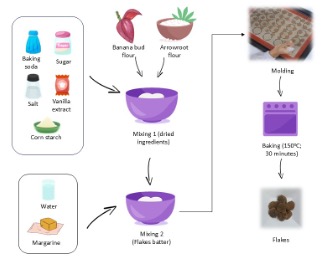
Banana bud is an underutilized byproduct of the banana plant. Banana bud is rich in fiber and macronutrients that promote health. The potential of banana bud can be optimized by transforming it into convenient ready-to-eat food products. This study was contributed to facilitate the conversion of agricultural waste into nutrient-dense functional foods. This investigation will involve the preparation of flakes using banana bud flour and arrowroot flour as substitutes for wheat flour. Each mixture incorporated banana bud and arrowroot flour at concentrations of 5%, 10%, and 15%. Additionally, the flakes will undergo assessment of their chemical, physical, and sensory characteristics. The incorporation of banana bud and arrowroot flour into the flakes resulted in a considerable increase in total protein and crude fiber values compared to the control sample. The hardness and crunchiness of the flakes varied considerably, although the water absorption capacity rose markedly. The incorporation of banana bud flour resulted in the flakes acquiring a reddish hue. The outcomes of the descriptive sensory evaluation yielded an assessment of color, odor, texture, flavor, aftertaste, and texture after rehydration conducted by the panellists. The study's results indicate that banana plant waste can be utilized to produce nutrient-dense food products favored by panellists.
References
T. Tasnim, P. C. Das, A. A. Begum, A. H. Nupur, and M. A. R. Mazumder, “Nutritional, textural and sensory quality of plain cake enriched with rice rinsed water treated banana blossom flour,” J. Agric. Food Res., vol. 2, p. 100071, 2020, https://doi.org/10.1016/j.jafr.2020.100071.
N. S. Mathew and P. S. Negi, “Traditional uses, phytochemistry and pharmacology of wild banana (Musa acuminata Colla): A review,” J. Ethnopharmacol., vol. 196, pp. 124–140, 2017, https://doi.org/10.1016/j.jep.2016.12.009.
B. F. Lau, K. W. Kong, K. H. Leong, J. Sun, X. He, Z. Wang, M. R. Mustafa, T. C. Ling, and A. Ismail, “Banana inflorescence: Its bio-prospects as an ingredient for functional foods,” Trends Food Sci. Technol., vol. 97, pp. 14–28, 2020, https://doi.org/10.1016/j.tifs.2019.12.023.
S. Ramírez‐Bolaños, J. Pérez‐Jiménez, S. Díaz, and L. Robaina, “A potential of banana flower and pseudo‐stem as novel ingredients rich in phenolic compounds,” Int. J. Food Sci. Technol., vol. 56, no. 11, pp. 5601–5608, 2021, https://doi.org/10.1111/ijfs.15072.
C. Panyayong and K. Srikaeo, “Foods from banana inflorescences and their antioxidant properties: An exploratory case in Thailand,” Int. J. Gastron. Food Sci., vol. 28, p. 100436, 2022, https://doi.org/10.1016/j.ijgfs.2021.100436.
M. D. O. Nogueira, M. de O. Guimarães, S. S. De Oliveira, F. M. N. de O. Freitas, and J. C. de S. Ferreira, “Perfil nutricional e benefícios de partes comestíveis não convencionais de bananeiras,” Brazilian J. Dev., vol. 8, no. 11, pp. 73473–73492, 2022, https://doi.org/10.34117/bjdv8n11-179.
P. Aiemcharoen, S. Wichienchot, and D. Sermwittayawong, “Antioxidant and anti-diabetic activities of crude ethanolic extract from the banana inflorescence of musa (ABB group) namwa maliong,” Funct. Foods Heal. Dis., vol. 12, no. 4, p. 161, 2022, https://doi.org/10.31989/ffhd.v12i4.909.
D. Soni and G. Saxena, “Complete nutrient profile of Banana flower: A review,” J. Plant Sci. Res., vol. 37, no. 2, pp. 263–267, 2021, https://doi.org/10.32381/JPSR.2021.37.02.6.
W. F. Awedem, M. B. L. Achu, and E. T. Happi, “Nutritive Value of three varieties of banana and plantain blossoms from Cameroon,” Greener J. Agric. Sci., vol. 5, no. 2, pp. 052–061, 2015, https://doi.org/10.15580/GJAS.2015.2.012115009.
P. Nisha and S. Mini, “In Vitro Antioxidant and Antiglycation Properties of Methanol Extract and Its Different Solvent Fractions of Musa paradisiaca L. (Cv. Nendran) Inflorescence,” Int. J. Food Prop., vol. 17, no. 2, pp. 399–409, 2014, https://doi.org/10.1080/10942912.2011.642050.
R. Ramu, P. S. Shirahatti, F. Zameer, L. V. Ranganatha, and M. N. Nagendra Prasad, “Inhibitory effect of banana (Musa sp. var. Nanjangud rasa bale) flower extract and its constituents Umbelliferone and Lupeol on α-glucosidase, aldose reductase and glycation at multiple stages,” South African J. Bot., vol. 95, pp. 54–63, 2014, https://doi.org/10.1016/j.sajb.2014.08.001.
J. J. Bhaskar, P. V Salimath, and C. D. Nandini, “Stimulation of glucose uptake by Musa sp. (cv. elakki bale) flower and pseudostem extracts in Ehrlich ascites tumor cells,” J. Sci. Food Agric., vol. 91, no. 8, pp. 1482–1487, 2011, https://doi.org/10.1002/jsfa.4337.
J. J. Bhaskar, M. S, N. D. Chilkunda, and P. V. Salimath, “Banana (Musa sp. var. elakki bale) Flower and Pseudostem: Dietary Fiber and Associated Antioxidant Capacity,” J. Agric. Food Chem., vol. 60, no. 1, pp. 427–432, 2012, https://doi.org/10.1021/jf204539v.
A. Krishnan, G. Deepakraj, N. Nishanth, and K. M. Anandkumar, “Autonomous walking stick for the blind using echolocation and image processing,” in 2016 2nd International Conference on Contemporary Computing and Informatics (IC3I), IEEE, Dec. 2016, pp. 13–16. https://doi.org/10.1109/IC3I.2016.7917927.
K. Sitthiya, L. Devkota, M. B. Sadiq, and A. K. Anal, “Extraction and characterization of proteins from banana (Musa Sapientum L) flower and evaluation of antimicrobial activities,” J. Food Sci. Technol., vol. 55, no. 2, pp. 658–666, 2018, https://doi.org/10.1007/s13197-017-2975-z.
M. M. Schmidt, R. C. Prestes, E. H. Kubota, G. Scapin, and M. A. Mazutti, “Evaluation of antioxidant activity of extracts of banana inflorescences (Musa cavendishii),” CyTA - J. Food, pp. 1–8, 2015, https://doi.org/10.1080/19476337.2015.1007532.
R. China, S. Dutta, S. Sen, R. Chakrabarti, D. Bhowmik, S. Ghosh, and P. Dhar, “In vitro Antioxidant Activity of Different Cultivars of Banana Flower (Musa paradicicus L.) Extracts Available in India,” J. Food Sci., vol. 76, no. 9, 2011, https://doi.org/10.1111/j.1750-3841.2011.02395.x.
B. S. Padam, H. S. Tin, F. Y. Chye, and M. I. Abdullah, “Antibacterial and Antioxidative Activities of the Various Solvent Extracts of Banana (Musa paradisiaca cv. Mysore) Inflorescences,” J. Biol. Sci., vol. 12, no. 2, pp. 62–73, 2012, https://doi.org/10.3923/jbs.2012.62.73.
V. Revadigar, M. A. Al-Mansoub, M. Asif, M. R. Hamdan, A. M. S. A. Majid, M. Z. Asmawi, and V. Murugaiyah, “Anti-oxidative and cytotoxic attributes of phenolic rich ethanol extract of Musa balbisiana Colla inflorescence,” J. Appl. Pharm. Sci., vol. 7, no. 5, pp. 103–110, 2017, https://doi.org/10.7324/JAPS.2017.70518.
Z. Sheng, M. Gu, W. Hao, Y. Shen, W. Zhang, L. Zheng, B. Ai, X. Zheng, and Z. Xu, “Physicochemical Changes and Glycation Reaction in Intermediate-Moisture Protein–Sugar Foods with and without Addition of Resveratrol during Storage,” J. Agric. Food Chem., vol. 64, no. 24, pp. 5093–5100, 2016, https://doi.org/10.1021/acs.jafc.6b00877.
S. Wang, Y. Yang, D. Xiao, X. Zheng, B. Ai, L. Zheng, and Z. Sheng, “Polysaccharides from banana (Musa spp.) blossoms: Isolation, identification and anti-glycation effects,” Int. J. Biol. Macromol., vol. 236, p. 123957, 2023, https://doi.org/10.1016/j.ijbiomac.2023.123957.
S. Rout and R. Banerjee, “Free radical scavenging, anti-glycation and tyrosinase inhibition properties of a polysaccharide fraction isolated from the rind from Punica granatum,” Bioresour. Technol., vol. 98, no. 16, pp. 3159–3163, 2007, https://doi.org/10.1016/j.biortech.2006.10.011.
R. Mapanao, T. Rangabpai, Y.-R. Lee, H.-W. Kuo, and W. Cheng, “The effect of banana blossom on growth performance, immune response, disease resistance, and anti-hypothermal stress of Macrobrachium rosenbergii,” Fish Shellfish Immunol., vol. 124, pp. 82–91, 2022, https://doi.org/10.1016/j.fsi.2022.03.041.
H. S. Mostafa, “Banana plant as a source of valuable antimicrobial compounds and its current applications in the food sector,” J. Food Sci., vol. 86, no. 9, pp. 3778–3797, 2021, https://doi.org/10.1111/1750-3841.15854.
S. Zhan-Wu, M. Wei-Hong, J. Zhi-Qiang, B. Yang, S. Zhi-Gao, D. Hua-Ting, G. Jin-He, L. Jing-Yang, and H. Li-Na, “Investigation of dietary fiber, protein, vitamin E and other nutritional compounds of banana flower of two cultivars grown in China,” African J. Biotechnol., vol. 9, no. 25, pp. 3888–3895, 2010, https://doi.org/10.5897/AJB2010.000-3262.
K. S. Wickramarachchi and S. L. Ranamukhaarachchi, “Preservation of Fiber-Rich Banana Blossom as a Dehydrated Vegetable,” ScienceAsia, vol. 31, no. 3, p. 265, 2005, https://doi.org/10.2306/scienceasia1513-1874.2005.31.265.
S. Muchahary, C. Nickhil, G. Jeevarathinam, S. Rustagi, and S. C. Deka, “Encapsulation of quercetin fraction from Musa balbisiana banana blossom in chitosan alginate solution, its optimization and characterizations,” Int. J. Biol. Macromol., vol. 264, p. 130786, 2024, https://doi.org/10.1016/j.ijbiomac.2024.130786.
S. Muchahary and S. C. Deka, “Impact of supercritical fluid extraction, ultrasound‐assisted extraction, and conventional method on the phytochemicals and antioxidant activity of bhimkol (Musa balbisiana) banana blossom,” J. Food Process. Preserv., vol. 45, no. 7, 2021, https://doi.org/10.1111/jfpp.15639.
R. E. Bruckdorfer, O. B. Büttner, and G. Mau, “‘Flavor, fun, and vitamins’? Consumers’ lay beliefs about child-oriented food products,” Appetite, vol. 205, p. 107773, 2025, https://doi.org/10.1016/j.appet.2024.107773.
M. S. Hossain, M. A. Wazed, S. Asha, M. A. Hossen, S. N. M. Fime, S. T. Teeya, L. Y. Jenny, D. Dash, and I. M. Shimul, “Flavor and Well‐Being: A Comprehensive Review of Food Choices, Nutrition, and Health Interactions,” Food Sci. Nutr., vol. 13, no. 5, 2025, https://doi.org/10.1002/fsn3.70276.
P. Silva, R. Araújo, F. Lopes, and S. Ray, “Nutrition and Food Literacy: Framing the Challenges to Health Communication,” Nutrients, vol. 15, no. 22, p. 4708, 2023, https://doi.org/10.3390/nu15224708.
S. Nakano and A. Washizu, “Aiming for better use of convenience food: an analysis based on meal production functions at home,” J. Heal. Popul. Nutr., vol. 39, no. 1, p. 3, 2020, https://doi.org/10.1186/s41043-020-0211-3.
C. J. Villegas-Ornelas, S. G. Sáyago-Ayerdi, V. M. Zamara-Gasga, and F. J. Blancas-Benítez, “The impact of composite flours in the in vitro gastrointestinal digestion on phenolic compounds in bakery products,” Food Res. Int., vol. 221, p. 117574, 2025, https://doi.org/10.1016/j.foodres.2025.117574.
A. Nicolosi, V. R. Laganà, and D. Di Gregorio, “Habits, Health and Environment in the Purchase of Bakery Products: Consumption Preferences and Sustainable Inclinations before and during COVID-19,” Foods, vol. 12, no. 8, p. 1661, 2023, https://doi.org/10.3390/foods12081661.
H. T. Kodithuwakku and P. D. A. Abeysundara, “Exploring the nutritional benefits of a ready-to-eat vegan sandwich filler developed with tender jackfruit, seaweed, banana blossom and soy flour: Formulation and quality analysis,” Food Chem. Adv., vol. 8, p. 101039, 2025, https://doi.org/10.1016/j.focha.2025.101039.
X. Cheng, D. Xiao, X. Zheng, Y. Yang, L. Zheng, B. Ai, S. Wang, and Z. Sheng, “Nano-engineered carbon dots from banana blossoms inhibit advanced glycation end products formation in bakery foods: A mechanistic study through multi-stage kinetic modeling,” LWT, vol. 222, p. 117619, 2025, https://doi.org/10.1016/j.lwt.2025.117619.
R. Vijaya Vahini, F. Lamiya, and C. Sowmya, “A study on preparation and quality assessment of fermented banana blossom (Musa Acuminate Colla),” Food Humanit., vol. 1, pp. 1188–1193, 2023, https://doi.org/10.1016/j.foohum.2023.09.016.
I. S. Rahayu, B. Saragih, and R. I. Mulyani, “The Effect of the Substitution of Banana Blossom Flour (Musa paradisiaca) and Mung Bean (Vigna radiata) on Proteins, Fiber, and Steamed Brownies Sensory,” Formosa J. Sci. Technol., vol. 2, no. 3, pp. 861–874, 2023, https://doi.org/10.55927/fjst.v2i3.3198.
P. A. da Silva Neto, M. L. P. Aires, F. E. T. Cunha, L. M. R. da Silva, P. H. M. de Sousa, and S. T. Gouveia, “Processing of banana mangará: Microbiological evaluation and development of preserves and appetizers with a focus on sensory qualities and gastronomic applications,” Int. J. Gastron. Food Sci., vol. 38, p. 101028, 2024, https://doi.org/10.1016/j.ijgfs.2024.101028.
M. Rosita, H. Evanuarini, A. Susilo, P. P. Rahayu, and I. W. Nursita, “The Effect of Banana Blossom Flour Addition on the Physical Quality of Chicken Sausages,” BIO Web Conf., vol. 191, p. 00038, 2025, https://doi.org/10.1051/bioconf/202519100038.
M. G. Priebe and J. R. McMonagle, “Effects of Ready-to-Eat-Cereals on Key Nutritional and Health Outcomes: A Systematic Review,” PLoS One, vol. 11, no. 10, p. e0164931, 2016, https://doi.org/10.1371/journal.pone.0164931.
E. J. Derbyshire and C. H. S. Ruxton, “A Systematic Review of Evidence on the Role of Ready-to-Eat Cereals in Diet and Non-Communicable Disease Prevention,” Nutrients, vol. 17, no. 10, p. 1680, 2025, https://doi.org/10.3390/nu17101680.
M. Košutić, I. Djalović, J. Filipović, S. Jakšić, V. Filipović, M. Nićetin, and B. Lončar, “The Development of Novel Functional Corn Flakes Produced from Different Types of Maize (Zea mays L.),” Foods, vol. 12, no. 23, p. 4257, 2023, https://doi.org/10.3390/foods12234257.
C. Kesre and M. T. Masatcioglu, “Physical characteristics of corn extrudates supplemented with red lentil bran,” LWT, vol. 153, p. 112530, 2022, https://doi.org/10.1016/j.lwt.2021.112530.
S. Afrin Zinia, A. Rahim, M. A. Latif Jony, A. Ara Begum, and M. A. Rahman Mazumder, “The Roles of Okara Powder on the Processing and Nutrient Content of Roti and Paratha,” Int. J. Agric. Environ. Sci., vol. 6, no. 2, pp. 18–23, 2019, https://doi.org/10.14445/23942568/IJAES-V6I2P104.
M. L. Estell, E. M. Barrett, K. R. Kissock, S. J. Grafenauer, J. M. Jones, and E. J. Beck, “Fortification of grain foods and NOVA: the potential for altered nutrient intakes while avoiding ultra-processed foods,” Eur. J. Nutr., vol. 61, no. 2, pp. 935–945, 2022, https://doi.org/10.1007/s00394-021-02701-1.
Y. Wang and C. Jian, “Sustainable plant-based ingredients as wheat flour substitutes in bread making,” npj Sci. Food, vol. 6, no. 1, p. 49, 2022, https://doi.org/10.1038/s41538-022-00163-1.
J. Lewandowicz, J. Le Thanh-Blicharz, P. Jankowska, and G. Lewandowicz, “Functionality of Alternative Flours as Additives Enriching Bread with Proteins,” Agriculture, vol. 15, no. 8, p. 851, 2025, https://doi.org/10.3390/agriculture15080851.
H. Marta, C. Febiola, Y. Cahyana, H. R. Arifin, F. Fetriyuna, and D. Sondari, “Application of Composite Flour from Indonesian Local Tubers in Gluten-Free Pancakes,” Foods, vol. 12, no. 9, p. 1892, 2023, https://doi.org/10.3390/foods12091892.
D. R. Pyasi, “Potential health benefits and industrial scope of arrowroot,” Int. J. Adv. Biochem. Res., vol. 8, no. 3S, pp. 282–284, 2024, https://doi.org/10.33545/26174693.2024.v8.i3Sd.722.
G. F. Nogueira, F. M. Fakhouri, and R. A. de Oliveira, “Extraction and characterization of arrowroot (Maranta arundinaceae L.) starch and its application in edible films,” Carbohydr. Polym., vol. 186, no. December 2017, pp. 64–72, 2018, https://doi.org/10.1016/j.carbpol.2018.01.024.
S. Sumardiono, B. Jos, M. F. Z. Antoni, Y. Nadila, and N. A. Handayani, “Physicochemical properties of novel artificial rice produced from sago, arrowroot, and mung bean flour using hot extrusion technology,” Heliyon, vol. 8, no. 2, p. e08969, 2022, https://doi.org/10.1016/j.heliyon.2022.e08969.
D. Damat, R. Anggriani, R. H. Setyobudi, and P. Soni, “Dietary fiber and antioxidant activity of gluten-free cookies with coffee cherry flour addition,” Coffee Sci., vol. 14, no. 4, p. 493, 2019, https://doi.org/10.25186/cs.v14i4.1625.
M. K. S. Malki, J. A. A. C. Wijesinghe, R. H. M. K. Ratnayake, and G. C. Thilakarathna, “Variation in Colour Attributes of Arrowroot (Maranta arundinacea) Flour from Five Different Provinces in Sri Lanka as a Potential Alternative for Wheat Flour,” IPS J. Nutr. Food Sci., vol. 1, no. 2, pp. 11–14, 2022, https://doi.org/10.54117/ijnfs.v1i2.14.
M. K. S. Malki, J. A. A. C. Wijesinghe, R. H. M. K. Ratnayake, and G. C. Thilakarathna, “Characterization of arrowroot (Maranta arundinacea) starch as a potential starch source for the food industry,” Heliyon, vol. 9, no. 9, p. e20033, 2023, https://doi.org/10.1016/j.heliyon.2023.e20033.
A. Díaz, R. Bomben, C. Dini, S. Z. Viña, M. A. García, M. Ponzi, and N. Comelli, “Jerusalem artichoke tuber flour as a wheat flour substitute for biscuit elaboration,” LWT, vol. 108, pp. 361–369, 2019, https://doi.org/10.1016/j.lwt.2019.03.082.
J. Tarique, S. M. Sapuan, A. Khalina, S. F. K. Sherwani, J. Yusuf, and R. A. Ilyas, “Recent developments in sustainable arrowroot (Maranta arundinacea Linn) starch biopolymers, fibres, biopolymer composites and their potential industrial applications: A review,” J. Mater. Res. Technol., vol. 13, pp. 1191–1219, 2021, https://doi.org/10.1016/j.jmrt.2021.05.047.
A. H. M. Firdaus, S. M. Sapuan, V. U. Siddiqui, A. Atiqah, and E. S. Zainudin, “Mechanical, physical and morphological properties of arrowroot starch reinforced arrowroot nanocrystalline cellulose biopolymer nanocomposites film,” Biomass and Bioenergy, vol. 202, p. 108230, 2025, https://doi.org/10.1016/j.biombioe.2025.108230.
S. Sood, K. Li, C. Sand, L. Pal, and M. A. Hubbe, “Fruit wastes: a source of value-added products,” in Adding Value to Fruit Wastes, 2024, pp. 3–48. https://doi.org/10.1016/B978-0-443-13842-3.00001-0.
Y. Huang, P. Kou, J. Luo, C. Chen, J. Li, Z. Lai, L. Miao, and Y. Chen, “Effect of Storage Temperature on Fruit Hardness and Anthocyanin Biosynthesis in Red Peeled Banana (Musa acuminata Hongmeiren),” HortScience, vol. 59, no. 11, pp. 1667–1673, 2024, https://doi.org/10.21273/HORTSCI18192-24.
S. N. Rahmadhia, D. R. Toni, and A. Fitriani, “Physical Characteristics of Kepok Banana Bud (Musa paradisiaca Linn.) Flakes With Variations of Mocaf Flour,” J. Keteknikan Pertan., vol. 12, no. 1, pp. 77–92, 2024, https://doi.org/10.19028/jtep.012.1.77-92.
A. Fitriani, D. R. Toni, and S. N. Rahmadhia, “Chemical Characteristics of Kepok Banana Bud (Musa Paradisiaca Linn.) Flakes with Variations of Mocaf Flour,” J. Funct. Food Nutraceutical, pp. 97–105, 2024, https://doi.org/10.33555/jffn.v5i2.114.
S. K. Putri and A. Setiyoko, “Proximate and Texture Profile Analysis of Gluten-Free Cookies Made from Black Glutinous Rice and Mung Bean Flour,” J. Agri-Food Sci. Technol., vol. 6, no. 2, pp. 107–116, 2025, https://doi.org/10.12928/jafost.v6i2.12717.
S. Langyan, R. Bhardwaj, J. Radhamani, R. Yadav, R. K. Gautam, S. Kalia, and A. Kumar, “A Quick Analysis Method for Protein Quantification in Oilseed Crops: A Comparison With Standard Protocol,” Front. Nutr., vol. 9, 2022, https://doi.org/10.3389/fnut.2022.892695.
AOAC International, Official Methods of Analysis Association of Official Analytical Chemists. AOAC International, 2005, https://books.google.co.id/books?id=QY_wwAEACAAJ.
J. A. Adeyanju, G. O. Babarinde, B. F. Olanipekun, I. F. Bolarinwa, and S. O. Oladokun, “Quality assessment of flour and cookies from wheat, African yam bean and acha flours,” Food Res., vol. 5, no. 1, pp. 371–379, 2021, https://doi.org/10.26656/fr.2017.5(1).370.
N. Salma, A. Setiyoko, Y. P. Sari, and Y. Rahmadian, “Effect of wheat flour and yellow pumpkin flour ratios on the physical, chemical properties, and preference level of cookies,” J. Agri-Food Sci. Technol., vol. 4, no. 2, pp. 59–70, 2024, https://doi.org/10.12928/jafost.v4i2.7882.
U. Patil, M. Chanchi Prashanthkumar, K. Sharma, S. Nile, B. Zhang, L. Ma, and S. Benjakul, “Development of whole wheat functional cookies fortified with natural iron-rich hemeproteins from asian seabass gills: Nutritional, textural, and sensory properties,” Food Biosci., vol. 66, p. 106276, 2025, https://doi.org/10.1016/j.fbio.2025.106276.
C. Verbeke, E. Debonne, S. Versele, F. Van Bockstaele, and M. Eeckhout, “Technological Evaluation of Fiber Effects in Wheat-Based Dough and Bread,” Foods, vol. 13, no. 16, p. 2582, 2024, https://doi.org/10.3390/foods13162582.
I. G. A. M. Putra, L. D. Rna Fajarini, P. J. N. Dewi, W. A. Muzakki, and N. S. Ibrahim, “Sago Porridge Enriched with Red Dragon Fruit (Hylocereus polyrhizus) Extract: A Functional Food with Enhanced Sensory and Nutritional Properties,” J. Agri-Food Sci. Technol., vol. 6, no. 2, pp. 98–106, 2025, https://doi.org/10.12928/jafost.v6i2.12847.
S. Sinthusamran, S. Benjakul, K. Kijroongrojana, and T. Prodpran, “Chemical, physical, rheological and sensory properties of biscuit fortified with protein hydrolysate from cephalothorax of Pacific white shrimp,” J. Food Sci. Technol., vol. 56, no. 3, pp. 1145–1154, 2019, https://doi.org/10.1007/s13197-019-03575-2.
M. N. Azkia and S. B. Wahjuningsih, “Sensory Characteristics of Mocaf-Substituted Noodles Enriched with Latoh (Caulerpa lentillifera),” J. Agri-food Sci. Technol., vol. 6, no. 3, pp. 141–151, 2025, https://doi.org/10.12928/jafost.v6i3.14145.
S. N. N. Makiyah, I. Setyawati, S. N. Rahmadhia, S. Tasminatun, and M. Kita, “Comparison of yam composite cookies sensory characteristic between sugar and stevia sweeteners,” J. Agri-Food Sci. Technol., vol. 5, no. 2, pp. 120–133, 2024, https://doi.org/10.12928/jafost.v5i2.10211.
H. Barakat, R. M. Alhomaid, and R. Algonaiman, “Production and evaluation of kleija-like biscuits formulated with sprouted mung beans,” Foods, vol. 14, no. 9, p. 1571, 2025, https://doi.org/10.3390/foods14091571.
F. C. Agustia, R. Salma, S. A. Hamidah, K. R. Dewi, and S. Sanayei, “Total Phenolic Content and Hedonic Quality of Germinated Jack Bean Tempeh at Different Fermentation Times and Packaging Types,” J. Agri-Food Sci. Technol., vol. 6, no. 2, pp. 73–86, 2025, https://doi.org/10.12928/jafost.v6i2.12698.
I. A. T. Wahyuniari, I. G. A. M. Putra, M. D. D. Devani, P. W. D. Wiguna, and D. P. Kartika, “Sensory evaluation and antioxidant activity of functional ice cream with the ratio of cardamom powder and dragon fruit peel puree,” J. Agri-Food Sci. Technol., vol. 6, no. 2, pp. 117–128, 2025, https://doi.org/10.12928/jafost.v6i2.12896.
N. I. Umam, R. R. Mariana, A. G. Gunawan, A. A. Prihanto, and H. Muyasyaroh, “Development of New Antidiabetic Drink from Sargassum sp.: Total Phenolic Content, α-Glucosidase Inhibition, and Sensory Analysis,” J. Agri-Food Sci. Technol., vol. 6, no. 1, pp. 63–72, 2025, https://doi.org/10.12928/jafost.v6i1.12596.
Y. S. K. Dewi, N. I. Rosanti, and T. Rahayuni, “Physicochemical and Sensory Characteristics of ‘Terong Asam’ (Solanum ferox Linn) Dry Sweetmeat at Various Concentrations of Sugar,” J. Agri-Food Sci. Technol., vol. 3, no. 1, pp. 21–27, 2022, https://doi.org/10.12928/jafost.v3i1.6505.
M. Hayes, “Measuring Protein Content in Food: An Overview of Methods,” Foods, vol. 9, no. 10, p. 1340, 2020, https://doi.org/10.3390/foods9101340.
Y. S. Vershinina, I. V. Mitin, A. V. Garmay, G. K. Sugakov, and I. A. Veselova, “Simple and Robust Approach for Determination of Total Protein Content in Plant Samples,” Foods, vol. 14, no. 3, p. 358, 2025, https://doi.org/10.3390/foods14030358.
D. Chen, J. Song, H. Yang, S. Xiong, Y. Liu, and R. Liu, “Effects of Acid and Alkali Treatment on the Properties of Proteins Recovered from Whole Gutted Grass Carp (Ctenopharyngodon idellus) Using Isoelectric Solubilization/Precipitation,” J. Food Qual., vol. 39, no. 6, pp. 707–713, 2016, https://doi.org/10.1111/jfq.12236.
S. M. Aravind, R. K. S. Mattshe, P. Prasanna, S. P. Saran, D. Dharanesh, S. R. Kumar, and A. Kishore, “Valorization and characterization of red banana (Musa acuminata) peel powder for the development of functional cookies,” Food Humanit., vol. 5, p. 100683, 2025, https://doi.org/10.1016/j.foohum.2025.100683.
N. Senevirathna and A. Karim, “Banana inflorescence as a new source of bioactive and pharmacological ingredients for food industry,” Food Chem. Adv., vol. 5, p. 100814, 2024, https://doi.org/10.1016/j.focha.2024.100814.
Hardoko, E. Suprayitno, T. D. Sulistiyati, B. B. Sasmito, A. Chamidah, M. A. P. Panjaitan, J. E. Tambunan, and H. Djamaludin, “Banana blossom addition to increase food fiber in tuna (Thunnus sp.) floss product as functional food for degenerative disease’s patient,” IOP Conf. Ser. Earth Environ. Sci., vol. 1036, no. 1, p. 012095, 2022, https://doi.org/10.1088/1755-1315/1036/1/012095.
O. D. Indriani and A. N. Khairi, “Physico-chemical Characteristics of Jelly Drink with Variation of Red Dragon Fruit Peel (Hylocereus polyrhizus) and Additional Sappan Wood (Caesalpinia sappan),” J. Agri-Food Sci. Technol., vol. 4, no. 1, pp. 37–48, 2023, https://doi.org/10.12928/jafost.v4i1.7069.
R. G. M. van der Sman and E. Schenk, “Causal factors concerning the texture of French fries manufactured at industrial scale,” Curr. Res. Food Sci., vol. 8, p. 100706, 2024, https://doi.org/10.1016/j.crfs.2024.100706.
D. Dziki, A. Krajewska, and P. Findura, “Particle Size as an Indicator of Wheat Flour Quality: A Review,” Processes, vol. 12, no. 11, p. 2480, 2024, https://doi.org/10.3390/pr12112480.
A. Fitriani, M. N. Haliza, N. P. Utami, I. Nyambayo, S. Sanayei, and S. N. Rahmadhia, “Texture Profile Analysis of Lamtoro Gung (Leucaena leucocephala ssp. Glabrata (Rose) S. Zarate) Tempeh,” J. Agri-Food Sci. Technol., vol. 5, no. 1, pp. 65–72, 2024, https://doi.org/10.12928/jafost.v5i1.10226.
M. A. Bastomy and S. N. Rahmadhia, “The Effect of Chitosan-Based Edible Coating on The Moisture Content, Texture, and Microbial Count of Chicken Sausages,” J. Ilmu-Ilmu Peternak., vol. 35, no. 1, pp. 67–79, 2025, https://doi.org/10.21776/ub.jiip.2025.035.01.7.
J. S. Myers, S. R. Bean, F. M. Aramouni, X. Wu, and K. A. Schmidt, “Textural and functional analysis of sorghum flour cookies as ice cream inclusions,” Grain Oil Sci. Technol., vol. 6, no. 2, pp. 100–111, 2023, https://doi.org/10.1016/j.gaost.2022.12.002.
M. F. Z. Mulla, E. Mullins, R. Lynch, and E. Gallagher, “A mixture design approach to investigate the impact of raw and processed chickpea flour on the techno-functional properties in a bakery application,” LWT, vol. 229, p. 118206, 2025, https://doi.org/10.1016/j.lwt.2025.118206.
R. P. F. Guiné, “Textural Properties of Bakery Products: A Review of Instrumental and Sensory Evaluation Studies,” Appl. Sci., vol. 12, no. 17, p. 8628, 2022, https://doi.org/10.3390/app12178628.
A. Panghal, N. Chhikara, and B. S. Khatkar, “Effect of processing parameters and principal ingredients on quality of sugar snap cookies: a response surface approach,” J. Food Sci. Technol., vol. 55, no. 8, pp. 3127–3134, 2018, https://doi.org/10.1007/s13197-018-3240-9.
F. Ma and B.-K. Baik, “Soft wheat quality characteristics required for making baking powder biscuits,” J. Cereal Sci., vol. 79, pp. 127–133, 2018, https://doi.org/10.1016/j.jcs.2017.10.016.
Z. Zhang, X. Fan, X. Yang, C. Li, R. G. Gilbert, and E. Li, “Effects of amylose and amylopectin fine structure on sugar-snap cookie dough rheology and cookie quality,” Carbohydr. Polym., vol. 241, p. 116371, 2020, https://doi.org/10.1016/j.carbpol.2020.116371.
M. Schopf and K. A. Scherf, “Water Absorption Capacity Determines the Functionality of Vital Gluten Related to Specific Bread Volume,” Foods, vol. 10, no. 2, p. 228, 2021, https://doi.org/10.3390/foods10020228.
H. Sapirstein, Y. Wu, F. Koksel, and R. Graf, “A study of factors influencing the water absorption capacity of Canadian hard red winter wheat flour,” J. Cereal Sci., vol. 81, pp. 52–59, 2018, https://doi.org/10.1016/j.jcs.2018.01.012.
D. Sfayhi‐Terras, N. Hadjyahia, and Y. Zarroug, “Effect of soaking time and temperature on water absorption capacity and dimensional changes of bulgur,” Cereal Chem., vol. 98, no. 4, pp. 851–857, 2021, https://doi.org/10.1002/cche.10427.
M. Mohammed, A. J. M. Jawad, A. M. Mohammed, J. K. Oleiwi, T. Adam, A. F. Osman, O. S. Dahham, B. O. Betar, S. C. B. Gopinath, and M. Jaafar, “Challenges and advancement in water absorption of natural fiber-reinforced polymer composites,” Polym. Test., vol. 124, p. 108083, 2023, https://doi.org/10.1016/j.polymertesting.2023.108083.
L. A. Alahmari, “Dietary fiber influence on overall health, with an emphasis on CVD, diabetes, obesity, colon cancer, and inflammation,” Front. Nutr., vol. 11, 2024, https://doi.org/10.3389/fnut.2024.1510564.
C. Opperman, M. Majzoobi, A. Farahnaky, R. Shah, T. T. H. Van, V. Ratanpaul, E. W. Blanch, C. Brennan, and R. Eri, “Beyond soluble and insoluble: A comprehensive framework for classifying dietary fibre’s health effects,” Food Res. Int., vol. 206, p. 115843, 2025, https://doi.org/10.1016/j.foodres.2025.115843.
W. Sztupecki, L. Rhazi, F. Depeint, and T. Aussenac, “Functional and Nutritional Characteristics of Natural or Modified Wheat Bran Non-Starch Polysaccharides: A Literature Review,” Foods, vol. 12, no. 14, p. 2693, 2023, https://doi.org/10.3390/foods12142693.
A. B. Adepeju, D. M. Aluko, A. O. Olugbuyi, A. M. Oyinloye, and O. O. Adeniran, “Assessment of mineral content, techno-functional properties and colour of an extruded breakfast cereals using yellow maize, sorghum and date palm,” Heliyon, vol. 10, no. 6, p. e27650, 2024, https://doi.org/10.1016/j.heliyon.2024.e27650.
A. Bielaszka, W. Staśkiewicz-Bartecka, A. Kiciak, M. Wieczorek, and M. Kardas, “Color and Its Effect on Dietitians’ Food Choices: Insights from Tomato Juice Evaluation,” Beverages, vol. 10, no. 3, p. 70, 2024, https://doi.org/10.3390/beverages10030070.
C. Chen, M. Espinal‐Ruiz, A. Francavilla, I. J. Joye, and M. G. Corradini, “Morphological changes and color development during cookie baking—Kinetic, heat, and mass transfer considerations,” J. Food Sci., vol. 89, no. 7, pp. 4331–4344, 2024, https://doi.org/10.1111/1750-3841.17117.
Z. Bahreini, M. Abedi, A. Ashori, and A. Parach, “Extraction and characterization of anthocyanin pigments from Iris flowers and metal complex formation,” Heliyon, vol. 10, no. 11, p. e31795, 2024, https://doi.org/10.1016/j.heliyon.2024.e31795.
S. Shameena, P. R. G. Lekshmi, P. P. Gopinath, P. Gidagiri, and S. Kanagarajan, “Dynamic transformations in fruit color, bioactive compounds, and textural characteristics of purple-fleshed dragon fruit (Hylocereus costaricensis) across fruit developmental stages under humid tropical climate,” Horticulturae, vol. 10, no. 12, p. 1280, 2024, https://doi.org/10.3390/horticulturae10121280.
B. C. K. Ly, E. B. Dyer, J. L. Feig, A. L. Chien, and S. Del Bino, “Research Techniques Made Simple: Cutaneous Colorimetry: A Reliable Technique for Objective Skin Color Measurement,” J. Invest. Dermatol., vol. 140, no. 1, pp. 3-12.e1, 2020, https://doi.org/10.1016/j.jid.2019.11.003.
N. Osakabe, T. Shimizu, Y. Fujii, T. Fushimi, and V. Calabrese, “Sensory Nutrition and Bitterness and Astringency of Polyphenols,” Biomolecules, vol. 14, no. 2, p. 234, 2024, https://doi.org/10.3390/biom14020234.
V. A. Silva Vidal, S. S. Juel, K. Mukhatov, I.-J. Jensen, and J. Lerfall, “Impact of processing conditions on the rehydration kinetics and texture profile of freeze-dried carbohydrates sources,” J. Agric. Food Res., vol. 19, p. 101693, 2025, https://doi.org/10.1016/j.jafr.2025.101693.
J. Peng, L. Lu, K.-X. Zhu, X.-N. Guo, Y. Chen, and H.-M. Zhou, “Effect of rehydration on textural properties, oral behavior, kinetics and water state of textured wheat gluten,” Food Chem., vol. 376, p. 131934, 2022, https://doi.org/10.1016/j.foodchem.2021.131934.
Published
How to Cite
Issue
Section
License
Copyright (c) 2025 Safinta Nurindra Rahmadhia, Meta Sari, Maulidya Eka Wahyudi, Ibdal, Aprilia Fitriani, Ali Jebreen

This work is licensed under a Creative Commons Attribution-ShareAlike 4.0 International License.
Authors who publish with this journal agree to the following terms:
- Authors retain copyright and grant the journal right of first publication with the work simultaneously licensed under a Creative Commons Attribution License that allows others to share the work with an acknowledgment of the work's authorship and initial publication in this journal.
- Authors are able to enter into separate, additional contractual arrangements for the non-exclusive distribution of the journal's published version of the work (e.g., post it to an institutional repository or publish it in a book), with an acknowledgment of its initial publication in this journal.
- Authors are permitted and encouraged to post their work online (e.g., in institutional repositories or on their website) prior to and during the submission process, as it can lead to productive exchanges, as well as earlier and greater citation of published work (See The Effect of Open Access).

This journal is licensed under a Creative Commons Attribution-ShareAlike 4.0 International License.