Fuzzy Logic-Based Classification of Crescent Moon Images Using Contrast and Thickness
DOI:
https://doi.org/10.12928/biste.v8i2.14964Keywords:
Classification, Contrast, Crescent Moon, Fuzzy Logic, Image ProcessingAbstract
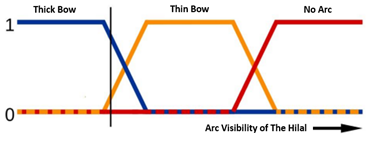
Accurate determination of the crescent moon (hilal) is crucial for establishing the start of lunar months in the Islamic calendar; however, observations are frequently hindered by daylight conditions, atmospheric disturbances, and subjective visual interpretation. This research proposes a fuzzy logic-based classification system to evaluate crescent moon images using contrast and arc thickness as input parameters, providing a transparent, rule-based alternative to black-box machine learning models for hilal visibility assessment. Images were collected on four distinct observation dates (May 28, 2025, August 5, 2024, September 16, 2023, and May 9, 2021) under varying atmospheric conditions and crescent appearances. Each image underwent pre-processing to extract quantitative measures of arc contrast and thickness, which were subsequently fuzzified using triangular and trapezoidal membership functions. A fuzzy inference system employing expert-defined rules was then used to compute a visibility score for each observation. The resulting visibility scores of 0.4691, 0.4604, 0.4689, and 0.4154, respectively, placed all four observations within the “partially visible” category. These findings demonstrate the system's capability to manage observational ambiguity in daylight conditions, showing potential for reliable classification while still requiring validation on larger datasets and clear non-visibility cases, and offering a transparent and interpretable framework to support more consistent and standardized hilal classification for calendrical purposes.
References
A. A. Afifi and A. F. Abbas, “Moderate Way Implementing Rukyah and Hisab to Determine A New Moon in Ramadan,” AL-IMAM: Journal on Islamic Studies, Civilization and Learning Societies, vol. 3, pp. 11–18, 2022, https://doi.org/10.58764/j.im.2022.3.12.
Z. Zufriani, A. Asa’ari, J. Mirdad, A. Arzam, A. Izuddin, and A. M. Radiamoda, “Rukyat as Determination of the Lunar Month Beginning: A Method, Obstacles, and Debate in Indonesia,” JURIS (Jurnal Ilmiah Syariah), vol. 22, no. 1, p. 53, 2023, https://doi.org/10.31958/juris.v22i1.6570.
M. S. Faid et al., “Confirmation Methodology for A Lunar Crescent Sighting Report,” New Astronomy, vol. 103, p. 102063, 2023, https://doi.org/10.1016/j.newast.2023.102063.
H. Tartory, “Determining the Beginning of the Lunar Month By Astronomical Calculation,” Hebron University Research Journal (HURJ): B- (Humanities), vol. 17, no. 1, pp. 295–317, 2022, https://doi.org/10.60138/171202211.
Y. Pramudya, A. R. Dhimas Prayoga Jullyantama, M. Khairul Ardi, C. Ayu Wandira, and Muchlas, “Observational Technique Development and Instruments Status in Observatorium Universitas Ahmad Dahlan,” J Phys Conf Ser, vol. 2773, no. 1, p. 012014, 2024, https://doi.org/10.1088/1742-6596/2773/1/012014.
S. A. Hassan, “HILAAL-CTM: Algorithm to Determine and Visualize the First Visibility of Lunar Crescent Using Contrast Threshold Model,” Journal of Information Systems Engineering and Management, vol. 10, no. 49s, pp. 714–720, 2025, https://doi.org/10.52783/jisem.v10i49s.9955.
A. Mulyadi, “Non-Astronomical Aspects of the Success of Rukyatul Hilal in East Java,” Samarah: Jurnal Hukum Keluarga dan Hukum Islam, vol. 8, no. 3, p. 1859, 2024, https://doi.org/10.22373/sjhk.v8i3.25258.
M. Gharaybeh, “Jurisprudential Reliance on Astronomical Calculations in Determining the Beginnings of the Hijri month,” In Arabic Conference of the Arab Union for Astronomy and Space Sciences and Tools for Decision Support, pp. 160–177, 2025, https://doi.org/10.1007/978-981-96-3276-3_13.
H. Khalfaoui and H. Guenichi, “Does Islam Promote Growth: Evidence From Arab Muslim Countries and Non-Arab Muslim Countries,” International Journal of Law and Management, vol. 64, no. 2, pp. 206–224, 2022, https://doi.org/10.1108/IJLMA-07-2021-0166.
M. S. E. Azam and M. A. ABDULLAH, “Global Halal Industry: Realities and Opportunities,” International Journal of Islamic Business Ethics, vol. 5, no. 1, p. 47, 2020, https://doi.org/10.30659/ijibe.5.1.47-59.
M. Al-Rajab, S. Loucif, and Y. Al Risheh, “Predicting New Crescent Moon Visibility Applying Machine Learning Algorithms,” Sci Rep, vol. 13, no. 1, p. 6674, 2023, https://doi.org/10.1038/s41598-023-32807-x.
S. Loucif, M. Al-Rajab, R. Abu Zitar, and M. Rezk, “Toward a Globally Lunar Calendar: A Machine Learning-Driven Approach for Crescent Moon Visibility Prediction,” J Big Data, vol. 11, no. 1, p. 114, 2024, https://doi.org/10.1186/s40537-024-00979-6.
P. D. Omodeo, “Astronomy,” in Encyclopedia of Renaissance Philosophy, pp. 1–5, 2015, https://doi.org/10.1007/978-3-319-02848-4_251-1.
M. S. A. M. Nawawi, M. S. Faid, M. H. M. Saadon, R. A. Wahab, and N. Ahmad, “Hijri Month Determination in Southeast Asia: An Illustration Between Religion, Science, and Cultural Background,” Heliyon, vol. 10, no. 20, p. e38668, 2024, https://doi.org/10.1016/j.heliyon.2024.e38668.
Karis Lusdianto, “The Concept of Maslahah in the Dynamics of the Rukyah and Hisab Methods for Determining the Beginning of the Lunar Month,” Istinbath : Jurnal Hukum, vol. 20, no. 01, pp. 102–122, 2024, https://doi.org/10.32332/istinbath.v20i01.9793.
A. J. Kasim, A. Abbas, N. Adhha, and I. Mutmainnah, “Determination of Hijri Calendar in Islamic History and Its Criteria in Southeast Asia,” Journal of Al-Tamaddun, vol. 19, no. 1, pp. 247–259, 2024, https://doi.org/10.22452/JAT.vol19no1.18.
M. S. Faid et al., “Assessment and Review of Modern Lunar Crescent Visibility Criterion,” Icarus, vol. 412, p. 115970, 2024, https://doi.org/10.1016/j.icarus.2024.115970.
R. H. Ali and A. S. M. Khidhir, “Enhancement of Daytime Crescent Image Using Wiener Filter Based De-Blurring Technique,” in 2021 7th International Conference on Contemporary Information Technology and Mathematics (ICCITM), pp. 203–206, 2021, https://doi.org/10.1109/ICCITM53167.2021.9677768.
A. L. A. M. Nasir et al., “Comparative Analysis of Image Processing Technique in Determining the New Crescent Moon Visibility,” J Phys Conf Ser, vol. 2915, no. 1, p. 012004, 2024, https://doi.org/10.1088/1742-6596/2915/1/012004.
M. Z. Gazalba, A. B. Sado, and M. S. Sofyan, “Pengaruh Kelembaban Atmosfer Terhadap Visibilitas Hilal di Pantai Loang Baloq,” AL - AFAQ : Jurnal Ilmu Falak dan Astronomi, vol. 5, no. 2, pp. 211–222, 2023, https://doi.org/10.20414/afaq.v5i2.7533.
A. Holzinger, A. Saranti, A. Angerschmid, B. Finzel, U. Schmid, and H. Mueller, “Toward Human-Level Concept Learning: Pattern Benchmarking for AI Algorithms,” Patterns, vol. 4, no. 8, p. 100788, 2023, https://doi.org/10.1016/j.patter.2023.100788.
P. R. Brandao, “The Impact of Artificial Intelligence on Modern Society,” AI, vol. 6, no. 8, p. 190, 2025, https://doi.org/10.3390/ai6080190.
M. Uddin, S. U. Arfeen, F. Alanazi, S. Hussain, T. Mazhar, and Md. Arafatur Rahman, “A Critical Analysis of Generative AI: Challenges, Opportunities, and Future Research Directions,” Archives of Computational Methods in Engineering, 2025, https://doi.org/10.1007/s11831-025-10355-z.
P. Xu, J. Wang, Y. Jiang, and X. Gong, “Applications of Artificial Intelligence and Machine Learning in Image Processing,” Front Mater, vol. 11, 2024, https://doi.org/10.3389/fmats.2024.1431179.
G. V. Lakshmi and N. Sharada, “Artificial Intelligence based Pattern Recognition,” International Journal of Engineering and Management Research, vol. 9, no. 2, pp. 29–32, 2019, https://doi.org/10.31033/ijemr.9.2.4.
R. N. Edi, H. J. Sada, W. Anggraini, and E. N. Safitri, “Study of Literature Determination of the New Moon (Hilal) Based on Astronomy and Religion,” In AIP Conference Proceedings, vol. 3058, no. 1, p. 050008, 2024, https://doi.org/10.1063/5.0200952.
A. N. Zulkeflee et al., “Detection of A New Crescent Moon Using the Maximally Stable Extremal Regions (MSER) Technique,” Astronomy and Computing, vol. 41, p. 100651, 2022, https://doi.org/10.1016/j.ascom.2022.100651.
A. N. Zulkeflee et al., “Detection of A New Crescent Moon using the Maximally Stable Extremal Regions (MSER) Technique,” Astronomy and Computing, vol. 41, p. 100651, 2022, https://doi.org/https://doi.org/10.1016/j.ascom.2022.100651.
I. Helmy, A. Shokry, D. Eid, and W. Choi, “Sky Seeing Estimation Using Nonparametric Fuzzy System of Low-Quality All-Sky Camera Images,” IEEE Trans Instrum Meas, vol. 73, pp. 1–17, 2024, https://doi.org/10.1109/TIM.2024.3425485.
I.-C. Sang and W. R. Norris, “A Robust Lane Detection Algorithm Adaptable to Challenging Weather Conditions,” IEEE Access, vol. 12, pp. 11185–11195, 2024, https://doi.org/10.1109/ACCESS.2024.3354975.
E. L. COHEN, “Adoption and Reform of the Gregorian Calendar,” Math Horizons, vol. 7, no. 3, pp. 5–11, 2000, https://doi.org/10.1080/10724117.2000.11975110.
S. A. Hassan, “HILAAL-CTM: Algorithm to Determine and Visualize the First Visibility of Lunar Crescent Using Contrast Threshold Model,” Journal of Information Systems Engineering and Management, vol. 10, no. 49s, pp. 714–720, 2025, https://doi.org/10.52783/jisem.v10i49s.9955.
D. M. Varisco, “Islamic Folk Astronomy,” In Astronomy across cultures: The history of non-Western astronomy, pp. 615–650, 2000, https://doi.org/10.1007/978-94-011-4179-6_21.
N. Ahmad, M. S. A. M. Nawawi, M. Z. Zainuddin, Z. M. Nasir, R. M. Yunus, and I. Mohamed, “A New Crescent Moon Visibility Criteria using Circular Regression Model: A Case Study of Teluk Kemang, Malaysia,” Sains Malays, vol. 49, no. 4, pp. 859–870, 2020, https://doi.org/10.17576/jsm-2020-4904-15.
C. A. Wandira and Y. Pramudya, “Development of a Python-Based Position Calculation System for the Moon’s Visible Position in Equatorial Coordinates,” EduFisika: Jurnal Pendidikan Fisika, vol. 8, no. 3, pp. 356–362, 2023, https://doi.org/10.59052/edufisika.v8i3.29053.
Z. T. Allawi, “A Pattern-Recognizer Artificial Neural Network for the Prediction of New Crescent Visibility in Iraq,” Computation, vol. 10, no. 10, p. 186, 2022, https://doi.org/10.3390/computation10100186.
L. Monferdini, G. Casella, and E. Bottani, “Development of a Fuzzy Logic-Based Tool for Evaluating KPIs in a Lean, Agile, Resilient, and Green (LARG) Supply Chain,” Applied Sciences, vol. 15, no. 14, p. 8010, 2025, https://doi.org/10.3390/app15148010.
M. Al-Rajab, S. Loucif, and Y. Al Risheh, “Predicting new crescent moon visibility applying machine learning algorithms,” Scientific Reports, vol. 13, no. 1, p. 6674, 2023, https://doi.org/10.1038/s41598-023-32807-x.
N. Ahmad, N. I. N. Mohamad, R. Abdul Wahab, M. S. A. Mohd Nawawi, M. Z. Zainuddin, and I. Mohamed, “Analysis Data of the 22 Years of Observations on the Young Crescent Moon at Telok Kemang Observatory in Relation to the Imkanur Rukyah Criteria 1995,” Sains Malays, vol. 51, no. 10, pp. 3415–3422, 2022, https://doi.org/10.17576/jsm-2022-5110-24.
T. Natarajan and S. Pichai, “Transition from Waterfall to Agile Methodology - An Action Research Study,” IEEE Access, vol. 12, pp. 49341–49362, 2024, https://doi.org/10.1109/ACCESS.2024.3384097.
C. A. Crespo-Santiago and S. de la C. Dávila-Cosme, “Waterfall method: a necessary tool for implementing library projects,” HETS Online Journal, vol. 1, no. 2, pp. 81–92, 2022, https://doi.org/10.55420/2693.9193.v1.n2.91.
K. Cox, M. Niazi, and J. Verner, “Empirical Study of Sommerville and Sawyer’s Requirements Engineering Practices,” IET Software, vol. 3, no. 5, pp. 339–355, 2009, https://doi.org/10.1049/iet-sen.2008.0076.
O. E. Olorunshola and F. N. Ogwueleka, “Review of System Development Life Cycle (SDLC) Models for Effective Application Delivery,” in Information and Communication Technology for Competitive Strategies (ICTCS 2020), pp. 281–289, 2022, https://doi.org/10.1007/978-981-16-0739-4_28.
Q. Yas, A. Alazzawi, and B. Rahmatullah, “A Comprehensive Review of Software Development Life Cycle methodologies: Pros, Cons, and Future Directions,” Iraqi Journal for Computer Science and Mathematics, vol. 4, no. 4, pp. 173–190, 2023, https://doi.org/10.52866/ijcsm.2023.04.04.014.
S. Pargaonkar, “A Comprehensive Research Analysis of Software Development Life Cycle (SDLC) Agile & Waterfall Model Advantages, Disadvantages, and Application Suitability in Software Quality Engineering,” International Journal of Scientific and Research Publications, vol. 13, no. 8, pp. 120–124, 2023, https://doi.org/10.29322/IJSRP.13.08.2023.p14015.
B. Wilkerson and L.-K. L. Trellevik, “Sustainability-Oriented Innovation: Improving Problem Definition Through Combined Design Thinking and Systems Mapping Approaches,” Think Skills Creat, vol. 42, p. 100932, 2021, https://doi.org/10.1016/j.tsc.2021.100932.
M. Y. Taher and F. M. Abdulla, “Evaluating the Development of the Crescent Visibility Criteria,” Iraqi Journal of Science, vol. 65, no. 1, pp. 555–566, 2024, https://doi.org/10.24996/ijs.2024.65.1.43.
A. Alshibani, B. E. Hafez, M. A. Hassanain, A. Mohammed, M. Al-Osta, and A. Bahraq, “Fuzzy Logic-Based Method for Forecasting Project Final Cost,” Buildings, vol. 14, no. 12, p. 3738, 2024, https://doi.org/10.3390/buildings14123738.
R. Muztaba, H. L. Malasan, and M. Djamal, “Deep Learning for Crescent Detection and Recognition: Implementation of Mask R-CNN to the Observational Lunar Dataset Collected with the Robotic Lunar Telescope System,” Astronomy and Computing, vol. 45, p. 100757, 2023, https://doi.org/10.1016/j.ascom.2023.100757.
J. A. Utama et al., “Young Lunar Crescent Detection Based on Video Data with Computer Vision Techniques,” Astronomy and Computing, vol. 44, p. 100731, 2023, https://doi.org/10.1016/j.ascom.2023.100731.
A. A. Romanov, A. A. Filippov, and N. G. Yarushkina, “An approach to generating fuzzy rules for a fuzzy controller based on the decision tree interpretation,” Axioms, vol. 14, no. 3, p. 196, 2025, https://doi.org/10.3390/axioms14030196.
I. Hussain, “A Stable Region-Based Image Segmentation Model Integrating Fuzzy Logic and Geometric Principles,” Acadlore Transactions on AI and Machine Learning, vol. 4, no. 2, pp. 124–136, 2025, https://doi.org/10.56578/ataiml040205.
C. Selvam, R. J. J. Jebadass, D. Sundaram, and L. Shanmugam, “A Novel Intuitionistic Fuzzy Generator for Low-Contrast Color Image Enhancement Technique,” Information Fusion, vol. 108, p. 102365, 2024, https://doi.org/10.1016/j.inffus.2024.102365.
Published
How to Cite
Issue
Section
License
Copyright (c) 2026 Yudhiakto Pramudya, Kartika Firdausy, Adi Jufriansah, Okimustava Okimustava, Itsnaini Irvina Khoirunnisa, Bayu Krisna Murti, Rihmah Alifah Hidayah, Murinto Murinto, Muhammad Maulidan

This work is licensed under a Creative Commons Attribution-ShareAlike 4.0 International License.
Authors who publish with this journal agree to the following terms:
- Authors retain copyright and grant the journal right of first publication with the work simultaneously licensed under a Creative Commons Attribution License that allows others to share the work with an acknowledgment of the work's authorship and initial publication in this journal.
- Authors are able to enter into separate, additional contractual arrangements for the non-exclusive distribution of the journal's published version of the work (e.g., post it to an institutional repository or publish it in a book), with an acknowledgment of its initial publication in this journal.
- Authors are permitted and encouraged to post their work online (e.g., in institutional repositories or on their website) prior to and during the submission process, as it can lead to productive exchanges, as well as earlier and greater citation of published work (See The Effect of Open Access).

This journal is licensed under a Creative Commons Attribution-ShareAlike 4.0 International License.