A Hybrid BSA-PSO Algorithm with Dynamic Parameters for Heterogeneous Data Classification
DOI:
https://doi.org/10.12928/biste.v8i4.14941Keywords:
Heterogeneous Data Classification, Birds Algorithm (BSA), Particle Swarm Optimization (PSO), Swarm Intelligence, Dynamic Parameter AdaptationAbstract
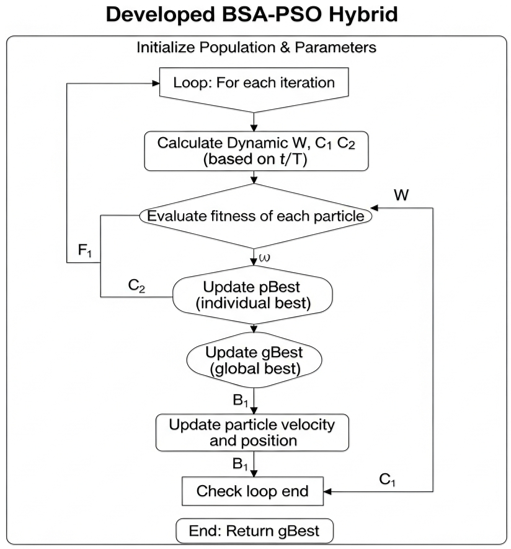
The explosive growth and immense diversity of modern data,that often described as heterogeneous,which present a significant challenge for traditional sorting and classification methods. Handling mixe the data types like text, images, and numerical values efficiently has become a major hurdle. This research is confronts this problem by proposing the development and improvement of the Birds Algorithm (BSA),a nature-inspired optimization technique. The primary goal was to significantly enhanced both the classification accuracy and the performance speed when dealing with such complex datasets. To achieve that, it modified the algorithm collective search mechanism by introducing new dynamic parameters, that moving beyond static values. That included dynamically adjusting the inertia itight and the cognitive and social learning factors,which allowing the algorithm to intelligently adapt its search strategy over time. That hybrid approach was then rigorously tested using the heterogeneous dataset and its performance was benchmarked against to other standard artificial intelligence algorithms that including Particle Swarm Optimization (PSO) and Genatic Algorithm (GA). The results from that comparative study itre definitive,that demonstrating the clear superiority of our developed algorithm in the both accuracy and execution time. The proposed modified BSA-PSO achieved the best performance with an average execution time of 0.95 seconds and an average final fitness of 0.05, significantly outperforming the Standard PSO, which recorded an execution time of 2.45 seconds and a fitness of 4.20, as itll as the GA, which shoitd an execution time of 3.10 seconds and a fitness of 3.80. This work underscores the urgent necessity of developing such adaptive, intelligent systems and confirms that combining optimization algorithms is a highly promising path toward managing the data challenges of our modern digital world.
References
X. Wu, J. Li, L. Yao, and Z. Xu, “Auto-sorting commonly recovered plastics from waste household appliances and electronics using near-infrared spectroscopy,” J Clean Prod, vol. 246, p. 118732, Feb. 2020, https://doi.org/10.1016/j.jclepro.2019.118732.
A. Femenias, M. B. Bainotti, F. Gatius, A. J. Ramos, and S. Marín, “Standardization of near infrared hyperspectral imaging for wheat single kernel sorting according to deoxynivalenol level,” Food Research International, vol. 139, p. 109925, Jan. 2021, https://doi.org/10.1016/j.foodres.2020.109925.
L. Wan, R. Liu, L. Sun, H. Nie, and X. Wang, “UAV swarm based radar signal sorting via multi-source data fusion: A deep transfer learning framework,” Information Fusion, vol. 78, pp. 90–101, Feb. 2022, https://doi.org/10.1016/j.inffus.2021.09.007.
P. Zhang, T. Li, Z. Yuan, C. Luo, K. Liu, and X. Yang, “Heterogeneous Feature Selection Based on Neighborhood Combination Entropy,” IEEE Trans Neural Netw Learn Syst, vol. 35, no. 3, pp. 3514–3527, Mar. 2024, https://doi.org/10.1109/TNNLS.2022.3193929.
T. Salzmann, B. Ivanovic, P. Chakravarty, and M. Pavone, “Trajectron++: Dynamically-Feasible Trajectory Forecasting with Heterogeneous Data,” In European conference on computer vision, pp. 683-700, 2020, https://doi.org/10.1007/978-3-030-58523-5_40.
A. Nazábal, P. M. Olmos, Z. Ghahramani, and I. Valera, “Handling incomplete heterogeneous data using VAEs,” Pattern Recognit, vol. 107, p. 107501, Nov. 2020, https://doi.org/10.1016/j.patcog.2020.107501.
M. Rahnemay, L. Farzinvash, M. Zolfi, and A. Taherkordi, “ECMSH: An Energy-efficient and Cost-effective data harvesting protocol for Mobile Sink-based Heterogeneous WSNs using PSO-TVAC,” Ad Hoc Networks, vol. 164, p. 103629, Nov. 2024, https://doi.org/10.1016/j.adhoc.2024.103629.
L. Cao, Y. Cai, and Y. Yue, “Data Fusion Algorithm for Heterogeneous Wireless Sensor Networks Based on Extreme Learning Machine Optimized by Particle Swarm Optimization,” J Sens, vol. 2020, pp. 1–17, Aug. 2020, https://doi.org/10.1155/2020/2549324.
K. Shao, H. Fu, and B. Wang, “An Efficient Combination of GA and Particle Swarm Optimization for Scheduling Data-Intensive Tasks in Heterogeneous Cloud Computing,” Electronics (Basel), vol. 12, no. 16, p. 3450, Aug. 2023, https://doi.org/10.3390/electronics12163450.
N. H. Phong, A. Santos, and B. Ribeiro, “PSO-Convolutional Neural Networks With Heterogeneous Learning Rate,” IEEE Access, vol. 10, pp. 89970–89988, 2022, https://doi.org/10.1109/ACCESS.2022.3201142.
D. A. Collier et al., “Age-related immune response heterogeneity to SARS-CoV-2 vaccine BNT162b2,” Nature, vol. 596, no. 7872, pp. 417–422, Aug. 2021, https://doi.org/10.1038/s41586-021-03739-1.
M. J. Petrany et al., “Single-nucleus RNA-seq identifies transcriptional heterogeneity in multinucleated skeletal myofibers,” Nat Commun, vol. 11, no. 1, p. 6374, Dec. 2020, https://doi.org/10.1038/s41467-020-20063-w.
X. Ma et al., “Multi-objective microgrid optimal dispatching based on improved bird swarm algorithm,” Global Energy Interconnection, vol. 5, no. 2, pp. 154–167, Apr. 2022, https://doi.org/10.1016/j.gloei.2022.04.013.
L. Feng, Y. Song, S. Basuray, and K. K. Sirkar, “IgG-BSA separation and purification by internally staged ultrafiltration,” Sep Purif Technol, vol. 354, p. 129245, Feb. 2025, https://doi.org/10.1016/j.seppur.2024.129245.
Y. Song, L. Feng, S. Basuray, K. K. Sirkar, and S. R. Wickramasinghe, “Hemoglobin-BSA separation and purification by internally staged ultrafiltration,” Sep Purif Technol, vol. 312, p. 123363, May 2023, https://doi.org/10.1016/j.seppur.2023.123363.
W. Hua, P. Liu, and L. Huang, “Energy-Efficient Resource Allocation for Heterogeneous Edge–Cloud Computing,” IEEE Internet Things J, vol. 11, no. 2, pp. 2808–2818, Jan. 2024, https://doi.org/10.1109/JIOT.2023.3293164.
[17] P. Jagdish Kumar and N. Subbu, “BSA-SGRU-A Novel Deep Learning Framework for Alleviate the Multiple Attacks in IoT-Cloud Environment,” Journal of Computational and Cognitive Engineering, Jul. 2024, https://doi.org/10.47852/bonviewJCCE42023061.
D. Dhinakaran, J. K. N., V. K. V., L. S, and D. Selvaraj, “Secured and Privacy-Preserved Aggregation of Data in Edge Computing Using Blockchain-Based Secured Aggregation (BSA),” In Convergence of cybersecurity and cloud computing, pp. 131-164, 2025, https://doi.org/10.4018/979-8-3693-6859-6.ch007.
A. Tiwari, R. M. Sharma, and R. Garg, “Emerging Ontology Formulation of Optimized Internet of Things (IOT) Services with Cloud Computing,” In Soft Computing: Theories and Applications: Proceedings of SoCTA 2018, pp. 31-52, 2020, https://doi.org/10.1007/978-981-15-0751-9_4.
Z. Zhou and J. Li, “A PSO Based Multi-view Hierarchical Clustering Method,” 2022, pp. 38–49. https://doi.org/10.1007/978-3-031-23741-6_4.
L. Abualigah et al., “Particle swarm optimization algorithm: review and applications,” in Metaheuristic Optimization Algorithms, pp. 1–14, 2024, https://doi.org/10.1016/B978-0-443-13925-3.00019-4.
J. Fang, W. Liu, L. Chen, S. Lauria, A. Miron, and X. Liu, “A Survey of Algorithms, Applications and Trends for Particle Swarm Optimization,” International Journal of Network Dynamics and Intelligence, pp. 24–50, Mar. 2023, https://doi.org/10.53941/ijndi0201002.
W. Chuanjun, W. Ling, and R. Xuejing, “General particle swarm optimization algorithm,” in 2023 IEEE 2nd International Conference on Electrical Engineering, Big Data and Algorithms (EEBDA), pp. 1204–1208, 2023, https://doi.org/10.1109/EEBDA56825.2023.10090725.
M. Jahandideh-Tehrani, O. Bozorg-Haddad, and H. A. Loáiciga, “Application of particle swarm optimization to water management: an introduction and overview,” Environ Monit Assess, vol. 192, no. 5, p. 281, May 2020, https://doi.org/10.1007/s10661-020-8228-z.
T. M. Shami, A. A. El-Saleh, M. Alswaitti, Q. Al-Tashi, M. A. Summakieh, and S. Mirjalili, “Particle Swarm Optimization: A Comprehensive Survey,” IEEE Access, vol. 10, pp. 10031–10061, 2022, https://doi.org/10.1109/ACCESS.2022.3142859.
A. G. Gad, “Particle Swarm Optimization Algorithm and Its Applications: A Systematic Review,” Archives of Computational Methods in Engineering, vol. 29, no. 5, pp. 2531–2561, Aug. 2022, https://doi.org/10.1007/s11831-021-09694-4.
J. Zhang and Z. Zhao, “Opposition-based particle swarm optimization algorithm integrating neighborhood rough set for feature selection in heterogeneous information system,” J Supercomput, vol. 81, no. 8, p. 866, May 2025, https://doi.org/10.1007/s11227-025-07324-5.
D. A. Abduljabbar, “Parallel Particle Swarm Optimization Algorithm for Identifying Complex Communities in Biological Networks,” Iraqi Journal of Science, pp. 512–527, Jan. 2024, https://doi.org/10.24996/ijs.2024.65.1.40.
J. Yan, G. Hu, H. Jia, A. G. Hussien, and L. Abualigah, “GPSOM: group-based particle swarm optimization with multiple strategies for engineering applications,” J Big Data, vol. 12, no. 1, p. 114, May 2025, https://doi.org/10.1186/s40537-025-01140-7.
M. Romano, C. Conversano, R. Siciliano, and A. D’Ambrosio, “Particle swarm optimization for preference rankings,” Adv Data Anal Classif, Feb. 2025, https://doi.org/10.1007/s11634-025-00626-9.
M. Romano, C. Conversano, R. Siciliano, and A. D’Ambrosio, “Particle swarm optimization for preference rankings,” Adv Data Anal Classif, Feb. 2025, https://doi.org/10.1007/s11634-025-00626-9.
S. Katoch, S. S. Chauhan, and V. Kumar, “A review on GA: past, present, and future,” Multimed Tools Appl, vol. 80, no. 5, pp. 8091–8126, Feb. 2021, https://doi.org/10.1007/s11042-020-10139-6.
Y. Zhou, W. Zhang, J. Kang, X. Zhang, and X. Wang, “A problem-specific non-dominated sorting GA for supervised feature selection,” Inf Sci (N Y), vol. 547, pp. 841–859, Feb. 2021, https://doi.org/10.1016/j.ins.2020.08.083.
S. Liu, H. Wang, W. Peng and W. Yao, "A Surrogate-Assisted Evolutionary Feature Selection Algorithm With Parallel Random Grouping for High-Dimensional Classification," in IEEE Transactions on Evolutionary Computation, vol. 26, no. 5, pp. 1087-1101, Oct. 2022, https://doi.org/10.1109/TEVC.2022.3149601.
S. mohammad E. Saryazdi, A. Etemad, A. Shafaat, and A. M. Bahman, “Data-driven performance analysis of a residential building applying artificial neural network (ANN) and multi-objective GA (GA),” Build Environ, vol. 225, p. 109633, Nov. 2022, https://doi.org/10.1016/j.buildenv.2022.109633.
K. Rathor, J. Kaur, U. A. Nayak, S. Kaliappan, R. Maranan, and V. Kalpana, “Technological Evaluation and Software Bug Training using GA and Time Convolution Neural Network (GA-TCN),” in 2023 Second International Conference on Augmented Intelligence and Sustainable Systems (ICAISS), pp. 7–12, 2023, https://doi.org/10.1109/ICAISS58487.2023.10250760.
M. Gen and L. Lin, “Genetic algorithms and their applications,” In Springer handbook of engineering statistics, pp. 635-674, 2023, https://doi.org/10.1007/978-1-4471-7503-2_33.
K. Shao, H. Fu, and B. Wang, “An Efficient Combination of GA and Particle Swarm Optimization for Scheduling Data-Intensive Tasks in Heterogeneous Cloud Computing,” Electronics (Basel), vol. 12, no. 16, p. 3450, Aug. 2023, https://doi.org/10.3390/electronics12163450.
C. Fu, S. Zhang, and K.-H. Chao, “Energy Management of a Poitr System for Economic Load Dispatch Using the Artificial Intelligent Algorithm,” Electronics (Basel), vol. 9, no. 1, p. 108, Jan. 2020, https://doi.org/10.3390/electronics9010108.
P. Chakraborty, S. Nama, and A. K. Saha, “RETRACTED ARTICLE: A hybrid slime mould algorithm for global optimization,” Multimed Tools Appl, vol. 82, no. 15, pp. 22441–22467, Jun. 2023, https://doi.org/10.1007/s11042-022-14077-3.
W. Tong, “A Hybrid Algorithm Framework with Learning and Complementary Fusion Features for Whale Optimization Algorithm,” Sci Program, vol. 2020, pp. 1–25, Feb. 2020, https://doi.org/10.1155/2020/5684939.
H. Yadav, R. Chhikara, and A. C. Kumari, “A novel hybrid approach for feature selection in software product lines,” Multimed Tools Appl, vol. 80, no. 4, pp. 4919–4942, Feb. 2021, https://doi.org/10.1007/s11042-020-09956-6.
K. Dasgupta, P. K. Jha, and P. K. Roy, “Solution of Combined Economic Emission Load Dispatch Problem using Chaotic BSA-PSO hybrid algorithm,” in 2020 National Conference on Emerging Trends on Sustainable Technology and Engineering Applications (NCETSTEA), pp. 1–5, Feb. 2020, https://doi.org/10.1109/NCETSTEA48365.2020.9119928.
H. Ling, X. Zhu, T. Zhu, M. Nie, Z. Liu, and Z. Liu, “A Parallel Multiobjective PSO Itighted Average Clustering Algorithm Based on Apache Spark,” Entropy, vol. 25, no. 2, p. 259, Jan. 2023, https://doi.org/10.3390/e25020259.
R.-L. Zhang and X.-H. Liu, “A Novel Hybrid High-Dimensional PSO Clustering Algorithm Based on the Cloud Model and Entropy,” Applied Sciences, vol. 13, no. 3, p. 1246, Jan. 2023, https://doi.org/10.3390/app13031246.
M. A. Najm Abed, A. Abdul Razzaq Altahir, A. O. Hanfesh and A. Abdulhadi Ahmed, "Performance Evaluation of PMSM and BLDC Motors in Different Operating Scenarios Based Slide Mode Control," 2024 4th International Conference on Electrical Machines and Drives (ICEMD), pp. 1-7, 2024. https://doi.org/10.1109/ICEMD64575.2024.10963593.
M. J. A. Alkhafaji, R. N. Mohammed, H. C. Mohammed, and M. A. N. Abed, “A lightweight 1D CNN for unified real-time communication signal classification and denoising in low-SNR edge environments” Buletin Ilmiah Sarjana Teknik Elektro, vol. 7, no. 3, pp. 496-508, 2025, https://doi.org/10.12928/biste.v7i3.13789.
M. A. N. Abed, D. S. Shanan, and Z. H. H. Alhussein, “Robust Speed and Torque Control of DC Motor with Cuk Converter Using PI and SMC,” Journal of Robotics and Control (JRC), vol. 6, no. 3, pp. 1216–1226, 2025, https://doi.org/10.18196/jrc.v6i3.25756.
M. Albaker et al., “GA-Tuned PID for Sensorless PMSM Speed Control Using a Second-Order Sliding Mode Observer,” Journal of Robotics and Control (JRC), vol. 6, no. 5, p. 2025, https://doi.org/10.18196/jrc.v6i5.27013.
A. K. Jha, A. K. Gupta, S. Singh and S. K. Singh, "A Review on Hybrid Electric Vehicles and Power Sources," 2022 2nd International Conference on Emerging Frontiers in Electrical and Electronic Technologies (ICEFEET), pp. 1-6, 2022, https://doi.org/10.1109/ICEFEET51821.2022.9848278.
M. Albaker, N. Abed, Z. Shihab, A. Hakeem, M. S. Yasir, and A. O. Hanfesh, “Boosting Energy for Building-Integrated Photovoltaic Cells using Novel Boost Converter with Voltage Multiplier Cell and ANN-MPPT,” Journal of Robotics and Control (JRC), vol. 6, no. 5, p. 2025, https://doi.org/10.18196/jrc.v6i5.26854.
Published
How to Cite
Issue
Section
License
Copyright (c) 2026 Basem Abdullah Mohammed Al Titjri, Mohammed Albaker Najm Abed, Salman Rasheed Owid, Mohammed Jasim Alkhafaji, Olha Lobova

This work is licensed under a Creative Commons Attribution-ShareAlike 4.0 International License.
Authors who publish with this journal agree to the following terms:
- Authors retain copyright and grant the journal right of first publication with the work simultaneously licensed under a Creative Commons Attribution License that allows others to share the work with an acknowledgment of the work's authorship and initial publication in this journal.
- Authors are able to enter into separate, additional contractual arrangements for the non-exclusive distribution of the journal's published version of the work (e.g., post it to an institutional repository or publish it in a book), with an acknowledgment of its initial publication in this journal.
- Authors are permitted and encouraged to post their work online (e.g., in institutional repositories or on their website) prior to and during the submission process, as it can lead to productive exchanges, as well as earlier and greater citation of published work (See The Effect of Open Access).

This journal is licensed under a Creative Commons Attribution-ShareAlike 4.0 International License.