Enhancing JSEG Color Texture Segmentation Using Quaternion Algebra Method
DOI:
https://doi.org/10.12928/biste.v8i1.14743Keywords:
Image Quantization, Quaternion, JSEG, Image SegmentationAbstract
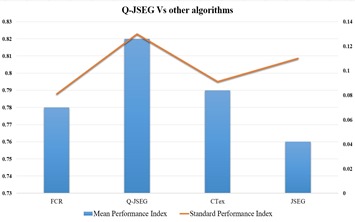
This work uses quaternion algebra to implement a unique color quantization method on the JSEG color texture segmentation. Typically, RGB color orientations in the composite hyper-planes are inverted to produce the key vectors of the color-space. Because quaternion algebra offers a highly logical way to work with homogeneous coordinates, color is represented as a quaternion in the proposed system. In this illustration, the color pixels are seen like in the 3D space such as point. The recommended model has resulted in a unique quantization method that uses level set techniques and projective geometry. This approach will be used in the JSEG color texture segmentation. This current color quantization technique is splintering clustering mechanism since it makes use of the binary quaternion moment preserving threshold technique. With this technique, color constancy throughout the spectrum and in the physical space are taken into account when they divide the color clusters located inside the RGB cube. The segmentation results are contrasted with JSEG and some of the recent established segmentation methods. These comparisons demonstrate how the proposed quantization approach strengthens the JSEG segmentation.
References
C. Huang, J. Li, and G. Gao, "Review of Quaternion-Based Color Image Processing Methods," Mathematics, vol. 11, no. 9, p. 2056, 2023, https://doi.org/10.3390/math11092056.
V. Frants, S. Agaian and K. Panetta, "QSAM-Net: Rain Streak Removal by Quaternion Neural Network With Self-Attention Module," in IEEE Transactions on Multimedia, vol. 26, pp. 789-798, 2024, https://doi.org/10.1109/TMM.2023.3271829.
A. El Alami, A. Mesbah, N. Berrahou, Z. Lakhili, A. Berrahou, and H. Qjidaa, "Quaternion discrete orthogonal Hahn moments convolutional neural network for color image classification and face recognition," Multimedia Tools Appl., pp. 1-27, 2023, https://doi.org/10.1007/s11042-023-14866-4.
Z. Jia and J. Zhu, "A New Low-Rank Learning Robust Quaternion Tensor Completion Method for Color Video Inpainting Problem and Fast Algorithms," arXiv preprint arXiv:2306.09652, 2023, https://doi.org/10.48550/arXiv.2306.09652.
X. Liu, Y. Wu, H. Zhang, J. Wu, and L. Zhang, "Quaternion discrete fractional Krawtchouk transform and its application in color image encryption and watermarking," Signal Process., vol. 189, p. 108275, 2021, https://doi.org/10.1016/j.sigpro.2021.108275.
G. V. S. Kumar and P. G. K. Mohan, "Enhanced Content-Based Image Retrieval Using Information Oriented Angle-Based Local Tri-Directional Weber Patterns," Int. J. Image Graph., vol. 21, no. 04, p. 2150046, 2021, https://doi.org/10.1142/S0219467821500467.
M. A. Tahiri, H. Amakdouf, and H. Qjidaa, "Optimized quaternion radial Hahn Moments application to deep learning for the classification of diabetic retinopathy," Multimedia Tools Appl., pp. 1–24, 2023, https://doi.org/10.1007/s11042-023-15582-9.
L.-S. Liu, Q.-W. Wang, J.-F. Chen, and Y.-Z. Xie, "An exact solution to a quaternion matrix equation with an application," Symmetry, vol. 14, no. 2, p. 375, 2022, https://doi.org/10.3390/sym14020375.
S. R. Salvadi, D. N. Rao, and S. Vatshal, "Melanoma Cancer Detection Using Quaternion Valued Neural Network," in Proc. Int. Conf. Soft Comput. Pattern Recognit., pp. 879–886, 2022, https://doi.org/10.1007/978-3-031-27524-1_86.
L. Qi, Z. Luo, Q.-W. Wang, and X. Zhang, "Quaternion matrix optimization: Motivation and analysis," J. Optim. Theory Appl., vol. 193, no. 1, pp. 621–648, 2022, https://doi.org/10.1007/s10957-021-01906-y.
C. F. Navarro and C. A. Perez, "Color–texture pattern classification using global–local feature extraction, an SVM classifier, with bagging ensemble post-processing," Appl. Sci., vol. 9, no. 15, p. 3130, 2019, https://doi.org/10.3390/app9153130.
Z. Zhang, X. Wei, S. Wang, C. Lin and J. Chen, "Fixed-Time Pinning Common Synchronization and Adaptive Synchronization for Delayed Quaternion-Valued Neural Networks," in IEEE Transactions on Neural Networks and Learning Systems, vol. 35, no. 2, pp. 2276-2289, 2024, https://doi.org/10.1109/TNNLS.2022.3189625.
A. Zelensky et al., "Video segmentation on static and dynamic textures using a quaternion framework," in Artificial Intelligence and Machine Learning in Defense Applications IV, vol. 12276, 2022, https://doi.org/10.1117/12.2641697.
G. Chu et al., "Robust registration of aerial and close‐range photogrammetric point clouds using visual context features and scale consistency," IET Image Process., vol. 17, no. 9, pp. 2698-2709, 2023, https://doi.org/10.1049/ipr2.12821.
Y.-Z. Hsiao and S.-C. Pei, "Edge detection, color quantization, segmentation, texture removal, and noise reduction of color image using quaternion iterative filtering," J. Electron. Imaging, vol. 23, no. 4, p. 043001, 2014, https://doi.org/10.1117/1.JEI.23.4.043001.
Z. Xia et al., "Novel quaternion polar complex exponential transform and its application in color image zero-watermarking," Digit. Signal Process., vol. 116, p. 103130, 2021, https://doi.org/10.1016/j.dsp.2021.103130.
P. Fan et al., "Multi-feature patch-based segmentation technique in the gray-centered RGB color space for improved apple target recognition," Agriculture, vol. 11, no. 3, p. 273, 2021, https://doi.org/10.3390/agriculture11030273.
Y. Shang et al., "LQGDNet: A Local Quaternion and Global Deep Network for Facial Depression Recognition," in IEEE Transactions on Affective Computing, vol. 14, no. 3, pp. 2557-2563, 2023, https://doi.org/10.1109/TAFFC.2021.3139651.
S. Kumar, R. K. Singh, and A. Chaudhary, "A novel non-linear neuron model based on multiplicative aggregation in quaternionic domain," Complex Intell. Syst., pp. 1–23, 2022, https://doi.org/10.1007/s40747-022-00911-6.
Y. Cheng et al., "Image super resolution via combination of two dimensional quaternion valued singular spectrum analysis based denoising, empirical mode decomposition based denoising and discrete cosine transform based denoising methods," Multimedia Tools Appl., pp. 1–18, 2023, https://doi.org/10.1007/s11042-023-14474-2.
F. Bianconi, A. Fernández, and R. E. Sánchez-Yáñez, "Special Issue Texture and Color in Image Analysis," Appl. Sci., vol. 11, no. 9, p. 3801, 2021, https://doi.org/10.3390/app11093801.
X. Xu, Z. Zhang, and M. J. C. Crabbe, "Quaternion Quasi-Chebyshev Non-local Means for Color Image Denoising," Chin. J. Electron., vol. 32, no. 3, pp. 1–18, 2023, https://doi.org/10.23919/cje.2022.00.138.
H. Yan, Y. Qiao, L. Duan, and J. Miao, "Novel methods to global Mittag-Leffler stability of delayed fractional-order quaternion-valued neural networks," Neural Netw., vol. 142, pp. 500–508, 2021, https://doi.org/10.1016/j.neunet.2021.07.005.
D. P. Tripathy and K. G. Reddy, "Separation of gangue from limestone using GLCM, LBP, LTP and Tamura," J. Mines Metals Fuels, pp. 26–33, 2022, https://doi.org/10.18311/jmmf/2022/29656.
Z. Yan and B. Jie, "Robust image hashing based on quaternion polar complex exponential transform and image energy," J. Electron. Imaging, vol. 32, no. 1, p. 013009, 2023, https://doi.org/10.1117/1.JEI.32.1.013009.
S. Murali, V. K. Govindan, and S. Kalady, "Quaternion-based image shadow removal," Visual Comput., pp. 1–12, 2022, https://doi.org/10.1007/s00371-021-02086-6.
T. Wu, Z. Mao, Z. Li, Y. Zeng, and T. Zeng, "Efficient Color Image Segmentation via Quaternion-based L1/L2L_1/L_2L1/L2 Regularization," J. Sci. Comput., vol. 93, no. 1, pp. 1–26, 2022, https://doi.org/10.1007/s10915-022-01970-0.
J. Li and Y. Zhou, "Automatic Color Image Stitching Using Quaternion Rank-1 Alignment," in Proc. IEEE/CVF Conf. Comput. Vis. Pattern Recognit., pp. 19720–19729, 2022, https://doi.org/10.1109/CVPR52688.2022.01910.
S. Walia, K. Kumar, and M. Kumar, "Unveiling digital image forgeries using Markov based quaternions in frequency domain and fusion of machine learning algorithms," Multimedia Tools Appl., vol. 82, no. 3, pp. 4517–4532, 2023, https://doi.org/10.1007/s11042-022-13610-8.
M. A. Hoang et al., "Color texture measurement and segmentation," Signal Process., 2005, https://doi.org/10.1016/j.sigpro.2004.10.009.
G. Ge, "A novel parallel unsupervised texture segmentation approach," SN Appl. Sci., vol. 5, no. 6, p. 156, 2023, https://doi.org/10.1007/s42452-023-05366-z.
M. Neshat, M. M. Nezhad, S. Mirjalili, G. Piras, and D. A. Garcia, "Quaternion convolutional long short-term memory neural model with an adaptive decomposition method for wind speed forecasting: North aegean islands case studies," Energy Convers. Manag., vol. 259, p. 115590, 2022, https://doi.org/10.1016/j.enconman.2022.115590.
G. Sfikas, A. P. Giotis, G. Retsinas, and C. Nikou, "Quaternion generative adversarial networks for inscription detection in byzantine monuments," in Pattern Recognit. ICPR Int. Worksh. Challenges, pp. 171–184, 2021, https://doi.org/10.1007/978-3-030-68787-8_12.
H. Zhang, Y. Fang, H. S. Wong, L. Li, and T. Zeng, "Saturation-Value Blind Color Image Deblurring with Geometric Spatial-Feature Prior," Commun. Comput. Phys., vol. 33, no. 3, pp. 795–823, 2023, https://doi.org/10.4208/cicp.OA-2022-0226.
K. Kaur, N. Jindal, and K. Singh, "QRFODD: Quaternion Riesz Fractional Order Directional Derivative for color image edge detection," Signal Process., p. 109170, 2023, https://doi.org/10.1016/j.sigpro.2023.109170.
I. S. Mangkunegara, P. Purwono, A. Ma’arif, N. Basil, H. M. Marhoon, and A.-N. Sharkawy, “Transformer Models in Deep Learning: Foundations, Advances, Challenges and Future Directions”, Buletin Ilmiah Sarjana Teknik Elektro, vol. 7, no. 2, pp. 231–241, 2025, https://doi.org/10.12928/biste.v7i2.13053.
Published
How to Cite
Issue
Section
License
Copyright (c) 2025 Vijay Kumar Sharma, Owais Ahmad Shah, Kunwar Babar Ali, Ravi Kumar H. C., Ankita Chourasia, Mohammed Mujammil Ahmed

This work is licensed under a Creative Commons Attribution-ShareAlike 4.0 International License.
Authors who publish with this journal agree to the following terms:
- Authors retain copyright and grant the journal right of first publication with the work simultaneously licensed under a Creative Commons Attribution License that allows others to share the work with an acknowledgment of the work's authorship and initial publication in this journal.
- Authors are able to enter into separate, additional contractual arrangements for the non-exclusive distribution of the journal's published version of the work (e.g., post it to an institutional repository or publish it in a book), with an acknowledgment of its initial publication in this journal.
- Authors are permitted and encouraged to post their work online (e.g., in institutional repositories or on their website) prior to and during the submission process, as it can lead to productive exchanges, as well as earlier and greater citation of published work (See The Effect of Open Access).

This journal is licensed under a Creative Commons Attribution-ShareAlike 4.0 International License.