Smart Cold Storage Based on Photovoltaic with Adaptive Fuzzy Control Approach for Guard Quality of Fish Catch on Fishing Vessels
DOI:
https://doi.org/10.12928/biste.v7i4.14508Keywords:
Transfer Learning, Hand Gesture Recognition, Convolutional Neural Network, Service Robot Integrated, Innovation, Information and Communication Technology, InfrastructureAbstract
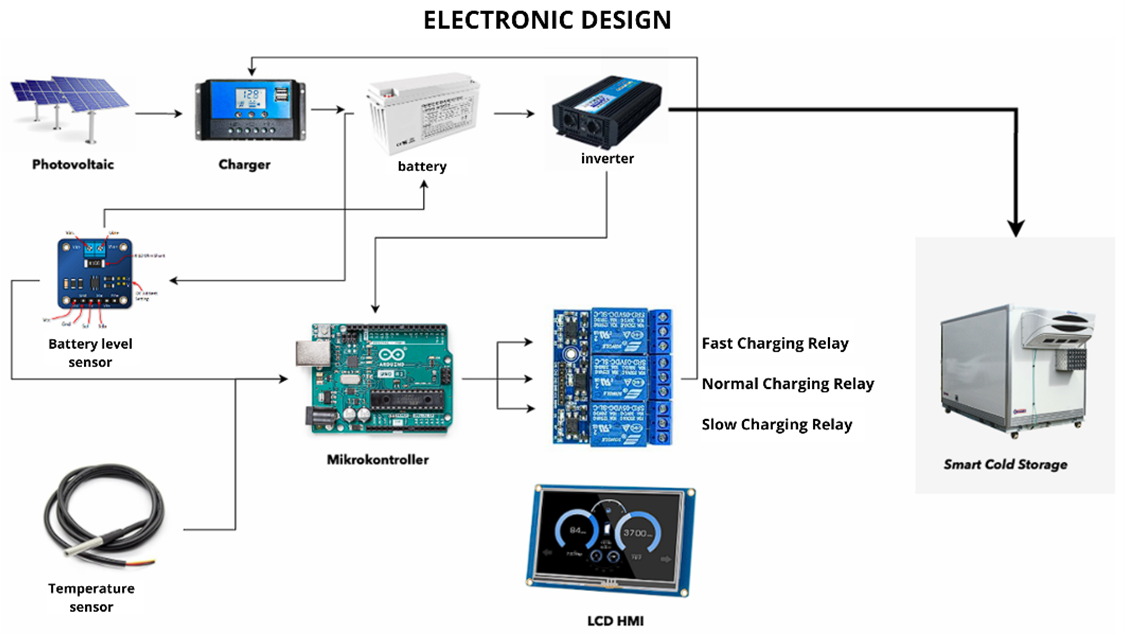
This research is motivated by the importance of maintaining the quality of fish catches on fishing vessels, which generally experience a decline in quality due to suboptimal conventional fish storage systems and limited energy supplies at sea. To address these challenges, the development of renewable energy-based cold storage technology through a Solar Power Plant (PLTS) or Photovoltaic system is needed. This research aims to design a PLTS-based smart cold storage system capable of optimally maintaining temperature stability using the Adaptive Fuzzy Control method. It is hoped that fish quality can be maintained and the economic value of fishermen's catches can be increased. This research uses an experimental approach through the design, implementation, and testing of a fuzzy logic-based adaptive control system in real-time. The performance results are then evaluated in maintaining the temperature stability of the cooling room and the efficiency of electrical energy sourced from solar panels. It is hoped that this research can provide real solutions for fishermen, support the economic independence of the fisheries sector, and support the achievement of sustainable development targets (SDGs) 7, 9 12, and 14. During the 24-hour test, the Adaptive Fuzzy Control system in a solar-based refrigerator demonstrated consistent performance in maintaining temperature stability (standard deviation σ = 3.28 °C–3.45 °C). The average refrigerator temperature was recorded at -5.44 °C with a range of -0.9 °C to -12 °C, which remains acceptable for marine fish preservation under superchilling and mild freezing conditions. The battery capacity was at an average of 89.95%, decreasing when there was no power supply and then increasing again during charging, thus reflecting adaptive energy management. The average charging speed was 3.14 A, with a peak of up to 15.6 A at 7–8 hours, then decreasing gradually as the battery was full to prevent overcharging. These findings confirm that the proposed system effectively balances cooling performance and renewable energy utilization. The use of solar photovoltaic energy directly supports SDG 7 (Affordable and Clean Energy), while system innovation and energy optimization align with SDG 9 (Industry, Innovation, and Infrastructure). The prototype demonstrates stable and efficient operation, and the design concept is scalable for practical implementation on small to medium-sized fishing vessels. A preliminary cost analysis indicates up to 50% lower operating costs compared to conventional diesel refrigeration systems.
References
B. Jatmiko. 13 Restoring Indonesia's Global Maritime. International Law and Security in Indo-Pacific: Strategic Design for the Region. 2025. https://books.google.co.id/books?hl=id&lr=&id=BpZnEQAAQBAJ.
H. Wijaya, H. A. Dien, R. A. Tumbol, and F. Mentang, “Good Fish Handling Techniques to Maintain the Quality of Catch from Ship to Consumer,” Jurnal Ilmiah PLATAX, vol. 12, no. 2, pp. 13–21, 2024, https://doi.org/10.35800/jip.v12i2.55636.
R. P. Mramba and K. E. Mkude, “Determinants of fish catch and post-harvest fish spoilage in small-scale marine fisheries in the Bagamoyo district, Tanzania,” Heliyon, vol. 8, no. 6, 2022, https://doi.org/10.1016/j.heliyon.2022.e09574.
X. Fan et al., “Effects of super-chilling storage on shelf-life and quality indicators of Coregonus peled based on proteomics analysis,” Food Research International, vol. 143, p. 110229, 2021, https://doi.org/https://doi.org/10.1016/j.foodres.2021.110229.
R. J. Setiawan, Y.-T. Chen, and I. D. Suryanto, “Cost-Effective Fish Storage Device for Artisanal Fishing in Indonesia - Utilization of Solar Cool Box,” in 2023 IEEE 17th International Conference on Industrial and Information Systems (ICIIS), IEEE, Aug. 2023, pp. 471–476. https://doi.org/10.1109/ICIIS58898.2023.10253549.
R. Hantoro, S. U. Hepriyadi, M. F. Izdhiharrudin, and M. H. Amir, “Solar dryer and photovoltaic for fish commodities (Case study in fishery community at Kenjeran Surabaya),” In AIP conference proceedings, vol. 1977, no. 1, p. 060013, 2018, https://doi.org/10.1063/1.5043025.
V. Z. P. Hardjono, N. Reyseliani, and W. W. Purwanto, “Planning for the integration of renewable energy systems and productive zone in Remote Island: Case of Sebira Island,” Cleaner Energy Systems, vol. 4, p. 100057, 2023, https://doi.org/https://doi.org/10.1016/j.cles.2023.100057.
S. Suryanto et al., “The potential contribution of Indonesian fishing vessels in reducing Green House gas emission,” Aquac Fish, vol. 10, no. 3, pp. 372–381, 2025, https://doi.org/https://doi.org/10.1016/j.aaf.2024.08.002.
M. Sarah, Marwati, E. Misran, and I. Madinah, “Analysis of drip loss and thermal destruction rate of tuna fillets during the low-temperature preservation period,” Applied Food Research, vol. 4, no. 2, p. 100648, 2024, https://doi.org/https://doi.org/10.1016/j.afres.2024.100648.
I. Sari et al., “Translating the ecosystem approach to fisheries management into practice: Case of anchovy management, Raja Ampat, West Papua, Indonesia,” Mar Policy, vol. 143, p. 105162, 2022, https://doi.org/https://doi.org/10.1016/j.marpol.2022.105162.
D. W. Sari et al., “The behavior of fishermen in handling post-harvest fish and its quality in East Java province,” Aquac Fish, 2024, https://doi.org/https://doi.org/10.1016/j.aaf.2024.08.003.
B. Harianto and M. Karjadi, “Planning of Photovoltaic (PV) Type Solar Power Plant as An Alternative Energy of the Future in Indonesia,” ENDLESS: International Journal of Future Studies, vol. 5, no. 2, pp. 182–195, 2022, https://doi.org/10.54783/endlessjournal.v5i2.87.
L. Faridah, M. A. Risnandar, and R. Nurdiansyah, “Planning of Solar Generation for Renewable Energy Development in the Evironment of Univeritas Siliwangi, Campus II Mugasari,” Journal of Electrical, Electronic, Information, and Communication Technology, vol. 6, no. 2, p. 59, 2024, https://doi.org/10.20961/jeeict.6.2.92485.
S. Angappan, A. Nataraj, L. N. Krishnan, and A. Palanisamy, “Development of an internet of things based smart cold storage with inventory monitoring system,” International Journal of Electrical and Computer Engineering (IJECE), vol. 15, no. 1, p. 89, 2025, https://doi.org/10.11591/ijece.v15i1.pp89-98.
H. Islam, A. Kumar Mandal, M. Sabbir Hossain, D. Haque, H. Saha, and T. Esha, “Development and Implementation of an IoT-enabled Real-time Cold Storage Monitoring and Notification System,” in 2024 International Conference on Advances in Computing, Communication, Electrical, and Smart Systems (iCACCESS), pp. 1–6, 2024, https://doi.org/10.1109/iCACCESS61735.2024.10499536.
A. Sher, U. Khan, M. N. Rafique, M. A. Ikram, and A. R. Mazhar, “Development and analysis of a smart cold storage system for fruit warehouses,” MATEC Web of Conferences, vol. 398, p. 01027, 2024, https://doi.org/10.1051/matecconf/202439801027.
M. Mohammed, K. Riad, and N. Alqahtani, “Design of a Smart IoT-Based Control System for Remotely Managing Cold Storage Facilities,” Sensors, vol. 22, no. 13, p. 4680, 2022, https://doi.org/10.3390/s22134680.
S. G. Srivatsa, K. R. M. Bharadwaj, S. L. Alamuri, M. M. C. Shanif, and H. S. Shreenidhi, “Smart Cold Storage and Inventory Monitoring System,” in 2021 International Conference on Recent Trends on Electronics, Information, Communication & Technology (RTEICT), pp. 485–488, 2021, https://doi.org/10.1109/RTEICT52294.2021.9573939.
S. Hosseinpour and A. Martynenko, “An adaptive fuzzy logic controller for intelligent drying,” Drying Technology, vol. 41, no. 7, pp. 1110-1132, 2023, https://doi.org/10.1080/07373937.2022.2119996.
P. Chotikunnan and Y. Pititheeraphab, “Adaptive P Control and Adaptive Fuzzy Logic Controller with Expert System Implementation for Robotic Manipulator Application,” Journal of Robotics and Control (JRC), vol. 4, no. 2, pp. 217–226, Mar. 2023, https://doi.org/10.18196/jrc.v4i2.17757.
J. Zhou and Q. Zhang, “Adaptive Fuzzy Control of Uncertain Robotic Manipulator,” Math Probl Eng, vol. 2018, 2018, https://doi.org/10.1155/2018/4703492.
F. Zhang, P. Dai, J. Na, G. Gao, Y. Shi, and F. Liu, “Adaptive Fuzzy Tracking Control for a Class of Uncertain Nonlinear Systems With Improved Prescribed Performance,” IEEE Transactions on Fuzzy Systems, vol. 33, no. 4, pp. 1133–1145, 2025, https://doi.org/10.1109/TFUZZ.2024.3506818.
M. Zhou, F. Yang, and X. Deng, “Tracking Control of High-Order Nonlinear Systems With Unknown Control Gains and Its Application: An Adaptive Fuzzy Control Method,” IEEE Access, vol. 12, pp. 141211–141223, 2024, https://doi.org/10.1109/ACCESS.2024.3467112.
K. Li and Y. Li, “Fuzzy Adaptive Optimization Prescribed Performance Control for Nonlinear Vehicle Platoon,” IEEE Transactions on Fuzzy Systems, vol. 32, no. 2, pp. 360–372, 2024, https://doi.org/10.1109/TFUZZ.2023.3298385.
J.-W. Wang, Y.-H. Wei, and P. Shi, “Spatiotemporal Adaptive Fuzzy Control for State Profile Tracking of Nonlinear Infinite-Dimensional Systems on a Hypercube,” IEEE Transactions on Fuzzy Systems, vol. 32, no. 2, pp. 683–696, 2024, https://doi.org/10.1109/TFUZZ.2023.3307619.
J. Chen, H.-K. Lam, and J. Yu, “Adaptive Fuzzy Output Feedback Tracking Control for Uncertain Nonstrict Feedback Systems With Variable Disturbances via Event-Triggered Mechanism,” IEEE Trans Syst Man Cybern Syst, vol. 53, no. 2, pp. 922–933, 2023, https://doi.org/10.1109/TSMC.2022.3190091.
T. Gao, T. Li, Y.-J. Liu, S. Tong, and F. Sun, “Observer-Based Adaptive Fuzzy Control of Nonstrict Feedback Nonlinear Systems With Function Constraints,” IEEE Transactions on Fuzzy Systems, vol. 31, no. 8, pp. 2556–2567, 2023, https://doi.org/10.1109/TFUZZ.2022.3228319.
S. I. Mohammad, N. Yogesst, N. Raja, R. Chetana, and A. Vasudevan, “Optimizing MIMO Antenna Performance Using Fuzzy Logic Algorithms,” Applied Mathematics & Information Sciences, vol. 19, no. 2, pp. 349–364, 2025, https://doi.org/10.18576/amis/190211.
Y. Zhao and H. Gao, “Fuzzy-Model-Based Control of an Overhead Crane With Input Delay and Actuator Saturation,” IEEE Transactions on Fuzzy Systems, vol. 20, no. 1, pp. 181–186, 2012, https://doi.org/10.1109/TFUZZ.2011.2164083.
M. Wan and L. Wan, “Exploring the Pathways to Participation in Household Waste Sorting in Different National Contexts: A Fuzzy-Set QCA Approach,” IEEE Access, vol. 8, pp. 179373–179388, 2020, https://doi.org/10.1109/ACCESS.2020.3027978.
P. Hušek, “Monotonic Smooth Takagi–Sugeno Fuzzy Systems With Fuzzy Sets With Compact Support,” IEEE Transactions on Fuzzy Systems, vol. 27, no. 3, pp. 605–611, 2019, https://doi.org/10.1109/TFUZZ.2019.2892355.
G. P. N. Hakim, R. Muwardi, M. Yunita, and D. Septiyana, “Fuzzy Mamdani performance water chiller control optimization using fuzzy adaptive neuro fuzzy inference system assisted,” Indonesian Journal of Electrical Engineering and Computer Science, vol. 28, no. 3, 2022, https://doi.org/10.11591/ijeecs.v28.i3.pp1388-1395.
D. G. Zhang, C. H. Ni, J. Zhang, T. Zhang, and Z. H. Zhang, “New method of vehicle cooperative communication based on fuzzy logic and signaling game strategy,” Future Generation Computer Systems, vol. 142, pp. 131-149, 2023, https://doi.org/10.1016/j.future.2022.12.039.
G. Castellano, G. Attolico, E. Stella, and A. Distante, “Reactive navigation by fuzzy control,” in Proceedings of IEEE 5th International Fuzzy Systems, vol. 3, pp. 2143–2149, 1996, https://doi.org/10.1109/FUZZY.1996.552796.
Q. Lou, Z. Deng, Z. Xiao, K.-S. Choi, and S. Wang, “Multilabel Takagi-Sugeno-Kang Fuzzy System,” IEEE Transactions on Fuzzy Systems, vol. 30, no. 9, pp. 3410–3425, 2022, https://doi.org/10.1109/TFUZZ.2021.3115967.
A. Safiotti, “Fuzzy logic in autonomous robotics: behavior coordination,” in Proceedings of 6th International Fuzzy Systems Conference, vol. 1, pp. 573–578, 1997, https://doi.org/10.1109/FUZZY.1997.616430.
S. Toyoda, Y. Asai, T. Itami, and J. Yoneyama, “Fuzzy Controller Design via Higher Order Derivatives of Lyapunov Function for Takagi-Sugeno Fuzzy System,” in 2022 61st Annual Conference of the Society of Instrument and Control Engineers (SICE), pp. 347–352, 2022, https://doi.org/10.23919/SICE56594.2022.9905794.
G. Tayfur, “Application of fuzzy logic in water resources engineering,” in Handbook of HydroInformatics: Volume III: Water Data Management Best Practices, pp. 155-166, 2022. https://doi.org/10.1016/B978-0-12-821962-1.00024-6.
D. J. Singh, N. K. Verma, A. K. Ghosh, and A. Malagaudanavar, “An Approach Towards the Design of Interval Type-3 T–S Fuzzy System,” IEEE Transactions on Fuzzy Systems, vol. 30, no. 9, pp. 3880–3893, 2022, https://doi.org/10.1109/TFUZZ.2021.3133083.
R. S. Krishnan et al., “Fuzzy Logic based Smart Irrigation System using Internet of Things,” J Clean Prod, vol. 252, 2020, https://doi.org/10.1016/j.jclepro.2019.119902.
R. S. Krishnan et al., “Fuzzy Logic based Smart Irrigation System using Internet of Things,” J Clean Prod, vol. 252, p. 119902, 2020, https://doi.org/https://doi.org/10.1016/j.jclepro.2019.119902.
W. Findiastuti, F. Adiputra, R. Annisa, F. Hanafi, and S. Hidayat, “Design of Seaweed Dryer Using Sugeno’s Fuzzy Logic Control Approach,” in 2023 IEEE 9th Information Technology International Seminar (ITIS), 2023, pp. 1–6. https://doi.org/10.1109/ITIS59651.2023.10419881.
B. C. Arrue, F. Cuesta, R. Braunstingl, and A. Ollero, “Fuzzy behaviors combination to control a nonholonomic mobile robot using virtual perception memory,” in Proceedings of 6th International Fuzzy Systems Conference, 1997, pp. 1239–1244 vol.3. https://doi.org/10.1109/FUZZY.1997.619465.
H. Belyadi and A. Haghighat, “Chapter 8 - Fuzzy logic,” in Machine Learning Guide for Oil and Gas Using Python, pp. 381–418, 2021, https://doi.org/https://doi.org/10.1016/B978-0-12-821929-4.00003-2.
L. Martínez López, A. Ishizaka, J. Qin, and P. A. Álvarez Carrillo, “Chapter 4 - Fuzzy sets and MCDM sorting,” in Multi-Criteria Decision-Making Sorting Methods, pp. 161–199, 2023, https://doi.org/https://doi.org/10.1016/B978-0-32-385231-9.00009-2.
N. Zagradjanin, A. Rodic, D. Pamucar, and B. Pavkovic, “Cloud-based multi-robot path planning in complex and crowded environment using fuzzy logic and online learning,” Information Technology and Control, vol. 50, no. 2, pp. 357–374, 2021, https://doi.org/10.5755/j01.itc.50.2.28234.
S. Ali, "Parametric Estimation and Optimization of Automatic Drip Irrigation Control System using Fuzzy Logic," 2022 International Conference on Emerging Trends in Electrical, Control, and Telecommunication Engineering (ETECTE), pp. 1-6, 2022, https://doi.org/10.1109/ETECTE55893.2022.10007188.
E. Petritoli and F. Leccese, “A Takagi-Sugeno Fuzzy Logic Motor Control for Robot for Assistance to Individuals with Impairments,” in 2024 IEEE International Workshop on Metrology for Living Environment (MetroLivEnv), pp. 509–513, 2024, https://doi.org/10.1109/MetroLivEnv60384.2024.10615895.
Y. Zheng, G. Dhiman, A. Sharma, A. Sharma, and M. A. Shah, “An IoT-Based Water Level Detection System Enabling Fuzzy Logic Control and Optical Fiber Sensor,” Security and Communication Networks, vol. 2021, 2021, https://doi.org/10.1155/2021/4229013.
F. Umam, A. Dafid, and A. D. Cahyani, “Implementation of Fuzzy Logic Control Method on Chilli Cultivation Technology Based Smart Drip Irrigation System,” Jurnal Ilmiah Teknik Elektro Komputer dan Informatika (JITEKI), vol. 9, no. 1, pp. 132–141, 2023, https://doi.org/10.26555/jiteki.v9i1.25813.
P. Chotikunnan and B. Panomruttanarug, “Practical design of a time-varying iterative learning control law using fuzzy logic,” Journal of Intelligent and Fuzzy Systems, vol. 43, no. 3, pp. 2419–2434, 2022, https://doi.org/10.3233/JIFS-213082.
M. A. O. Mendez and J. A. F. Madrigal, “Fuzzy Logic User Adaptive Navigation Control System For Mobile Robots In Unknown Environments,” in 2007 IEEE International Symposium on Intelligent Signal Processing, pp. 1–6, 2007, https://doi.org/10.1109/WISP.2007.4447633.
H. Li, M. Lin, and G. Yang, “Fuzzy Logic Based Model Predictive Direct Power Control of Three Phase PWM Rectifier,” in 2018 21st International Conference on Electrical Machines and Systems (ICEMS), pp. 2431–2435, 2018, https://doi.org/10.23919/ICEMS.2018.8549359.
H. A. Hagras, “A hierarchical type-2 fuzzy logic control architecture for autonomous mobile robots,” IEEE Transactions on Fuzzy Systems, vol. 12, no. 4, pp. 524–539, 2004, https://doi.org/10.1109/TFUZZ.2004.832538.
S. Setiowati, R. N. Wardhani, Riandini, E. B. Agustina Siregar, R. Saputra, and R. A. Sabrina, “Fertigation Control System on Smart Aeroponics using Sugeno’s Fuzzy Logic Method,” in 2022 8th International Conference on Science and Technology (ICST), pp. 1–6, 2022, https://doi.org/10.1109/ICST56971.2022.10136304.
J. Tavares, A. Martins, L. G. Fidalgo, V. Lima, R. A. Amaral, C. A. Pinto, A. M. Silva, and J. A. Saraiva, “Fresh fish degradation and advances in preservation using physical emerging technologies,” Foods, vol. 10, no. 4, p. 780, 2021, https://doi.org/10.3390/foods10040780.
T. N. Tsironi, N. G. Stoforos, and P. S. Taoukis, “Quality and shelf-life modeling of frozen fish at constant and variable temperature conditions,” Foods, vol. 9, no. 12, p. 1893, 2020, https://doi.org/10.3390/foods9121893.
Published
How to Cite
Issue
Section
License
Copyright (c) 2025 Weny Findiastuti, Faikul Umam, Yoga Aulia Sulaiman, Rajermani Thinakaran, Ach. Dafid, Adi Andriansyah, Ahcmad Yusuf

This work is licensed under a Creative Commons Attribution-ShareAlike 4.0 International License.
Authors who publish with this journal agree to the following terms:
- Authors retain copyright and grant the journal right of first publication with the work simultaneously licensed under a Creative Commons Attribution License that allows others to share the work with an acknowledgment of the work's authorship and initial publication in this journal.
- Authors are able to enter into separate, additional contractual arrangements for the non-exclusive distribution of the journal's published version of the work (e.g., post it to an institutional repository or publish it in a book), with an acknowledgment of its initial publication in this journal.
- Authors are permitted and encouraged to post their work online (e.g., in institutional repositories or on their website) prior to and during the submission process, as it can lead to productive exchanges, as well as earlier and greater citation of published work (See The Effect of Open Access).

This journal is licensed under a Creative Commons Attribution-ShareAlike 4.0 International License.