Resource-Efficient Sentiment Classification of App Reviews Using a CNN-BiLSTM Hybrid Model
DOI:
https://doi.org/10.12928/biste.v7i3.13954Keywords:
Sentiment Analysis, Mobile App Reviews, Hybrid Deep Learning Models, CNN-BiLSTM Architecture, Resource-efficient NLP, Model InterpretabilityAbstract
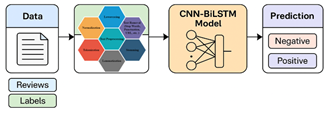
This study evaluates the performance of a hybrid convolutional neural network and bidirectional long short-term memory (CNN + BiLSTM) model for sentiment classification on user reviews from the Spotify mobile application. The primary aim is to explore whether competitive results can be achieved without relying on transformer-based architectures, which often require substantial computational resources. The proposed CNN + BiLSTM model combines local feature extraction with sequential context modeling and is benchmarked against traditional machine learning and simpler deep learning models, including a Random Forest classifier enhanced with polarity features, a standalone CNN, and a fully connected DNN. Sentiment labels were binary (positive or negative) and directly provided in the dataset without being inferred from star ratings. The dataset was balanced to avoid class skew. Experimental results indicate that the CNN + BiLSTM model achieves moderate improvements over the baseline models, with an accuracy of 0.8861 and an F1-score of 0.8691. While it does not surpass the highest-performing transformer-based methods reported in the literature, it performs comparably to several of them, despite having a lower computational footprint. Analyses of ROC curves, confusion matrices, and training dynamics further contextualize the model’s performance, showing strengths in classifying negative sentiments and convergence efficiency. To address overfitting, early stopping and dropout layers were employed as regularization techniques. The study contributes to the ongoing discourse on resource-efficient sentiment analysis by showing that hybrid architectures may offer a practical balance between model complexity and performance in specific application domains.
References
P. Sarin, A. K. Kar, and V. P. Ilavarasan, "Exploring engagement among mobile app developers–Insights from mining big data in user generated content," J. Adv. Manag. Res., vol. 18, no. 4, pp. 585–608, 2021, https://doi.org/10.1108/JAMR-06-2020-0128.
S. Li et al., "Text mining of user-generated content (UGC) for business applications in e-commerce: A systematic review," Mathematics, vol. 10, no. 19, p. 3554, 2022, https://doi.org/10.3390/math10193554.
A. Serek, A. Issabek, and A. Bogdanchikov, "Distributed sentiment analysis of an agglutinative language via Spark by applying machine learning methods," in Proc. 2019 15th Int. Conf. Electron., Comput. Comput. (ICECCO), pp. 1–4, 2019, https://doi.org/10.1109/ICECCO48375.2019.9043264.
L. Agner, B. J. Necyk, and A. Renzi, "User experience and information architecture: Interaction with recommendation system on a music streaming platform," in Handbook of Usability and User-Experience, pp. 247–268, 2022, https://doi.org/10.1201/9780429343490-18.
M. Richou, “Designing User Experience in Algorithmic Culture: User Agency in Spotify’s Algorithm‑driven Interface,” Dissertation, 2025, https://www.diva-portal.org/smash/record.jsf?pid=diva2%3A1965327.
W. G. de Assunção and L. A. M. Zaina, “Evaluating user experience in music discovery on Deezer and Spotify,” in Proc. 21st Brazilian Symp. Hum. Factors Comput. Syst. (IHC ’22), pp. 1–15, 2022, https://doi.org/10.1145/3554364.3560901.
R. M. Samant et al., “Framework for deep learning-based language models using multi-task learning in natural language understanding: A systematic literature review and future directions,” IEEE Access, vol. 10, pp. 17078–17097, 2022, https://doi.org/10.1109/ACCESS.2022.3149798.
L. Zholshiyeva, T. Zhukabayeba, A. Serek, R. Duisenbek, M. Berdieva, and N. Shapay, "Deep Learning-Based Continuous Sign Language Recognition," J. Robot. Control (JRC), vol. 6, no. 3, pp. 1106–1118, 2025, https://doi.org/10.18196/jrc.v6i1.23879.
J. Jia, W. Liang, and Y. Liang, “A review of hybrid and ensemble in deep learning for natural language processing,” arXiv preprint arXiv:2312.05589, 2023, https://doi.org/10.48550/arXiv.2312.05589.
I. D. Mienye, T. G. Swart, and G. Obaido, “Recurrent neural networks: A comprehensive review of architectures, variants, and applications,” Information, vol. 15, no. 9, p. 517, 2024, https://doi.org/10.3390/info15090517.
L. Alzubaidi et al., "Review of deep learning: concepts, CNN architectures, challenges, applications, future directions," J. Big Data, vol. 8, no. 1, p. 53, 2021, https://doi.org/10.1186/s40537-021-00444-8.
B. A. Demiss and W. A. Elsaigh, “Application of novel hybrid deep learning architectures combining convolutional neural networks (CNN) and recurrent neural networks (RNN): construction duration estimates prediction considering preconstruction uncertainties,” Eng. Res. Express, vol. 6, no. 3, p. 032102, 2024, https://doi.org/10.1088/2631-8695/ad6ca7.
N. M. Gardazi et al., “BERT applications in natural language processing: a review,” Artif. Intell. Rev., vol. 58, no. 6, pp. 1–49, 2025, https://doi.org/10.1007/s10462-025-11162-5.
N. Patwardhan, S. Marrone, and C. Sansone, “Transformers in the real world: A survey on NLP applications,” Information, vol. 14, no. 4, p. 242, 2023, https://doi.org/10.3390/info14040242.
S. Singla, Priyanshu, A. Thakur, A. Swami, U. Sawarn and P. Singla, "Advancements in Natural Language Processing: BERT and Transformer-Based Models for Text Understanding," 2024 Second International Conference on Advanced Computing & Communication Technologies (ICACCTech), pp. 372-379, 2024, https://doi.org/10.1109/ICACCTech65084.2024.00068.
O. Abdelaziz, “Integrating User Feedback to Enhance Software Quality and User Satisfaction in Mobile Application Development,” dissertation, 2024, https://hdl.handle.net/10388/16046.
Y. Fu et al., “Satisfaction with and continuous usage intention towards mobile health services: translating users’ feedback into measurement,” Sustainability, vol. 15, no. 2, p. 1101, 2023, https://doi.org/10.3390/su15021101.
T. Rajendran and M. M. Yunus, “A systematic literature review on the use of mobile‑assisted language learning (MALL) for enhancing speaking skills among ESL and EFL learners,” Int. J. Acad. Res. Prog. Educ. Dev., vol. 10, no. 1, pp. 586–609, 2021, https://doi.org/10.6007/IJARPED/v10-i1/8939.
M. Bordoloi and S. K. Biswas, “Sentiment analysis: A survey on design framework, applications and future scopes,” Artif. Intell. Rev., vol. 56, no. 11, pp. 12505–12560, 2023, https://doi.org/10.1007/s10462-023-10442-2.
T. Abdullah and A. Ahmet, “Deep learning in sentiment analysis: Recent architectures,” ACM Comput. Surv., vol. 55, no. 8, pp. 1–37, 2022, https://doi.org/10.1145/3548772.
M. Rodríguez‑Ibáñez et al., “A review on sentiment analysis from social media platforms,” Expert Syst. Appl., vol. 223, p. 119862, 2023, https://doi.org/10.1016/j.eswa.2023.119862.
B. Berlikozha, A. Serek, T. Zhukabayeva, A. Zhamanov, and O. Dias, "Development of Method to Predict Career Choice of IT Students in Kazakhstan by Applying Machine Learning Methods," J. Robot. Control (JRC), vol. 6, no. 1, pp. 426–436, 2025, https://doi.org/10.18196/jrc.v6i1.25558.
K. Meraliyev, A. Serek, S. Shoyinbek, S. Sharipov, S. Shoyinbek, and K. Meraliyev, "Development of an AI-Based Communication Fraud Detection System," Appl. Math. Inf. Sci., vol. 19, no. 4, 2025, https://doi.org/10.18576/amis/190419.
G. Kocher and G. Kumar, “Machine learning and deep learning methods for intrusion detection systems: recent developments and challenges,” Soft Comput., vol. 25, no. 15, pp. 9731–9763, 2021, https://doi.org/10.1007/s00500-021-05893-0.
A. Areshey and H. Mathkour, “Exploring transformer models for sentiment classification: A comparison of BERT, RoBERTa, ALBERT, DistilBERT, and XLNet,” Expert Syst., vol. 41, no. 11, p. e13701, 2024, https://doi.org/10.1111/exsy.13701.
H. Bashiri and H. Naderi, “Comprehensive review and comparative analysis of transformer models in sentiment analysis,” Knowl. Inf. Syst., vol. 66, no. 12, pp. 7305–7361, 2024, https://doi.org/10.1007/s10115-024-02214-3.
F. A. Acheampong, H. Nunoo‑Mensah, and W. Chen, “Transformer models for text‑based emotion detection: a review of BERT‑based approaches,” Artif. Intell. Rev., vol. 54, no. 8, pp. 5789–5829, 2021, https://doi.org/10.1007/s10462-021-09958-2.
H. I. Liu et al., “Lightweight deep learning for resource‑constrained environments: A survey,” ACM Comput. Surv., vol. 56, no. 10, pp. 1–42, 2024, https://doi.org/10.1145/3657282.
A. Santoso and Y. Surya, “Maximizing decision efficiency with edge‑based AI systems: advanced strategies for real‑time processing, scalability, and autonomous intelligence in distributed environments,” Quarterly J. Emerg. Technol. Innov., vol. 9, no. 2, pp. 104–132, 2024, https://vectoral.org/index.php/QJETI/article/view/144.
V. Shankar, "Edge AI: A Comprehensive Survey of Technologies, Applications, and Challenges," 2024 1st International Conference on Advanced Computing and Emerging Technologies (ACET), pp. 1-6, 2024, https://doi.org/10.1109/ACET61898.2024.10730112.
H. Huang, A. A. Zavareh, and M. B. Mustafa, “Sentiment analysis in e-commerce platforms: A review of current techniques and future directions,” IEEE Access, vol. 11, pp. 90367–90382, 2023, https://doi.org/10.1109/ACCESS.2023.3307308.
P. Bakhsh et al., “Optimisation of sentiment analysis for e‑commerce,” VFAST Trans. Softw. Eng., vol. 12, no. 3, pp. 243–262, 2024, https://doi.org/10.21015/vtse.v12i3.1907.
I. Karabila et al., “BERT-enhanced sentiment analysis for personalized e‑commerce recommendations,” Multimed. Tools Appl., vol. 83, no. 19, pp. 56463–56488, 2024, https://doi.org/10.1007/s11042-023-17689-5.
N. Alsaleh, R. Alnanih, and N. Alowidi, “Hybrid deep learning approach for automating app review classification: advancing usability metrics classification with an aspect-based sentiment analysis framework,” Computers, Materials & Continua, vol. 82, no. 1, 2025, https://doi.org/10.32604/cmc.2024.059351.
M. Hadwan et al., “An improved sentiment classification approach for measuring user satisfaction toward governmental services’ mobile apps using machine learning methods with feature engineering and SMOTE technique,” Applied Sciences, vol. 12, no. 11, p. 5547, 2022, https://doi.org/10.3390/app12115547.
N. A. Sharma, A. B. M. S. Ali, and M. A. Kabir, “A review of sentiment analysis: tasks, applications, and deep learning techniques,” International Journal of Data Science and Analytics, vol. 19, no. 3, pp. 351–388, 2025, https://doi.org/10.1007/s41060-024-00594-x.
A. Shaji George and T. Baskar, “Leveraging big data and sentiment analysis for actionable insights: A review of data mining approaches for social media,” Partners Universal Int. Innov. J., vol. 2, no. 4, pp. 39–59, 2024, https://doi.org/10.5281/zenodo.13623776.
A. Alsayat, “Improving sentiment analysis for social media applications using an ensemble deep learning language model,” Arab. J. Sci. Eng., vol. 47, no. 2, pp. 2499–2511, 2022, https://doi.org/10.1007/s13369-021-06227-w.
H.-A. Goh, C.-K. Ho, and F. S. Abas, “Front-end deep learning web apps development and deployment: a review,” Appl. Intell., vol. 53, no. 12, pp. 15923–15945, 2023, https://doi.org/10.1007/s10489-022-04278-6.
H. Huang, A. A. Zavareh, and M. B. Mustafa, “Sentiment analysis in e‑commerce platforms: A review of current techniques and future directions,” IEEE Access, vol. 11, pp. 90367–90382, 2023, https://doi.org/10.1109/ACCESS.2023.3307308.
P. Bakhsh et al., “Optimisation of sentiment analysis for e‑commerce,” VFAST Trans. Softw. Eng., vol. 12, no. 3, pp. 243–262, 2024, https://doi.org/10.21015/vtse.v12i3.1907.
E. Hashmi and S. Y. Yayilgan, “A robust hybrid approach with product context‑aware learning and explainable AI for sentiment analysis in Amazon user reviews,” Electron. Commer. Res., pp. 1–33, 2024, https://doi.org/10.1007/s10660-024-09896-5.
C. C. Ike et al., “Advancing machine learning frameworks for customer retention and propensity modeling in ecommerce platforms,” GSC Adv. Res. Rev., vol. 14, no. 2, p. 17, 2023, https://doi.org/10.30574/gscarr.2023.14.2.0017.
M. Wankhade, A. C. S. Rao, and C. Kulkarni, “A survey on sentiment analysis methods, applications, and challenges,” Artif. Intell. Rev., vol. 55, no. 7, pp. 5731–5780, 2022, https://doi.org/10.1007/s10462-022-10144-1.
L. Bharadwaj, “Sentiment analysis in online product reviews: mining customer opinions for sentiment classification,” Int. J. Multidiscip. Res., vol. 5, no. 5, 2023, https://doi.org/10.36948/ijfmr.2023.v05i05.6090.
Z. Kastrati et al., “Sentiment analysis of students’ feedback with NLP and deep learning: a systematic mapping study,” Appl. Sci., vol. 11, no. 9, p. 3986, 2021, https://doi.org/10.3390/app11093986.
K. L. Tan, C. P. Lee, and K. M. Lim, “A survey of sentiment analysis: Approaches, datasets, and future research,” Appl. Sci., vol. 13, no. 7, p. 4550, 2023, https://doi.org/10.3390/app13074550.
N. Raghunathan and K. Saravanakumar, “Challenges and issues in sentiment analysis: A comprehensive survey,” IEEE Access, vol. 11, pp. 69626–69642, 2023, https://doi.org/10.1109/ACCESS.2023.3293041.
M. S. Islam et al., “Challenges and future in deep learning for sentiment analysis: a comprehensive review and a proposed novel hybrid approach,” Artif. Intell. Rev., vol. 57, no. 3, p. 62, 2024, https://doi.org/10.1007/s10462-023-10651-9.
W. Cui et al., “Research status and emerging trends in remediation of contaminated sites: a bibliometric network analysis,” Environ. Rev., vol. 31, no. 3, pp. 542–564, 2023, https://doi.org/10.1139/er-2023-0023.
X. Chen et al., “A computational analysis of aspect‑based sentiment analysis research through bibliometric mapping and topic modeling,” J. Big Data, vol. 12, no. 1, p. 40, 2025, https://doi.org/10.1186/s40537-025-01068-y.
C. Dang, “An adaptive hybrid deep learning architecture for sentiment analysis‑based recommendations on social networks,” 2021, http://hdl.handle.net/10366/151045.
T. Anderson and S. Sarkar, "From Words to Action: Sentiment Analysis on Sustainability Initiatives," SoutheastCon 2024, pp. 269-274, 2024, https://doi.org/10.1109/SoutheastCon52093.2024.10500089.
M. R. Iqbal, “Time Series Analysis and Improved Deep Learning Model for Electricity Price Forecasting,” University of Malaya (Malaysia) ProQuest Dissertations & Theses, 2022, https://www.proquest.com/openview/db705d4ebc57b12e9a9a62ac61face6e/1?pq-origsite=gscholar&cbl=2026366&diss=y.
H. R, M. S. Patel and O. P. P G, "Predictive Analysis for Loan Defaults: A Deep Learning Approach," 2025 Global Conference in Emerging Technology (GINOTECH), pp. 1-5, 2025, https://doi.org/10.1109/GINOTECH63460.2025.11076632.
S. Kusal et al., “Sentiment analysis of product reviews using deep learning and transformer models: a comparative study,” in Proc. Int. Conf. Artif. Intell. Text. App. (AI‑TA), pp. 183-204, 2023, https://doi.org/10.1007/978-981-99-8476-3_15.
P. Atandoh et al., “Scalable deep learning framework for sentiment analysis prediction for online movie reviews,” Heliyon, vol. 10, no. 10, 2024, https://doi.org/10.1016/j.heliyon.2024.e30756.
A. Hossain et al., Sentiment classification on Bengali food and restaurant reviews, M.S. dissertation, Brac Univ., 2024, http://hdl.handle.net/10361/22836.
R. N. Patil et al., “Improving sentiment classification on restaurant reviews using deep learning models,” Procedia Comput. Sci., vol. 235, pp. 3246–3256, 2024, https://doi.org/10.1016/j.procs.2024.04.307.
R. Bedoriya and S. Banerjee, “A review on sentiment classification of Amazon product review dataset using NLP technique,” Int. J. Adv. Res. Multidiscip. Trends, vol. 2, no. 1, pp. 654–669, 2025, https://ijarmt.com/index.php/j/article/view/261.
G. Kontonatsios et al., “FABSA: An aspect‑based sentiment analysis dataset of user reviews,” Neurocomputing, vol. 562, p. 126867, 2023, https://doi.org/10.1016/j.neucom.2023.126867.
P. C.-H. Lam et al., “Finding representative interpretations on convolutional neural networks,” in Proc. IEEE/CVF Int. Conf. Computer Vision, 2021, https://openaccess.thecvf.com/content/ICCV2021/html/Lam_Finding_Representative_Interpretations_on_Convolutional_Neural_Networks_ICCV_2021_paper.html.
M. T. Daza and U. J. Ilozumba, “A survey of AI ethics in business literature: Maps and trends between 2000 and 2021,” Front. Psychol., vol. 13, p. 1042661, 2022, https://doi.org/10.1016/j.neucom.2023.126867.
J. Sangeetha and U. Kumaran, “Using BiLSTM structure with cascaded attention fusion model for sentiment analysis,” J. Sci. Ind. Res., vol. 82, no. 4, pp. 444–449, 2023, https://doi.org/10.56042/jsir.v82i04.72385.
Li, Y. et al., “Multi‑level textual‑visual alignment and fusion network for multimodal aspect‑based sentiment analysis,” Artif. Intell. Rev., vol. 57, no. 4, p. 78, 2024, https://doi.org/10.1007/s10462-023-10685-z.
P. Dhanalakshmi, B. M. Lavanya, N. Balakrishna, N. Penchalaiah, and G. V. Lakshmi, “Deep learning for sentiment analysis in social media: current challenges,” in Proc. First Int. Conf. Data Eng. Mach. Intell. (ICDEMI 2023), vol. 1261, p. 145, 2024, https://doi.org/10.1007/978-981-97-7616-0_11.
A. S. Arnob et al., “Comparative result analysis of cauliflower disease classification based on deep learning approach VGG16, Inception V3, ResNet, and a custom CNN model,” Hybrid Adv., vol. 10, p. 100440, 2025, https://doi.org/10.1016/j.hybadv.2025.100440.
P. Ferri et al., “Deep continual learning for medical call incidents text classification under the presence of dataset shifts,” Comput. Biol. Med., vol. 175, p. 108548, 2024, https://doi.org/10.1016/j.compbiomed.2024.108548.
T. Takata et al., “Generative deep‑learning‑model based contrast enhancement for digital subtraction angiography using a text‑conditioned image‑to‑image model,” Comput. Biol. Med., vol. 195, p. 110598, 2025, https://doi.org/10.1016/j.compbiomed.2025.110598.
M. Chen, M. Mohammadi, and S. Izadpanah, “Language learning through music on the academic achievement, creative thinking, and self-esteem of the English as a foreign language (EFL) learners,” Acta Psychol., vol. 247, p. 104318, 2024, https://doi.org/10.1016/j.actpsy.2024.104318.
M.-w. Xu et al., “PMFF‑Net: A deep learning‑based image classification model for UIP, NSIP, and OP,” Comput. Biol. Med., vol. 195, p. 110618, 2025, https://doi.org/10.1016/j.compbiomed.2025.110618.
Ye, Z. et al., “Bayesian deep learning based semantic segmentation for unmanned surface vehicles in uncertain marine environments,” Ocean Eng., vol. 339, p. 122065, 2025, https://doi.org/10.1016/j.oceaneng.2025.122065.
A. Ho et al., “Fusion of deep convolutional and LSTM recurrent neural networks for automated detection of code smells,” in Proc. 27th Int. Conf. Eval. Assess. Softw. Eng., 2023, https://doi.org/10.1145/3593434.3593476.
S. Abarna, J. I. Sheeba, and S. Pradeep Devaneyan, “An ensemble model for idioms and literal text classification using knowledge-enabled BERT in deep learning,” Measurement: Sensors, vol. 24, p. 100434, 2022, https://doi.org/10.1016/j.measen.2022.100434.
I. C. Rico and J. P. Espada, “Expert system for extracting keywords in educational texts and textbooks based on transformers models,” Expert Syst. Appl., vol. 282, p. 127735, 2025, https://doi.org/10.1016/j.eswa.2025.127735.
A. M. Alshareef et al., “Automated detection of ChatGPT-generated text vs. human text using gannet-optimized deep learning,” Alexandria Eng. J., vol. 124, pp. 495–512, 2025, https://doi.org/10.1016/j.aej.2025.03.139.
R. Polly and E. A. Devi, “Semantic segmentation for plant leaf disease classification and damage detection: A deep learning approach,” Smart Agric. Technol., vol. 9, p. 100526, 2024, https://doi.org/10.1016/j.atech.2024.100526.
M. Ayemowa, R. Ibrahim, and M. M. Khan, “Analysis of recommender system using generative artificial intelligence: A systematic literature review,” SSRN, Tech. Rep. 4922584, 2024, https://doi.org/10.2139/ssrn.4922584.
R. G. Al‑anazi et al., “An intelligent framework for sarcasm detection in Arabic tweets using deep learning with Al‑Biruni earth radius optimization algorithm,” Alexandria Eng. J., vol. 127, pp. 562–572, 2025, https://doi.org/10.1016/j.aej.2025.05.040.
Q. Cao, P. Dao‑Hoang, D. T. Nguyen, X. H. Nguyen, and K. H. Le, “BERT‑Enhanced DGA Botnet Detection: A Comparative Analysis of Machine Learning and Deep Learning Models,” in Proc. 2024 13th Int. Conf. Control, Automation and Information Sciences (ICCAIS), pp. 1–6, 2024, https://doi.org/10.1109/ICCAIS63750.2024.10814364.
S. Lin, F. Frasincar, and J. Klinkhamer, “Hierarchical deep learning for multi‑label imbalanced text classification of economic literature,” Appl. Soft Comput., p. 113189, 2025, https://doi.org/10.1016/j.asoc.2025.113189.
A. Siddhanta and A. K. Bhagat, "Sentiment Showdown—Sentence Transformers stand their ground against Language Models: Case of Sentiment Classification using Sentence Embeddings," Procedia Comput. Sci., vol. 257, pp. 1205–1212, 2025, https://doi.org/10.1016/j.procs.2025.03.161.
H. Kumawat, A. Sharan, and S. Verma, “Impact analysis of text representation on biomedical multi‑label text classification with deep learning,” Procedia Comput. Sci., vol. 258, pp. 3294–3304, 2025, https://doi.org/10.1016/j.procs.2025.04.587.
R. Rajan and M. S. Geetha Devasena, “Deep learning based optimization model for document layout and text recognition,” Ain Shams Eng. J., vol. 16, no. 10, p. 103587, 2025, https://doi.org/10.1016/j.asej.2025.103587.
A. Previati, V. Silvestri, and G. Crosta, “Deep learning text classification of borehole logs for regional scale modeling of hydrofacies (Po Plain, N Italy),” J. Hydrol. Reg. Stud., vol. 58, p. 102157, 2025, https://doi.org/10.1016/j.ejrh.2024.102157.
X. Tang, "Author identification of literary works based on text analysis and deep learning," Heliyon, vol. 10, no. 3, 2024, https://doi.org/10.1016/j.heliyon.2024.e25464.
J. Yi et al., “Challenges and innovations in LLM‑Powered fake news detection: A synthesis of approaches and future directions,” in Proc. 2025 2nd Int. Conf. Generative Artif. Intell. Inf. Secur., pp. 87-93, 2025, https://doi.org/10.1145/3728725.3728739.
K. Kashif et al., “MKELM based multi-classification model for foreign accent identification,” Heliyon, vol. 10, no. 16, 2024, https://doi.org/10.1016/j.heliyon.2024.e36460.
M. Musaev, I. Khujayorov, and M. Ochilov, “Automatic recognition of Uzbek speech based on integrated neural networks,” In World Conference Intelligent System for Industrial Automation, pp. 215-223, 2020, https://doi.org/10.1007/978-3-030-68004-6_28.
Y. Amirgaliyev, D. Kuanyshbay, and A. Shoiynbek, “Comparison of optimization algorithms of connectionist temporal classifier for speech recognition system,” Informatyka, Automatyka, Pomiary w Gospodarce i Ochronie Środowiska, vol. 9, 2019, https://doi.org/10.35784/iapgos.234.
A. Serek, A. Issabek, A. Akhmetov, and A. Sattarbek, “Part-of-speech tagging of Kazakh text via LSTM network with a bidirectional modifier,” in Proc. 2021 16th Int. Conf. Electronics Computer and Computation (ICECCO), pp. 1–4, 2021, https://doi.org/10.1109/ICECCO53203.2021.9663794.
L. Zholshiyeva, T. Zhukabayeva, D. Baumuratova, and A. Serek, “Design of QazSL Sign Language Recognition System for Physically Impaired Individuals,” J. Robot. Control, vol. 6, no. 1, pp. 191–201, 2025, https://doi.org/10.18196/jrc.v6i1.23879.
A. Kim, “Spotify dataset: User reviews and engagement insights,” Kaggle Datasets, 2025, https://www.kaggle.com/datasets/alexandrakim2201/spotify-dataset/data.
Published
How to Cite
Issue
Section
License
Copyright (c) 2025 Daulet Baktibayev, Azamat Serek, Bauyrzhan Berlikozha, Babur Rustauletov

This work is licensed under a Creative Commons Attribution-ShareAlike 4.0 International License.
Authors who publish with this journal agree to the following terms:
- Authors retain copyright and grant the journal right of first publication with the work simultaneously licensed under a Creative Commons Attribution License that allows others to share the work with an acknowledgment of the work's authorship and initial publication in this journal.
- Authors are able to enter into separate, additional contractual arrangements for the non-exclusive distribution of the journal's published version of the work (e.g., post it to an institutional repository or publish it in a book), with an acknowledgment of its initial publication in this journal.
- Authors are permitted and encouraged to post their work online (e.g., in institutional repositories or on their website) prior to and during the submission process, as it can lead to productive exchanges, as well as earlier and greater citation of published work (See The Effect of Open Access).

This journal is licensed under a Creative Commons Attribution-ShareAlike 4.0 International License.