Occlusion Adaptive Motion Estimation Techniques for Aerial Object Tracking: A Comprehensive Review
DOI:
https://doi.org/10.12928/biste.v8i2.13821Keywords:
Aerial Tracking, Motion Estimation, Occlusion Handling, Computer Vision, Motion PredictionAbstract
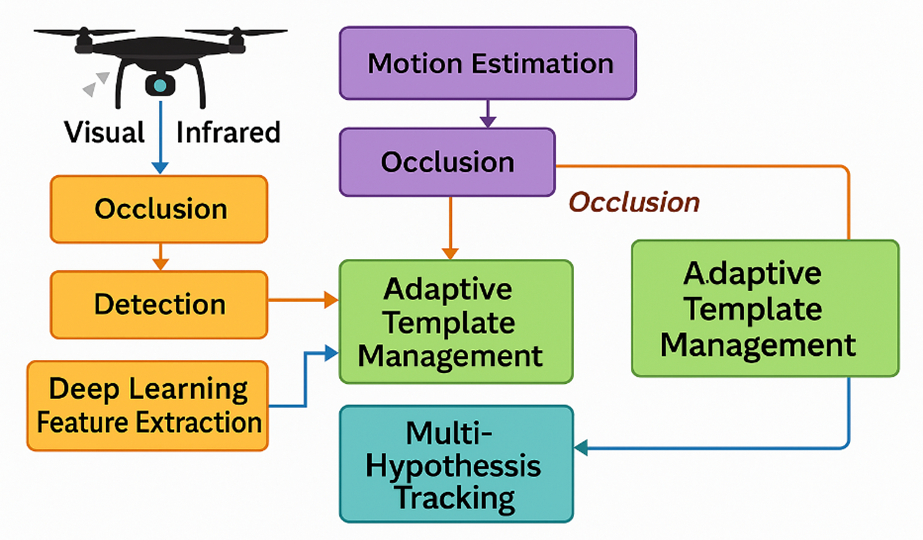
Aerial object tracking plays a crucial role in applications that span from surveillance and reconnaissance to autonomous navigation and environmental monitoring. One of the most critical challenges in aerial tracking systems is occlusion, which can significantly degrade tracking performance and result in complete track loss. This paper provides an extensive review of occlusion adaptive motion estimation methods tailored for aerial object tracking applications. It systematically reviews the transition from conventional correlation-based techniques to cutting-edge deep learning methods, comparing their performance in tackling different occlusion situations. The review covers basic motion estimation concepts, occlusion detection processes, adaptive tracking processes, and performance assessment methodologies. Based on a critical evaluation of available literature, we recognize ongoing research directions, point out ongoing challenges, and suggest future directions. The results suggest that hybrid methods interweaving various combinations of motion estimation algorithms with enlightened occlusion treatment exhibit better performance in demanding aerial scenarios, although computational overhead is still a limiting factor for real-time applications.
References
X. Wu et al., “Deep Learning for Unmanned Aerial Vehicle-Based Object Detection and Tracking: A Survey,” IEEE Geoscience and Remote Sensing Magazine, pp. 2–35, 2021, https://doi.org/10.1109/mgrs.2021.3115137.
X. Wang et al., “Aerial Infrared Object Tracking via an improved Long-term Correlation Filter with optical flow estimation and SURF matching,” Infrared Physics & Technology, vol. 116, p. 103790, 2021, https://doi.org/10.1016/j.infrared.2021.103790.
Shravya, A.R. et al., “A Comprehensive Survey on Multi Object Tracking Under Occlusion in Aerial Image Sequences,” pp. 225–230, 2019, https://doi.org/10.1109/icatiece45860.2019.9063778.
L. Shi et al., “Global-Local and Occlusion Awareness Network for Object Tracking in UAVs,” IEEE Journal of Selected Topics in Applied Earth Observations and Remote Sensing, vol. 16, pp. 8834–8844, 2023, https://doi.org/10.1109/jstars.2023.3308042.
A. Sezgin and A. Boyacı, “Advancements in Object Detection for Unmanned Aerial Vehicles: Applications, Challenges, and Future Perspectives,” 2024 12th International Symposium on Digital Forensics and Security (ISDFS), 1–6, 2024, https://doi.org/10.1109/isdfs60797.2024.10527339.
A. M. Polina, H. Suparwito, and R. A. Kumalasanti, “Aerial object detection analysis: Challenges and preliminary results,” E3S Web of Conferences, vol. 475, p. 02017, 2024, https://doi.org/10.1051/e3sconf/202447502017.
H. Anwar, K. Javed, S. Rubab, and M. J. Khan, “Towards Efficient Aerial Object Detection: Techniques, Datasets and Challenges,” In 2021 International Conference on Communication Technologies (ComTech), pp. 61–66, 2021, https://doi.org/10.1109/comtech52583.2021.9616675.
P. K. Pradhan, K. Purkayastha, A. L. Sharma, U. Baruah, B. Sen, and P. Ghosal, “Graphically Residual Attentive Network for tackling aerial image occlusion,” Computers and Electrical Engineering, vol. 125, p. 110429, 2025, https://doi.org/10.1016/j.compeleceng.2025.110429.
Y. Bai, Y. Song, Y. Zhao, Y. Zhou, X. Wu, Y. He, Z. Zhang, X. Yang, and Q. Hao, “Occlusion and Deformation Handling Visual Tracking for UAV via Attention-Based Mask Generative Network,” Remote Sensing, vol. 14, vol. 19, pp. 4756–4756, 2022, https://doi.org/10.3390/rs14194756.
P. K. Pradhan and U. Baruah, “Object Detection Under Occlusion in Aerial Images: A Review,” Lecture Notes in Networks and Systems, pp. 215–227, 2021, https://doi.org/10.1007/978-981-16-4244-9_17.
Z. Cai et al., “A target tracking method based on adaptive occlusion judgment and model updating strategy,” PeerJ Computer Science, vol. 9, p. e1562, 2023, https://doi.org/10.7717/peerj-cs.1562.
H. W. Cheng, T.-L. Chen, and C.-H. Tien, “Motion Estimation by Hybrid Optical Flow Technology for UAV Landing in an Unvisited Area,” Sensors, vol. 19, no. 6, pp. 1380–1380, 2019, https://doi.org/10.3390/s19061380.
Z. Dang et al., “OMCTrack: Integrating Occlusion Perception and Motion Compensation for UAV Multi-Object Tracking,” Drones, vol. 8, no. 9, p. 480, 2024, https://doi.org/10.3390/drones8090480.
K. J. Deepthi and B. N. Kumar Rao, "Deep Learning Approaches for Occlusion Removal in Medical Images," 2024 2nd International Conference on Recent Trends in Microelectronics, Automation, Computing and Communications Systems (ICMACC), pp. 431-435, 2024, https://doi.org/10.1109/icmacc62921.2024.10894353.
A. Nurunnabi et al., “An Efficient Deep Learning Approach For Ground Point Filtering In Aerial Laser Scanning Point Clouds,” The International Archives of the Photogrammetry, Remote Sensing and Spatial Information Sciences, pp. 31–38, 2021, https://doi.org/10.5194/isprs-archives-xliii-b1-2021-31-2021.
Y. Mao et al., “The Motion Estimation of Unmanned Aerial Vehicle Axial Velocity Using Blurred Images,” Drones, vol. 8, no. 7, p. 306, 2024, https://doi.org/10.3390/drones8070306.
A. Lago, S. Patel, and A. Singh, “Low-cost real-time aerial object detection and GPS location tracking pipeline,” ISPRS Open Journal of Photogrammetry and Remote Sensing, vol. 13, p. 100069, 2024, https://doi.org/10.1016/j.ophoto.2024.100069.
J. Leng, Y. Ye, M. Mo, C. Gao, J. Gan, B. Xiao, and X. Gao, “Recent Advances for Aerial Object Detection: A Survey,” ACM Computing Surveys, vol. 56, no. 12, pp. 1–36, 2024, https://doi.org/10.1145/3664598.
I. Delibaşoğlu, “Motion-aware object tracking for aerial images with deep features and discriminative correlation filter,” Multimedia Tools and Applications, vol. 83, no. 30, pp. 75369–75386, 2024, https://doi.org/10.1007/s11042-024-18571-8.
Y. Park, L. M. Dang, S. Lee, D. Han, and H. Moon, “Multiple Object Tracking in Deep Learning Approaches: A Survey,” Electronics, vol. 10, no. 19, p. 2406, 2021, https://doi.org/10.3390/electronics10192406.
S. A. Memon et al., “Tracking Multiple Unmanned Aerial Vehicles through Occlusion in Low-Altitude Airspace,” Drones, vol. 7, no. 4, p. 241, 2023, https://doi.org/10.3390/drones7040241.
J. -M. Li, C. -W. Chen and T. -H. Cheng, "Motion Prediction and Robust Tracking of a Dynamic and Temporarily-Occluded Target by an Unmanned Aerial Vehicle," in IEEE Transactions on Control Systems Technology, vol. 29, no. 4, pp. 1623-1635, 2021, https://doi.org/10.1109/tcst.2020.3012619.
I. Karakostas et al., “Occlusion detection and drift-avoidance framework for 2D visual object tracking,” Signal Processing: Image Communication, vol. 90, p. 116011, 2021, https://doi.org/10.1016/j.image.2020.116011.
M. Ahmad, I. Ahmed, F. A. Khan, F. Qayum, and H. Aljuaid, “Convolutional neural network–based person tracking using overhead views,” International Journal of Distributed Sensor Networks, vol. 16, no. 6, p.155014772093473, 2020, https://doi.org/10.1177/1550147720934738.
Y. Z. Cheong and W. J. Chew, “The Application of Image Processing to Solve Occlusion Issue in Object Tracking,” MATEC Web of Conferences, vol. 152, p. 03001, 2018, https://doi.org/10.1051/matecconf/201815203001.
D. Stutz, M. Hein, and B. Schiele, “Disentangling adversarial robustness and generalization,” In Proceedings of the IEEE/CVF conference on computer vision and pattern recognition, pp. 6976-6987, 2019, https://doi.org/10.1109/CVPR.2019.00714.
N. M. Quy et al., “Edge computing for real-time internet of things applications: Future internet revolution,” Wireless Personal Communications, vol. 132, no. 2, pp. 1423-1452, 2023, https://doi.org/10.1007/s11277-023-10669-w.
E. Spens and N. Burgess, “A generative model of memory construction and consolidation,” Nature Human Behaviour, vol. 8, pp. 1–18. 2024, https://doi.org/10.1038/s41562-023-01799-z.
Z. Wu, A. Moemeni, S. Castle-Green and P. Caleb-Solly, "Robustness of Deep Learning Methods for Occluded Object Detection - A Study Introducing a Novel Occlusion Dataset," 2023 International Joint Conference on Neural Networks (IJCNN), pp. 1-10, 2023, https://doi.org/10.1109/ijcnn54540.2023.10191368.
Z. Ren, M. Jin, H. Nie, J. Shen, A. Dong, and Q. Zhang, “Towards realistic human motion prediction with latent diffusion and physics-based models,” Electronics, vol. 14, no. 3, p. 605, 2025, https://doi.org/10.3390/electronics14030605.
Y. Xue et al., “Handling Occlusion in UAV Visual Tracking With Query-Guided Redetection,” IEEE Transactions on Instrumentation and Measurement, vol. 73, pp. 1–17, 2024, https://doi.org/10.1109/tim.2024.3440378.
A. Salhi, F. Ghozzi, and A. Fakhfakh, “Estimation for Motion in Tracking and Detection Objects with Kalman Filter,” Dynamic Data Assimilation - Beating the Uncertainties, 2020, https://doi.org/10.5772/intechopen.92863.
N. Jing, “Multi-target tracking based on appearance features and similarity fusion,” Physical Communication, vol. 63, p. 102303, 2024, https://doi.org/10.1016/j.phycom.2024.102303.
P. K. Pradhan and U. Baruah, “Object Detection Under Occlusion in Aerial Images: A Review,” Lecture Notes in Networks and Systems, pp. 215–227, 2021, https://doi.org/10.1007/978-981-16-4244-9_17.
S. M. M. Yousefi et al., “A Practical Approach to Tracking Estimation Using Object Trajectory Linearization,” International Journal of Computational Intelligence Systems, vol. 17, no. 1, 2024, https://doi.org/10.1007/s44196-024-00579-5.
Q. Tang, J. Liang, and F. Zhu, “A Comparative Review on Multi-modal Sensors Fusion based on Deep Learning,” Signal Processing, vol. 213, pp. 109165–109165, 2023, https://doi.org/10.1016/j.sigpro.2023.109165.
N. Passi, M. Raj and N. A. Shelke, "A Review on Transformer Models: Applications, Taxonomies, Open Issues and Challenges," 2024 4th Asian Conference on Innovation in Technology (ASIANCON), pp. 1-6, 2024, https://doi.org/10.1109/ASIANCON62057.2024.10838047.
T. Ivanov and V. Penchev, “AI Benchmarks and Datasets for LLM Evaluation,” arXiv preprint arXiv:2412.01020, 2024, https://doi.org/10.48550/arXiv.2412.01020.
Y. Yuan et al., “A scale-adaptive object-tracking algorithm with occlusion detection,” EURASIP Journal on Image and Video Processing, vol. 2020, no. 1, 2020, https://doi.org/10.1186/s13640-020-0496-6.
X. Zhou et al., “Current Status, Challenges, and Prospects for New Types of Aerial Robots,” Engineering, vol. 41, pp. 19-34, 2024, https://doi.org/10.1016/j.eng.2024.05.008.
M. Zolfaghari, H. Ghanei-Yakhdan, and M. Yazdi, “Real-time object tracking based on an adaptive transition model and extended Kalman filter to handle full occlusion,” The Visual Computer, vol. 36, no. 4, pp. 701–715, 2019, https://doi.org/10.1007/s00371-019-01652-3.
Z. Wang, J. Sun, Q. Li, and G. Ding, “A New Multiple Hypothesis Tracker Integrated with Detection Processing,” Sensors, vol. 19, no. 23, pp.5278–5278, 2019, https://doi.org/10.3390/s19235278.
Published
How to Cite
Issue
Section
License
Copyright (c) 2026 Shravya A R, S Srividhya

This work is licensed under a Creative Commons Attribution-ShareAlike 4.0 International License.
Authors who publish with this journal agree to the following terms:
- Authors retain copyright and grant the journal right of first publication with the work simultaneously licensed under a Creative Commons Attribution License that allows others to share the work with an acknowledgment of the work's authorship and initial publication in this journal.
- Authors are able to enter into separate, additional contractual arrangements for the non-exclusive distribution of the journal's published version of the work (e.g., post it to an institutional repository or publish it in a book), with an acknowledgment of its initial publication in this journal.
- Authors are permitted and encouraged to post their work online (e.g., in institutional repositories or on their website) prior to and during the submission process, as it can lead to productive exchanges, as well as earlier and greater citation of published work (See The Effect of Open Access).

This journal is licensed under a Creative Commons Attribution-ShareAlike 4.0 International License.