Strengthening leadership integrity in religious educational institutions; the phenomenon of muhammadiyah boarding schools in Indonesia
DOI:
https://doi.org/10.26555/almisbah.v13i1.13032Keywords:
Strengthening integrity, Leadership, Islamic values, Boarding school MuhammadiyahAbstract
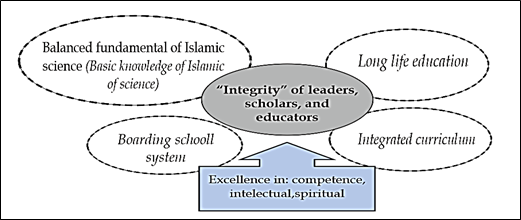
Integrity is a key determinant of effective leadership. Indonesia’s next generation faces various challenges related to integrity and leadership as the country moves toward Indonesia Emas 2045. Strengthening leadership integrity in Islamic boarding schools is unique, as it is rooted in Islamic values. This study describes a model for fostering leadership integrity among future national leaders at Mu’allimin Muhammadiyah Yogyakarta Islamic Boarding School. The research employs a qualitative phenomenological approach. The study involved 17 informants, including kiai, ustaz, community leaders, alumni, musyrif, and students. Researchers actively participated in data collection, which included steps of data reduction, display, and verification. The findings reveal that strengthening the integrity of prospective leaders encompasses several aspects: long-term cadre education policies (for leaders, community, nation), behavior, and open-mindedness (Islamic and national worldview), all developed through value internalization, social interaction, and self-reflection. The balanced development of competencies includes spiritual, intellectual, practical, and moral dimensions. Continuous learning and integration are key features of cadre training at all stages of adolescence. This research contributes to Islamic boarding schools by providing a model for designing and developing leadership integrity systems aligned with Islamic leadership principles. It also highlights the growing public trust in boarding schools as centers for cultivating future leaders’ integrity based on Islamic education. Furthermore, the findings suggest that educational institutions outside the boarding school context can also enhance integrity when guided by a shared vision.
References
Ardiansyah, D., & Iswahyudi. (2023). Peran Pendidikan Pesantren dalam Membentuk Generasi Muda yang Berkarakter Integritas. INTEGRATIA: Journal of Education, Human Development, and Community Engagement, 1(2), 143–156.
Arif, M., Rahman, Abdul, N., & Hanapi, H. (2017). Madrasah Education System And Terrorism: Reality And Misconception Ministry of Education, Malaysia. International Journal of Educational Best Practices, 1(1), 92–101.
Baharom, M., Halimatus, S. M. S., & Sharifah, H. S. I. (2014). The role of integrity as a mediator between work satisfaction and work performance in the perspective of Islam: An empirical approach using Sem/Amos Model. International Journal of Research in Applied, Natural and Social Sciences, 2(1), 71–84.
Betawi, A. (2018). Calling for character education: promoting moral integrity in early childhood education in Jordan. Early Child Development and Care, 1–12. https://doi.org/10.1080/03004430.2018.1489383
Creswell, J. W. (2015). Qualitative Inquiry And Study Design. Pustaka Pelajar.
Darman, R. A. (2017). Mempersiapkan Generasi Emas Indonesia Tahun 2045 Melalui Pendidikan Berkualitas. Edik Informatika, 3(2), 73–87. https://doi.org/10.22202/ei.2017.v3i2.1320
Dunn, P. C. (2009). Integrity matters. European Pharmaceutical Contractor, AUTUMN, 114–117.
Falikul Isbah, M. (2020). Pesantren in the changing indonesian context: History and current developments. Qudus International Journal of Islamic Studies, 8(1), 65–106. https://doi.org/10.21043/QIJIS.V8I1.5629
Fitri, R., & Ondeng, S. (2022). Pesantren Di Indonesia: Lembaga Pembentukan Karakter. AL-URWATUL WUTSQA: Kajian Pendidikan Islam, 2(1), 42–54.
Gea, A. . (2014). Integritas Personal dan Kepemimpinan Etis. Humaniora, 5(2), 950. https://doi.org/10.21512/humaniora.v5i2.3197
Horowitz, M. (2001). Defining Character Integrity. Journal of the American Psychoanalytic Association, 50(2), 551–573. https://doi.org/10.1177/00030651020500021601
Huberts, L. W. J. C. (2018). Integrity: What it is and Why it is Important. Public Integrity, 20, S18–S32. https://doi.org/10.1080/10999922.2018.1477404
Irfani, S., Riyanti, D., Muharam, R. S., & Suharno. (2021). Rand Design Generasi Emas 2045: Tantangan Dan Prospek Pendidikan Kewarganegaraan Untuk Kemajuan Indonesia. Jurnal Penelitian Kebijakan Pendidikan, 14(2), 123–134. https://doi.org/10.24832/jpkp.v14i2.532
Jamrah, A. (2016). Shaping Golden Generation Through Character Education Toward 100 Years Indonesia. Proceeding International Seminar on Education 2016 Faculty of Tarbiyah and Teacher Training, 41–50.
Karthikeyan, P. C. (2017). A Meta Analytical Study on Leadership Integrity : A leadership Ethics Perspective. International Journal of Management, IT and Engineering, 7(4), 240–263.
Kosim, M., Muqoddam, F., Mubarok, F., & Laila, N. Q. (2023). The dynamics of Islamic education policies in Indonesia. Cogent Education, 10(1). https://doi.org/10.1080/2331186X.2023.2172930
Listyaningsih, L., Alrianingrum, S., & Sumarno, S. (2021). Preparing Independent Golden Millennial Generation Through Character Education. 2nd Annual Conference on Education and Social Science (ACCESS 2020), 162–167. https://doi.org/10.2991/assehr.k.210525.066
Ma’arif, S. (2018). Education as a Foundation of Humanity: Learning from the Pedagogy of Pesantren in Indonesia. Journal of Social Studies Education Research, 9(2), 104–123.
Malihah, E. (2015). An ideal Indonesian in an increasingly competitive world: Personal character and values required to realise a projected 2045 “Golden Indonesia.” Citizenship, Social and Economics Education, 14(2), 148–156. https://doi.org/10.1177/2047173415597143
Marzuki, M. A., & Sholihah, R. A. (2023). Sinergi Tripusat Pendidikan dalam Menanamkan Perilaku Terpuji di Madrasah Ibtidaiyah Berbasis Pesantren. Intelektual: Jurnal Pendidikan Dan Studi Keislaman, 13(1), 16–29. https://doi.org/10.33367/JI.V13I1.3521
Mitchell, L. A. (2015). Integrity and Virtue: The Forming of Good Character. https://doi.org/10.1179/2050854915Y.0000000001, 82(2), 149–169. https://doi.org/10.1179/2050854915Y.0000000001
Nata, A. (2001). Sejarah pertumbuhan dan perkembangan lembaga-lembaga pendidikan Islam di Indonesia. PT Grafindo persada.
Nilan, P. (2009). The “spirit of education” in Indonesian Pesantren. British Journal of Sociology of Education, 30(2), 219–232. https://doi.org/10.1080/01425690802700321
Parry, K. W., & Proctor-Thomson, S. B. (2002). Perceived integrity of transformational leaders in organisational settings. Journal of Business Ethics, 35(2), 75–96. https://doi.org/10.1023/A:1013077109223/METRICS
Piascik, P., & Brazeau, G. A. (2010). Promoting a culture of academic integrity. American Journal of Pharmaceutical Education, 74(6), 1–2. https://doi.org/10.5688/aj7406113
Raharjo, M. D. (1983). Pesantren dan Pembaharuan. Jurnal LP3ES.
Rokhman, F., Hum, M., Syaifudin, A., & Yuliati. (2014). Character Education for Golden Generation 2045 (National Character Building for Indonesian Golden Years). Procedia - Social and Behavioral Sciences, 141, 1161–1165. https://doi.org/10.1016/j.sbspro.2014.05.197
Roni, W., Suntoro, I., & Sowiyah. (2020). The Effectiveness of Strengthening Character Education In Boarding School. … Journal of Research and …, IV(Xi), 103–107.
Schuyler, K. G. (2010). Increasing Leadership Integrity Through Mind Training and Embodied Learning. Consulting Psychology Journal, 62(1), 21–38. https://doi.org/10.1037/a0018081
Setiawan, A. R., & Velasufah, W. (2020). Nilai Pesantren Sebagai Dasar Pendidikan Karakter. Pelantan, September, 1–8.
Setyosari, P. (2013). Metode penelitian pendidikan dan pengembangan. Prenada media.
Shaturaev, J. (2021). 2045: Path to nation’s golden age (Indonesia Policies and Management of Education). “Science and Education” Scientific Journal, 2(12), 866–875.
Sihombing, S. O. (2018). Youth perceptions toward corruption and integrity: Indonesian context. Kasetsart Journal of Social Sciences, 39(2), 299–304. https://doi.org/10.1016/j.kjss.2018.03.004
Simons, T. L. (1999). Behavioral integrity as a critical ingredient for transformational leadership. Journal of Organizational Change Management, 12(2), 89–104. https://doi.org/10.1108/09534819910263640/FULL/XML
Siradz, Y. (2019). Kultur Madrasah dalam Membentuk Sikap Kepemimpinan Siswa Di Madrasah Muallimin Muhammadiyah Yogyakarta. Jurnal Sosialita, 11(1), 57–74.
Storr, L. (2004). Leading with integrity: A qualitative research study. Journal of Health Organization and Management, 18(6), 415–434. https://doi.org/10.1108/14777260410569984/FULL/XML
Tasi, R., & Syamsir, S. (2021). Strengthening Work Ethics and Integrity in Corruption Prevention. Proceedings of the 1st Tidar International Conference on Advancing Local Wisdom. https://doi.org/10.4108/eai.21-10-2020.2311842
Umami, I., Gani, A., & Waskito, T. (2019). Proposal of character and moral education for gifted young scientists in Indonesia. Journal for the Education of Gifted Young Scientists, 7(2), 377–387. https://doi.org/10.17478/JEGYS.579560
Vakilbashi, A., Alhumaikani, A. T., Zamil, N. A. M., & Mokhber, M. (2017). The Impact of Integrity on Leadership Effectiveness. Advanced Science Letters, 23(9), 9334–9336. https://doi.org/10.1166/ASL.2017.10080
Van Bruinessen, M. (1995). Kitab kuning pesantren dan tarekat : tradisi - tradisi islam di Indonesia. Mizan.
Widianto, R. T., Suherman, A., & Supriyadi, T. (2023). Strengthening Character Education for Elementary School Children through Rugby Games. Journal of Physical Education, Sport, Health and Recreations, 12(1), 1265–1270.
Downloads
Published
How to Cite
Issue
Section
License
Copyright (c) 2025 Umar Umar, Punaji Setyosari, Waras Kamdi

This work is licensed under a Creative Commons Attribution-ShareAlike 4.0 International License.
Authors who publish with Al-Misbah agree to the following terms:
- Authors retain copyright and grant the journal right of first publication with the work simultaneously licensed under a Creative Commons Attribution License (CC BY-SA 4.0) that allows others to share the work with an acknowledgment of the work's authorship and initial publication in this journal.
- Authors are able to enter into separate, additional contractual arrangements for the non-exclusive distribution of the journal's published version of the work (e.g., post it to an institutional repository or publish it in a book), with an acknowledgment of its initial publication in this journal.
- Authors are permitted and encouraged to post their work online (e.g., in institutional repositories or on their website) prior to and during the submission process, as it can lead to productive exchanges, as well as earlier and greater citation of published work.

This work is licensed under a Creative Commons Attribution-ShareAlike 4.0 International License.