Spiritual and mental harmonization: religious education through the lens of psychology
DOI:
https://doi.org/10.26555/almisbah.v13i1.12634Keywords:
Religious of Psychology, Education, Harmony Spriritual MentalAbstract
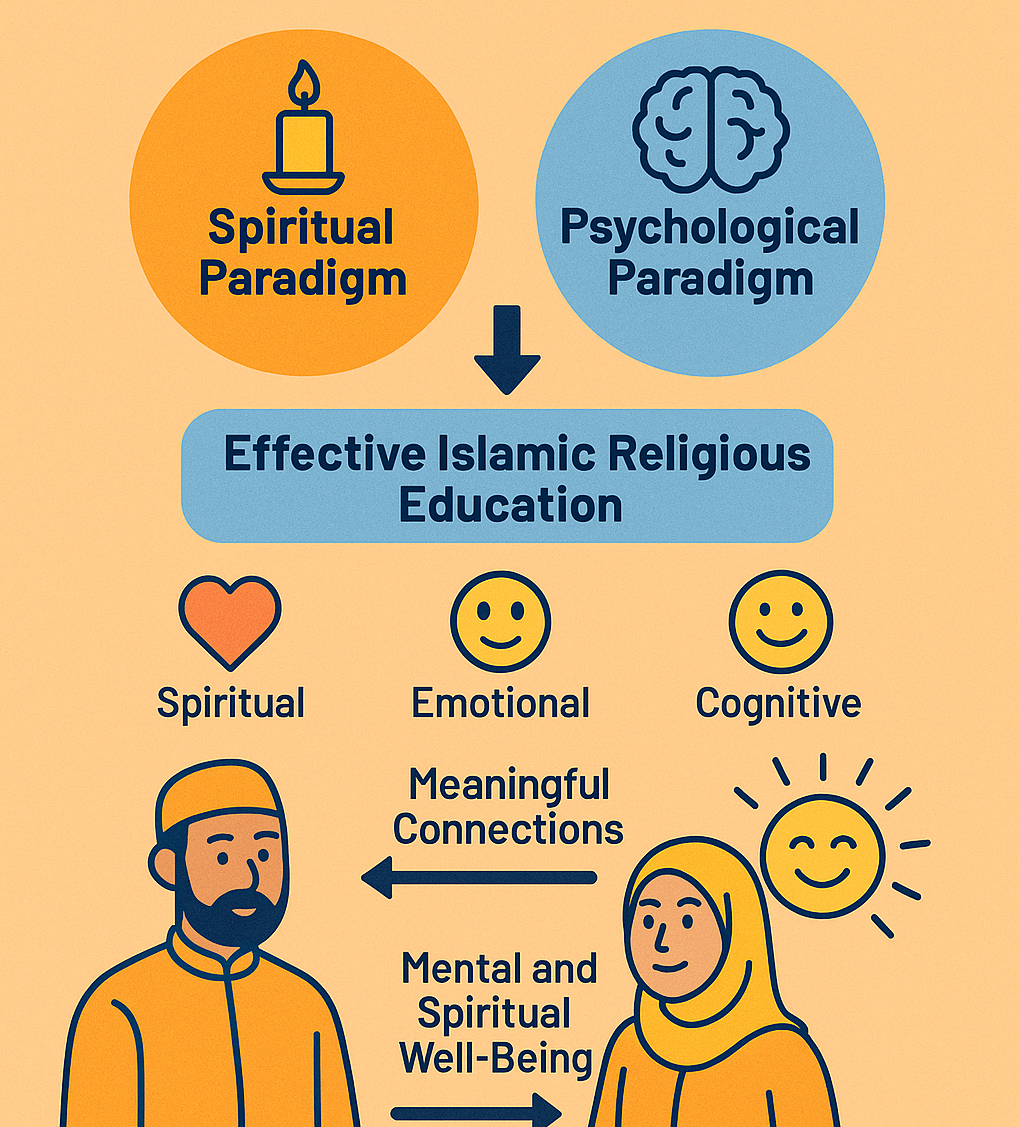
This research offers a new, holistic, and multidisciplinary perspective on Islamic Religious Education by combining spiritual and psychological paradigms. The study adopts a literature review method, which involves several stages: identifying sources, selecting and filtering relevant literature, collecting information, and analyzing and synthesizing data. The findings show that effective Islamic Religious Education should integrate the spiritual, emotional, and cognitive aspects of learners. By considering students’ psychology, interests, motivations, and talents, religious education can serve as a powerful tool for building mental and spiritual well-being. Educators, as spiritual guides, play a vital role in creating meaningful connections between religious teachings and students’ daily lives. Students with spiritual awareness and a positive attitude are believed to experience beneficial effects on other aspects of their personal lives. The implications of these findings suggest that when students’ psychological development, interests, motivations, and talents are balanced with spirituality, spiritual and mental harmony can become a source of happiness, serenity, and life’s meaning.
References
Ahya, B., & Dharmawan, I. I. N. (2023). Analisis Peran Psikologi Agama Dalam Pembentukan Karakter dan Jiwa Agama Pada Remaja. ARIMA : Jurnal Sosial Dan Humaniora, 1(2), 108–115.
Amma, T., Setiyanto, A., & Fauzi, M. (2021). Problematika Pembelajaran Pendidikan Agama Islam Pada Peserta Didik. Edification Journal, 3(2), 135–151. https://doi.org/10.37092/ej.v3i2.261
Aprillia, L., Idi Warsah, & Dewi Purnama Sari. (2023). Peran Psikologi Agama Terhadap Perkembangan. Jurnal Muhafadzah: Jurnal Ilmiah Bimbingan Dan Konseling Islam, 3(2), 62–70.
Bauto, L. M. (2016). Perspektif agama dan kebudayaan dalam kehidupan masyarakat Indonesia (Suatu Tinjauan Sosiologi Agama). Jurnal Pendidikan Ilmu Sosial, 23(2), 11–25. https://doi.org/10.17509/jpis.v23i2.1616
Daswati, D., & Fitriani, W. (2023). Studi Analisis Psikologi Belajar Pendidikan Agama Islam Berdasarkan Kreativitas, Minat, Bakat, dan Intelegensi. ITQAN: Jurnal Ilmu-Ilmu Kependidikan, 14(1), 67–82. https://doi.org/10.47766/itqan.v13i2.811
Frankl, V. E. (2000). Man’s search for meaning: The classic tribute to hope from the Holocaust. Random House.
Freud, S. (2012). The Future of an Illusion (T. Dufresne (ed.)). Library and Archive Canada.
Hamdo, S. H. (2022). Hubungan Motivasi Belajar Dan Minat Belajar Terhadap Hasil Belajar Pendidikan Agama Islam Peserta Didik Kelas VIII SMP Negeri 26 Makassar. Jurnal Pendidikan Agama Islam Indonesia (JPAII), 3(2), 35–39. https://doi.org/10.37251/jpaii.v3i2.626
Hamid, N. (2021). Pengaruh Motivasi dan Minat Belajar Terhadap Hasil Belajar Pendidikan Agama Islam. Jurnal Ilmu Pendidikan Agama.
Harahap, A. N., & Afrinaldi, A. (2024). Pengembangan Bakat Dan Minat Peserta Didik Di Smp Negeri 1 Tilatang Kamang Provinsi Sumatera Barat. Jurnal Pendidikan Dan Ilmu Sosial (Jupendis), 2(1), 359–376. https://doi.org/10.54066/jupendis.v2i1.1410
Hendro, W. (2023). Perkembangan Kurikulum PAI (Fadhlurrahman (ed.)). UAD PRESS.
Ibda, F. (2023). Perkembangan Moral Dalam Pandangan Lawrence Kohlberg. Intelektualita, 12(1), 62–77. https://doi.org/10.22373/ji.v12i1.19256
James, W. (2015). The Varieties of Religious Experience/A Study in Human Nature. Xist Publishing.
Jung, C. . (2014). Psychology and Religion Volume 11 (G. Adler (ed.); 2nd ed.). Routledge. https://doi.org/10.4324/9781315725505
Kurniawati, D., & Dwistia, H. (2022). Pentingnya Psikologi Agama Terhadap Pendidikan Islam. Cinli Education Journal : Penelitian Ibnu Rusyd Kotabumi, 1(1).
Mardatillah. (2023). Model pembelajaran pendidikan agama islam dalam menanamkan nilai moderasi beragama di SMK Bina Potensi Palu (Vol. 13, Issue 1).
Mardhiah, A., & Julike, M. (2022). Strategi Guru Kelas Dalam Pengembangan Bakat Minat Peserta Didik di MIN 2 Ujung Baro Blangkejeren Gayo Lues. Urnal Intelektualita Prodi MPI, 11(2), 141–159.
Marinda, L. (2020). Teori Perkembangan Kognitif Jean Piaget Dan Problematikanya Pada Anak Usia Sekolah Dasar. An-Nisa’ : Jurnal Kajian Perempuan Dan Keislaman, 13(1), 116–152. https://doi.org/10.35719/annisa.v13i1.26
Masduki, D. Y., & Warsah, D. I. (2020). Psikologi Agama (O. Martilawari (ed.); Pertama). Tunas Gemilang Press.
Meliza. (2024). Model Pembelajaran Berbasis Nilai dalam Pendidikan Agama Islam untuk Meningkatkan Akhlak Mulia. 1.
Mofid, M. (2020). Teori Dasar Psikologi Agama. institut Agama Islam Sunan Kalijogo Malang.
Ningsih, W., Az-Zahra, F., Rizki, A., Damhudi, H. J., & Adhdhawy. (2024). Peran Guru Pai Dalam Program Bk. 2(1), 104–109.
Puspitasari, N., Relistian. R, L., & Yusuf, R. (2022). Peran Pendidikan Agama Islam Terhadap Pembentukan Karakter Religius Peserta Didik. Atta’dib Jurnal Pendidikan Agama Islam, 3(1), 57–68. https://doi.org/10.30863/attadib.v3i1.2565
Putria, I. P., & Syamsudin. (2023). Konseling spiritual untuk mengatasi siswa bermasalah di Madrasah Aliyah Negeri 3 Sleman. 5(2), 997–1007.
Riza, M. F. (2021). Psikologi Agama : Agama Menurut Psikolog Sekuler.
Rozalina, E. (2021). Psikologi Agama Buku Referensi Penerbit: PT Dewangga Energi Internasional. 285.
Suryani, S., & Ismail, M. (2020). Materi PAI dan Perkembangan Kognitif Peserta Didik. Jurnal Pendidikan Dan Kebudayaan Islam.
Umar, J. (2020). Analisis Tingkat Pemahaman Terhadap Mata Pelajaran Agama Islam Pada Siswa SMP Negeri 1 Delima Pidie. Jurnal Mudarrisuna: Media Kajian Pendidikan Agama Islam, 10(2), 23–39.
Winda Agustian, Hamengkubowono, W. S. (2020 B.C.E.). Model Pembelajaran Pendidikan Agama Islam Di Sekolah Umum. At-Ta’Dib : Jurnal Ilmiah Prodi Pendidikan Agama Islam. Ilmiah Prodi Pendidikan Agama Islam, 112–126.
Yenti, S. (2021). Perkembangan Sosial Emosional Anak Usia Dini (AUD): Studi Literatur. Jurnal Pendidikan Tambusai, 5(3), 9814–9819.
Downloads
Published
How to Cite
Issue
Section
License
Copyright (c) 2025 Ika Sofia Rizqiani, Tobroni , Faridi Faridi

This work is licensed under a Creative Commons Attribution-ShareAlike 4.0 International License.
Authors who publish with Al-Misbah agree to the following terms:
- Authors retain copyright and grant the journal right of first publication with the work simultaneously licensed under a Creative Commons Attribution License (CC BY-SA 4.0) that allows others to share the work with an acknowledgment of the work's authorship and initial publication in this journal.
- Authors are able to enter into separate, additional contractual arrangements for the non-exclusive distribution of the journal's published version of the work (e.g., post it to an institutional repository or publish it in a book), with an acknowledgment of its initial publication in this journal.
- Authors are permitted and encouraged to post their work online (e.g., in institutional repositories or on their website) prior to and during the submission process, as it can lead to productive exchanges, as well as earlier and greater citation of published work.

This work is licensed under a Creative Commons Attribution-ShareAlike 4.0 International License.