Debate ethics education in the Quran: an examination of tafsir al-Misbah
DOI:
https://doi.org/10.26555/almisbah.v13i1.12628Keywords:
Education,, Ethics,, Debate,, Tafsir Al-MisbahAbstract
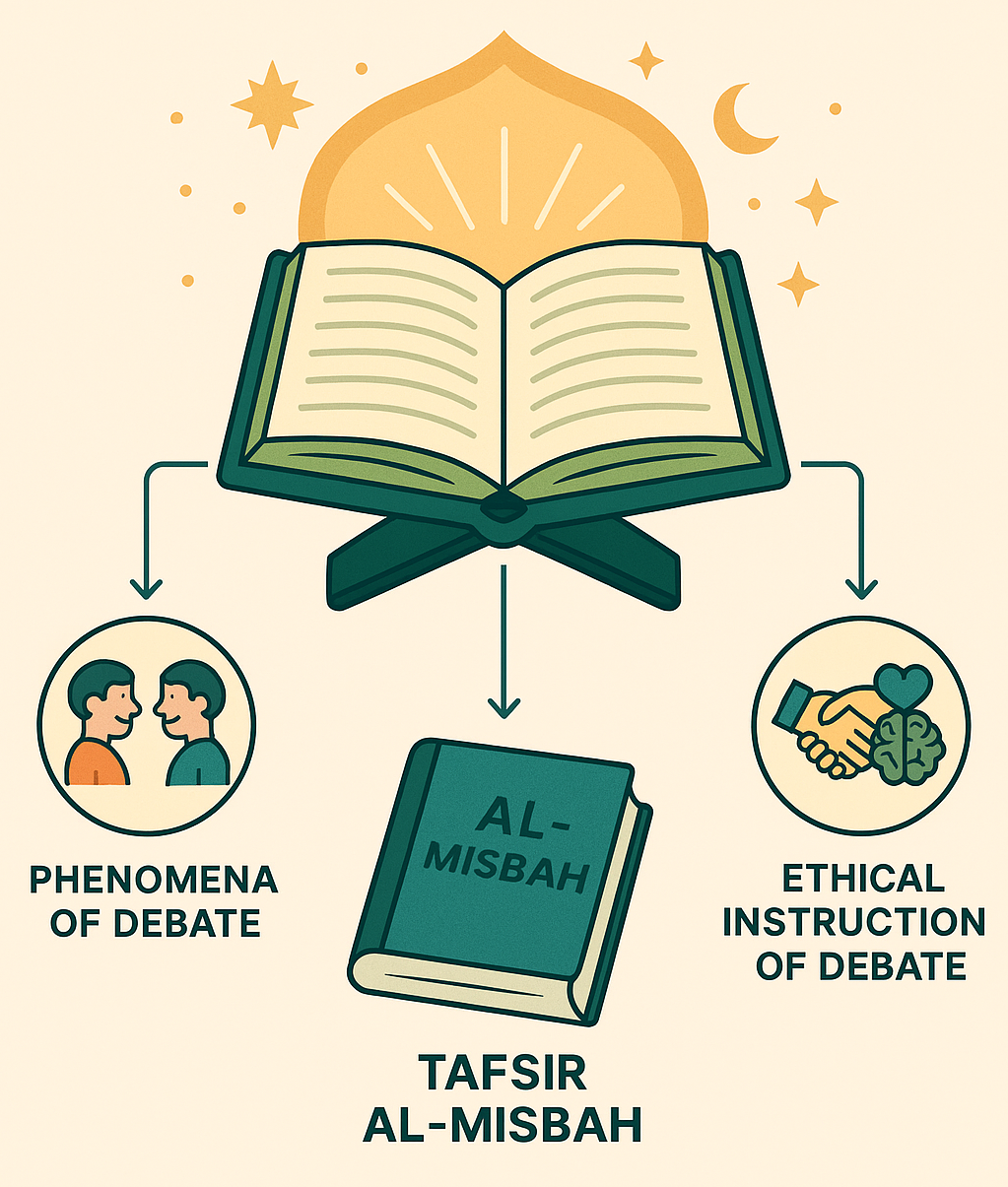
Differences in thought and opinion frequently arise in social interactions, often leading to debates. This study aims to explore how Al-Misbah interprets debate ethics in the Qur'an, emphasizing the importance of understanding ethical argumentation without causing division. Using a qualitative methodology based on library research, this study examines M. Quraish Shihab’s interpretation of Al-Misbah as reflected in several Qur’anic verses, including QS. Al-Kahf 18:54, QS. An-Nahl 16:125, QS. Ghafir 40:5, QS. Al-Hajj 22:8, and QS. Al-Ankabut 29:46. The findings indicate that teaching proper debate ethics according to the Qur'an involves revisiting these interpretations, which highlight the need for self-control (not being easily provoked by emotion), logical reasoning, and polite rhetoric free from violence or insults. Debate should be grounded in knowledge, presenting correct arguments with confidence and aiming to persuade opponents through clear and respectful communication.
References
Al-’Utsman, H. bin I. (2004). al-Usul al-Jadal wa al-Munazarah fi al-Kitab wa al-Sunnah. Dar Ibn Hazm.
Al-Baqi, M. F. (1987). al-Mu’jam al-Mufahras li al-Faz al-Qur’an al-Karim. In Beirut: Dar al-Fikr (Vol. 1407).
Al‑Ḥanbālī, N. al‑Ṭūfī. (1987). ʿAlam al‑Jazal fī ʿIlm al‑Jadal. Franz Steiner Verlag.
Al-Jazāirī, A. B. J. (1990). Aysaru At-Tafāsīr Li Kalām Al-Alī Al-Kabīr. In Jeddah: Racem.
Al-Jurjani, A. bin M. (2004). Mu’jam al-Ta’rifat. In Cairo: Dar al-Fadilah.
Al-Mawardi, A. bin M. (1998). al-Nukat wa al-‘Uyun. In Beirut: Dar al-Kutub al-Ilmiyah.
Al-Qaththan, S. M. (2018). Pengantar Studi Ilmu Al-Qur’an. Pustaka Al-Kautsar.
Al-Shinqīṭī, M. al-A. ibn M. al-M. al-J. (1968). Adab al-baḥth wa al-munāẓarah. Dar ’Alim al-Fawaid.
Al-Suyūṭī, Ğ. al-D., & ibn al-Ṭayyib, A. B. M. (1978). al-Itqān fīulūm al-Qur’ān. Muṣṭafā al-Bābī al-Ḥalabī.
Arum Sari, D. F. P., & Retnaningsih, D. A. (2023). Keutamaan Orang Berilmu Dalam Al-Qur’an Surat Al-Mujadalah Ayat 11. Tarbiya Islamica, 10(2), 118–129. https://doi.org/10.37567/ti.v10i2.2252
Asrori, A., & Krisnawati, N. M. (2021). Implementasi Metode Dakwah Qur’ani Dalam Memahami Ajaran Agama Islam. Jurnal Abdidas, 2(4), 944–953. https://doi.org/10.31004/abdidas.v2i4.401
Baaqi, M. F. ‘Abdul. (1992). Mu“jam Mufahras li Alfāẓ al-Qur”ān al-Karīm. Dār al-Fikr.
Depdiknas, P. B. (2008). Kamus Besar Bahasa Indonesia (Edisi Keempat). Depdiknas, Pusat Bahasa.
Faisal, M. (2022). Karakteristik Corak Penafsiran Al-Qur’an dalam Surat Al-Fatihah Perspektif Tafsir Al-Azhar dan Tafsir Al-Misbah. At-Turas: Jurnal Studi Keislaman, 9(2), 263–281. https://doi.org/10.33650/at-turas.v9i2.4481
Fikri, H. K. (2019). Jadal Dalam Pandangan Al-Quran dan Pendidikan Konseling. El-’Umdah, 2(1), 56–74. https://doi.org/10.20414/el-umdah.v2i1.912
Hefner, R. W. (2001). Civil Islam: Islam dan demokratisasi di Indonesia (A. Baso, Trans.). Institut Studi Arus Informasi (ISAI).
Iqbal, M. (2010). Etika Politik Qur’ani. IAIN Press.
Isnaini, I. (2021). Analisis Faktor Penyebab Krisis Akhlak Pada Anak Pesisir. Jurnal Anifa, 1(1), 59–74. https://doi.org/10.32505/anifa.v1i1.2443
Junaidi, M. (2011). Rasionalitas Kalam M. Quraish Shihab. Angaksa Solo.
Kamarusdiana, K., & Nahrawi, A. (2020). Wacana Debat Inklusif: Menyoal Jadal Sebagai Perdebatan dalam Al-Quran. Alashriyyah, 6(02), 107–119. https://doi.org/10.53038/alashriyyah.v6i02.132
Maya, R. (2018). Perspektif AlQur’an tentang Perubahan Sosial: Analisis Penafsiran Term Al-Taghyîr, Al-Ibtilâ', AlTamhîsh, dan Al-Tamkîn. Al - Tadabbur: Jurnal Ilmu Al-Qur’an Dan Tafsir, 3(01). https://doi.org/10.30868/at.v3i01.255
Munawir, A. W. (2002). Kamus Arab-Indonesia. Pustaka Progressif.
Musaddad, E. (2004). Metode dan Corak Tafsir Quraish Shihab. Al Qalam Jurnal Ilmiah Bidang Keagamaan Dan Kemasyarakatan, 21(100), 55. https://doi.org/10.32678/alqalam.v21i100.1647
Nata, A. (2015). Akhlak Tasawuf dan Karakter Mulia. Rajawali Pers.
Nur, A. (2012). M. Quraish Shihab dan Rasionalisasi Tafsir. Jurnal Ushuluddin, 18(1), 21–33.
Shihab, M. Q. (1994). Membumikan al-Qur’an: Fungsi dan Peran Wahyu Dalam Kehidupan Masyarakat. Mizan.
Shihab, M. Q. (2002a). Tafsir al-Misbah, Volume IX. Lentera Hati.
Shihab, M. Q. (2002b). Tafsir al-Misbah, Volume VII. Lentera Hati.
Shihab, M. Q. (2002c). Tafsir al-Misbah, Volume XII. Lentera Hati.
Shihab, M. Q. (2005). Logika Agama: Kedudukan Wahyu dan Batas-Batas Akal Dalam Islam. Lentera Hati.
Shihab, M. Q. (2007). Membumikan al-Qur’an: Fungsi dan Peran Wahyu Dalam Kehidupan Masyarakat. Mizan.
Shihab, M. Q. (2009). Tafsir Al-Misbah. Lentera Hati.
Shihab, M. Q. (2013a). Kaidah Tafsir. Lentera Hati.
Shihab, M. Q. (2013b). Sejarah dan Ulumul Qur’an. Pustaka Firdaus.
Shihab, M. Q. (2014a). Menabur Pesan Ilahi: Al-Qur’an dan Dinamika Kehidupan Masyarakat. Mizan.
Shihab, M. Q. (2014b). Mukjizat Al-Qur’an: Ditinjau Dari Aspek Kebahasaan, Isyarat Ilmiah, dan Pemberitaan Ghaib. Mizan.
Sugiarto, F. (2023). Ulum al-Qur’an (Ringkasan Materi Dasar Ilmu-ilmu al-Qur'an). Lembaga Ladang Kata.
Sugiyono. (2014). Teknik Pengumpulan Data. In Metode Penelitian Kuantitatif, Kualitatif dan R&D. https://doi.org/10.3354/dao02420
Suherman, E., & Yuninda Widya Afifah. (2023). Al-Ma’un Sebagai Perubahan Sosial dan Pendidikan Akhlak Manusia. Madaniyah, 13(1), 29–48. https://doi.org/10.58410/madaniyah.v13i1.681
Tarman, A.-F. M. R., & Suherman, E. (2024). Tinjauan Awal Kritisisme Immanuel Kant. JURNAL ILMIAH FALSAFAH: Jurnal Kajian Filsafat, Teologi Dan Humaniora, 10(2), 63–75. https://doi.org/10.37567/jif.v10i2.2717
Wartini, A. (2014). Corak Penafsiran M. Quraish Shihab Dalam Tafsir Al Misbah. HUNAFA: Jurnal Studia Islamika, 11(1), 109. https://doi.org/10.24239/jsi.v11i1.343.109-126
Zahratunnisa’, Z. (2022). Konsep Debat (Jadal) Dalam Al-Qur’an: Urgensi Kecerdasan dan Moralitas. Academic Journal of Islamic Principles and Philosophy, 2(2), 155–172. https://doi.org/10.22515/ajipp.v2i2.4065
Downloads
Published
How to Cite
Issue
Section
License
Copyright (c) 2025 Eman Suherman, Dewi Fatimah Putri Arum Sari, Sunanto Sunanto , Ghazi Abdullah Muttaqien

This work is licensed under a Creative Commons Attribution-ShareAlike 4.0 International License.
Authors who publish with Al-Misbah agree to the following terms:
- Authors retain copyright and grant the journal right of first publication with the work simultaneously licensed under a Creative Commons Attribution License (CC BY-SA 4.0) that allows others to share the work with an acknowledgment of the work's authorship and initial publication in this journal.
- Authors are able to enter into separate, additional contractual arrangements for the non-exclusive distribution of the journal's published version of the work (e.g., post it to an institutional repository or publish it in a book), with an acknowledgment of its initial publication in this journal.
- Authors are permitted and encouraged to post their work online (e.g., in institutional repositories or on their website) prior to and during the submission process, as it can lead to productive exchanges, as well as earlier and greater citation of published work.

This work is licensed under a Creative Commons Attribution-ShareAlike 4.0 International License.