Transformation of integration Indonesian islamic values on the islamic university curriculum
DOI:
https://doi.org/10.26555/almisbah.v13i1.12332Keywords:
Curriculum Integration, Curriculum Development, Indonesian Islamic ValuesAbstract
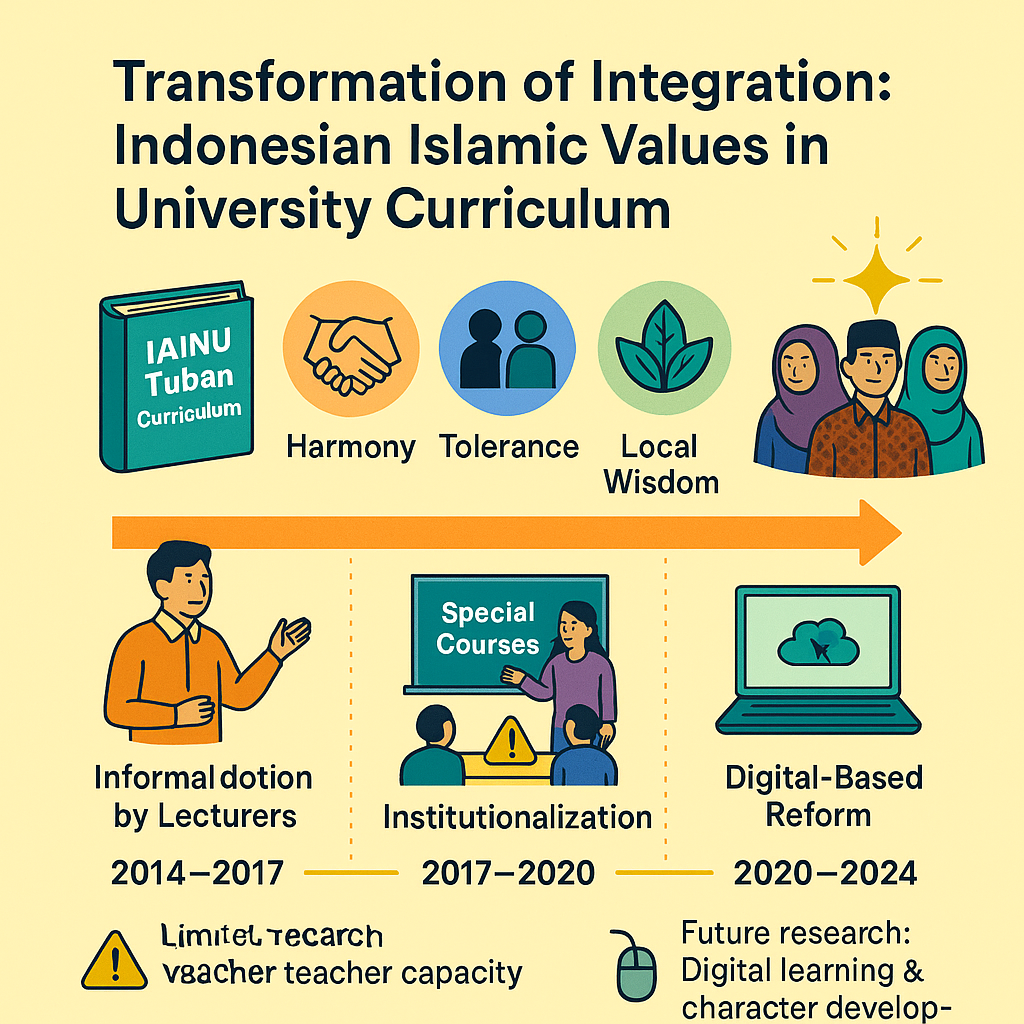
This study addresses the growing need for Islamic education grounded in local values, as globalization and the homogenization of religious thought continue to advance. Focusing on IAINU Tuban, the research examines how Islamic Nusantara values, such as harmony, tolerance, and local wisdom, have been integrated into the curriculum from 2014 to 2024 to support a moderate and contextually relevant approach to Islamic education in Indonesia. The study aims to map the historical trajectory of this integration, analyze operational challenges, and evaluate its impact on educational practices. Employing a qualitative approach with historical methods, data were collected from curriculum documents, institutional archives, stakeholder interviews, and classroom observations. The results identify three phases of integration: (1) informal adoption by lecturers (2014–2017), (2) institutionalization through special courses (2017–2020), and (3) digital-based curriculum reform (2020–2024). Although challenges such as limited teaching resources and teacher capacity remain, this integration model has contributed to strengthening a contextual Islamic identity. Future research should assess the effectiveness of digital learning and its long-term influence on student character development.
References
Fakhurokhman, A., Adyaputra, R., Rachman, M. N., Mansyz, M. I. R., Efandi, B. M., & Muvid, M. B. (2022). The Aktualisasi Nilai-nilai Islam Nusantara terhadap Penguatan Moderasi Beragama di Indonesia. EL-BANAT: Jurnal Pemikiran dan Pendidikan Islam, 12(1), 19–34. https://doi.org/10.54180/elbanat.2022.12.1.19-34
Hayumi, Utami, W. Y. D., Yuniar, E. I., & Jannah, N. H. (2024). Archipelago Islamic Philosophy; Ontological, Epistemological and Axiological Analysis of Archipelago Islamic Ideas in Indonesia. Arus Jurnal Sosial dan Humaniora, 4(2), 946–951. https://doi.org/10.57250/ajsh.v4i2.583
Hurst, A. (2023). Chapter 16. Archival and Historical Research.
Hutabarat, F. (2023). Navigating Diversity: Exploring Religious Pluralism and Social Harmony in Indonesian Society. European Journal of Theology and Philosophy, 3(6), 6–13. https://doi.org/10.24018/theology.2023.3.6.125
Ishtiaq, M. (2019). Book Review Creswell, J. W. (2014). Research Design: Qualitative, Quantitative and Mixed Methods Approaches (4th ed.). Thousand Oaks, CA: Sage. English Language Teaching, 12(5), 40. https://doi.org/10.5539/elt.v12n5p40
Kusuma, N., & Pepilina, D. (2024). The Values Of Islam Nusantara’s Civilization And Religious Moderation In Lampungnese Culture Community. Paradigma, 21(1), 157–178. https://doi.org/10.33558/paradigma.v21i1.8276
McKee, A. J. (2023). Section 6.1: Qualitative and Historical Research.
Muali, C. (2017). Rasionalitas konsepsi budaya nusantara dalam menggagas pendidikan karakter bangsa multikultural. Jurnal Islam Nusantara, 1(1), 105–117. https://doi.org/10.33852/jurnalin.v1i1.64
Nahar, A. W. K., Syafiq, M., & Aqil, F. H. (2021). Konsep Kultural Dakwah Walisongo Memperkuat Moderasi Beragama. Muẚṣarah: Jurnal Kajian Islam Kontemporer, 5(2), 85–92.
Nasikhin, D. (2019). Proses Internalisasi Nilai-Nilai Karakter Berwawasan Islam Nusantara. Turatsuna: Jurnal Keislaman dan Pendidikan, 1(2), 19–34.
Rahman, A. (2024). Implikasi teknologi terhadap pendidikan agama Islam di era globalisasi. Sindoro: Cendikia Pendidikan, 6(7), 31–40. https://doi.org/10.9644/sindoro.v6i7.5800
Saumantri, T. (2022). The Dialectic of Islam Nusantara and Its Contribution To The Development of Religious Moderation In Indonesia. FOKUS Jurnal Kajian Keislaman Dan Kemasyarakatan, 7(1), 57–67. https://doi.org/10.29240/jf.v7i1.4295
Setiawan, D. E., & Stevanus, K. (2023). Significance of Islam Nusantara Values in an Indonesian Multicultural Society. Journal of Al-Tamaddun, 18(1), 203–214. https://doi.org/10.22452/JAT.vol18no1.17
Susanto, E., & Hermawati, T. (2022). Konstruksi Pendidikan Islam Nusantara Berwawasan Multikultural di STAI Brebes Jawa Tengah. Amorti: Jurnal Studi Islam Interdisipliner, 42–54. https://doi.org/10.59944/amorti.v1i1.11
Tarigan, M., Muniroh, Z. Z., Lasei, P. N., & Zatayumni, S. I. (2024). Pendidikan islam di Era globalisasi. Jurnal Dirosah Islamiyah, 6(3), 566–572. https://doi.org/10.47467/jdi.v6i3.2367
Yahya, H. H. (2024). Characteristics of the nusantara Islamic education model. Tawasut, 11(1). https://doi.org/10.31942/ta.v11i1.6903
Downloads
Published
How to Cite
Issue
Section
License
Copyright (c) 2025 Siti Nurjanah, Nasihun Amin, Irfa'i Alfian Mubaidilla Mubaidilla , Ubaidilah Munir

This work is licensed under a Creative Commons Attribution-ShareAlike 4.0 International License.
Authors who publish with Al-Misbah agree to the following terms:
- Authors retain copyright and grant the journal right of first publication with the work simultaneously licensed under a Creative Commons Attribution License (CC BY-SA 4.0) that allows others to share the work with an acknowledgment of the work's authorship and initial publication in this journal.
- Authors are able to enter into separate, additional contractual arrangements for the non-exclusive distribution of the journal's published version of the work (e.g., post it to an institutional repository or publish it in a book), with an acknowledgment of its initial publication in this journal.
- Authors are permitted and encouraged to post their work online (e.g., in institutional repositories or on their website) prior to and during the submission process, as it can lead to productive exchanges, as well as earlier and greater citation of published work.

This work is licensed under a Creative Commons Attribution-ShareAlike 4.0 International License.