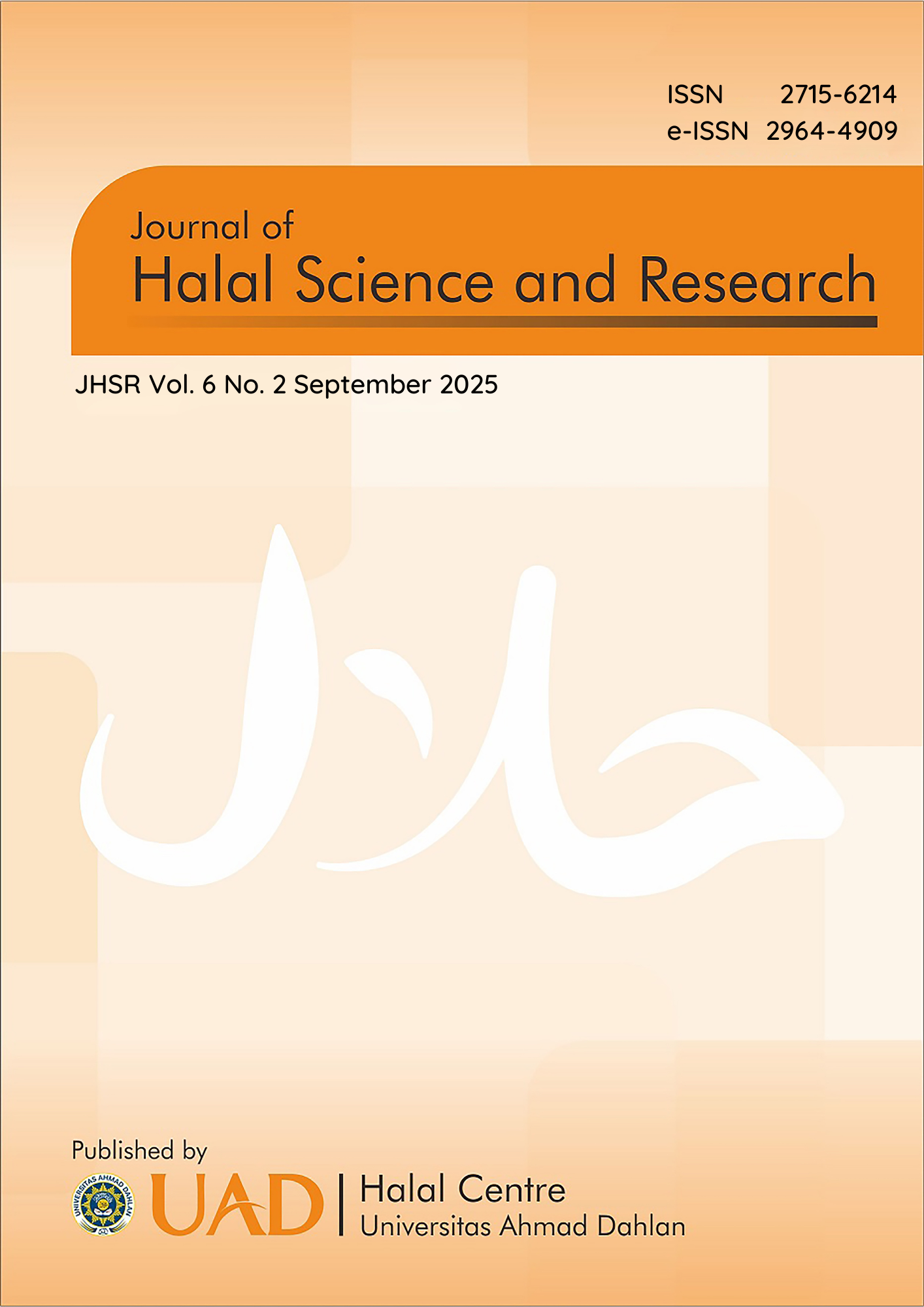
Systematic review: Comparison of halal regulations in Asia
DOI:
https://doi.org/10.12928/jhsr.v6i2.12111Abstract
The harmonization of halal standards in Asia is crucial for boosting regional trade, ensuring consumer confidence, and meeting religious requirements in the growing halal industry. This systematic review employed a qualitative comparative analysis of 9 key journal articles and 8 major halal regulations in Asia, including Malaysia's MS 1500-2009, OIC/SMIIC 1:2019, Saudi Arabia's SASO 2172, and UAE.S 2055-1:2015, as well as recent changes in Indonesia's laws (Law No. 33/2014, Law No. 6/2023, PP No. 39/2021, and PP No. 42/2024). This analysis reveals significant differences in halal definitions, certification protocols, and the role of regulatory authorities, which hinder harmonization. Specifically, it was found that countries such as Indonesia, Malaysia, Saudi Arabia, and Brunei implement mandatory halal policies, while others like Japan, Thailand, and India adopt voluntary approaches. The review highlights that while countries share common goals of food safety and sharia compliance, cultural and technological variations, alongside certification costs for MSMEs, remain significant barriers. Mutual recognition agreements, cross-border compliance, and the adoption of technologies like blockchain are emphasized as essential for fostering transparency and an integrated halal market. This study provides fresh insights into the benefits of harmonizing halal standards for producers, consumers, and regulators, ultimately aiming to reduce trade barriers, increase trust, and support regional economic growth.
Keywords: Asia halal certification, Asia trade, Blockchain technology, Halal standard, Regional harmonization.
Downloads
Published
Issue
Section
License
Copyright (c) 2025 Universitas Ahmad Dahlan

This work is licensed under a Creative Commons Attribution-NonCommercial-ShareAlike 4.0 International License.
Authors who publish with JHSR (Journal of Halal Science and Research) agree to the following terms:
1. Authors retain the copyright and grant Universitas Ahmad Dahlan right of first publication with the work simultaneously licensed under a Creative Commons Attribution-NonCommercial-ShareAlike 4.0 License (CC BY-NC-SA 4.0) that allows others to share (copy and redistribute the material in any medium or format) and adapt (remix, transform, and build upon the material) the work for any purpose, even commercially with an acknowledgement of the work's authorship and initial publication in Universitas Ahmad Dahlan.
2. Authors are able to enter into separate, additional contractual arrangements for the non-exclusive distribution of the journal's published version of the work (e.g., post it to an institutional repository or publish it in a book), with an acknowledgement of its initial publication in Universitas Ahmad Dahlan.
3. Authors are permitted and encouraged to post their work online (e.g., in institutional repositories or on their website) prior to and during the submission process, as it can lead to productive exchanges, as well as earlier and greater citation of published work (See The Effect of Open Access).
This work is licensed under a Creative Commons Attribution-NonCommercial-ShareAlike 4.0 International License.