Optimizing operational performance through logistics and supply chain system effectiveness: evidence from Indonesian automotive manufacturing firms
DOI:
https://doi.org/10.12928/ijio.v7i2.15845Keywords:
Logistics and supply chain effectiveness, Operational performance, Inventory efficiency, Firm size moderation, Indonesian automotive industryAbstract
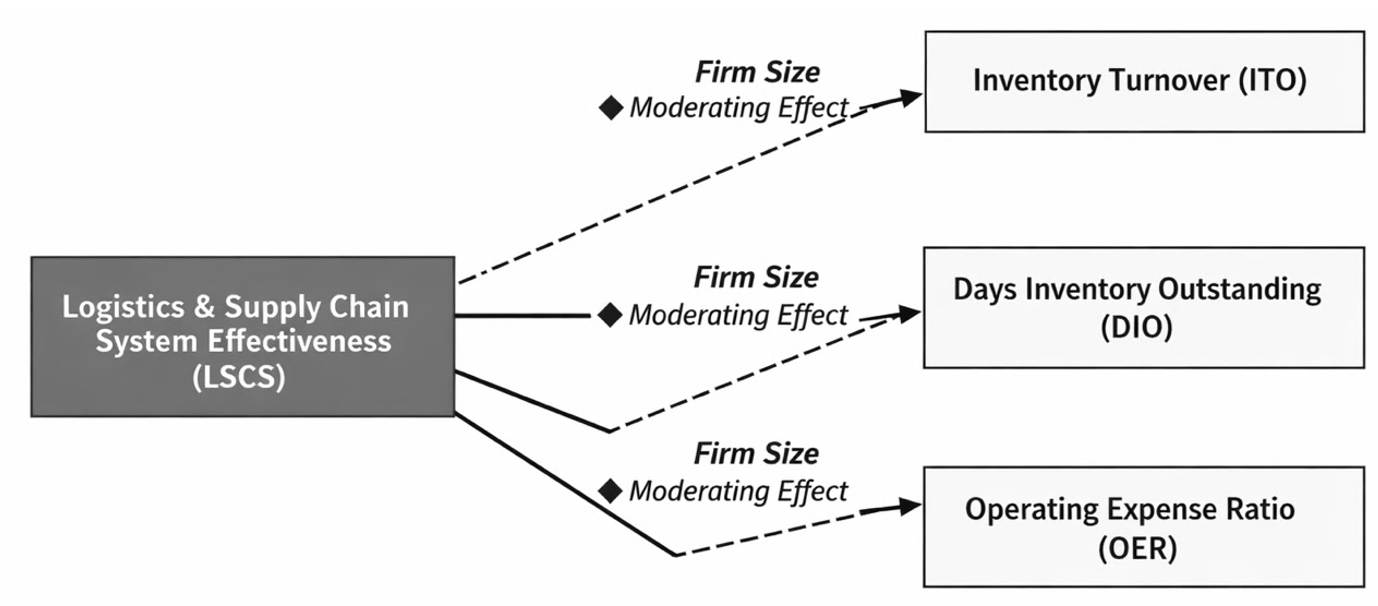
Logistics and supply chain systems are critical determinants of operational efficiency in inventory-intensive industries such as automotive manufacturing. Although prior studies have examined the relationship between supply chain management and firm performance, much of the evidence relies on perceptual measures or single-dimensional outcomes, leaving limited finance-based empirical validation in emerging markets. This study addresses this gap by examining how logistics and supply chain system effectiveness influences multidimensional operational performance in the Indonesian automotive sector. The study contributes to the literature by providing finance-based evidence of capability-driven performance and by integrating the Resource-Based View with Contingency Theory within an emerging-market regulatory context. A quantitative explanatory design is employed using pooled firm-year data from automotive manufacturing firms listed on the Indonesian Stock Exchange over the period 2022–2024. Logistics effectiveness is operationalized using objective financial efficiency ratios derived from audited statements. Multiple regression analysis with moderation testing is conducted using SPSS. The findings indicate that logistics and supply chain system effectiveness significantly improve inventory turnover and time-based inventory efficiency, demonstrating strong support for capability-driven performance effects. However, the relationship between logistics effectiveness and operating cost efficiency is not statistically significant, suggesting that cost structures are influenced by broader structural factors. Firm size positively moderates the relationship between logistics effectiveness and inventory-based performance, confirming that organizational scale conditions capability effectiveness. Robustness tests confirm the stability of these results across alternative model specifications.
References
H. A. DeCampos, C. R. Rosales, and S. Narayanan, “Supply chain horizontal complexity and the moderating impact of inventory turns: A study of the automotive component industry,” Int. J. Prod. Econ., vol. 245, p. 108377, Mar. 2022, doi: 10.1016/j.ijpe.2021.108377.
M. Pirttilä, V. M. Virolainen, L. Lind, and T. Kärri, “Working capital management in the Russian automotive industry supply chain,” Int. J. Prod. Econ., vol. 221, p. 107474, Mar. 2020, doi: 10.1016/j.ijpe.2019.08.009.
O. Okşaş, E. G. Emecen Kara, T. Özbey, E. Kaçmaz, and M. Karaoğlu, “Identifying Similarities of National Yacht Qualifications Using Hierarchical Clustering Methods,” Sustainability, vol. 14, no. 19, p. 12622, Oct. 2022, doi: 10.3390/su141912622.
S. Tripathi, S. S. Roy, and B. Talukder, “The effect of firm-specific determinants on export performance: the mediating role of supply chain performance,” Int. J. Product. Perform. Manag., vol. 74, no. 4, pp. 1297–1325, Mar. 2025, doi: 10.1108/IJPPM-11-2023-0639.
A. Azadegan, M. M. Parast, L. Lucianetti, and R. Nishant, “Supply chain disruptions and business continuity: An empirical assessment,” Decis. Sciences, 2020, doi: 10.1111/deci.12395.
X. Pan, M. Dresner, and Y. Xie, “Logistics IS resources, organizational factors, and operational performance,” Int. J. Logist. Manag., vol. 30, no. 2, pp. 569–594, May 2019, doi: 10.1108/IJLM-02-2018-0023.
K. T. Shibin et al., “Examining sustainable supply chain management of SMEs using resource based view and institutional theory,” Ann. Oper. Res., vol. 290, no. 1–2, pp. 301–326, Jul. 2020, doi: 10.1007/s10479-017-2706-x.
M. Javadi, Z. Raeisi, and A. Latifian, “Enhancing production strategies using service-oriented architecture and enterprise service bus in manufacturing companies,” Journal of Bus. Manag. Studies, 2025, doi: 10.32996/jbms.2025.7.3.16.
G. T. Akinleye and O. D. Adesina, “Inventory Management and Financial Performance of Listed Manufacturing Firms in Nigeria,” J. Appl. Theor. Soc. Sci., vol. 6, no. 4, pp. 292–318, Dec. 2024, doi: 10.37241/jatss.2024.116.
V. Cataltepe, R. Kamasak, F. Bulutlar, and D. Palalar Alkan, “Dynamic and marketing capabilities as determinants of firm performance: evidence from automotive industry,” J. Asia Bus. Stud., vol. 17, no. 3, pp. 617–638, Apr. 2023, doi: 10.1108/JABS-11-2021-0475.
S. Bag, L. C. Wood, L. Xu, P. Dhamija, and Y. Kayikci, “Big data analytics as an operational excellence approach to enhance sustainable supply chain performance,” Resour. Conserv. Recycl., vol. 153, p. 104559, Feb. 2020, doi: 10.1016/j.resconrec.2019.104559.
S. Tripathi and B. Talukder, “Supply Chain Performance and Profitability in Indian Automobile Industry: Evidence of Segmental Difference,” Glob. Bus. Rev., vol. 24, no. 2, pp. 371–392, Apr. 2023, doi: 10.1177/0972150919898302.
O. Zabraoui, Y. Hmamou, A. Chafi, and S. K. Alami, “Supply Chain Analytics.
X. Zhu and J. Liu, “The Effect of Inventory Flexibility on Financial Performance: Moderating Role of Firm Size and Growth,” Eng. Econ., vol. 35, no. 1, pp. 119–132, Feb. 2024, doi: https://doi.org/10.5755/j01.ee.35.1.33611.
L. de C. Gomes, G. J. C. da Silveira, F. Kliemann Neto, C. J. Chiappetta Jabbour, and F. H. Lermen, “How can supply chain optimization and improvement be achieved in an automotive sector modular consortium?,” Supply Chain Manag. An Int. J., vol. 30, no. 3, pp. 286–303, May 2025, doi: 10.1108/SCM-07-2024-0472.
M. Fadaki, S. Rahman, and C. Chan, “Leagile supply chain: design drivers and business performance implications,” Int. J. Prod. Research., 2020, doi: 10.1080/00207543.2019.1693660.
S. Liu, J. Tan, H. Mao, and Y. Gong, “Does national culture matter? Understanding the impact of supply chain integration in multiple countries,” Supply Chain Management: An International Journal. emerald.com, 2021. doi: 10.1108/SCM-03-2020-0099
B. Wernerfelt, “A resource‐based view of the firm,” Strateg. Manag. J., vol. 5, no. 2, pp. 171–180, Apr. 1984, doi: 10.1002/smj.4250050207.
J. Barney, “Firm Resources and Sustained Competitive Advantage,” J. Manage., vol. 17, no. 1, pp. 99–120, Mar. 1991, doi: 10.1177/014920639101700108.
L. Wang and S. Hou, “The impact of digital transformation and earnings management on ESG performance: evidence from Chinese listed enterprises,” Scientific Reports. 2024, doi: 10.1038/s41598-023-48636-x.
S. Munir and U. Khalid, “The relationship among working capital efficiency, financial leverage, and firm performance: An empirical analysis of the healthcare firms listed in Saudi Bourse,” Crit. Rev. Soc. Sci. Stud., 2024, doi: doi.org/10.59075/h4z4m010.
N. Mahor and A. Banerji, “Profitability analysis of indian readymade garment industry: Profitability analysis of indian readymade garment industry,” J. Sci. &Industrial Res., 2024, doi: 10.56042/jsir.v83i8.6028.
J. Xu and J. Li, “The impact of intellectual capital on SMEs’ performance in China: Empirical evidence from non-high-tech vs. high-tech SMEs,” Journal of Intellectual Capital. 2019, doi: 10.1108/JIC-04-2018-0074
B. Lin, W. Wu, and M. Song, “Industry 4.0: Driving factors and impacts on firm’s performance: An empirical study on China’s manufacturing industry,” Ann. Oper. Res., 2023, doi: 10.1007/s10479-019-03433-6.
J. Li, “Enacting multilingual entrepreneurship: an ethnography of Myanmar university students learning Chinese as an international language,” Int. J. Multiling., vol. 20, no. 3, pp. 1234–1249, 2023, doi: 10.1080/14790718.2021.1976785.
C. Y. Wong, S. Boon‐itt, and C. W. Y. Wong, “The contingency effects of environmental uncertainty on the relationship between supply chain integration and operational performance,” J. Oper. Manag., vol. 29, no. 6, pp. 604–615, Sep. 2011, doi: 10.1016/j.jom.2011.01.003.
T. Schoenherr and M. Swink, “Revisiting the arcs of integration: Cross‐validations and extensions,” J. Oper. Manag., vol. 30, no. 1–2, pp. 99–115, Jan. 2012, doi: 10.1016/j.jom.2011.09.001.
Y.-K. Juan and Y. Chen, “The influence of indoor environmental factors on learning: An experiment combining physiological and psychological measurements,” Build. Environ., vol. 221, p. 109299, 2022, doi: 10.1016/j.buildenv.2022.109299.
A. R. Huerta, L. P. Güereca, and M. D. L. S. R. Lozano, “Environmental impact of beef production in Mexico through life cycle assessment,” Resour. Conserv. Recycl., vol. 109, 2016, doi: 10.1016/j.resconrec.2016.01.020.
R. Narasimhan and S. W. Kim, “Effect of supply chain integration on the relationship between diversification and performance: evidence from Japanese and Korean firms,” J. Oper. Manag., vol. 20, no. 3, pp. 303–323, Jun. 2002, doi: 10.1016/S0272-6963(02)00008-6.
M. Swink, R. Narasimhan, and C. Wang, “Managing beyond the factory walls: Effects of four types of strategic integration on manufacturing plant performance,” J. Oper. Manag., vol. 25, no. 1, pp. 148–164, Jan. 2007, doi: 10.1016/j.jom.2006.02.006.
D. Thaib, “Drivers of the green supply chain initiatives: Evidence from Indonesian automotive industry,” Uncertain Supply Chain Manag., pp. 105–116, 2020, doi: 10.5267/j.uscm.2019.8.002.
T. Nhung, “Supply Chain and Logistics Management in the Automotive Industry,” J. Asian Multicult. Res. Econ. Manag. Study, vol. 5, no. 1, pp. 27–33, Apr. 2024, doi: 10.47616/jamrems.v5i1.492.
Sherry, Rizqi Anantia, Kristina, Jessica Valeria, and Selen Angelina, “Analisis Supply Chain Management pada PT. Toyota Manufacturing Indonesia,” J. Kolaboratif Sains, vol. 6, no. 6, pp. 503–508, Jun. 2023, doi: 10.56338/jks.v6i6.3617.
H. T. Waileruny, “The Effect of ERP System Utilization, Inventory Management, and Interdivisional Collaboration on Supply Chain Operational Efficiency in the Automotive Industry,” West Sci. Soc. Humanit. Stud., vol. 2, no. 10, pp. 1750–1760, Oct. 2024, doi: https://doi.org/10.58812/wsshs.v2i10.1392.
Downloads
Published
How to Cite
Issue
Section
License
Copyright (c) 2026 Ari Andriansyah

This work is licensed under a Creative Commons Attribution-ShareAlike 4.0 International License.
License and Copyright Agreement
In submitting the manuscript to the journal, the authors certify that:
- They are authorized by their co-authors to enter into these arrangements.
- The work described has not been formally published before, except in the form of an abstract or as part of a published lecture, review, thesis, or overlay journal. Please also carefully read the International Journal of Industrial Optimization (IJIO) Author Guidelines at http://journal2.uad.ac.id/index.php/ijio/about/submissions#onlineSubmissions
- That it is not under consideration for publication elsewhere,
- That its publication has been approved by all the author(s) and by the responsible authorities tacitly or explicitly of the institutes where the work has been carried out.
- They secure the right to reproduce any material that has already been published or copyrighted elsewhere.
- They agree to the following license and copyright agreement.
Copyright
Authors who publish with the International Journal of Industrial Optimization (IJIO) agree to the following terms:
- Authors retain copyright and grant the journal right of first publication with the work simultaneously licensed under a Creative Commons Attribution License (CC BY-SA 4.0) that allows others to share the work with an acknowledgment of the work's authorship and initial publication in this journal.
- Authors are able to enter into separate, additional contractual arrangements for the non-exclusive distribution of the journal's published version of the work (e.g., post it to an institutional repository or publish it in a book), with an acknowledgment of its initial publication in this journal.
- Authors are permitted and encouraged to post their work online (e.g., in institutional repositories or on their website) prior to and during the submission process, as it can lead to productive exchanges, as well as earlier and greater citation of published work.

1.png)