Occupational health risk assessment of manufacturing workers using the hand activity level method
DOI:
https://doi.org/10.12928/ijio.v7i1.13834Keywords:
ACGIH TLV, Ergonomics, Hand Activity Level, Musculoskeletal DisordersAbstract
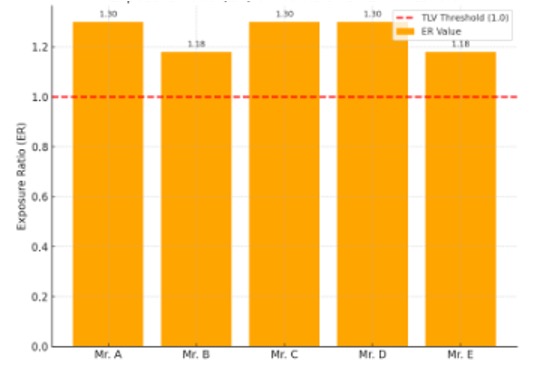
Repetitive manual handling tasks in industrial settings often expose workers to musculoskeletal risks, particularly when performed without ergonomic consideration. At PT. ABC, production workers are routinely engaged in lifting and assembling heavy components, raising concerns about their long-term health and safety. To address this issue, a structured assessment using the ACGIH TLV for Hand Activity Level (HAL) was conducted to evaluate biomechanical exposure and identify ergonomic risks. This study contributes by applying a quantitative, evidence-based framework to assess real workplace conditions and offer actionable insights for intervention. It also demonstrates how HAL and Borg CR-10 metrics can be integrated into practical ergonomic evaluations in industrial environments. The research involved five workers from the concrete production division. Data were collected through direct observation and video analysis to determine hand movement frequency and peak force levels. The HAL values and Borg CR-10 scores were used to calculate the Exposure Ratio (ER) for each worker, serving as the main indicator of ergonomic risk. Results revealed that all five workers had ER values ranging from 1.18 to 1.30, exceeding the ACGIH TLV threshold of 1.0. This indicates a consistently high risk for work-related musculoskeletal disorders (WMSDs). Frequent lifting of 12–13 kg loads combined with moderate-to-high hand activity and poor posture contributed to elevated strain levels. These findings confirm that the existing work system places employees at risk and highlight the need for immediate ergonomic improvements. Moreover, the HAL-ER assessment framework used in this study provides structured data that can be utilized in simulation-based planning or optimization models. By integrating these metrics into ergonomic redesign scenarios such as task reallocation, force-load balancing, or layout planning future studies can enhance both worker safety and operational efficiency.
References
P. Dutta, Understanding Work-Related Musculoskeletal Disorders: A comprehensive guide to tackle Work-Related Musculoskeletal Issues for professionals. Blue Rose Publishers, 2024.
T. A. E. Prasetya, N. I. A. Samad, A. Rahmania, D. A. Arifah, R. A. A. Rahma, and A. Al Mamun, “Workstation Risk Factors for Work-related Musculoskeletal Disorders Among IT Professionals in Indonesia,” J. Prev. Med. Public Heal., vol. 57, no. 5, p. 451, 2024. https://doi.org/10.3961/jpmph.24.214
S. Winiarski, D. Molek-Winiarska, and B. Chomątowska, “From Motion to Prevention: Evaluating Ergonomic Risks of Asymmetrical Movements and Worker Well-Being in an Assembly Line Work,” Applied Sciences, vol. 15, no. 2. 2025, doi: 10.3390/app15020560.
D. Colombini and E. Occhipinti, “Preventing upper limb work-related musculoskeletal disorders (UL-WMSDS): New approaches in job (re)design and current trends in standardization,” Appl. Ergon., vol. 37, no. 4, pp. 441–450, 2006, doi: https://doi.org/10.1016/j.apergo.2006.04.008.
M. Deonarain, “The quality of work life of frontline healthcare workers that affect service delivery at selected hospitals in South Africa.” Cape Peninsula University of Technology, 2024. https://doi.org/10.13140/RG.2.2.17155.82728
F. Mumali and J. Kałkowska, “Intelligent support in manufacturing process selection based on artificial neural networks, fuzzy logic, and genetic algorithms: Current state and future perspectives,” Comput. Ind. Eng., vol. 193, p. 110272, 2024, doi: https://doi.org/10.1016/j.cie.2024.110272.
X. Xu, Y. Lu, B. Vogel-Heuser, and L. Wang, “Industry 4.0 and Industry 5.0—Inception, conception and perception,” J. Manuf. Syst., vol. 61, pp. 530–535, 2021. https://doi.org/10.1016/j.jmsy.2021.10.006
V. Azamfirei, F. Psarommatis, A. Granlund, and Y. Lagrosen, “Towards Zero-Defect Manufacturing: a review on measurement-assisted processes and their technologies,” Procedia Comput. Sci., vol. 232, pp. 1001–1010, 2024, doi: https://doi.org/10.1016/j.procs.2024.01.099.
G. Sansone, M. Anselmi, A. Simeone, P. C. Priarone, and L. Settineri, “Impact of operator health and safety on manufacturing process risk management,” Procedia CIRP, vol. 126, pp. 915–920, 2024, doi: https://doi.org/10.1016/j.procir.2024.08.350.
M. Lopes, “Exploring the Efficacy of a Set of Smart Devices for Postural Awareness for Workers in an Industrial Context: Protocol for a Single-Subject Experimental Design,” JMIR Res. Protoc., vol. 12, 2023, doi: https://doi.org/10.2196/43637.
Z. Arkouli, G. Michalos, G. Kokotinis, and S. Makris, “Worker-centered evaluation and redesign of manufacturing tasks for ergonomics improvement using axiomatic design principles,” CIRP J. Manuf. Sci. Technol., vol. 55, pp. 188–209, 2024, doi: https://doi.org/10.1016/j.cirpj.2024.10.001.
A. Ibrahim and C. Nnaji, “Framework for Quantifying the Impact of Exoskeleton on Musculoskeletal Disorder Risk Reduction.,” J. Eng. Proj. Prod. Manag., vol. 14, no. 2, 2024. https://doi.org/10.1016/j.robot.2024.104743
C. T. J. Hulshof, “The effect of occupational exposure to ergonomic risk factors on osteoarthritis of hip or knee and selected other musculoskeletal diseases: A systematic review and meta-analysis from the WHO/ILO Joint Estimates of the Work-related Burden of Disease and In,” Environ. Int., vol. 150, p. 106349, 2021, doi: https://doi.org/10.1016/j.envint.2020.106349.
A. Abobakr, “RGB-D ergonomic assessment system of adopted working postures,” Appl. Ergon., vol. 80, no. April 2018, pp. 75–88, 2019, doi: 10.1016/j.apergo.2019.05.004.
A. H. Hilmi, A. R. A. Hamid, and W. A. R. A. W. Ibrahim, “Human-Centered Ergonomics: Advancements, Challenges, and Future Directions in Industrial and Occupational Settings,” Malaysian J. Ergon., vol. 6, pp. 90–104, 2024. https://doi.org/10.58915/mjer.v6.2024.1311
U. Adiga, “Enhancing occupational health and ergonomics for optimal workplace well-being: a review,” Int. J. Chem. Biochem. Sci., vol. 24, no. 4, pp. 157–164, 2023. https://www.iscientific.org/wp-content/uploads/2023/10/17-ijcbs-23-24-4-17-done.pdf
E. Garosi, F. Sheikh, and M. Goodarzi, “Ergonomic Interventions in Risk Reduction,” 2025. 10.5772/intechopen.1008463.
K. Shahabadkar, “Embodied Posture Analysis for Industry Operator Safety Enhancements.” Swinburne, 2024. https://doi.org/10.25916/sut.26297641
N. Carlan, “Occupational Health Research in Workplaces Transitioning from Modernity to Post-Modernity.” University of Waterloo, 2024. http://hdl.handle.net/10012/20437
N. S. Ünlü, H. R. Çavdar, A. Aydoğdu, and A. Kılıç, “Ergonomic Improvements In Service And Manufacturing Sectors,” Uygulamalı Mühendislik ve Tarım Derg., vol. 1, no. 2, pp. 21–36, 2024. https://dergipark.org.tr/en/pub/umtd/article/1597403
S. Arab, “Quantitative and Qualitative Data Analytics in Ergonomics: Case Studies in Forest and Technology Industries.” Polytechnique Montréal, 2023. https://publications.polymtl.ca/54853/1/2023_SaharArab.pdf
G. Hodosi, E. Sule, and T. Bodis, “Multi-criteria decision making: A comparative analysis,” in Economic and Social Development (Book of Proceedings), 103rd International Scientific Conference on Economic and Social Development, 2023, p. 81.
S. Elkady, S. Mehryar, J. Hernantes, and L. Labaka, “Prioritizing stakeholder interactions in disaster management: A TOPSIS-based decision support tool for enhancing community resilience,” Prog. Disaster Sci., vol. 22, p. 100320, 2024. https://doi.org/10.1016/j.pdisas.2024.100320
A. Krishnan, “Data-driven ergonomic risk assessment of complex hand-intensive manufacturing processes,” Commun. Eng., vol. 4, no. 1, p. 45, 2025. https://doi.org/10.1038/s44172-025-00382-w
D. H. Seidel, “Assessment of work-related hand and elbow workloads using measurement-based TLV for HAL,” Appl. Ergon., vol. 92, p. 103310, 2021, doi: https://doi.org/10.1016/j.apergo.2020.103310.
D. Rempel, “Recent changes to the ACGIH hand activity level TLV.” BMJ Publishing Group Ltd, 2018. https://doi.org/10.1136/oemed-2018-ICOHabstracts.739
M. Yung, “Modeling the effect of the 2018 revised ACGIH® hand activity threshold limit value®(TLV) at reducing risk for carpal tunnel syndrome,” J. Occup. Environ. Hyg., vol. 16, no. 9, pp. 628–633, 2019. https://doi.org/10.1080/15459624.2019.1640366
C. Dahlqvist, I. Arvidsson, L. Löfqvist, and J. Gremark Simonsen, “Consistency between the ACGIH TLV for hand activity and proposed action levels for wrist velocity and forearm muscular load based on objective measurements: an example from the assembly industry,” Int. J. Occup. Saf. Ergon., vol. 30, no. 3, pp. 927–935, 2024. https://doi.org/10.1080/10803548.2024.2367367
R. Bonfiglioli, “Validation of the ACGIH TLV for hand activity level in the OCTOPUS cohort: a two-year longitudinal study of carpal tunnel syndrome,” Scand. J. Work. Environ. Health, pp. 155–163, 2013. https://doi.org/10.5271/sjweh.3312
R. F. A. de Carvalho and M. A. Marçal, “Ergonomic evaluation of assembly line work activity in the automotive industry: a case study,” Explor. Musculoskelet. Dis., vol. 2, no. 5, pp. 336–352, 2024. https://doi.org/10.37349/emd.2024.00060
K. H. Dunn, M. P. Grant, and J. L. Rinsky, “Evaluation of Ergonomic Risks, Musculoskeletal Disorders, and Peracetic Acid Exposure Among Employees at a Pork Processing Plant in Michigan,” 2024. https://doi.org/10.26616/NIOSHHHE202101173397
X. Jin, “Ergonomic interventions to improve musculoskeletal disorders among vehicle assembly workers: a one-year longitudinal study,” BMC Public Health, vol. 25, no. 1, p. 824, 2025. https://doi.org/10.1186/s12889-025-21798-1
J. A. Jackson, M. Sund, G. B. Lobos, L. Melin, and S. E. Mathiassen, “Assessing the efficacy of a job rotation for improving occupational physical and psychosocial work environment, musculoskeletal health, social equality, production quality and resilience at a commercial laundromat: protocol for a longitudinal case study,” BMJ Open, vol. 13, no. 5, p. e067633, 2023. https://doi.org/10.1136/bmjopen-2022-067633
J. M. Weimer, “A new approach for the implementation of ergonomics in sonography to prevent work-related musculoskeletal disorders (ErgoSon),” J. Occup. Med. Toxicol., vol. 20, no. 1, p. 11, 2025. https://doi.org/10.1186/s12995-025-00457-6
P. Amanzadeh, F. Dekamini, R. Birau, and R. Pourmansouri, “Investigating basics and principles of ergonomics in the sheet,” Multidiscip. Sci. J., vol. 7, no. 2, p. 2025081, 2025. https://doi.org/10.31893/multiscience.2025081
G. Borg, “Psychophysical scaling with applications in physical work and the perception of exertion,” Scand. J. Work. Environ. Health, pp. 55–58, 1990. https://doi.org/10.5271/sjweh.1815
A. Nambiema, “Proportion of upper extremity musculoskeletal disorders attributable to personal and occupational factors: results from the French Pays de la Loire study,” BMC Public Health, vol. 20, no. 1, p. 456, 2020. https://doi.org/10.1186/s12889-020-08548-1
M. Correa, M. Projetti, I. A. Siegler, and N. Vignais, “Reliability and sensitivity of MMG and EMG signals during isometric contractions of upper limb muscles,” Comput. Methods Biomech. Biomed. Engin., vol. 25, pp. S76–S77, 2022. https://dx.doi.org/10.1080/10255842.2022.2116885
I. Pratiwi, V. Brillyanto, M. A. Ratnanto Fitriadi, and M. N. Abdol, “Postural evaluation and hand activity level at batik cap process using LUBA and ACGIH HAL methods,” Int J Late Technol Eng, vol. 8, no. 3, pp. 2552–2560, 2019. https://doi.org/10.35940/ijrte.C4765.098319
W. N. W. Harun, S. A. C. Ghani, and M. S. M. Noh, “Evaluation of Work-Related Musculoskeletal Disorders (WMSDs) among Manual Assembly Workers in the Medical Device Manufacturing Industry,” in Journal of Physics: Conference Series, 2025, vol. 2933, no. 1, p. 12023. doi: 10.1088/1742-6596/2933/1/012023
Downloads
Published
How to Cite
Issue
Section
License
Copyright (c) 2026 Silvi Widodo, Lolyka Dewi Indrasari

This work is licensed under a Creative Commons Attribution-ShareAlike 4.0 International License.
License and Copyright Agreement
In submitting the manuscript to the journal, the authors certify that:
- They are authorized by their co-authors to enter into these arrangements.
- The work described has not been formally published before, except in the form of an abstract or as part of a published lecture, review, thesis, or overlay journal. Please also carefully read the International Journal of Industrial Optimization (IJIO) Author Guidelines at http://journal2.uad.ac.id/index.php/ijio/about/submissions#onlineSubmissions
- That it is not under consideration for publication elsewhere,
- That its publication has been approved by all the author(s) and by the responsible authorities tacitly or explicitly of the institutes where the work has been carried out.
- They secure the right to reproduce any material that has already been published or copyrighted elsewhere.
- They agree to the following license and copyright agreement.
Copyright
Authors who publish with the International Journal of Industrial Optimization (IJIO) agree to the following terms:
- Authors retain copyright and grant the journal right of first publication with the work simultaneously licensed under a Creative Commons Attribution License (CC BY-SA 4.0) that allows others to share the work with an acknowledgment of the work's authorship and initial publication in this journal.
- Authors are able to enter into separate, additional contractual arrangements for the non-exclusive distribution of the journal's published version of the work (e.g., post it to an institutional repository or publish it in a book), with an acknowledgment of its initial publication in this journal.
- Authors are permitted and encouraged to post their work online (e.g., in institutional repositories or on their website) prior to and during the submission process, as it can lead to productive exchanges, as well as earlier and greater citation of published work.

1.png)