Portofolio optimization with cardinality and minimum return constraints on the LQ45 index using genetic algorithm
DOI:
https://doi.org/10.12928/ijio.v7i2.13238Keywords:
Portofolio, Genetic Algorithm, Minimum return, Cardinality, LG45Abstract
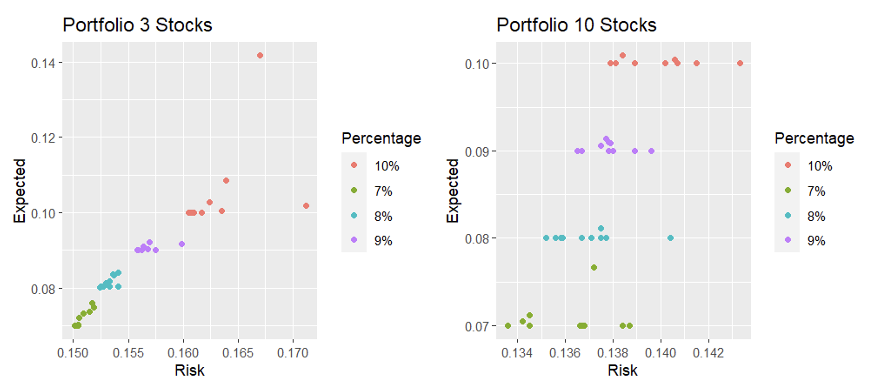
Traditional mean-variance portfolio optimization often faces limitation in accommodating practical investment constraints, particularly in restricting the number of selected assets while ensuring a minimum expected return. To address these limitations, this study proposes a Genetic Algorithm (GA)-based portfolio optimization framework that simultaneously incorporates cardinality and minimum return constraints for constructing efficient portfolios. The main contribution of this study is the integration of these practical investment constraints into a GA framework to improve portfolio optimization under realistic investment scenarios using LQ45 stocks. Historical daily stock price data of LQ45 constituents were collected from Yahoo Finance and used to estimate portfolio returns, portfolio risk (standard deviation), and Sharpe ratios. The optimization process minimizes portfolio risk while enforcing cardinality and minimum return constraints through penalty function. Experimental results show that the proposed framework successfully generated efficient portfolios under various parameter settings. The best portfolio was obtained using a cardinality constraint of three stocks and a minimum return target of 10%. This portfolio achieved a return of 14.17%, a risk (standard deviation) of 0.1670, and a Sharpe ratio of 0.4867. In comparation, the equal-weighted LQ45 portfolio produces a return of -16.64% with a Sharpe ratio of -1.2710, indicating substantially lower investment performance. These findings demonstrate that the proposed GA-based framework provides an effective and practical portfolio optimization strategy under realistic investment constraints while highlighting the potential of evolutionary optimization methods for improving risk-adjusted portfolio performance in dynamic market environments.
References
B. T. Endaryono and T. Djuhartono, “Faktor Faktor yang Menentukan Tingkat Investasi dalam Pertumbuhan Ekonomi,” JABE (Journal Appl. Bus. Econ., vol. 10, no. 4, p. 399, Jun. 2024, doi: 10.30998/jabe.v10i4.22456.
E. S. Nurfitri Imro’ah, Eka Lestari, “Penentuan Portofolio Saham Optimal Menggunakan Algoritma Genetika,” Bimaster Bul. Ilm. Mat. Stat. dan Ter., vol. 8, no. 2, Apr. 2019, doi: 10.26418/bbimst.v8i2.31534.
M. R. Nisardi, H. Husain, K. Kusnaeni, and A. Resky, “Penentuan Portofolio Saham Optimal Menggunakan Metode Markowitz sebagai dasar Keputusan Investasi,” Sq. J. Math. Math. Educ., vol. 6, no. 1, pp. 33–40, Apr. 2024, doi: 10.21580/square.2024.6.1.20441.
C. R. Kurniawati, “Pengaruh current ratio, total asset turnover, dan debt to equity ratio terhadap return on asset,” J. Cendekia Keuang., vol. 1, no. 2, p. 101, Oct. 2022, doi: 10.32503/jck.v1i2.2832.
V. P. Balqis, S. Subiyanto, and S. Supian, “Optimizing stock portfolio with Markowitz method as a reference for investment community decisions,” International Journal of Research in Community Services. 2021. doi: 10.46336/ijrcs.v2i2.213.
K. Febriani, T. Tarno, and D. Fakhriyana, “Penentuan Value At Risk (Var) pada Portofolio Bivariat dengan Pendekatan Copula Gumbel,” J. Gaussian, vol. 13, no. 1, pp. 79–87, Sep. 2024, doi: 10.14710/j.gauss.13.1.79-87.
F. J. Fabozzi, H. M. Markowitz, and F. Gupta, “Portfolio Selection,” in Handbook of Finance, Wiley, 2008.
P. B. Agrawal and D. Anuradha Samal, “Mapping portfolio optimisation: a systematic and bibliometric review,” Glob. J. Math. Anal., vol. 11, no. 1, pp. 1–10, Oct. 2024, doi: 10.14419/nfmybb32.
M. A. Akbay, C. B. Kalayci, and O. Polat, “A parallel variable neighborhood search algorithm with quadratic programming for cardinality constrained portfolio optimization,” Knowledge-Based Syst., vol. 198, p. 105944, Jun. 2020, doi: 10.1016/j.knosys.2020.105944.
D. C. Fransisca, Sukono, D. Chaerani, and N. A. Halim, “Robust Portfolio Mean-Variance Optimization for Capital Allocation in Stock Investment Using the Genetic Algorithm: A Systematic Literature Review,” Computation, vol. 12, no. 8, p. 166, Aug. 2024, doi: 10.3390/computation12080166.
F. Aziz, Y. Yanto, and E. Herdit Juningsih, “Rancang Bangun Sistem Penunjang Keputusan Penentuan Beasiswa Menggunakan Metode Fuzzy Tsukamoto dengan Optimasi Genetic Algorithm,” JATI (Jurnal Mhs. Tek. Inform., vol. 8, no. 1, pp. 709–715, Feb. 2024, doi: 10.36040/jati.v8i1.9338.
J. H. Holland, Adaptation in Natural and Artificial Systems. The MIT Press, 1992.
E. P. Setiawan, “Comparing bio-inspired heuristic algorithm for the mean-CVaR portfolio optimization,” J. Phys. Conf. Ser., vol. 1581, no. 1, p. 012014, Jul. 2020, doi: 10.1088/1742-6596/1581/1/012014.
D. Rosadi, E. P. Setiawan, M. Templ, and P. Filzmoser, “Robust covariance estimators for mean-variance portfolio optimization with transaction lots,” Oper. Res. Perspect., vol. 7, p. 100154, 2020, doi: 10.1016/j.orp.2020.100154.
R. Syahla, D. Susanti, and H. Napitupulu, “Optimization of Investment Portfolio Mean-Variance Model Using Genetic Algorithm,” Int. J. Business, Econ. Soc. Dev., vol. 5, no. 2, pp. 227–234, May 2024, doi: 10.46336/ijbesd.v5i2.654.
A. Guarino, D. Santoro, L. Grilli, R. Zaccagnino, and M. Balbi, “EvoFolio: a portfolio optimization method based on multi-objective evolutionary algorithms,” Neural Comput. Appl., vol. 36, no. 13, pp. 7221–7243, May 2024, doi: 10.1007/s00521-024-09456-w.
R. Khodier, A. Radi, B. Ayman, and M. Gheith, “An adapted black widow optimization algorithm for financial portfolio optimization problem with cardinalty and budget constraints,” Scientific Reports. 2024, doi: 10.1038/s41598-024-71193-w.
W. Xu, J. Tang, K. F. C. Yiu, and J. W. Peng, “An Efficient Global Optimal Method for Cardinality Constrained Portfolio Optimization,” INFORMS J. Comput., vol. 36, no. 2, pp. 690–704, Mar. 2024, doi: 10.1287/ijoc.2022.0344.
H. P. Ramos, M. B. Righi, P. C. Guedes, and F. M. Müller, “A comparison of risk measures for portfolio optimization with cardinality constraints,” Expert Syst. Appl., vol. 228, p. 120412, Oct. 2023, doi: 10.1016/j.eswa.2023.120412.
S. Millán-Palacios and J. Sánchez-Soriano, “Investment Portfolios Optimization with Genetic Algorithm: An Approach Applied to the Spanish Market (IBEX 35),” Electronics, vol. 14, no. 13, p. 2559, Jun. 2025, doi: 10.3390/electronics14132559.
T. Salsabila, D. Saepudin, and A. A. Rohmawati, “Optimizing LQ45 Stock Portfolio To Maximize Sharpe Ratio Value Using LSTM,” J. Comput. Syst. Informatics, vol. 4, no. 2, pp. 339–347, Feb. 2023, doi: 10.47065/josyc.v4i2.3065.
M. Kaucic, F. Piccotto, and G. Sbaiz, “A constrained swarm optimization algorithm for large-scale long-run investments using Sharpe ratio-based performance measures,” Comput. Manag. Sci., vol. 21, no. 1, p. 6, Jun. 2024, doi: 10.1007/s10287-023-00483-x.
I. Yaman and T. Erbay Dalkılıç, “A hybrid approach to cardinality constraint portfolio selection problem based on nonlinear neural network and genetic algorithm,” Expert Syst. Appl., vol. 169, p. 114517, May 2021, doi: 10.1016/j.eswa.2020.114517.
L. Fu, J. Li, and S. Pu, “A comparative study of heuristic methods for cardinality constrained portfolio optimization,” High-Confidence Comput., vol. 3, no. 1, p. 100097, Mar. 2023, doi: 10.1016/j.hcc.2022.100097.
S. Q. Azizah, L. A. Talalu, and M. H. Ziaulhaq, “Optimasi Portofolio Saham BUMN20 Menggunakan Particle Swarm Optimization dan Genetic Algorithm dengan Pendekatan Maximizing Sharpe Ratio,” J. Literasi Akunt., 2026, doi: 10.55587/jla.v6i2.290.
F. M. Alam, K. R. McNaught, and T. J. Ringrose, “A comparison of experimental designs in the development of a neural network simulation metamodel,” Simul. Model. Pract. Theory, vol. 12, no. 7–8, pp. 559–578, Nov. 2004, doi: 10.1016/j.simpat.2003.10.006.
N. A. S. Abdullah and S. Razali, “Optimal Parameter Value of Genetic Algorithms for Different Size Instances in Solving Traveling Salesman Problem,” Enhanc. Knowl. in Sciences and Technology, 2024, [Online]. Available: https://penerbit.uthm.edu.my/periodicals/index.php/ekst/article/view/14167.
L. Manzoni, L. Mariot, and E. Tuba, “Balanced crossover operators in Genetic Algorithms,” Swarm Evol. Comput., vol. 54, p. 100646, May 2020, doi: 10.1016/j.swevo.2020.100646.
Q. Pan, C. Si, and L. Wang, “A stage-based adaptive penalty method for constrained evolutionary optimization,” Expert Syst. Appl., vol. 269, p. 126351, Apr. 2025, doi: 10.1016/j.eswa.2024.126351.
T.-F. Ilade and E. Croitoru, “A Comparative Analysis of Genetic Algorithms and NSGA-II on the Portfolio Optimisation Problem,” in 2024 26th International Symposium on Symbolic and Numeric Algorithms for Scientific Computing (SYNASC), Sep. 2024, pp. 191–198, doi: 10.1109/SYNASC65383.2024.00041.
P. Waluyo, “Algoritma genetika: Teori dan aplikasinya untuk bisnis dan industri.” 2018.
Y. Arkeman, K. B. Seminar, and H. Gunawan, “Algoritma genetika teori dan aplikasinya untuk bisnis dan industri.” agris.fao.org, 2012, [Online]. Available: https://agris.fao.org/search/en/providers/122323/records/64e8b7b6f8d9ea1acc271fe1.
R. Chaudhary, P. Verma, R. Salgotra, and A. H. Gandomi, “Five decades of genetic algorithms: A systematic and bibliometric review (1975–2025),” Archives of Computational Methods in Engineering. 2026, doi: 10.1007/s11831-025-10487-2.
A. Pătrăușanu, A. Florea, M. Neghină, A. Dicoiu, and R. Chiș, “A Systematic Review of Multi-Objective Evolutionary Algorithms Optimization Frameworks,” Processes, vol. 12, no. 5, p. 869, Apr. 2024, doi: 10.3390/pr12050869.
I. Saba, L. M. Andrade, and L. A. Viana, “Análise de Desempenho do Algoritmo Genético e Enxame de Partículas Aplicados Individualmente ao Problema de Otimização de Portfólio,” 2024, doi: 10.59254/sbpo-2024-193451.
S. de Amaral and L. Parrondo, “Sustainability and Genetic Algorithms: An Approach to Asset Portfolio Optimization,” Rev. Bus. Manag., vol. 27, no. 2, pp. 1–22, 2025, doi: 10.7819/rbgn.v27i02.4295.
Y. Sun, C. Shambare, and O. Imoru, “OFDM Network Optimization Using a QPSK Based on a Wind-Driven Genetic Algorithm,” Sensors, vol. 22, no. 16, p. 6174, Aug. 2022, doi: 10.3390/s22166174.
F. A. Zainuddin, M. F. A. Samad, “A review of crossover methods and problem representation of genetic algorithm in recent engineering applications,” International Journal of Advanced Science and Technology. 2020.
J. Tu and G. Zhou, “Markowitz meets Talmud: A combination of sophisticated and naive diversification strategies,” J. financ. econ., vol. 99, no. 1, pp. 204–215, Jan. 2011, doi: 10.1016/j.jfineco.2010.08.013.
E. P. Setiawan and D. Rosadi, “Model Pengoptimuman Portofolio Mean-Variance dan Perkembangan Praktisnya,” J. Optimasi Sist. Ind., vol. 18, no. 1, pp. 8–16, May 2019, doi: https://doi.org/10.25077/josi.v18.n1.p8-16.2019.
I. S. N. Handayani, “Analisis Value At Risk (VaR) Portofolio dengan Metode Variance-Covariance, Historical Simulation dan Monte Carlo.” 2025, doi: 10.13140/RG.2.2.11166.86089.
M. Gelmini and P. Uberti, “The equally weighted portfolio still remains a challenging benchmark,” International Economics. 2024, doi: 10.1016/j.inteco.2024.100525.
S. Bullah and T. L. van Zyl, “A learnheuristic approach to a constrained multi-objective portfolio optimisation problem,” Proc. 2023 7th Int. Conference on Intelligent Systems, Metaheuristics & Swarm Intelligence, 2023, doi: 10.1145/3596947.3596965.
Downloads
Published
How to Cite
Issue
Section
License
Copyright (c) 2026 Firsta Grandicha Tirafany, Ezra Putranda Setiawan

This work is licensed under a Creative Commons Attribution-ShareAlike 4.0 International License.
License and Copyright Agreement
In submitting the manuscript to the journal, the authors certify that:
- They are authorized by their co-authors to enter into these arrangements.
- The work described has not been formally published before, except in the form of an abstract or as part of a published lecture, review, thesis, or overlay journal. Please also carefully read the International Journal of Industrial Optimization (IJIO) Author Guidelines at http://journal2.uad.ac.id/index.php/ijio/about/submissions#onlineSubmissions
- That it is not under consideration for publication elsewhere,
- That its publication has been approved by all the author(s) and by the responsible authorities tacitly or explicitly of the institutes where the work has been carried out.
- They secure the right to reproduce any material that has already been published or copyrighted elsewhere.
- They agree to the following license and copyright agreement.
Copyright
Authors who publish with the International Journal of Industrial Optimization (IJIO) agree to the following terms:
- Authors retain copyright and grant the journal right of first publication with the work simultaneously licensed under a Creative Commons Attribution License (CC BY-SA 4.0) that allows others to share the work with an acknowledgment of the work's authorship and initial publication in this journal.
- Authors are able to enter into separate, additional contractual arrangements for the non-exclusive distribution of the journal's published version of the work (e.g., post it to an institutional repository or publish it in a book), with an acknowledgment of its initial publication in this journal.
- Authors are permitted and encouraged to post their work online (e.g., in institutional repositories or on their website) prior to and during the submission process, as it can lead to productive exchanges, as well as earlier and greater citation of published work.

1.png)