Smart door lock design and development using the pahl and beitz approach
DOI:
https://doi.org/10.12928/ijio.v6i2.12892Keywords:
Smart Door Lock, IoT, RFID, Security System, Product DevelopmentAbstract
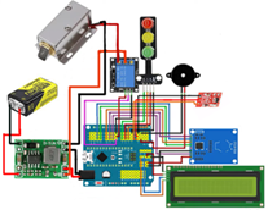
Security vulnerabilities in conventional locks and existing smart locks necessitate innovative solutions that integrate robust authentication mechanisms. This study addresses the research gap by developing a smart door lock system that uniquely combines Indonesia's government-issued e-KTP (embedded with an RFID chip) and a capacitive touch sensor for multi-factor authentication, enhancing security while ensuring universal accessibility. The design process employs the Pahl and Beitz systematic engineering methodology, emphasizing iterative optimization through planning, conceptual design, embodiment design, and detail design phases. Key specifications, including e-KTP compatibility, cost-effectiveness <IDR 1 million, and energy efficiency, were prioritized. Prototype evaluations revealed that the final design achieved superior functionality, scoring 87/100 in a multi-criteria assessment. The assessment considered components, space, aesthetics, cost, and manufacturability. The system integrates an Arduino Nano Microcontroller, a 9V battery with a 17-day lifespan, and IoT connectivity for real-time feedback. Comparative analysis demonstrates a 40–60% cost reduction compared to commercial alternatives, alongside tamper-resistant advantages from e-KTP integration system, modularity potential, and rechargeable battery. This study underscores the viability of leveraging national ID systems in IoT security frameworks, offering policymakers and manufacturers actionable insights for scalable, standardized smart home solutions.
References
Y. Motwani, S. Seth, D. Dixit, A. Bagubali, and R. Rajesh, “Multifactor door locking systems: A review,” Mater. Today Proc., vol. 46, pp. 7973–7979, Jan. 2021, doi: 10.1016/j.matpr.2021.02.708.
A. A. Zainuddin et al., “Innovative IoT Smart Lock System: Enhancing Security with Fingerprint and RFID Technology,” Malaysian J. Sci. Adv. Technol., vol. 4, no. 4, pp. 360–365, Aug. 2024, doi: 10.56532/mjsat.v4i4.335.
R. Ismail, H. C. Yee, K. Terh Jing, and M. W. M. Shafiei, “Preferences of Security Criteria in Low-Cost Housings among Malaysian Residents,” Int. J. Adv. Sci. Eng. Inf. Technol., vol. 13, no. 3, pp. 1170–1176, May 2023, doi: 10.18517/ijaseit.13.3.16956.
O. Taiwo, A. E. Ezugwu, O. N. Oyelade, and M. S. Almutairi, “Enhanced Intelligent Smart Home Control and Security System Based on Deep Learning Model,” Wirel. Commun. Mob. Comput., vol. 2022, no. 1, pp. 1–22, Jan. 2022, doi: 10.1155/2022/9307961.
S. Kaya, E. Aşkar Ayyildiz, And M. Ayyildiz, “Smart Door Lock Design With Internet Of Things,” Int. J. 3D Print. Technol. Digit. Ind., vol. 6, no. 2, pp. 201–206, Aug. 2022, doi: 10.46519/ij3dptdi.1074468.
H. Gadupu, O. Mokharji, R. Kankaria, S. Kumar, and K. Jayavel, “ACCESS - IoT enabled smart lock,” Int. J. Reconfigurable Embed. Syst., vol. 10, no. 3, p. 176, Nov. 2021, doi: 10.11591/ijres.v10.i3.pp176-185.
M. I. Ahmed and G. Kannan, “Cloud-Based Remote RFID Authentication for Security of Smart Internet of Things Applications,” J. Inf. Knowl. Manag., vol. 20, no. Supp01, p. 2140004, Feb. 2021, doi: 10.1142/S0219649221400049.
Ö. Aslan, S. S. Aktuğ, M. Ozkan-Okay, A. A. Yilmaz, and E. Akin, “A Comprehensive Review of Cyber Security Vulnerabilities, Threats, Attacks, and Solutions,” Electronics, vol. 12, no. 6, p. 1333, Mar. 2023, doi: 10.3390/electronics12061333.
M. I. Tawakal and Y. Ramdhani, “Smart Lock Door Using E-KTP Access Based on the Internet of Things,” J. Responsif Ris. Sains dan Inform., vol. 3, no. 1, pp. 83–91, Mar. 2021, doi: 10.51977/jti.v3i1.417.
D. Salim, D. N. Salim, N. A. Pujisusilo, and S. P. Manik, “Smart Door Lock Security System Using E-KTP (Electronic Resident Identity Card) Based on Internet of Things (IoT),” Go Infotech J. Ilm. STMIK AUB, vol. 27, no. 2, p. HAL. 196-206, Dec. 2021, doi: 10.36309/goi.v27i2.157.
A. A. Najib, R. Munadi, and N. B. Aditya Karna, “Security system with RFID control using E-KTP and internet of things,” Bull. Electr. Eng. Informatics, vol. 10, no. 3, pp. 1436–1445, Jun. 2021, doi: 10.11591/eei.v10i3.2834.
J. W. Simatupang and R. W. Tambunan, “Security Door Lock Using Multi-Sensor System Based on RFID, Fingerprint, and Keypad,” in 2022 International Conference on Green Energy, Computing and Sustainable Technology (GECOST), Oct. 2022, pp. 453–457, doi: 10.1109/GECOST55694.2022.10010367.
S. Ganesan, B. Esakki, S. Mathiyazhagan, and V. Pandimuthu, “Design Conception And Evaluation Of An Unmanned Amphibious Aerial Vehicle Using Systematic Approach,” Aviation, vol. 26, no. 1, pp. 41–53, Mar. 2022, doi: 10.3846/aviation.2022.16519.
O. O. Trilian and R. B. Jakaria, “Designing a Lecture Chair Product Using the Pahl and Beitz Method,” Innov. Technol. Methodical Res. J., vol. 3, no. 2, pp. 9–9, Feb. 2024, doi: 10.47134/innovative.v3i2.101.
N. AY and M. Bozdemir, “Conceptual Design Process of a Missile Model and Production Using Additive Manufacturing Method,” Def. Sci. J., vol. 74, no. 5, pp. 734–742, Sep. 2024, doi: 10.14429/dsj.74.19512.
B. Darmanin, A. Bonello, and E. Francalanza, “A Systematic Design Approach for Cognitively Ergonomic Collaborative Robotic Workspaces,” Procedia CIRP, vol. 130, pp. 853–860, Jan. 2024, doi: 10.1016/j.procir.2024.10.175.
F. Koppenhagen, T. Blümel, T. Held, C. H. Wecht, and P. D. Kollmer, “Hybrid development of physical products based on systems engineering and design thinking: towards a new process model,” J. Des. Res., vol. 21, no. 3/4, pp. 210–261, 2024, doi: 10.1504/JDR.2024.143686.
H. I. Unria, M. I. Hamdy, M. Yola, T. Nurainun, and A. Anwardi, “Design of a Corn Thresher and Corn Cob Chopper Using the Pahl & Beitz Method,” Semesta Tek., vol. 27, no. 2, pp. 203–212, Nov. 2024, doi: 10.18196/st.v27i2.23322.
M. Shehata, “Designing Smart Products in The Light of Design Thinking and The Systematic Design Approach,” J. Des. Sci. Appl. Arts, vol. 5, no. 1, pp. 310–320, Jan. 2024, doi: 10.21608/jdsaa.2023.221509.1312.
J. Rekayasa Material, M. dan Energi, R. Novianty Pasaribu, N. Andri Silviana, N. Siregar, and P. Utama, “Brick Mold Design Using the Pahl and Beitz Method,” J. Rekayasa Mater. Manufaktur dan Energi, vol. 8, no. 1, pp. 01–05, Feb. 2025. [Online]. Available at: https://jurnal.umsu.ac.id/index.php/RMME/article/view/17866.
B. Triyono, R. Putranto, and D. E. Septiyani Arifin, “Conceptualization of Soft Capsule Shell Material Preparation Tool Using the Pahl and Beitz Method,” Manutech J. Teknol. Manufaktur, vol. 16, no. 01, pp. 1–8, Aug. 2024, doi: 10.33504/manutech.v16i01.294.
A. K. Agbonkhese, “Application Of Solidworks Simulation To Improve Mechanical Design Skills Of Mechanical Engineering Students In The National Institute Of Construction Technology And Management, Edo State, Nigeria,” Int. J. Funct. Res. Sci. Eng., vol. 3, no. 1, pp. 72–79, Apr. 2024. [Online]. Available at: https://www.journalfrse.com/journal/article/view/18.
R. Abdallah et al., “The use of SolidWorks in the evaluation of wind turbines in Palestine,” Energy Nexus, vol. 7, p. 100135, Sep. 2022, doi: 10.1016/j.nexus.2022.100135.
K. Vardaan and P. Kumar, “Design, analysis, and optimization of thresher machine flywheel using Solidworks simulation,” Mater. Today Proc., vol. 56, pp. 3651–3655, Jan. 2022, doi: 10.1016/j.matpr.2021.12.348.
T. S. KERK and mohd azwir Azlan, “Design of A Vertical Conveyor System for Scrap Rubber in FGV Felda Rubber Industry,” Res. Prog. Mech. Manuf. Eng., vol. 2, no. 2, pp. 569–579, 2021. [Online]. Available at: https://publisher.uthm.edu.my/periodicals/index.php/rpmme/article/view/4114.
S. Mishra and A. V. Ullas, “Concept Modelling of Small Scale Device for Continuous Production of Graphene using Solidworks,” Mater. Today Proc., vol. 79, pp. 345–348, Jan. 2023, doi: 10.1016/j.matpr.2022.12.034.
Y. Lu et al., “Application of SolidWorks software in preoperative planning of high tibial osteotomy,” Front. Surg., vol. 9, p. 951820, Jan. 2023, doi: 10.3389/fsurg.2022.951820.
O. С. Мачуга and Т. В. Олянишен, “Using Solidworks Simulation tool for automated design of drying chambers and study of their operation parameters,” Sci. Bull. UNFU, vol. 34, no. 2, pp. 109–115, Mar. 2024, doi: 10.36930/40340214.
M. Q. Mehmood, M. S. Malik, M. H. Zulfiqar, M. A. Khan, M. Zubair, and Y. Massoud, “Invisible touch sensors-based smart and disposable door locking system for security applications,” Heliyon, vol. 9, no. 2, p. e13586, Feb. 2023, doi: 10.1016/j.heliyon.2023.e13586.
Yulisman, N. Iman, E. Sabna, and H. Fonda, “Automatic Door System Using Internet of Things (IoT) Based E-KTP in Hotel Rooms,” SATESI J. Sains Teknol. dan Sist. Inf., vol. 1, no. 2, pp. 85–91, Oct. 2021, doi: 10.54259/satesi.v1i2.60.
Azhari, R. R. Manullang, M. Yanti, C. D. Hasibuan, and E. Yudhistira, “Performance of Secure Door Access System Using Identification Numbers, Fingerprints, and Facial Recognition,” J. Phys. Conf. Ser., vol. 2733, no. 1, p. 012003, Mar. 2024, doi: 10.1088/1742-6596/2733/1/012003.
D. Ramadini and H. Hastuti, “Electronic Lock System for Boarding House Doors Using IoT Based on E-KTP,” MASALIQ, vol. 5, no. 1, pp. 160–174, Dec. 2024, doi: 10.58578/masaliq.v5i1.4475.
N. Hanafiah, C. P. Kariman, N. Fandino, E. Halim, F. Jingga, and W. Atmadja, “Digital Door-Lock using Authentication Code Based on ANN Encryption,” Procedia Comput. Sci., vol. 179, pp. 894–901, Jan. 2021, doi: 10.1016/j.procs.2021.01.079.
S. Mansfield-Devine, “Locking the door: tackling credential abuse,” Netw. Secur., vol. 2021, no. 3, pp. 11–19, Mar. 2021, doi: 10.1016/S1353-4858(21)00030-1.
S. A. Prity, J. Afrose, and M. M. Hasan, “RFID Based Smart Door Lock Security System,” Am. J. Sci. Eng. Res., vol. 4, no. 3, pp. 162–168, 2021, [Online]. Available at: https://iarjournals.com/upload/43162168.pdf.
M. Kumar A., I. Ahamath M., and Gowtham R., “Revolutionizing Home Security: A Comprehensive Overview of an Advanced RFID Door Lock System for Keyless Access and Smart Home Protection,” Asian J. Appl. Sci. Technol., vol. 08, no. 01, pp. 01–13, 2024, doi: 10.38177/ajast.2024.8101.
J. Guntur, S. S. Raju, T. Niranjan, S. K. Kilaru, R. Dronavalli, and N. S. S. Kumar, “IoT-Enhanced Smart Door Locking System with Security,” SN Comput. Sci., vol. 4, no. 2, p. 209, Feb. 2023, doi: 10.1007/s42979-022-01641-9.
H. Ahmad Taslim, N. A. Md Lazam, and N. A. Mohd Yahya, “Development of Smart Home Door Lock System,” in Advances in Intelligent Systems and Computing, vol. 1350 AISC, Springer, Cham, 2021, pp. 118–126, doi: 10.1007/978-3-030-70917-4_13.
G. B. A. Svaboe, K. Y. Bjerkan, and S. Meland, “Safe delivery of goods and services with smart door locks: Unlocking potential use,” Transp. Res. Interdiscip. Perspect., vol. 29, p. 101309, Jan. 2025, doi: 10.1016/j.trip.2024.101309.
V. P.Datar, A. Tankasali, and K. Chavan, “Smart Door Lock and Lighting System using Internet of Things,” IARJSET, vol. 8, no. 8, pp. 102–108, Aug. 2021, doi: 10.17148/IARJSET.2021.8820.
Downloads
Published
How to Cite
Issue
Section
License
Copyright (c) 2025 Rizky Reynaldy Brahmana, Mochamad Tutuk Safirin

This work is licensed under a Creative Commons Attribution-ShareAlike 4.0 International License.
License and Copyright Agreement
In submitting the manuscript to the journal, the authors certify that:
- They are authorized by their co-authors to enter into these arrangements.
- The work described has not been formally published before, except in the form of an abstract or as part of a published lecture, review, thesis, or overlay journal. Please also carefully read the International Journal of Industrial Optimization (IJIO) Author Guidelines at http://journal2.uad.ac.id/index.php/ijio/about/submissions#onlineSubmissions
- That it is not under consideration for publication elsewhere,
- That its publication has been approved by all the author(s) and by the responsible authorities tacitly or explicitly of the institutes where the work has been carried out.
- They secure the right to reproduce any material that has already been published or copyrighted elsewhere.
- They agree to the following license and copyright agreement.
Copyright
Authors who publish with the International Journal of Industrial Optimization (IJIO) agree to the following terms:
- Authors retain copyright and grant the journal right of first publication with the work simultaneously licensed under a Creative Commons Attribution License (CC BY-SA 4.0) that allows others to share the work with an acknowledgment of the work's authorship and initial publication in this journal.
- Authors are able to enter into separate, additional contractual arrangements for the non-exclusive distribution of the journal's published version of the work (e.g., post it to an institutional repository or publish it in a book), with an acknowledgment of its initial publication in this journal.
- Authors are permitted and encouraged to post their work online (e.g., in institutional repositories or on their website) prior to and during the submission process, as it can lead to productive exchanges, as well as earlier and greater citation of published work.

1.png)