Application of deep learning for predicting ignition delay in hydrogen combustion engines
DOI:
https://doi.org/10.12928/ijio.v6i2.12382Keywords:
Deep learning, Neural networks, Data mining, Ignition delay, CombustionAbstract
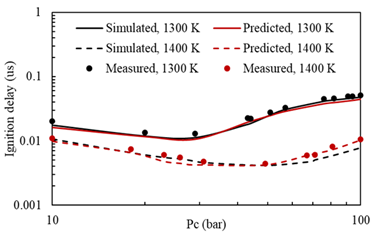
This study investigates the use of deep learning techniques to forecast ignition delays in hydrogen combustion systems, with a focus on optimizing hydrogen combustion processes in industrial applications such as stationary power generation and the automotive industry. The work utilizes experimental data from a rapid compression machine (RCM) and a shock tube. Two large datasets were created through 0-D simulations and experimental measurements, covering a wide range of conditions. The study involves the development of two artificial neural network (ANN) models, one for RCM and another for shock tube data, each with distinct architectures. The ANN models were trained, tested, and evaluated using thoughtfully divided datasets. The results demonstrate the effectiveness of the developed ANN models in predicting ignition delays with remarkable accuracy. Comparative analyses with 0-D simulations and experimental measurements reveal that the ANN models predict ignition delays "1000 times faster" than traditional simulation methods. This speed improvement is crucial for real-time industrial applications, allowing engineers to quickly optimize combustion parameters, adjust engine settings, and make operational decisions in a fraction of the time. The study highlights the potential of these ANN models to optimize hydrogen combustion processes, improving combustion efficiency, reducing operational costs, and enhancing resource utilization in industrial settings. This progress can play a significant role in optimizing hydrogen-powered internal combustion engines by increasing fuel efficiency, reducing emissions, and enhancing overall engine performance. In the automotive and power generation sectors, the quick predictive abilities of ANN models can support more effective energy production, decrease operational expenses, and lessen environmental harm.
References
M. Otto, K. L. Chagoya, R. G. Blair, S. M. Hick, and J. S. Kapat, “Optimal hydrogen carrier: Holistic evaluation of hydrogen storage and transportation concepts for power generation, aviation, and transportation,” J. Energy Storage, vol. 55, p. 105714, Nov. 2022, doi: 10.1016/j.est.2022.105714.
S. Wanniarachchi, K. Hewage, C. Wirasinghe, G. Chhipi-Shrestha, H. Karunathilake, and R. Sadiq, “Transforming road freight transportation from fossils to hydrogen: Opportunities and challenges,” Int. J. Sustain. Transp., vol. 17, no. 5, pp. 552–572, May 2023, doi: 10.1080/15568318.2022.2068389.
I. Maisaia, “Optionally Piloted Hypersonic Aerospace Vehicle With Inflight Hydrogen Generation Propulsion system,” in AIAA AVIATION 2023 Forum, Jun. 2023, p. 3234, doi: 10.2514/6.2023-3234.
P. Zoldak, J. Douvry-Rabjeau, and A. Zyada, “Potential of a Hydrogen Fueled Opposed-Piston Four Stroke (OP4S) Engine,” Apr. 2023, doi: 10.4271/2023-01-0408.
P. Zoldak, J. Douvry-Rabjeau, and J. Warren, “Development of a Gaseous Fueled Boosted Opposed-Piston Four Stroke (OP4S) Engine,” Gamma Technol. Tech. Conf., pp. 1–20, 2022, doi: 10.4271/2023-01-0408.
T. Peng et al., “Choice of hydrogen energy storage in salt caverns and horizontal cavern construction technology,” J. Energy Storage, vol. 60, p. 106489, Apr. 2023, doi: 10.1016/j.est.2022.106489.
M. Zghaibeh et al., “Optimization of green hydrogen production in hydroelectric-photovoltaic grid connected power station,” Int. J. Hydrogen Energy, vol. 52, pp. 440–453, Jan. 2024, doi: 10.1016/j.ijhydene.2023.06.020.
R. Sharma et al., “Optimizing green hydrogen production: Leveraging load profile simulation and renewable energy integration,” Int. J. Hydrogen Energy, vol. 48, no. 96, pp. 38015–38026, Dec. 2023, doi: 10.1016/j.ijhydene.2023.03.179.
M. A. Habib, G. A. Q. Abdulrahman, A. B. S. Alquaity, and N. A. A. Qasem, “Hydrogen combustion, production, and applications: A review,” Alexandria Eng. J., vol. 100, pp. 182–207, Aug. 2024, doi: 10.1016/j.aej.2024.05.030.
Y. Baranyshyn, V. Kuzmitski, O. Penyazkov, and K. Sevrouk, “Ignition Delay and Reaction Time Measurements of Hydrogen–Air Mixtures at High Temperatures,” Fire, vol. 7, no. 2, p. 43, Jan. 2024, doi: 10.3390/fire7020043.
G. Li, M. Niu, J. Jian, and Y. Lu, “Recent progress and prospects of hydrogen combustion chemistry in the gas phase,” Renew. Sustain. Energy Rev., vol. 213, p. 115411, May 2025, doi: 10.1016/j.rser.2025.115411.
D. Han, K. Song, J. Huo, X. Li, and C. Xu, “Combustion characteristics of ammonia-hydrogen mixture with turbulent jet ignition,” Appl. Therm. Eng., vol. 260, p. 124995, Feb. 2025, doi: 10.1016/j.applthermaleng.2024.124995.
J. K. Moses, T. A. Tivfa, N. A. A. Qasem, and A. B. S. Alquaity, “Combustion characteristics of hydrogen, ammonia, and their blends: A review,” Fuel, vol. 388, p. 134404, May 2025, doi: 10.1016/j.fuel.2025.134404.
Z. Zhao and Y. Wu, “Standardizing the Ignition Delay Time Measurements of Rapid Compression Machine: An Inverse Application of the Livengood–Wu Integral Method,” Energies, vol. 18, no. 1, p. 165, Jan. 2025, doi: 10.3390/en18010165.
M. Molana, T. Goyal, and O. Samimi-Abianeh, “Measurement and Simulation of n -Heptane Mixture Autoignition,” Ind. Eng. Chem. Res., vol. 60, no. 38, pp. 13859–13868, Sep. 2021, doi: 10.1021/acs.iecr.1c02943.
M. Wagh, N. R. Joo, P. Zoldak, H. Won, Y. Ra, and Y. Shi, “Real Fuel Modeling for Gasoline Compression Ignition Engine,” in SAE Technical Papers, Apr. 2020, vol. 2020-April, no. April, doi: 10.4271/2020-01-0784.
N. Villenave, G. Dayma, P. Brequigny, and F. Foucher, “Experimental measurements of ultra-lean hydrogen ignition delays using a rapid compression machine under internal combustion engine conditions,” Fuel, vol. 355, p. 129431, Jan. 2024, doi: 10.1016/j.fuel.2023.129431.
M. Pochet, V. Dias, B. Moreau, F. Foucher, H. Jeanmart, and F. Contino, “Experimental and numerical study, under LTC conditions, of ammonia ignition delay with and without hydrogen addition,” Proc. Combust. Inst., vol. 37, no. 1, pp. 621–629, Jan. 2019, doi: 10.1016/j.proci.2018.05.138.
V. Pavlov, G. Gerasimov, V. Levashov, P. Kozlov, I. Zabelinsky, and N. Bykova, “Shock Tube Study of Ignition Delay Times for Hydrogen–Oxygen Mixtures,” Fire, vol. 6, no. 11, p. 435, Nov. 2023, doi: 10.3390/fire6110435.
C. Huang, C. Qi, and Z. Chen, “Non-uniform ignition behind a reflected shock and its influence on ignition delay measured in a shock tube,” Shock Waves, vol. 29, no. 7, pp. 957–967, Sep. 2019, doi: 10.1007/s00193-018-00889-6.
Y. Cui et al., “Development of the ignition delay prediction model of n-butane/hydrogen mixtures based on artificial neural network,” Energy AI, vol. 2, p. 100033, Nov. 2020, doi: 10.1016/j.egyai.2020.100033.
Y. Huang et al., “Prediction of ignition delay times of Jet A-1/hydrogen fuel mixture using machine learning,” Aerosp. Sci. Technol., vol. 127, p. 107675, Aug. 2022, doi: 10.1016/j.ast.2022.107675.
S. Sakleshpur Nagaraja and S. M. Sarathy, “Artificial Neural Networks-Based Ignition Delay Time Prediction for Natural Gas Blends,” Combust. Sci. Technol., vol. 195, no. 14, pp. 3248–3261, Oct. 2023, doi: 10.1080/00102202.2023.2239467.
D. Sharma, C. Lecoutre, F. Palencia, O. Nguyen, A. Erriguible, and S. Marre, “Assessment of machine learning algorithms for predicting autoignition and ignition delay time in microscale supercritical water oxidation process,” Fuel, vol. 352, p. 129098, Nov. 2023, doi: 10.1016/j.fuel.2023.129098.
M. E. Shejan, S. M. Y. Bhuiyan, M. P. Schoen, and R. Mahamud, “Assessment of Machine Learning Techniques for Simulating Reacting Flow: From Plasma-Assisted Ignition to Turbulent Flame Propagation,” Energies, vol. 17, no. 19, p. 4887, Sep. 2024, doi: 10.3390/en17194887.
B. Gerard and B. Akih-Kumgeh, “Predicting the Complex Dependence of Ignition Delay Times on Pressure Using Machine Learning,” in Volume 3B: Combustion, Fuels & Emissions, Jun. 2025, p. 11, doi: 10.1115/GT2025-154194.
R. Bounaceur et al., “Development of an Artificial Intelligence Model to Predict Combustion Properties, With a Focus on Auto-Ignition Delay,” J. Eng. Gas Turbines Power, vol. 146, no. 6, Jun. 2024, doi: 10.1115/1.4063774.
J. F. MacArt, “Machine Learning-Augmented Kinetics for Shock-Tube Ignition Delay Using a Variational Approach,” in AIAA SCITECH 2025 Forum, Jan. 2025, p. 0787, doi: 10.2514/6.2025-0787.
N. R. S. Araujo, F. S. Carvalho, L. V. Amaral, J. P. Braga, F. J. P. Pujatti, and R. C. O. Sebastião, “Kinetic study of the combustion process in internal combustion engines: A new methodological approach employing an artificial neural network,” Fuel, vol. 382, p. 133739, Feb. 2025, doi: 10.1016/j.fuel.2024.133739.
Z. Huang, P. Dai, C. Xu, H. Tian, L. Sun, and X. Li, “Optimization of ammonia/methane mixture combustion kinetic model based on Artificial Neural Network,” Appl. Therm. Eng., vol. 264, p. 125484, Apr. 2025, doi: 10.1016/j.applthermaleng.2025.125484.
M. Yang and D. Zhou, “Ignition delay prediction for fuels with diverse molecular structures using transfer learning-based neural networks,” Energy AI, vol. 19, p. 100467, Jan. 2025, doi: 10.1016/j.egyai.2024.100467.
H. Hashemi, J. M. Christensen, S. Gersen, and P. Glarborg, “Hydrogen oxidation at high pressure and intermediate temperatures: Experiments and kinetic modeling,” Proc. Combust. Inst., vol. 35, no. 1, pp. 553–560, Jan. 2015, doi: 10.1016/j.proci.2014.05.101.
“Chemkin-Pro Ansys,” Engineering Simulation Software, 2018. [Online]. Available at: https://www.ansys.com/.
M. P. Burke, S. J. Klippenstein, and L. B. Harding, “A quantitative explanation for the apparent anomalous temperature dependence of OH + HO2= H2O + O2 through multi-scale modeling,” Proc. Combust. Inst., vol. 34, no. 1, pp. 547–555, Jan. 2013, doi: 10.1016/j.proci.2012.05.041.
M. Ó Conaire, H. J. Curran, J. M. Simmie, W. J. Pitz, and C. K. Westbrook, “A comprehensive modeling study of hydrogen oxidation,” Int. J. Chem. Kinet., vol. 36, no. 11, pp. 603–622, Nov. 2004, doi: 10.1002/kin.20036.
E. A. Hassan, M. D. Hageman, M. S. Knadler, and S. Lucas, “Error In Shock Tube Ignition Delay Time Predictions Due to Bifurcation and Boundary Layer Effects,” Jan. 2025, doi: 10.2514/6.2025-2140.
M. Abadi et al., “TensorFlow: Large-Scale Machine Learning on Heterogeneous Distributed Systems,” arXiv, pp. 1–19, Mar. 2016,. [Online]. Available at: https://arxiv.org/pdf/1603.04467.
Downloads
Published
How to Cite
Issue
Section
License
Copyright (c) 2025 Maysam Molana, Abbas Biglar, Nadia Darougheh, Philip Zoldak

This work is licensed under a Creative Commons Attribution-ShareAlike 4.0 International License.
License and Copyright Agreement
In submitting the manuscript to the journal, the authors certify that:
- They are authorized by their co-authors to enter into these arrangements.
- The work described has not been formally published before, except in the form of an abstract or as part of a published lecture, review, thesis, or overlay journal. Please also carefully read the International Journal of Industrial Optimization (IJIO) Author Guidelines at http://journal2.uad.ac.id/index.php/ijio/about/submissions#onlineSubmissions
- That it is not under consideration for publication elsewhere,
- That its publication has been approved by all the author(s) and by the responsible authorities tacitly or explicitly of the institutes where the work has been carried out.
- They secure the right to reproduce any material that has already been published or copyrighted elsewhere.
- They agree to the following license and copyright agreement.
Copyright
Authors who publish with the International Journal of Industrial Optimization (IJIO) agree to the following terms:
- Authors retain copyright and grant the journal right of first publication with the work simultaneously licensed under a Creative Commons Attribution License (CC BY-SA 4.0) that allows others to share the work with an acknowledgment of the work's authorship and initial publication in this journal.
- Authors are able to enter into separate, additional contractual arrangements for the non-exclusive distribution of the journal's published version of the work (e.g., post it to an institutional repository or publish it in a book), with an acknowledgment of its initial publication in this journal.
- Authors are permitted and encouraged to post their work online (e.g., in institutional repositories or on their website) prior to and during the submission process, as it can lead to productive exchanges, as well as earlier and greater citation of published work.

1.png)