Robust parametric optimization of cyclone separator by means of probabilistic multi - objective optimization
DOI:
https://doi.org/10.12928/ijio.v7i1.12050Keywords:
Machining processes, Optimal parameter, Robust PMOO, Simultaneity, Systems theoryAbstract
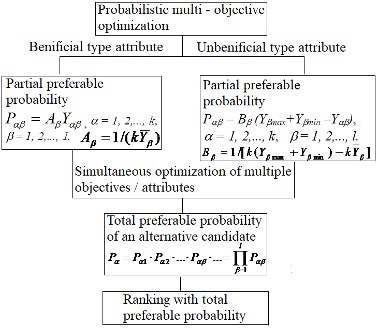
In this article, robust parametric optimization of cyclone separator is done by means of robust probabilistic multi - objective optimization (RPMOO). In RPMOO, the optimal attributes (objectives) are essentially divided into two types, i.e., both unbeneficial and beneficial types, which devote their partial preferable probabilities with equivalent manner quantitatively; especially the averaged value of the experimental data of each attribute and its dispersity are evaluated individually in accordance with its corresponding type. The total preferable probability of each scheme alternative is formed from the multiplication of all available partial preferable probabilities, which is the uniquely decisive indicator of an alternative in this assessment; the optimum scheme is with the highest total preferable probability. For the parametric optimization of cyclone separator, the inlet velocity, helical angle, and outlet diameter are as the variable parameters, while the pressure drop and separation efficiency are the evaluated responses of the cyclone separator to get optimization, the former is an unbeneficial type of attribute and the latter is a beneficial type of attribute. The orthogonal array L9(33) was employed to arrange the experimental scheme alternatives. The evaluated results indicate that the optimized experimental scheme is alternative 6, which yields the optimal responses of a pressure drop of 0.3 mba and a separation efficiency of 98.95 % at an optimum inlet velocity of 13 m/s, an outlet diameter of 72 mm, and a helical angle of 5. This work reveals the independent contributions of the averaged value of the experimental data and its dispersion to an attribute response in the optimization process, and the irrelevance of pressure drop and separation efficiency in the system.
References
K. C. Wickramasinghe, H. Sasahara, E. A. Rahim, and G. I. P. Perera, “Recent advances on high performance machining of aerospace materials and composites using vegetable oil-based metal working fluids,” J. Clean. Production, 2021, [Online]. Available: https://www.sciencedirect.com/science/article/pii/S0959652621016784.
C. Sivakandhan, G. B. Loganathan, and R. Pradhan, “Material characterization and unconventional machining on synthesized Niobium metal matrix,” Mater. Res. Express, 2020, doi: 10.1088/2053-1591/ab624d.
A. Zulkarnain, A. Hammada, and F. Fauzan, “Optimization of the cyclone separator performance using taguchi method and multi-response pcr-topsis,” International Journal of Industrial Optimization. 2022, [Online]. doi: 10.12928/ijio.v3i1.4272.
G. Box, “Signal-to-noise ratios, performance criteria, and transformations,” Technometrics, 1988, doi: 10.1080/00401706.1988.10488313.
V. N. Nair and D. Pregibon, “Analyzing dispersion effects from replicated factorial experiments,” Technometrics, 1988, doi: 10.1080/00401706.1988.10488398.
M. Heidari-Rarani, N. Ezati, P. Sadeghi, and M. R. Badrossamay, “Optimization of FDM process parameters for tensile properties of polylactic acid specimens using Taguchi design of experiment method,” J. of Thermoplastic Composite Materials, 2022, doi: 10.1177/0892705720964560.
T. J. Robinson, C. M. Borror, and R. H. Myers, “Robust parameter design: a review,” Qual. Reliab. Engineering International, 2004, doi: 10.1002/qre.602.
N. Samanpong, S. Wongsaipun, Y. Udnan, and W. C. Chaiyasith, “Natural deep eutectic based dispersive liquid-liquid microextraction and solidified floating organic drop for cadmium determination by electrothermal atomic absorption spectrometry with multivariate optimization,” J. Food Composition and Analysis, 2024, [Online]. Available: https://www.sciencedirect.com/science/article/pii/S0889157524007877.
M. Zheng and J. Yu, “Parameter Design in Production by Means of Robust Fuzzed PMOO in Case of Desirable Target,” Eng. Sci. &Technology, 2025, [Online]. Available: https://doi.org/10.37256/est.6120255823.
S. Mittal and S. V Ukkusuri, “Overcoming data scarcity in transit planning: A novel framework combining machine learning and metaheuristics,” Data Sci. Transp., 2025, doi: 10.1007/s42421-025-00116-6.
B. Grigelionis, J. Kubilius, and V. Paulauskas, Probability Theory and Mathematical Statistics: Proceedings of the Seventh Vilnius Conference, Vilnius, Lithuania, 12–18 August, 1998. books.google.com, 2020.
Z. Akhmetov, S. Seitova, G. Kalzhanova, and A. Koishybekova, “Effective the tools of probability theory and mathematical statistics in solving the problems of the professional orientation of physicists and mathematicians: an interdisciplinary approach,” Pedagog. An International Journal, 2025, doi: 10.1080/1554480X.2024.2422609.
S. Solomatina, N. Podruchnji, M. Tokmakova, and E. Dombrovskaya, “Research of Approaches to the Application of Programming Elements in Solving Problems of Probability Theory and Mathematical Statistics in Higher Education Institutions,” DET-2024: International Conf. Distance Education Technologies, 2024, doi: 10.1007/978-3-032-04365-8_41.
M. Zheng, J. Yu, H. Teng, and Y. Wang, “Application of probability-based multi-objective optimization in portfolio investment and engineering management problems. Tehnički Glas. 18 (2)(2024).” 2024. doi: 10.31803/tg-20221202130111
M. Zheng and J. Yu, “A novel method for solving multi-objective shortest path problem in respect of probability theory,” Teh. Glas., 2023, [Online]. Available: https://hrcak.srce.hr/clanak/445551.
M. Zheng, H. Teng, J. Yu, Y. Cui, and Y. Wang, Probability-based multi-objective optimization for material selection. Springer, 2023. doi: 10.1007/978-981-99-3939-8
M. Zheng and J. Yu, “A Probability-based Fuzzy Multi-objective Optimization for Material Selection,” Teh. Glas., 2024, [Online]. Available: https://hrcak.srce.hr/clanak/457950.
F. L. Kan and C. T. Wang, “Constrained Multi-objective Optimization Design of Building Pipeline Layout Based on Improved Bee Colony Algorithm [J],” Control Engineering of China. 2023.
M. Zheng and J. Yu, Systems Theory for Engineering Practice: Insights from Physics. Springer, 2024.
M. A. Alao, T. R. Ayodele, A. S. O. Ogunjuyigbe, and O. M. Popoola, “Multi-criteria decision based waste to energy technology selection using entropy-weighted TOPSIS technique: The case study of Lagos, Nigeria,” Energy, 2020, [Online]. Available: https://www.sciencedirect.com/science/article/pii/S0360544220307829.
D. L. Olson, “Comparison of weights in TOPSIS models,” Math. Comput. Model., 2004, [Online]. Available: https://www.sciencedirect.com/science/article/pii/S089571770400264X.
M. A. El Sayed, M. A. El-Shorbagy, F. A. Farahat, A. F. Fareed, and M. A. Elsisy, “Stability of Parametric Intuitionistic Fuzzy Multi-Objective Fractional Transportation Problem,” Fractal Fract., vol. 5, no. 4, p. 233, Nov. 2021, doi: 10.3390/fractalfract5040233.
S. Venkatesh, M. Sakthivel, H. Saranav, N. Saravanan, and K. K. Santhosh, “Performance investigation of the combined series and parallel arrangement cyclone separator using experimental and CFD approach,” Powder Technol., 2020, [Online]. Available: https://www.sciencedirect.com/science/article/pii/S0032591019309167.
K. Palczewski and W. Sałabun, “The fuzzy TOPSIS applications in the last decade,” Procedia Comput. Sci., 2019, [Online]. Available: https://www.sciencedirect.com/science/article/pii/S1877050919316084.
A. Shukla, P. Agarwal, R. S. Rana, and R. Purohit, “Applications of TOPSIS algorithm on various manufacturing processes: a review,” Mater. Today Proc., 2017, [Online]. Available: https://www.sciencedirect.com/science/article/pii/S2214785317307502.
S. Ahmad and M. Kamruzzaman, “Inspection cost minimization by optimizing the number of inspectors in apparel manufacturing,” Int. J. Ind. Optim., vol. 6, no. 1, pp. 71–86, Mar. 2025, doi: 10.12928/ijio.v6i1.9279.
S. Nie, Y. P. Li, J. Liu, and C. Z. Huang, “Risk management of energy system for identifying optimal power mix with financial-cost minimization and environmental-impact mitigation under uncertainty,” Energy Econ., 2017, [Online]. Available: https://www.sciencedirect.com/science/article/pii/S0140988316303401.
M. Sadeghi and S. Shavvalpour, “Energy risk management and value at risk modeling,” Energy Policy, 2006, [Online]. Available: https://www.sciencedirect.com/science/article/pii/S0301421505001850.
V. Marimoutou, B. Raggad, and A. Trabelsi, “Extreme value theory and value at risk: application to oil market,” Energy Econ., 2009, [Online]. Available: https://www.sciencedirect.com/science/article/pii/S0140988309000322.
A. B. Abdullah, Z. K. Wani, and N. A. Jaafar, “Optimizing welding parameters for high deposition efficiency in waam by using the taguchi method,” International Journal of Industrial Optimization. 2024, [Online]. Available: https://doi.org/10.12928/ijio.v5i2.9046.
Z. K. Wani, A. B. Abdullah, and A. F. Pauzi, “Semi-automatic 3D Metal Deposition Machine Based on Wire Arc Additive Manufacturing (WAAM),” 2022, pp. 119–124. doi: 10.1007/978-981-16-8129-5_19
Z. K. Wani and A. B. Abdullah, “Bead Geometry Control in Wire Arc Additive Manufactured Profile — A Review,” Pertanika J. Sci. Technol., vol. 32, no. 2, pp. 917–942, Mar. 2024, doi: 10.47836/pjst.32.2.23.
A. Ardeshiri Lordejani, L. Vitali, M. Guagliano, and S. Bagherifard, “Estimating deposition efficiency and chemical composition variation along thickness for cold spraying of composite feedstocks,” Surf. Coatings Technol., vol. 436, p. 128239, Apr. 2022, doi: 10.1016/j.surfcoat.2022.128239.
R. I. Lestari, L. Andrawina, and I. Mufidah, “Optimization of throughput rate prediction in animal feed industry using crisp-dm and operational research approaches,” Int. J. Ind. Optim., vol. 6, no. 1, pp. 87–102, Mar. 2025, doi: 10.12928/ijio.v6i1.11357.
T. H. Lee, M. Kang, J. H. Oh, and D.-H. Kam, “Deposition quality and efficiency improvement method for additive manufacturing of Ti–6Al–4V using gas metal arc with CMT,” J. Mater. Process. Technol., vol. 308, p. 117720, Oct. 2022, doi: 10.1016/j.jmatprotec.2022.117720.
S. L. Tsaqila, S. Winiarti, and I. Widaningrum, “Decision support system in determining the location of new supermarket branches using the copras method,” International Journal of Industrial Optimization. 2024, [Online]. doi: 10.12928/ijio.v5i1.9061.
V. S. Gadakh, “Application of complex proportional assessment method for vendor selection,” Int. J. Logist. Res. Appl., vol. 17, no. 1, pp. 23–34, Jan. 2014, doi: 10.1080/13675567.2013.836159.
L. Kraujalienė, “Comparative Analysis of Multicriteria Decision-Making Methods Evaluating the Efficiency of Technology Transfer,” Business, Manag. Educ., vol. 17, pp. 72–93, Aug. 2019, doi: 10.3846/bme.2019.11014.
S. Narayanamoorthy, L. Ramya, S. Kalaiselvan, J. V. Kureethara, and D. Kang, “Use of DEMATEL and COPRAS method to select best alternative fuel for control of impact of greenhouse gas emissions,” Socioecon. Plann. Sci., vol. 76, p. 100996, Aug. 2021, doi: 10.1016/j.seps.2020.100996.
P. Chatterjee, V. M. Athawale, and S. Chakraborty, “Materials selection using complex proportional assessment and evaluation of mixed data methods,” Mater. Des., vol. 32, no. 2, pp. 851–860, Feb. 2011, doi: 10.1016/j.matdes.2010.07.010.
Downloads
Published
How to Cite
Issue
Section
License
Copyright (c) 2026 Maosheng Zheng, Jie Yu

This work is licensed under a Creative Commons Attribution-ShareAlike 4.0 International License.
License and Copyright Agreement
In submitting the manuscript to the journal, the authors certify that:
- They are authorized by their co-authors to enter into these arrangements.
- The work described has not been formally published before, except in the form of an abstract or as part of a published lecture, review, thesis, or overlay journal. Please also carefully read the International Journal of Industrial Optimization (IJIO) Author Guidelines at http://journal2.uad.ac.id/index.php/ijio/about/submissions#onlineSubmissions
- That it is not under consideration for publication elsewhere,
- That its publication has been approved by all the author(s) and by the responsible authorities tacitly or explicitly of the institutes where the work has been carried out.
- They secure the right to reproduce any material that has already been published or copyrighted elsewhere.
- They agree to the following license and copyright agreement.
Copyright
Authors who publish with the International Journal of Industrial Optimization (IJIO) agree to the following terms:
- Authors retain copyright and grant the journal right of first publication with the work simultaneously licensed under a Creative Commons Attribution License (CC BY-SA 4.0) that allows others to share the work with an acknowledgment of the work's authorship and initial publication in this journal.
- Authors are able to enter into separate, additional contractual arrangements for the non-exclusive distribution of the journal's published version of the work (e.g., post it to an institutional repository or publish it in a book), with an acknowledgment of its initial publication in this journal.
- Authors are permitted and encouraged to post their work online (e.g., in institutional repositories or on their website) prior to and during the submission process, as it can lead to productive exchanges, as well as earlier and greater citation of published work.

1.png)