Collaborative digital marketing and supply chain management for micro, small and medium enterprises
DOI:
https://doi.org/10.12928/ijio.v6i2.11739Keywords:
Digital marketing, MSMEs, Business Process, Textile sector, Supply Chain ManagementAbstract
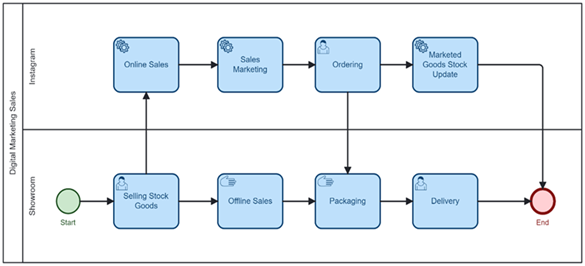
This study explores specific supply chain challenges faced by Batik Ayu Arimbi, a small-scale business in the batik industry, particularly how the manual calculations in its make-to-stock system impact its financial accuracy and operational efficiency. The company has been experiencing financial losses due to these inaccuracies. To address these issues, this research proposes improvements in supply chain management by implementing Business Process Model Notation (BPMN) to streamline process visualization and coordination among the artisans, showrooms, and production houses. The use of digital marketing platforms, particularly Instagram, is also suggested to optimize marketing efforts and achieve sales targets. This study contributes to the literature by emphasizing novel BPMN implementation aspects and demonstrating the effectiveness of digital marketing for MSMEs in the textile sector. The qualitative data was collected through semi-structured interviews, which provided insights into current practices and areas for improvement. The findings show that increased cooperation between supply chain actors reduces inventory errors by 20% and increases the accuracy of financial tracking by 15%, thereby reducing operational risks. Furthermore, the digital marketing strategies increased customer engagement rates by 25%, directly contributing to sales growth. The findings further suggest that the proposed solutions not only resolve the identified problems but also provide a scalable model for enhancing resilience in Batik Ayu Arimbi’s supply chain operations as one of MSMEs. In conclusion, boosting sustainability and performance in MSMEs requires improved supply chain collaboration and the strategic application of digital tools.
References
B. Surya, F. Menne, H. Sabhan, S. Suriani, H. Abubakar, and M. Idris, “Economic Growth, Increasing Productivity of SMEs, and Open Innovation,” J. Open Innov. Technol. Mark. Complex., vol. 7, no. 1, p. 20, Mar. 2021, doi: 10.3390/joitmc7010020.
H. Limanseto, “To encourage MSMEs to upgrade and export, the government is preparing an integrated financing ecosystem.,” 2023. [Online]. Available at: https://www.ekon.go.id/.
M. Song, R. Fisher, A. B. L. de Sousa Jabbour, and E. D. R. Santibañez Gonzalez, “Green and sustainable supply chain management in the platform economy,” Int. J. Logist. Res. Appl., vol. 25, no. 4–5, pp. 349–363, May 2022, doi: 10.1080/13675567.2022.2045763.
I. Putu, T. Noviana, and G. S. Darma, “Exploring Digital Marketing Strategies during the New Normal Era in Enhancing the Use of Digital Payment,” J. Mantik, vol. 4, no. 3, pp. 2257–2262, Nov. 2020. [Online]. Available at: https://iocscience.org/ejournal/index.php/mantik/article/view/1084.
S. Monalisa and D. Apsyarin, “Design And Construction Of A Web-Based Supply Chain Management Information System For Goods And Services Distribution,” J. Ilm. Rekayasa dan Manaj. Sist. Inf., vol. 7, no. 2, pp. 139–144, Aug. 2021. [Online]. Available at: https://ejournal.uin-suska.ac.id/index.php/RMSI/article/view/13143.
B. Arifin, A. Muzakki, and M. W. Kurniawan, “Digital Marketing Concept Based On Seo (Search Engine Optimization) In Marketing Strategy,” Ekombis Sains J. Ekon. Keuang. dan Bisnis, vol. 4, no. 2, pp. 87–94, Dec. 2019, doi: 10.24967/ekombis.v4i2.474.
M. R. Fahdia, I. Kurniawati, F. Amsury, Heriyanto, and I. Saputra, “Digital Marketing Training to Increase Sales for Tajur Halang Makmur MSMEs,” Abdiformatika J. Pengabdi. Masy. Inform., vol. 2, no. 1, pp. 34–39, May 2022, doi: 10.25008/abdiformatika.v2i1.147.
H. B. Ahmadi, H.-W. Lo, H. Gupta, S. Kusi-Sarpong, and J. J. H. Liou, “An integrated model for selecting suppliers on the basis of sustainability innovation,” J. Clean. Prod., vol. 277, p. 123261, Dec. 2020, doi: 10.1016/j.jclepro.2020.123261.
G. Ali Abbasi, N. F. Abdul Rahim, H. Wu, M. Iranmanesh, and B. N. C. Keong, “Determinants of SME’s Social Media Marketing Adoption: Competitive Industry as a Moderator,” Sage Open, vol. 12, no. 1, Jan. 2022, doi: 10.1177/21582440211067220.
D. Sasongko, I. R. Putri, V. N. Alfiani, S. D. Qiranti, R. S. Sari, and P. E. Allafa, “Digital Marketing as a Marketing Strategy for the Macaroni Bajak Laut MSME in Temanggung Regency,” J. Ilm. Pangabdhi, vol. 6, no. 2, pp. 92–96, Oct. 2020, doi: 10.21107/pangabdhi.v6i2.7809.
T. R. Prasetiani and C. R. Sutrisno, “Re-formulating business strategy in Pekalongan Batik Industry MSMEs entering the new normal era,” J. Ekon. Dan Bisnis, vol. 24, no. 3, pp. 246–260, 2021.
M. Susilayati, P. Marwoto, and S. Priatmoko, “Characterization of Spent Coffee Grounds in the Community as Supporting Materials for Renewable Energy,” J. Penelit. Pendidik. IPA, vol. 8, no. 2, pp. 918–924, Apr. 2022, doi: 10.29303/jppipa.v8i2.1227.
M. Yang, M. Fu, and Z. Zhang, “The adoption of digital technologies in supply chains: Drivers, process and impact,” Technol. Forecast. Soc. Change, vol. 169, p. 120795, Aug. 2021, doi: 10.1016/j.techfore.2021.120795.
A. Stroumpoulis and E. Kopanaki, “Theoretical Perspectives on Sustainable Supply Chain Management and Digital Transformation: A Literature Review and a Conceptual Framework,” Sustainability, vol. 14, no. 8, p. 4862, Apr. 2022, doi: 10.3390/su14084862.
P. K. Dey, C. Malesios, D. De, P. Budhwar, S. Chowdhury, and W. Cheffi, “Circular economy to enhance sustainability of small and medium‐sized enterprises,” Bus. Strateg. Environ., vol. 29, no. 6, pp. 2145–2169, Sep. 2020, doi: 10.1002/bse.2492.
D. Horváth and R. Z. Szabó, “Driving forces and barriers of Industry 4.0: Do multinational and small and medium-sized companies have equal opportunities?,” Technol. Forecast. Soc. Change, vol. 146, pp. 119–132, Sep. 2019, doi: 10.1016/j.techfore.2019.05.021.
S. Joshi and M. Sharma, “Sustainable Performance through Digital Supply Chains in Industry 4.0 Era: Amidst the Pandemic Experience,” Sustainability, vol. 14, no. 24, p. 16726, Dec. 2022, doi: 10.3390/su142416726.
A. Miklosik, M. Kuchta, N. Evans, and S. Zak, “Towards the Adoption of Machine Learning-Based Analytical Tools in Digital Marketing,” IEEE Access, vol. 7, pp. 85705–85718, 2019, doi: 10.1109/ACCESS.2019.2924425.
G. Perboli and M. Rosano, “Parcel delivery in urban areas: Opportunities and threats for the mix of traditional and green business models,” Transp. Res. Part C Emerg. Technol., vol. 99, pp. 19–36, Feb. 2019, doi: 10.1016/j.trc.2019.01.006.
Y. Bashirzadeh, R. Mai, and C. Faure, “How rich is too rich? Visual design elements in digital marketing communications,” Int. J. Res. Mark., vol. 39, no. 1, pp. 58–76, Mar. 2022, doi: 10.1016/j.ijresmar.2021.06.008.
H. Terho, J. Mero, L. Siutla, and E. Jaakkola, “Digital content marketing in business markets: Activities, consequences, and contingencies along the customer journey,” Ind. Mark. Manag., vol. 105, pp. 294–310, Aug. 2022, doi: 10.1016/j.indmarman.2022.06.006.
Y. K. Dwivedi et al., “Setting the future of digital and social media marketing research: Perspectives and research propositions,” Int. J. Inf. Manage., vol. 59, p. 102168, Aug. 2021, doi: 10.1016/J.IJINFOMGT.2020.102168.
G. Appel, L. Grewal, R. Hadi, and A. T. Stephen, “The future of social media in marketing,” J. Acad. Mark. Sci., vol. 48, no. 1, pp. 79–95, Jan. 2020, doi: 10.1007/s11747-019-00695-1.
J. J. López García, D. Lizcano, C. M. Q. Ramos, and N. Matos, “Digital Marketing Actions That Achieve a Better Attraction and Loyalty of Users: An Analytical Study,” Futur. Internet, vol. 11, no. 6, p. 130, Jun. 2019, doi: 10.3390/fi11060130.
V. Stein Dani, C. M. Dal Sasso Freitas, and L. H. Thom, “Ten years of visualization of business process models: A systematic literature review,” Comput. Stand. Interfaces, vol. 66, p. 103347, Oct. 2019, doi: 10.1016/j.csi.2019.04.006.
J. Green, “Value and roles of qualitative methods in natural experimental evaluations,” Eur. J. Public Health, vol. 33, no. Supplement_2, Oct. 2023, doi: 10.1093/eurpub/ckad160.155.
H. S. Bisht and D. Singh, “Challenges faced by micro, small and medium enterprises: a systematic review,” World Rev. Sci. Technol. Sustain. Dev., vol. 16, no. 3, p. 205, 2020, doi: 10.1504/WRSTSD.2020.113046.
S. E. Hardiyanti and H. Wai Si, “Role Of Micro Small Medium Enterprises (Msmes) Growth On The Indonesian Economy,” Manag. Sci. Res. J., vol. 1, no. 3, pp. 102–106, Nov. 2022, doi: 10.56548/msr.v1i3.29.
H. A. Salhab, M. Allahham, I. A. Abu-AlSondos, R. H. Frangieh, A. F. Alkhwaldi, and B. J. A. Ali, “Inventory competition, artificial intelligence, and quality improvement decisions in supply chains with digital marketing,” Uncertain Supply Chain Manag., vol. 11, no. 4, pp. 1915–1924, 2023, doi: 10.5267/j.uscm.2023.8.009.
H. M. Marin-Castro and E. Tello-Leal, “An end-to-end approach and tool for BPMN process discovery,” Expert Syst. Appl., vol. 174, p. 114662, Jul. 2021, doi: 10.1016/j.eswa.2021.114662.
R. Choudhary and N. Riaz, “A business process re-engineering approach to transform business process simulation to BPMN model,” PLoS One, vol. 18, no. 3, p. e0277217, Mar. 2023, doi: 10.1371/journal.pone.0277217.
F. Corradini, A. Morichetta, A. Polini, B. Re, L. Rossi, and F. Tiezzi, “Correctness checking for BPMN collaborations with sub-processes,” J. Syst. Softw., vol. 166, p. 110594, Aug. 2020, doi: 10.1016/j.jss.2020.110594.
L. Lemon and J. Hayes, “Enhancing Trustworthiness of Qualitative Findings: Using Leximancer for Qualitative Data Analysis Triangulation,” Qual. Rep., vol. 25, no. 3, pp. 604–614, Mar. 2020, doi: 10.46743/2160-3715/2020.4222.
S. S. SHAPIRO and M. B. WILK, “An analysis of variance test for normality (complete samples),” Biometrika, vol. 52, no. 3–4, pp. 591–611, Dec. 1965, doi: 10.1093/biomet/52.3-4.591.
S. Bates, E. Candès, L. Lei, Y. Romano, and M. Sesia, “Testing for outliers with conformal p-values,” Ann. Stat., vol. 51, no. 1, pp. 149–178, Feb. 2023, doi: 10.1214/22-AOS2244.
N. Oelze, “Sustainable Supply Chain Management Implementation–Enablers and Barriers in the Textile Industry,” Sustainability, vol. 9, no. 8, p. 1435, Aug. 2017, doi: 10.3390/su9081435.
S. A. Hendrawan, Afdhal Chatra, Nurul Iman, Soemarno Hidayatullah, and Degdo Suprayitno, “Digital Transformation in MSMEs: Challenges and Opportunities in Technology Management,” J. Inf. dan Teknol., vol. 6, pp. 141–149, Jun. 2024, doi: 10.60083/jidt.v6i2.551.
A. Mansur, E. Worldailmi, and W. Sutrisno, “A Literature Review on Digital Marketing Strategies and Its Impact on Batik SMEs After COVID-19 Pandemic,” in Proceedings of the International Conference on Industrial Engineering and Operations Management, 2023, pp. 2244–2256, doi: 10.46254/AP03.20220371.
G. Silvano and C. Mbogo, “Impact of Social Media Marketing on Small Businesses’ Sales Performance: A Case of Women Clothing Stores in Nyamagana District, Tanzania,” Int. J. Eng. Bus. Manag., vol. 6, no. 2, pp. 70–82, 2022, doi: 10.22161/IJEBM.6.2.6.
K. K. Kapoor, K. Tamilmani, N. P. Rana, P. Patil, Y. K. Dwivedi, and S. Nerur, “Advances in Social Media Research: Past, Present and Future,” Inf. Syst. Front., vol. 20, no. 3, pp. 531–558, Jun. 2018, doi: 10.1007/s10796-017-9810-y.
W. A. Deku, J. Wang, and A. K. Preko, “Digital marketing and small and medium-sized enterprises’ business performance in emerging markets,” Asia Pacific J. Innov. Entrep., vol. 18, no. 3, pp. 251–269, Sep. 2024, doi: 10.1108/APJIE-07-2022-0069.
S. K. Sahoo, S. S. Goswami, S. Sarkar, and S. Mitra, “A Review of Digital Transformation and Industry 4.0 in Supply Chain Management for Small and Medium-sized Enterprises,” Spectr. Eng. Manag. Sci., vol. 1, no. 1, pp. 58–72, Dec. 2023, doi: 10.31181/sems1120237j.
E. Aminullah et al., “Interactive Components of Digital MSMEs Ecosystem for Inclusive Digital Economy in Indonesia,” J. Knowl. Econ., vol. 15, no. 1, pp. 487–517, Mar. 2024, doi: 10.1007/s13132-022-01086-8.
P. Smith and Z. Zook, Marketing Communications: Integrating Online and Offline, Customer Engagement and Digital Technologies. 2024.
Z. Wang and H. G. Kim, “Can Social Media Marketing Improve Customer Relationship Capabilities and Firm Performance? Dynamic Capability Perspective,” J. Interact. Mark., vol. 39, no. 1, pp. 15–26, Aug. 2017, doi: 10.1016/j.intmar.2017.02.004.
Downloads
Published
How to Cite
Issue
Section
License
Copyright (c) 2025 Agus Mansur, Razel Thimoty, Syafa Thania Prawibowo , Wahyudi Sutrino, Fadhil Adita Ramadhan, Tiara Febian

This work is licensed under a Creative Commons Attribution-ShareAlike 4.0 International License.
License and Copyright Agreement
In submitting the manuscript to the journal, the authors certify that:
- They are authorized by their co-authors to enter into these arrangements.
- The work described has not been formally published before, except in the form of an abstract or as part of a published lecture, review, thesis, or overlay journal. Please also carefully read the International Journal of Industrial Optimization (IJIO) Author Guidelines at http://journal2.uad.ac.id/index.php/ijio/about/submissions#onlineSubmissions
- That it is not under consideration for publication elsewhere,
- That its publication has been approved by all the author(s) and by the responsible authorities tacitly or explicitly of the institutes where the work has been carried out.
- They secure the right to reproduce any material that has already been published or copyrighted elsewhere.
- They agree to the following license and copyright agreement.
Copyright
Authors who publish with the International Journal of Industrial Optimization (IJIO) agree to the following terms:
- Authors retain copyright and grant the journal right of first publication with the work simultaneously licensed under a Creative Commons Attribution License (CC BY-SA 4.0) that allows others to share the work with an acknowledgment of the work's authorship and initial publication in this journal.
- Authors are able to enter into separate, additional contractual arrangements for the non-exclusive distribution of the journal's published version of the work (e.g., post it to an institutional repository or publish it in a book), with an acknowledgment of its initial publication in this journal.
- Authors are permitted and encouraged to post their work online (e.g., in institutional repositories or on their website) prior to and during the submission process, as it can lead to productive exchanges, as well as earlier and greater citation of published work.

1.png)