Effect of return rate on optimal order quantity for single-period products: a modified newsboy problem approach
DOI:
https://doi.org/10.12928/ijio.v7i1.11340Keywords:
Newsboy model, Order quantity, Return rateAbstract
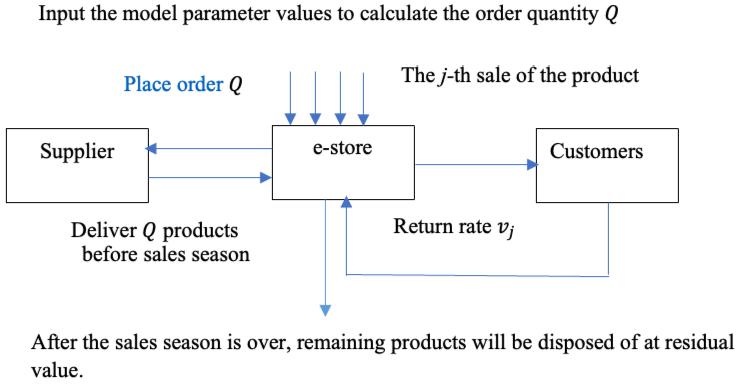
This paper proposes a modified newsboy problem for single-period fashion products, sold by e-stores, for the case where product returns are allowed during the sales season. This is because, even if an e-store sells high-quality products, returns may still occur due to unpredictable consumer behavior in online sales. In the developed model, the assumption from the literature that the number of returns during the sales period is unlimited has been modified to align with real-world conditions. In formulating the problem, the number of returns is assumed to be bounded by a random variable. The corresponding mathematical model is established and the optimal order quantity investigated. The traditional newsboy model is shown to be a special case of the proposed model for which the return factor is ignored. The numerical results show that the optimal order quantity determined when the return rate is ignored is always overestimated and the resulting expected total profit is thus always underestimated. A sensitivity analysis is performed to determine the effects of the model parameters on the optimal solution. The numerical example demonstrates that, in the case of the product return rate, the order quantity predicted by the traditional newsboy model is overestimated by approximately 10%, which results in a profit reduction of about 1%. The numerical results have shown that when the return rate is ignored, the estimated optimal order quantity is higher than the true optimal order quantity and causes the total profit to be slightly underestimated.
References
C. Canyakmaz, S. Özekici, and F. Karaesmen, “A newsvendor problem with markup pricing in the presence of within-period price fluctuations,” Eur. J. Oper. Res., vol. 301, no. 1, pp. 153–162, Aug. 2022, doi: 10.1016/j.ejor.2021.09.042.
A. Khazaei and P. Samouei, “Newsboy Problem with Outsourcing, Limited Capacity and Resalable Return.,” J. Decis. &Operations Research, 2023, [Online]. Available: https://doi.org/10.22105/dmor.2021.266283.1298
A. Hing Ling Lau and H.-S. Lau, “The effects of reducing demand uncertainty in a manufacturer–retailer channel for single-period products,” Comput. Oper. Res., vol. 29, no. 11, pp. 1583–1602, Sep. 2002, doi: 10.1016/S0305-0548(01)00047-8.
A. Angelus and E. L. Porteus, “Simultaneous Capacity and Production Management of Short-Life-Cycle, Produce-to-Stock Goods Under Stochastic Demand,” Manage. Sci., vol. 48, no. 3, pp. 399–413, Mar. 2002, doi: 10.1287/mnsc.48.3.399.7726.
G. D. Eppen and A. V. Iyer, “Backup Agreements in Fashion Buying—The Value of Upstream Flexibility,” Manage. Sci., vol. 43, no. 11, pp. 1469–1484, Nov. 1997, doi: 10.1287/mnsc.43.11.1469.
P. Guo and X. Ma, “Newsvendor models for innovative products with one-shot decision theory,” Eur. J. Oper. Res., vol. 239, no. 2, pp. 523–536, Dec. 2014, doi: 10.1016/j.ejor.2014.05.028.
E. Widodo, K. Takahashi, K. Morikawa, I. N. Pujawan, and B. Santosa, “Managing sales return in dual sales channel: its product substitution and return channel analysis,” Int. J. Ind. Syst. Eng., vol. 9, no. 1, p. 67, 2011, doi: 10.1504/IJISE.2011.042539.
S. Yan, X. Xu, and Y. Bian, “Pricing and Return Strategy: Whether to Adopt a Cross-Channel Return Option?,” IEEE Trans. Syst. Man, Cybern. Syst., vol. 50, no. 12, pp. 5058–5073, Dec. 2020, doi: 10.1109/TSMC.2020.2964560.
S. Wu, “Warranty return policies for products with unknown claim causes and their optimisation,” Int. J. Prod. Econ., vol. 156, pp. 52–61, Oct. 2014, doi: 10.1016/j.ijpe.2014.05.016.
W. Pan and C. H. Huynh, “Optimal operational strategies for online retailers with demand and return uncertainty,” Oper. Manag. Res., vol. 16, no. 2, pp. 755–767, Jun. 2023, doi: 10.1007/s12063-022-00321-4.
A. H. M. Mashud, H.-M. Wee, C.-V. Huang, and J.-Z. Wu, “Optimal Replenishment Policy for Deteriorating Products in a Newsboy Problem with Multiple Just-in-Time Deliveries,” Mathematics, vol. 8, no. 11, p. 1981, Nov. 2020, doi: 10.3390/math8111981.
T. Higuchi and M. D. Troutt, “Dynamic simulation of the supply chain for a short life cycle product—Lessons from the Tamagotchi case,” Comput. Oper. Res., vol. 31, no. 7, pp. 1097–1114, Jun. 2004, doi: 10.1016/S0305-0548(03)00067-4.
B. Lantz and K. Hjort, “Real e-customer behavioural responses to free delivery and free returns,” Electron. Commer. Res., vol. 13, no. 2, pp. 183–198, May 2013, doi: 10.1007/s10660-013-9125-0.
S. K. Mukhopadhyay and R. Setoputro, “Reverse logistics in e‐business,” Int. J. Phys. Distrib. Logist. Manag., vol. 34, no. 1, pp. 70–89, Jan. 2004, doi: 10.1108/09600030410515691.
S. K. Mukhopadhyay and R. Setaputra, “A dynamic model for optimal design quality and return policies,” Eur. J. Oper. Res., vol. 180, no. 3, pp. 1144–1154, Aug. 2007, doi: 10.1016/j.ejor.2006.05.016.
H. Yang, J. Chen, X. Chen, and B. Chen, “The impact of customer returns in a supply chain with a common retailer,” Eur. J. Oper. Res., vol. 256, no. 1, pp. 139–150, Jan. 2017, doi: 10.1016/j.ejor.2016.06.011.
L. Shen, F. Lin, Y. Wang, L. Ding, T. C. E. Cheng, and D. Wang, “Decision and Coordination of an E-commerce Supply Chain Considering Returns and Network Externalities,” J. Syst. Sci. Syst. Eng., vol. 33, no. 5, pp. 552–575, Oct. 2024, doi: 10.1007/s11518-024-5609-9.
J. Chen and P. C. Bell, “Implementing market segmentation using full-refund and no-refund customer returns policies in a dual-channel supply chain structure,” Int. J. Prod. Econ., vol. 136, no. 1, pp. 56–66, Mar. 2012, doi: 10.1016/j.ijpe.2011.09.009.
Z. Hua, H. Hou, and Y. Bian, “Optimal Shipping Strategy and Return Service Charge Under No-Reason Return Policy in Online Retailing,” IEEE Trans. Syst. Man, Cybern. Syst., vol. 47, no. 12, pp. 3189–3206, Dec. 2017, doi: 10.1109/TSMC.2016.2564920.
Y. Li, L. Xu, T.-M. Choi, and K. Govindan, “Optimal Advance-Selling Strategy for Fashionable Products With Opportunistic Consumers Returns,” IEEE Trans. Syst. Man, Cybern. Syst., vol. 44, no. 7, pp. 938–952, Jul. 2014, doi: 10.1109/TSMC.2013.2280558.
D. Vlachos and R. Dekker, “Return handling options and order quantities for single period products,” Eur. J. Oper. Res., vol. 151, no. 1, pp. 38–52, Nov. 2003, doi: 10.1016/S0377-2217(02)00596-9.
G. Ni, “Optimal decisions on price and inventory for a newsboy-type retailer with identifiable information and discount promotion,” PLoS One, vol. 18, no. 7, p. e0288874, Jul. 2023, doi: 10.1371/journal.pone.0288874.
W. Hu, Y. Li, and K. Govindan, “The impact of consumer returns policies on consignment contracts with inventory control,” Eur. J. Oper. Res., vol. 233, no. 2, pp. 398–407, Mar. 2014, doi: 10.1016/j.ejor.2013.03.015.
M. Bieniek, “Consumer returns in consignment contracts with inventory control and additive uncertainty,” INFOR Inf. Syst. Oper. Res., vol. 59, no. 1, pp. 169–189, Jan. 2021, doi: 10.1080/03155986.2020.1796065.
G. Tekin Temur, M. Balcilar, and B. Bolat, “A fuzzy expert system design for forecasting return quantity in reverse logistics network,” J. Enterp. Inf. Manag., vol. 27, no. 3, pp. 316–328, Apr. 2014, doi: 10.1108/JEIM-12-2013-0089.
T. Clottey, W. C. Benton, and R. Srivastava, “Forecasting Product Returns for Remanufacturing Operations,” Decis. Sci., vol. 43, no. 4, pp. 589–614, Aug. 2012, doi: 10.1111/j.1540-5915.2012.00362.x.
J. Chen, “The impact of sharing customer returns information in a supply chain with and without a buyback policy,” Eur. J. Oper. Res., vol. 213, no. 3, pp. 478–488, Sep. 2011, doi: 10.1016/j.ejor.2011.03.027.
J. Chen and P. C. Bell, “The impact of customer returns on pricing and order decisions,” Eur. J. Oper. Res., vol. 195, no. 1, pp. 280–295, May 2009, doi: 10.1016/j.ejor.2008.01.030.
Y. Saito and E. Kusukawa, “Impact of Information Sharing Regarding Customer Returns Ratio on Optimal Sales Strategy under E-commerce,” Ind. Eng. Manag. Syst., vol. 14, no. 2, pp. 111–121, Jun. 2015, doi: 10.7232/iems.2015.14.2.111.
J. Mostard, R. de Koster, and R. Teunter, “The distribution-free newsboy problem with resalable returns,” Int. J. Prod. Econ., vol. 97, no. 3, pp. 329–342, Sep. 2005, doi: 10.1016/j.ijpe.2004.09.003.
J. Mostard and R. Teunter, “The newsboy problem with resalable returns: A single period model and case study,” Eur. J. Oper. Res., vol. 169, no. 1, pp. 81–96, Feb. 2006, doi: 10.1016/j.ejor.2004.04.048.
O. Dey and D. Chakraborty, “A single period inventory problem with resalable returns: A fuzzy stochastic approach,” International Journal of Mathematical. 2008, [Online].
H. Ren, R. Chen, and Z. Lin, “A Study of Electronic Product Supply Chain Decisions Considering Quality Control and Cross-Channel Returns,” Sustainability, vol. 15, no. 16, p. 12304, Aug. 2023, doi: 10.3390/su151612304.
F. Cheng, J. Zhang, and L. Xue, “Study on The Optimal Order Quantity of single-period products Returned for Continuous Demand,” 2017, doi: 10.2991/iccse-17.2017.41.
B. M. Brand and C. S. Kopplin, “Effective Return Prevention Measures in the Post-purchase Stage: A Best-Worst Scaling Approach,” Mark. ZFP, vol. 45, no. 1, pp. 30–47, 2023, doi: 10.15358/0344-1369-2023-1-30.
T. Joshi, A. Mukherjee, and G. Ippadi, “One Size Does Not Fit All: Predicting Product Returns in E-Commerce Platforms,” in 2018 IEEE/ACM International Conference on Advances in Social Networks Analysis and Mining (ASONAM), Aug. 2018, pp. 926–927, doi: 10.1109/ASONAM.2018.8508486.
A. Nestler, N. Karessli, K. Hajjar, R. Weffer, and R. Shirvany, “SizeFlags: Reducing Size and Fit Related Returns in Fashion E-Commerce,” in Proceedings of the 27th ACM SIGKDD Conference on Knowledge Discovery & Data Mining, Aug. 2021, pp. 3432–3440, doi: 10.1145/3447548.3467160.
T. S. Robertson, R. Hamilton, and S. D. Jap, “Many (Un)happy Returns? The Changing Nature of Retail Product Returns and Future Research Directions,” J. Retail., vol. 96, no. 2, pp. 172–177, Jun. 2020, doi: 10.1016/j.jretai.2020.04.001.
H. LIU, “Retailer’s Optimal Ordering Decision Based on Cost Curve,” 2021, doi: 10.2991/assehr.k.210806.022.
T. Nakagawa and S. Osaki, “The Discrete Weibull Distribution,” IEEE Trans. Reliab., vol. R-24, no. 5, pp. 300–301, Dec. 1975, doi: 10.1109/TR.1975.5214915.
Downloads
Published
How to Cite
Issue
Section
License
Copyright (c) 2026 Wen-Feng Hsiao, W.C. Tsai, Chih-Hsiung Wang

This work is licensed under a Creative Commons Attribution-ShareAlike 4.0 International License.
License and Copyright Agreement
In submitting the manuscript to the journal, the authors certify that:
- They are authorized by their co-authors to enter into these arrangements.
- The work described has not been formally published before, except in the form of an abstract or as part of a published lecture, review, thesis, or overlay journal. Please also carefully read the International Journal of Industrial Optimization (IJIO) Author Guidelines at http://journal2.uad.ac.id/index.php/ijio/about/submissions#onlineSubmissions
- That it is not under consideration for publication elsewhere,
- That its publication has been approved by all the author(s) and by the responsible authorities tacitly or explicitly of the institutes where the work has been carried out.
- They secure the right to reproduce any material that has already been published or copyrighted elsewhere.
- They agree to the following license and copyright agreement.
Copyright
Authors who publish with the International Journal of Industrial Optimization (IJIO) agree to the following terms:
- Authors retain copyright and grant the journal right of first publication with the work simultaneously licensed under a Creative Commons Attribution License (CC BY-SA 4.0) that allows others to share the work with an acknowledgment of the work's authorship and initial publication in this journal.
- Authors are able to enter into separate, additional contractual arrangements for the non-exclusive distribution of the journal's published version of the work (e.g., post it to an institutional repository or publish it in a book), with an acknowledgment of its initial publication in this journal.
- Authors are permitted and encouraged to post their work online (e.g., in institutional repositories or on their website) prior to and during the submission process, as it can lead to productive exchanges, as well as earlier and greater citation of published work.

1.png)