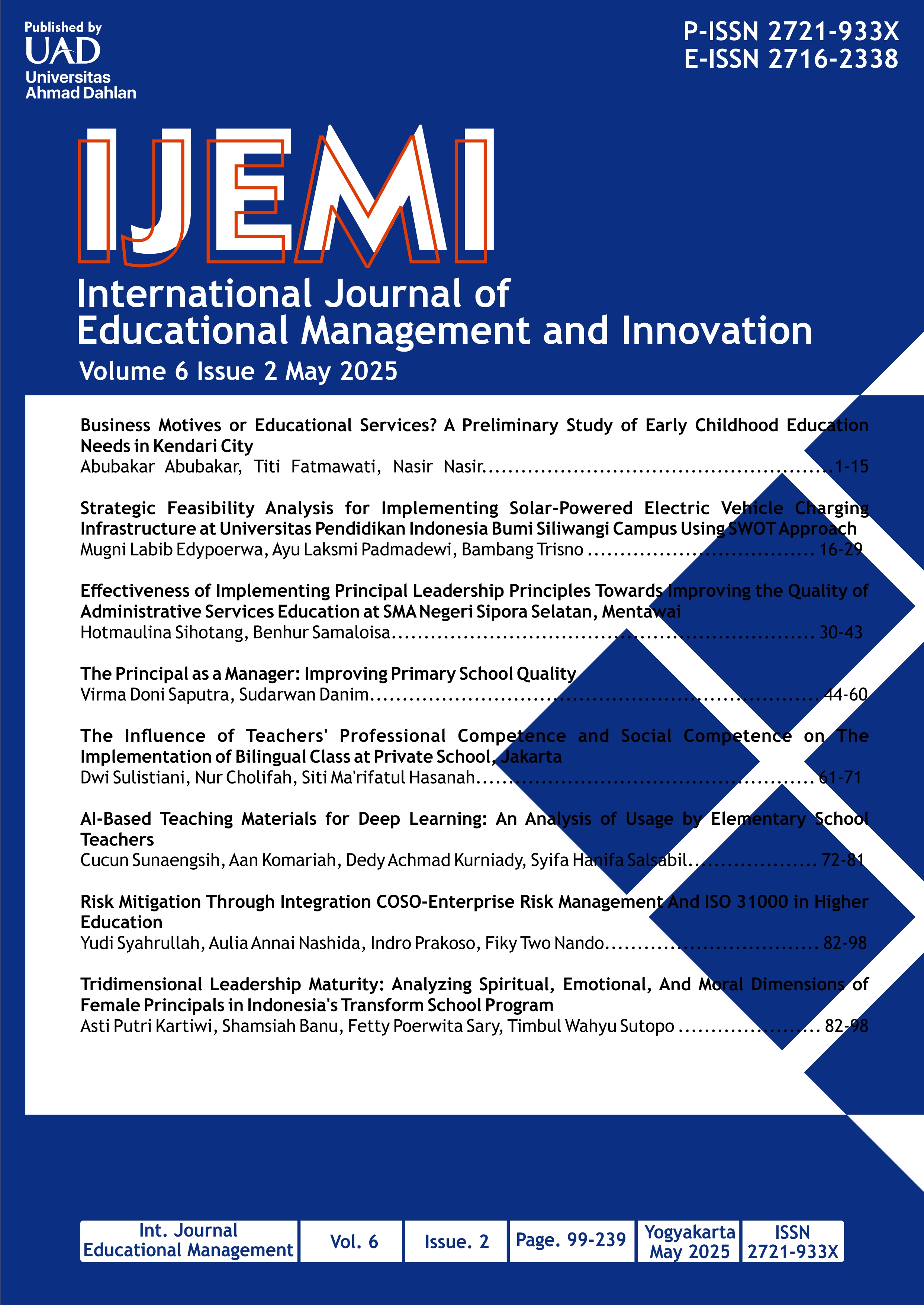
Tridimensional Leadership Maturity: Analyzing Spiritual, Emotional, And Moral Dimensions of Female Principals in Indonesia's Transform School Program
DOI:
https://doi.org/10.12928/ijemi.v6i2.13957Keywords:
spiritual leadership, female principals, moral maturity, emotional intelligence, educational transformationAbstract
Background. Despite female teachers comprising the global teaching workforce majority, significant gender disparities persist in educational leadership positions, necessitating holistic approaches integrating spiritual, emotional, and moral intelligence for effective educational transformation. This study aims to analyze tridimensional spiritual leadership implementation by female principals at SDN 72 and SDN 76 Central Bengkulu District within Indonesia's "Sekolah Penggerak" (Transform School) Program, examining how spiritual, moral, and emotional intelligence dimensions integrate in educational leadership contexts.
Methods. A descriptive quantitative approach employed saturation sampling of 26 teachers and educational staff, utilizing a 36-item structured questionnaire measuring spiritual, moral, and emotional maturity dimensions across both institutions.
Results. Demonstrated a hierarchical leadership profile where moral maturity achieved "excellent" ratings (M = 3.23), spiritual maturity scored "good" (M = 3.19), while emotional maturity emerged as a priority development area requiring improvement (M = 2.73, SD = 0.89) with notable inter-institutional disparities between schools. Moral maturity functioned as a catalytic force strengthening other leadership dimensions, confirming ethical foundations' critical importance in comprehensive leadership excellence within educational transformation initiatives. The study
Conclusion. that tridimensional spiritual leadership requires balanced development across all dimensions, with moral maturity serving as the foundational element that enables spiritual and emotional intelligence integration, providing empirical evidence for multidimensional leadership models in Indonesian educational reform contexts and informing leadership development strategies for female educational leaders.
References
Abdallah, A. K., & Farhan, A. F. (2023). Breaking barriers and empowering women leaders to drive school improvement. Restructuring Leadership for School Improvement and Reform. https://www.scopus.com/pages/publications/85163653479
Adeniji, A., Osibanjo, A., Salau, O., Falola, H., Igbadume, F., & Edewor, O. (2020). Leadership dimensions, employee engagement and job performance of selected consumer-packaged goods firms. Cogent Arts and Humanities, 7(1), Article 1794936. https://doi.org/10.1080/23311983.2020.1794936
Akgöz, E. E., Şahin, F., & Erdoğan, O. (2024). The mediator role of school climate in the relationship between instructional leadership behaviors of school principals and teacher autonomy. International Journal of Educational Management, 38(4), 789-806. https://www.scopus.com/pages/publications/85195090893
Alemu, A. (2024). How female principals in Ethiopia fight for gender justice: A qualitative study of their challenges and strategies. Frontiers in Education. https://www.scopus.com/pages/publications/85208442900
Arjanto, P., Senduk, F. F. W., Melati, I. S., Kawulur, H. R., & Saputri, D. E. (2025). Moral leadership in primary education: Constructing and validating an instrument for principal assessment. Educational Process: International Journal, 14(1), 45-62. https://www.scopus.com/pages/publications/85214360562
Azmi, Z. (2020). Discoursing women's political participation towards achieving sustainable development: The case of women in Parti Islam Se-Malaysia (PAS). Kajian Malaysia, 38(Suppl. 1), 83-100. https://doi.org/10.21315/KM2020.38.S1.5
Berkovich, I. (2023). Emotional capital in schools: Principals' caring leadership as a moderator of the mediated association between emotional geographies and school climate. Journal of Professional Capital and Community, 8(3), 234-251. https://www.scopus.com/pages/publications/85158171396
Carrasco, A., & Palma, I. (2024). Female leadership as a process of collective responsibility: The case of Chilean school principals. School Leadership and Management, 44(2), 156-174. https://www.scopus.com/pages/publications/85179751765
Cruz-González, C., Rodríguez, C. L., Segovia, J. D., & Falcón, J. M. (2021). Female principals leading in Spanish schools: Exploring professional values and challenges through their voices. Journal of Special Education Leadership, 34(2), 89-104. https://www.scopus.com/pages/publications/85126517762
Eyal, O., Berkovich, I., & Yosef-Hassidim, D. (2024). Principal-teachers agreement on teachers' interpersonal emotion regulation: Relations with principals' transformational leadership, teaching staff positive collective emotions, and teaching staff organizational commitment. Asia-Pacific Education Researcher, 33(4), 445-462. https://www.scopus.com/pages/publications/85208459808
Fuller, K., & Harford, J. (2015). Gender and leadership in education: Women achieving against the odds. Gender and Leadership in Education: Women Achieving Against the Odds. https://www.scopus.com/pages/publications/84967194510
Gil-Espinosa, F. J., López-Fernández, I., Jiménez-García, J. D., & Cadenas-Sanchez, C. (2024). Gender differences in school leadership: Collaborative and task-oriented styles of principals in Andalusia, Spain. Educational Management Administration and Leadership, 52(3), 567-584. https://www.scopus.com/pages/publications/85203017870
Glass, C., Cook, A., & Pierce, B. (2020). Do women in leadership reduce sexual harassment claims on college campuses? Journal of Women and Gender in Higher Education, 13(2), 137-156. https://doi.org/10.1080/26379112.2020.1782227
Hauseman, C. (2021). Strategies secondary school principals use to manage their emotions. Leadership and Policy in Schools, 20(4), 623-641. https://www.scopus.com/pages/publications/85081740400
Jaiswal, M. (2025). Dynamic nature of leadership – the case of university management. CASE Journal, 21(4), 564-578. https://doi.org/10.1108/TCJ-06-2024-0179
Laritza, M.-R., Eva, C., Pilar, L. S., & Mónica, S.-P. (2025). The role of experiential and transformative learning in fostering young women's leadership: A pilot study. International Journal of Management Education, 23(2), Article 101123. https://doi.org/10.1016/j.ijme.2024.101123
Li, J., Ju, S.-Y., Kong, L.-K., & Zheng, L. (2024). How spiritual leadership boosts elementary and secondary school teacher well-being: The chain mediating roles of grit and job satisfaction. Current Psychology, 43(15), 13245-13260. https://www.scopus.com/pages/publications/85189204329
Lu, X. (2020). The barriers, facilitators, and solutions for women in educational leadership roles in a Chinese university. International Journal of Chinese Education. https://www.scopus.com/pages/publications/85091492785
Maharromiyati, Sumaryanto, Yuliana, L., & Suhardiman, S. (2024). Killing the stereotype of women leadership at senior high school. Journal of Ecohumanism, 3(1), 78-95. https://www.scopus.com/pages/publications/85205898877
McGrath, K. F. (2020). When female leaders outnumber men: the decline of male school principals in Australia. Journal of Gender Studies, 29(5), 564-578. https://doi.org/10.1080/09589236.2019.1642739
Mestry, R., & Schmidt, M. (2012). A feminist postcolonial examination of female principals' experiences in South African secondary schools. Gender and Education. https://www.scopus.com/pages/publications/84865101517
Miah, P., & Gupta, N. (2025). Gender and ethnic diversity and wage gaps in the Canadian chiropractic workforce. Discover Social Science and Health, 5(1), Article 3. https://doi.org/10.1007/s44155-025-00148-x
Msila, V. (2020). Searching for effective people-centered leadership approaches in schools: Voices of South African teachers on spiritual leadership. International Journal of Religion and Spirituality in Society, 10(2), 23-38. https://www.scopus.com/pages/publications/85110622002
Mythili, N. (2019). Legitimisation of women school leaders in India. Contemporary Education Dialogue. https://www.scopus.com/pages/publications/85058440400
Parham, T. (2024). Breaking barriers and leading with distinction: The impact of female leadership in international secondary schools. In Diversity and Inclusion Challenges for Leaders of International Schools (pp. 145-167). Springer. https://www.scopus.com/pages/publications/86000273839
Park, V., & Datnow, A. (2022). Principals' emotions in school improvement: The role of people, practices, policies, and patterns. School Leadership and Management, 42(3), 289-307. https://www.scopus.com/pages/publications/85130444324
Ramachandaran, S. D., Krauss, S. E., Hamzah, A., & Idris, K. (2017). Effectiveness of the use of spiritual intelligence in women academic leadership practice. International Journal of Educational Management, 31(2), 160-178.
Samul, J. (2024). Linking spiritual leadership with other leadership concepts: A literature review of four decades. SAGE Open, 14(2), 1-15. https://doi.org/10.1177/21582440241251234
Spanò, E. (2020). Femina Academica: women 'confessing' leadership in Higher Education. Gender and Education, 32(3), 295-312. https://doi.org/10.1080/09540253.2017.1336205
Stockton, C. M. (2024). Men as advocates for women in leadership. Christian Higher Education. https://www.scopus.com/pages/publications/85185515163
Subhaktiyasa, P. G., Agung, A. A. G., Jampel, I. N., & Dantes, K. R. (2023). Spiritual leadership in educational organization: A systematic literature review. Journal of Law and Sustainable Development, 11(4), 234-251. https://www.scopus.com/pages/publications/85169593680
Thien, L. M., Lim, H. L., Ahmad Shabudin, A. F., Che Aman, R., Ismail, A., Zuharah, W. F., & Muftahu, M. (2025). Women leadership in higher education: exploring enablers and challenges from middle-level academics' perspective. Humanities and Social Sciences Communications, 12(1), Article 35. https://doi.org/10.1057/s41599-024-04278-6
Venter, D. J., Naicker, S. R., & Awodiji, O. A. (2024). Enhancing school principals' instructional leadership through emotional intelligence. International Journal of Educational Organization and Leadership, 31(2), 112-128. https://www.scopus.com/pages/publications/85204379523
Wang, M., Guo, T., Ni, Y., Shang, S., & Tang, Z. (2019). The effect of spiritual leadership on employee effectiveness: An intrinsic motivation perspective. Frontiers in Psychology, 10, Article 896. https://doi.org/10.3389/fpsyg.2019.00896
Zoro, B., Montecinos, C., & Castro, G. (2021). Examining Chilean novice principals' work through the lenses of emotional meaning making. Compare, 51(6), 891-909. https://www.scopus.com/pages/publications/85075736150
Downloads
Published
How to Cite
Issue
Section
License
Copyright (c) 2025 Asti Putri Kartiwi, Shamsiah Banu, Fetty Poerwita Sary; Timbul Wahyu Sutopo

This work is licensed under a Creative Commons Attribution-ShareAlike 4.0 International License.
The copyright to this article is transferred to Universitas Ahmad Dahlan (UAD) if and when the article is accepted for publication. The undersigned hereby transfers any rights in and to the paper including without limitation all copyrights to UAD. The undersigned hereby represents and warrants that the paper is original and that he/she is the author of the paper, except for material that is identified as to its source, with permission notices from the copyright owners where required. The undersigned represents that he/she has the power and authority to make and execute this assignment.
We declare that:
This paper has not been published in the same form elsewhere.
It will not be submitted anywhere else for publication before acceptance/rejection by this Journal.
Copyright permission is obtained for materials published elsewhere and which require this permission for reproduction.
Furthermore, I/We hereby transfer the unlimited rights of publication of the above-mentioned paper in whole to UAD. The copyright transfer covers the exclusive right to reproduce and distribute the article, including reprints, translations, photographic reproductions, microform, electronic form (offline, online), or any other reproductions of similar nature.
The corresponding author signs for and accepts responsibility for releasing this material on behalf of any and all co-authors. This agreement is to be signed by at least one of the authors who have obtained the assent of the co-author(s) where applicable. After submission of this agreement signed by the corresponding author, changes of authorship or in the order of the authors listed will not be accepted.
Retained Rights/Terms and Conditions
Authors retain all proprietary rights in any process, procedure, or article of manufacture described in the Work.
Authors may reproduce or authorize others to reproduce the Work or derivative works for the authors' personal use or for company use, provided that the source and the UAD copyright notice are indicated, the copies are not used in any way that implies UAD endorsement of a product or service of any employer, and the copies themselves are not offered for sale.
Although authors are permitted to re-use all or portions of the Work in other works, this does not include granting third-party requests for reprinting, republishing, or other types of re-use.