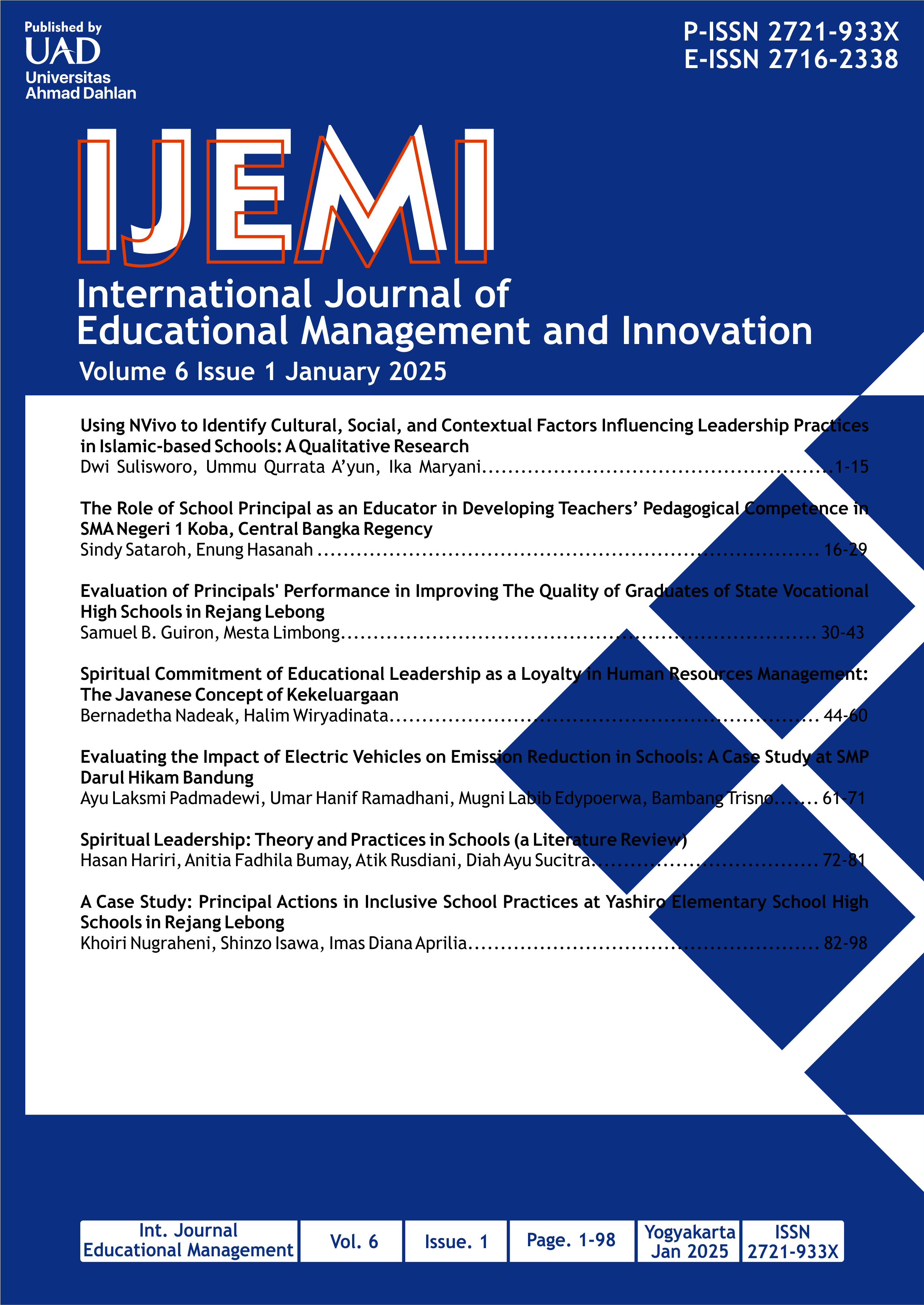
A Case Study: Principal Actions in Inclusive School Practices at Yashiro Elementary School
DOI:
https://doi.org/10.12928/ijemi.v6i1.12758Keywords:
elementary school, inclusive education, school administration, school leadershipAbstract
The implementation of inclusive education in Japan’s elementary schools is increasingly urgent, as national reforms prioritize equitable learning environments for special educational needs (SEN). Despite the commitment, challenges remain in interpreting the policy in school practices. School principals play critical role in the transition from policy to practice. This study explores the effectiveness of inclusive educational practices at Yashiro Elementary School under the principal actions in executing inclusive school practices. Utilize a qualitative case study design, data were collected through semi-structured interview with school principal and classroom observation in inclusive and resources setting. Focusing on the implementation of the Multi-tiered System of Supports (MTSS), data analysis was conducted using thematic analysis, enabling the identification of recurring patterns and core theme with the qualitative data. The findings reveal that strategic leadership, knowledgeable hiring of specialized staff, and collaborative teaching approaches significantly enhance the learning experiences of special educational needs (SEN) students, ensuring their successful inclusion in mainstream educational settings.
References
Ainscow, M., & Sandill, A. (2010). Developing inclusive education systems: The role of organisational cultures and leadership. International Journal of Inclusive Education, 14(4), 401–416. https://doi.org/10.1080/13603110802504903
Beqiraj, L., Denne, L. D., Hastings, R. P., & Paris, A. (2022). Positive behavioural support for children and young people with developmental disabilities in special education settings: A systematic review. Journal of Applied Research in Intellectual Disabilities, 35(3), 719–735. https://doi.org/10.1111/jar.12989
Billingsley, B., DeMatthews, D., Raab, R. R., & James, L. (2021). Principal Actions in Effective Inclusive Schools: A Review of Elementary Case Studies. In J. McLeskey, F. Spooner, B. Algozzine, & N. L. Waldron, Handbook of Effective Inclusive Elementary Schools (2nd ed., pp. 16–42). Routledge. https://doi.org/10.4324/9781003043874-2
Bray, M., Adamson, B., & Mason, M. (Eds.). (2014). Comparative Education Research: Approaches and Methods (2nd ed. 2014). Springer International Publishing : Imprint: Springer.
Chennat, S. (Ed.). (2019). Disability inclusion and inclusive education. Springer. https://doi.org/10.1007/978-981-15-0524-9
Cho, S., & Park, J. (2024). Inclusive education in Japan and its role in international cooperation: Analysis of a project for children with disabilities in Mongolia. Asia Pacific Education Review, 25(1), 229–242. https://doi.org/10.1007/s12564-023-09923-4
DeMatthews, D. (2020). Undoing systems of exclusion: Exploring inclusive leadership and systems thinking in two inclusive elementary schools. Journal of Educational Administration, 59(1), 5–21. https://doi.org/10.1108/JEA-02-2020-0044
DeMatthews, D. E., Serafini, A., & Watson, T. N. (2021a). Leading Inclusive Schools: Principal Perceptions, Practices, and Challenges to Meaningful Change. Educational Administration Quarterly, 57(1), 3–48. https://doi.org/10.1177/0013161X20913897
DeMatthews, D. E., Serafini, A., & Watson, T. N. (2021b). Leading Inclusive Schools: Principal Perceptions, Practices, and Challenges to Meaningful Change. Educational Administration Quarterly, 57(1), 3–48. https://doi.org/10.1177/0013161X20913897
DeMatthews, D. E., Serafini, A., & Watson, T. N. (2021c). Leading Inclusive Schools: Principal Perceptions, Practices, and Challenges to Meaningful Change. Educational Administration Quarterly, 57(1), 3–48. https://doi.org/10.1177/0013161X20913897
Futaba, Y. (2016). INCLUSIVE EDUCATION UNDER COLLECTIVISTIC CULTURE. Journal of Research in Special Educational Needs, 16(S1), 649–652. https://doi.org/10.1111/1471-3802.12325
Gargiulo, R. M., & Metcalf, D. (2022). Teaching in Today’s Inclusive Classrooms: A Universal Design for Learning Approach. Cengage Learning.
ISOGAI, K. (2017). Recent Developments in Japan`s Special Needs Education “Promoting an Inclusive Education System “. National Institute of Special Needs Education, Japan, Vol. 16(March 2017). https://www.nise.go.jp/nc/wysiwyg/file/download/1/1266
Jurkowski, S., Ulrich, M., & Müller, B. (2023). Co-teaching as a resource for inclusive classes: Teachers’ perspectives on conditions for successful collaboration. International Journal of Inclusive Education, 27(1), 54–71. https://doi.org/10.1080/13603116.2020.1821449
Khakpour, A. (2012). Methodology of comparative studies in education. 1, 20–26.
Lambrecht, J., Lenkeit, J., Hartmann, A., Ehlert, A., Knigge, M., & Spörer, N. (2022). The effect of school leadership on implementing inclusive education: How transformational and instructional leadership practices affect individualised education planning. International Journal of Inclusive Education, 26(9), 943–957. https://doi.org/10.1080/13603116.2020.1752825
Maeda, K., Hashimoto, H., & Sato, K. (2021). Japanese Schoolteachers’ Attitudes and Perceptions Regarding Inclusive Education Implementation: The Interaction Effect of Help-Seeking Preference and Collegial Climate. Frontiers in Education, 5, 587266. https://doi.org/10.3389/feduc.2020.587266
Mahabbati, A., Purwanta, E., & Astuti, B. (2023). School-Based Positive Behavior Support for Students with Emotional and Behavioral Problems: Implementation and Teachers’ Experiences. International Journal of Learning, Teaching and Educational Research, 22(4), 326–344. https://doi.org/10.26803/ijlter.22.4.19
McNess, E. (2004). Culture, context and the quality of education: Evidence from a small‐scale extended case study in England and Denmark. Compare: A Journal of Comparative and International Education, 34(3), 315–327. https://doi.org/10.1080/0305792042000257158
Melloy, K. J., Cieminski, A., & Sundeen, T. (2022). Accepting Educational Responsibility: Preparing Administrators to Lead Inclusive Schools. Journal of Research on Leadership Education, 17(4), 358–382. https://doi.org/10.1177/19427751211018498
MEXT. (2018). 特別支援教育資料(平成29年度):文部科学省. 文部科学省ホームページ. https://www.mext.go.jp/a_menu/shotou/tokubetu/material/1406456.htm
OECD. (2018). Education Policy in Japan: Building Bridges towards 2030. OECD. https://doi.org/10.1787/9789264302402-en
Powell, J. J. W. (2014). Comparative and International Perspectives on Special Education. In L. Florian, The SAGE Handbook of Special Education: Two Volume Set (pp. 335–349). SAGE Publications Ltd. https://doi.org/10.4135/9781446282236.n22
Pradhan, K. C., & Naik, S. (2024). Inclusive Education: A Foundation for Equality and Empowerment at the Elementary Stage. International Journal of Multidisciplinary Research in Arts, Science and Technology, 2(2), 1–8. https://doi.org/10.61778/ijmrast.v2i2.36
Randolph, K. M., Riggleman, S., Taylor, M. S., Oh, J. H., & Lohmann, M. (2024). Preparing Early Elementary Preservice Teachers to Positively Support Students with Challenging Behavior. Journal of Special Education Preparation, 4(1), 58–67. https://doi.org/10.33043/4baad965
Rasmitadila, Humaira, M. A., Prasetyo, T., Hasnin, H. D., & Rachmadtullah, R. (2023). Teacher perceptions of inclusive education training: Implementation of an inclusive elementary school mentoring program based on collaborative partnership. Journal of Education and E-Learning Research, 10(4), 682–688. https://doi.org/10.20448/jeelr.v10i4.5054
Scott, D., & Lock, J. (Eds.). (2021). Teacher as Designer: Design Thinking for Educational Change. Springer Singapore. https://doi.org/10.1007/978-981-15-9789-3
Spandagou, I. (2020). Inclusive Education: Principles and Practice. In I. Spandagou, C. Little, D. Evans, & M. L. Bonati, Inclusive Education in Schools and Early Childhood Settings (pp. 35–44). Springer Singapore. https://doi.org/10.1007/978-981-15-2541-4_4
Sugai, G., & Horner, R. H. (2014). Positive Behavior Support, School‐Wide. In C. R. Reynolds, K. J. Vannest, & E. Fletcher‐Janzen (Eds.), Encyclopedia of Special Education (1st ed.). Wiley. https://doi.org/10.1002/9781118660584.ese1902
Tsirantonaki, S., & Vlachou, A. (2024). Inclusive Educational Leadership and Research Instrument Validation: School principals’ values, knowledge, beliefs, attitudes and practices regarding inclusive education of disabled students. European Journal of Inclusive Education, 3(1), 119–141. https://doi.org/10.7146/ejie.v3i1.142505
UNICEF. (n.d.). Inclusive Education—Understanding Article 24 of the Convention on the Rights of Persons with Disabilities. 2015.
Wulff, A. (Ed.). (2020). Quality Education for All? The Promises and Limitations of the SDG Framework for Inclusive Education and Students with Disabilities. In Grading Goal Four (pp. 96–115). BRILL. https://doi.org/10.1163/9789004430365_004
Yoneda, H. (2019). Development of the Japanese Inclusive Education System: From Special Schools to Curriculum Modification for Special-Needs Education in Regular Schools. 1st Progress in Social Science, Humanities and Education Research Symposium (PSSHERS 2019), Padang, Indonesia. https://doi.org/10.2991/assehr.k.200824.228
Yoshitoshi, M., & Takahashi, K. (2023). A critical analysis of court decision on mainstream school attendance of a child with medical care needs in Japan: A long way towards inclusive education. International Journal of Inclusive Education, 27(11), 1257–1271. https://doi.org/10.1080/13603116.2021.1888322
Downloads
Published
How to Cite
Issue
Section
License
Copyright (c) 2025 Khoiri Nugraheni, Shinzo Isawa, Imas Diana Aprilia

This work is licensed under a Creative Commons Attribution-ShareAlike 4.0 International License.
The copyright to this article is transferred to Universitas Ahmad Dahlan (UAD) if and when the article is accepted for publication. The undersigned hereby transfers any rights in and to the paper including without limitation all copyrights to UAD. The undersigned hereby represents and warrants that the paper is original and that he/she is the author of the paper, except for material that is identified as to its source, with permission notices from the copyright owners where required. The undersigned represents that he/she has the power and authority to make and execute this assignment.
We declare that:
This paper has not been published in the same form elsewhere.
It will not be submitted anywhere else for publication before acceptance/rejection by this Journal.
Copyright permission is obtained for materials published elsewhere and which require this permission for reproduction.
Furthermore, I/We hereby transfer the unlimited rights of publication of the above-mentioned paper in whole to UAD. The copyright transfer covers the exclusive right to reproduce and distribute the article, including reprints, translations, photographic reproductions, microform, electronic form (offline, online), or any other reproductions of similar nature.
The corresponding author signs for and accepts responsibility for releasing this material on behalf of any and all co-authors. This agreement is to be signed by at least one of the authors who have obtained the assent of the co-author(s) where applicable. After submission of this agreement signed by the corresponding author, changes of authorship or in the order of the authors listed will not be accepted.
Retained Rights/Terms and Conditions
Authors retain all proprietary rights in any process, procedure, or article of manufacture described in the Work.
Authors may reproduce or authorize others to reproduce the Work or derivative works for the authors' personal use or for company use, provided that the source and the UAD copyright notice are indicated, the copies are not used in any way that implies UAD endorsement of a product or service of any employer, and the copies themselves are not offered for sale.
Although authors are permitted to re-use all or portions of the Work in other works, this does not include granting third-party requests for reprinting, republishing, or other types of re-use.