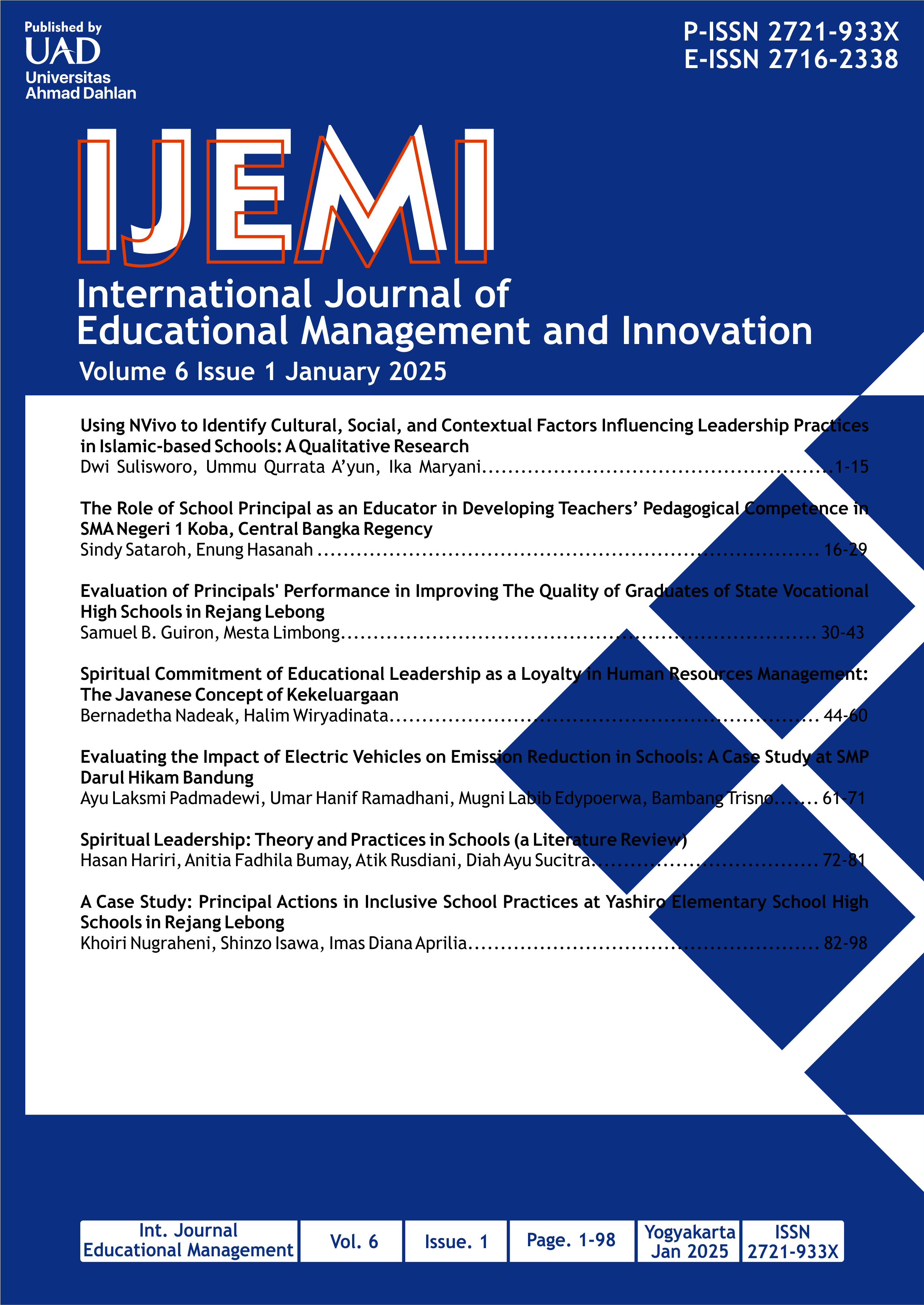
Spiritual Commitment of Educational Leadership as a Loyalty in Human Resources Management: The Javanese Concept of Kekeluargaan
DOI:
https://doi.org/10.12928/ijemi.v6i1.12140Keywords:
human resources management, javanese concept, kekeluargaan, leadership, spiritual commitmentAbstract
This research aims to show that the Javanese concept of Kekeluargaan as the spiritual commitment influences the loyalty of human resources through management. Human loyalty depends upon fulfilling employees’ needs, which is one of the motivation factors for working. The meaning of work becomes absurd and leads to the material element as the form of human resources development. This old-fashioned paradigm cannot perform the best human resources performance due to commitment and spiritual factors. The previous element creates the incapability of humans to search for the meaning of work for life. The latter makes humans unable to appreciate the job for themselves. Therefore, human resources development issues become a burden for organizations. The method uses the sociological approach to evaluate and analyze the emic through books, articles, journals, and academic writings to systematize research division through analytical thinking. The result is that the concept of Kekeluargaan, as an Indonesian local culture, becomes a spiritual commitment to bringing diversity to the organization as one family. The conclusion is that the valuable points of Kekeluargaan create a workplace atmosphere for human resources that is happy, comfortable, involved, and together in line with spiritual values.
References
Abbas, M. (2017). The Effect of Organizational Culture and Leadership Style towards Employee Engagement and Their Impact towards Employee Loyalty. Asian Journal of Technology and Management Research, 7(2), 1–11.
Adiguzel, Z., Ozcinar, M. F., & Karadal, H. (2020). Does servant leadership moderate the link between strategic human resource management on rule breaking and job satisfaction? European Research on Management and Business Economics, 26(2), 103–110. https://doi.org/10.1016/j.iedeen.2020.04.002
Afendi, A., & Ghofur, A. (2021). Spiritual Well-Being and Religious Commitment in Explaining Customer Satisfaction and Loyalty in Sharia Banking. Economica: Jurnal Ekonomi Islam, 12(1), undefined-undefined. https://doi.org/10.21580/ECONOMICA.2021.12.1.6429
Alimudin, A., Septian, D., Sasono, A. D., & Wulandari, A. (2017). Effect of Spiritual Leadership on Organizational Culture and Employee’s Loyalty. JURNAL TERAPAN MANAJEMEN DAN BISNIS, 3(2), 76–86. https://doi.org/10.26737/JTMB.V3I2.210
Babalola, O., Patience, E., Afolabi, O., ‘Sola, L., & ‘Femi, O. (2018). Adoption of Human Resources Management Policies for Practices: Harvard versus Religious Model. Business and Management Research, 7(1), 51–60. https://doi.org/10.5430/bmr.v7n1p51
Bouckaert, L. (2011). Personalism. In The Palgrave Handbook of Spirituality and Business (pp. 155–162). Hampshire: Palgrave Macmillan.
Burrell, G., & Morgan, G. (2019). Sociological Paradigms and Organisational Analysis. In Sociological Paradigms and Organisational Analysis. https://doi.org/10.4324/9781315609751
Castro-Gonzales, S., & Perez, E. R. (2021). Management Strategy to Achieve Competitive Advantages in Commercial Companies and Improve Productivity, Employee Loyalty and Customer Service Quality: Spirituality in the Work Environment. Journal of Applied Business and Economics, 23(8), 105–121. https://doi.org/10.33423/JABE.V23I8.4876
Chen, S., Xu, K., & Yao, X. (2022). An empirical study of employee loyalty and satisfaction in the mining industry using structural equation modeling. Scientific Reports, 12(1). https://doi.org/10.1038/S41598-022-05182-2
Citra, L. M., & Fahmi, M. (2019). Pengaruh Kepemimpinan, Kepuasan Kerja Dan Motivasi Kerja Terhadap Loyalitas Karyawan. Maneggio: Jurnal Ilmiah Magister Manajemen, 2(2), 214–225. https://doi.org/10.30596/MANEGGIO.V2I2.3776
Costers, A., Van Vaerenbergh, Y., & Van den Broeck, A. (2019). How to boost frontline employee service recovery performance: the role of cultural intelligence. Service Business, 13(3), 581–602. https://doi.org/10.1007/S11628-019-00396-3
Decha, O., Khlungsaeng, W., Bousri, A., & Pulphon, S. (2020). The role of service quality, employee satisfaction and loyalty on the effective human resource management in the pharmacies in Thailand: Mediating role of customer satisfaction. Systematic Reviews in Pharmacy, 11(3), 1–9. https://doi.org/10.5530/SRP.2020.3.01
Dehaghi, M. R., Goodarzi, M., & Arazi, Z. K. (2012). The Effect of Spiritual Values on Employees’ Organizational Commitment and Its Models. Procedia - Social and Behavioral Sciences, 62, 159–166. https://doi.org/10.1016/J.SBSPRO.2012.09.025
Djafri, F., & Noordin, K. (2017). The impact of workplace spirituality on organizational commitment: A case study of Takaful agents in Malaysia. Humanomics, 33(3), 384–396. https://doi.org/10.1108/H-02-2017-0018
Efferin, S., & Hartono, M. S. (2015). Management control and leadership styles in family business: An Indonesian case study. Journal of Accounting and Organizational Change, 11(1), 130–159. https://doi.org/10.1108/JAOC-08-2012-0074
Ellis, N., Lowe, S., & Purchase, S. (2006). Toward a Re-interpretation of Industrial Network. The IMP Journal, 1(2), 20–40.
Fanani, A. F., & Ibrahim, S. (2018). COLLABORATIVE GOVERNANCE DALAM KEMANDIRIAN DESA. DIALEKTIKA : Jurnal Ekonomi Dan Ilmu Sosial, 3(2), 1–18. https://doi.org/10.36636/DIALEKTIKA.V3I2.148
Febriansyah, H. (2019). HOW DOES THE RELIGION INFLUENCE THE EMPLOYEE ENGAGEMENT IN INDONESIAN CONTEXT? Jurnal Manajemen Bisnis, 10(2). https://doi.org/10.18196/MB.10180
Garg, N. (2017). Workplace Spirituality and Employee Well-being: An Empirical Exploration. Journal of Human Values, 23(2), 129–147. https://doi.org/10.1177/0971685816689741
Garg, N., Kumari, S., & Punia, B. K. (2022). Resolving stress of university teacher: exploring the role of workplace spirituality and constructive workplace deviance. South Asian Journal of Business Studies, 11(3), 295–315. https://doi.org/10.1108/SAJBS-04-2020-0118
Garg, N., Punia, B. K., & Jain, A. (2019). Workplace Spirituality and Job Satisfaction: Exploring Mediating Effect of Organization Citizenship Behaviour. Vision, 23(3), 287–296. https://doi.org/10.1177/0972262919850928
Ghosh, D., & Gurunathan, L. (2015). Do commitment-based human resource practices influence job embeddedness and intention to quit? IIMB Management Review, 27(4), 240–251. https://doi.org/10.1016/J.IIMB.2015.09.003/DO_COMMITMENT_BASED_HUMAN_RESOURCE_PRACTICES_INFLUENCE_JOB_EMBEDDEDNESS_AND_INTENTION_TO_QUIT_.PDF
Guo, Y., Xiong, G., Zhang, Z., Tao, J., & Deng, C. (2020). Effects of supervisor’s developmental feedback on employee loyalty: A moderated mediation model. Social Behavior and Personality, 48(1). https://doi.org/10.2224/SBP.8269
Hall, J. (2021). What Is In Your Workplace Toolbox? Recognizing And Developing Spiritual Intelligence Through Problem Solving. Scholar Chatter, 2(3), 1–13. https://doi.org/10.47036/SC.2.3.1-13.2021
Hermawan, M. S., & Loo, M. K. (2019). The Construction of Kekeluargaan as an Indonesia’s Organizational Culture. Jurnal Humaniora, 31(1), 1. https://doi.org/10.22146/JH.V31I1.42851
Hidayati, T., Lestari, D., Maria, S., & Zainurossalamia, S. (2019). Effect of employee loyalty and commitment on organizational performance with considering role of work stress. Polish Journal of Management Studies, 20(2), 256–266. https://doi.org/10.17512/PJMS.2019.20.2.21
Jaskeviciute, V., Stankeviciene, A., Diskiene, D., & Savicke, J. (2021). The relationship between employee well-being and organizational trust in the context of sustainable human resource management. Problems and Perspectives in Management, 19(2), 118–131. https://doi.org/10.21511/PPM.19(2).2021.10
Jurado-Caraballo, M. Á., & Rodríguez-Fernández, M. (2021). Productivity in religious orders: A management by values applied approach. Heliyon, 7(3), 1–9. https://doi.org/10.1016/J.HELIYON.2021.E06584/PRODUCTIVITY_IN_RELIGIOUS_ORDERS_A_MANAGEMENT_BY_VALUES_APPLIED_APPROACH.PDF
Khuong, M. N., Mai, T. P., & Minh Phuong, N. T. (2020). The impacts of human resource management practices on employees’ motivation and loyalty. Management Science Letters, 10(11), 2673–2682. https://doi.org/10.5267/j.msl.2020.3.025
Kunaifi, A., & Qomariyah, L. (2021). Developing Company Images Through Spiritual Public Relations Facing Covid-19 Outbreak. Jurnal Iqtisaduna, 1(1), 13. https://doi.org/10.24252/IQTISADUNA.V1I1.15808
Langton, N., Robbins, S. P., & Judge, T. A. (2013). Fundamentals of Organizational Behavior. Canada: Person Education.
Larentis, F., Antonello, C. S., & Slongo, L. A. (2019). Inter-organizational Culture and the Cultural Perspective. In Inter-Organizational Culture. Switzerland: Springer Nature. https://doi.org/10.1007/978-3-030-00392-0_2
Lee, Y.-S., & Liu, W.-K. (2021). The Moderating Effects of Employee Benefits and Job Burnout among the Employee Loyalty, Corporate Culture and Employee Turnover. Universal Journal of Management, 9(2), 62–69. https://doi.org/10.13189/UJM.2021.090205
Ling, C., & Amponstira, F. (2021). Impact of High Commitment Human Resource Management Practices on Performance in Chinese SME. International Business Research, 14(11), undefined-undefined. https://doi.org/10.5539/IBR.V14N11P24
Melewar, T. C., Foroudi, P., Gupta, S., Kitchen, P. J., & Foroudi, M. M. (2017). Integrating identity, strategy and communications for trust, loyalty and commitment. European Journal of Marketing, 51(3), 572–604. https://doi.org/10.1108/EJM-08-2015-0616
Mitašiūnaitė, K. (2021). Influence of Human Resource Management Policy on Customer Loyalty. Vilnius University Open Series, 76–83. https://doi.org/10.15388/VGISC.2021.10
Neal, J. (2018). Overview of Workplace Spirituality Research . In In The Palgrave Handbook of Workplace Spirituality and Fulfilment (pp. 3–57). Palgrave: MacMillan.
Nguyen, N.-T. (2020). An Empirical Study on Factors Affecting Employee Loyalty in the Wood Processing Industry. Journal of Southwest Jiaotong University, 55(3), undefined-undefined. https://doi.org/10.35741/ISSN.0258-2724.55.3.15
Nisar, Q. A., Uzair, M., Razzaq, W., & Sarfraz, M. (2017). Impact of HR Practices on Employee loyalty and commitment: Mediating role of Job satisfaction. International Journal of Management Excellence, 9(2), 1067–1073. https://doi.org/10.17722/ijme.v9i2.347
Novianti, K. R. (2018). Cultural dimension issues in Indonesia human resource management practices: a structured literature review. Management and Economic Journal (MEC-J), 2(3), 245–256. https://doi.org/10.18860/MEC-J.V0I0.5073
Nurhalimah, N., Setiawan, A. R., & Haryadi, B. (2019). BUDAYA PERSAUDARAAN KHAS MADURA DALAM PENGELOLAAN BISNIS BESI TUA. Jurnal Akuntansi Multiparadigma, 10(1), 1–21. https://doi.org/10.18202/JAMAL.2019.04.10001
Okutan, B. B. (2020). Tricks of Methods in Sociology of Religion: A Schemetical Attempt. Cumhuriyet Ilahiyat Dergisi, 24(2), 911–931. https://doi.org/10.18505/cuid.784076
Omar, M. K., Jamhari, N. A., & Yusoff, Y. M. (2021). Islamic Human Resource Management and Turnover Intention among Employees of an Islamic Religious Council. GATR Journal of Management and Marketing Review, 6(1), 56–64. https://doi.org/10.35609/JMMR.2021.6.1(6)
Pamungkas, G. B., & Sulistyo, H. (2020). PERAN ORGANIZATIONAL JUSTICE DAN SPIRITUAL MANAGEMENT TERHADAP EMPLOYEE ENGAGEMENT DAN TURNOVER INTENTION DENGAN DIMODERASI LOCUS OF CONTROL. JBTI : Jurnal Bisnis Teori Dan Implementasi, 11(2), 166–181. https://doi.org/10.18196/bti.112138
Pandey, A., Gupta, R. K., & Kumar, P. (2016). Spiritual Climate and Its Impact on Learning in Teams in Business Organizations. Global Business Review, 17, 159–172. https://doi.org/10.1177/0972150916631208
Patty, F. N., Wenno, V. K., & Toisuta, F. A. (2020). Keluarga dan Pendidikan Karakter: Menggali Implikasi Nilai-nilai Hausetafel dalam Efesus 6:1-9. Kurios, 6(2), 102–109. https://doi.org/10.30995/KUR.V6I2.155
Rego, A., & Pina E Cunha, M. (2008). No Title. Journal of Organizational Change Management, 21(1), 53–75.
Rudolph, C. W., Rauvola, R. S., & Zacher, H. (2018). Leadership and generations at work: A critical review. Leadership Quarterly, 29(1), 44–57. https://doi.org/10.1016/J.LEAQUA.2017.09.004
Rustiarini, N. W., T, S., Nurkholis, N., & Andayani, W. (2019). Why people commit public procurement fraud? The fraud diamond view. Journal of Public Procurement, 19(4), 345–362. https://doi.org/10.1108/JOPP-02-2019-0012
Saifalddin Abu-Alhaija, A., Nerina Raja Yusof, R., Hashim, H., & Siah Jaharuddin, N. (2018). Determinants of Customer Loyalty: A Review and Future Directions. AUSTRALIAN JOURNAL OF BASIC AND APPLIED SCIENCES, 12(7), 106–111. https://doi.org/10.22587/AJBAS.2018.12.7.17
Samul, J. (2020). Spiritual leadership: Meaning in the sustainable workplace. Sustainability (Switzerland), 12(1). https://doi.org/10.3390/su12010267
Sapta, I. K. S., Rustiarini, N. W., Kusuma, I. G. A. E. T., & Astakoni, I. M. P. (2021). Spiritual leadership and organizational commitment: The mediation role of workplace spirituality. Cogent Business and Management, 8(1), 1–15. https://doi.org/10.1080/23311975.2021.1966865
Shahid, S., Zain, Z., & Alam, S. S. (2017). The Mediating Effect of Organizational Trust on Human Resource Management and Affective Commitment. International Journal of Human Resource Studies, 8(1), 38–59. https://doi.org/10.5296/IJHRS.V8I1.12006
Storey, J., Ulrich, D., & Wright, P. M. (2019). Strategic Human Resource Management. New York: Routledge.
Strenitzerov, M., Achimsk, K., Strenitzerová, M., & Achimský, K. (2019). Employee Satisfaction and Loyalty as a Part of Sustainable Human Resource Management in Postal Sector. Sustainability (Switzerland), 11(4591), 1–30. https://doi.org/10.3390/su11174591
Wang, Y., Jin, Y., Cheng, L., & Li, Y. (2021). The Influence of Spiritual Leadership on Harmonious Passion: A Case Study of the Hotel Industry in China. Frontiers in Psychology, 12, 1–14. https://doi.org/10.3389/FPSYG.2021.730634/PDF
Wei, J., & Lin, X. (2022). Research on the influence of compensation methods and customer sentiment on service recovery effect. Total Quality Management and Business Excellence, 33(5–6), 489–508. https://doi.org/10.1080/14783363.2020.1856650
Yusuf, Y. O., & Saragih, R. (2020). The Effect of Organizational Culture on Employee Loyalty. Almana : Jurnal Manajemen Dan Bisnis, 4(3), 380–387. https://doi.org/10.36555/ALMANA.V4I3.1476
Zhong, X., Zhang, Y. X., Li, S., & Liu, Y. (2020). A Multilevel Research on the Factors Influencing Employee Loyalty Under the New Employer Economics. Business and Management Research, 9(2), undefined-undefined. https://doi.org/10.5430/BMR.V9N2P1
Zsolnai, L. (2011). Spirituality and Ethics in Management 2. ed.
Zsolnai, L. (2015). Post-Materialistic Business: Spiritual Value-Orientation in Renewing Management. Hampshire: Palgrave Macmillan.
Downloads
Published
How to Cite
Issue
Section
License
Copyright (c) 2025 Bernadetha Nadeak, Halim Wiryadinata

This work is licensed under a Creative Commons Attribution-ShareAlike 4.0 International License.
The copyright to this article is transferred to Universitas Ahmad Dahlan (UAD) if and when the article is accepted for publication. The undersigned hereby transfers any rights in and to the paper including without limitation all copyrights to UAD. The undersigned hereby represents and warrants that the paper is original and that he/she is the author of the paper, except for material that is identified as to its source, with permission notices from the copyright owners where required. The undersigned represents that he/she has the power and authority to make and execute this assignment.
We declare that:
This paper has not been published in the same form elsewhere.
It will not be submitted anywhere else for publication before acceptance/rejection by this Journal.
Copyright permission is obtained for materials published elsewhere and which require this permission for reproduction.
Furthermore, I/We hereby transfer the unlimited rights of publication of the above-mentioned paper in whole to UAD. The copyright transfer covers the exclusive right to reproduce and distribute the article, including reprints, translations, photographic reproductions, microform, electronic form (offline, online), or any other reproductions of similar nature.
The corresponding author signs for and accepts responsibility for releasing this material on behalf of any and all co-authors. This agreement is to be signed by at least one of the authors who have obtained the assent of the co-author(s) where applicable. After submission of this agreement signed by the corresponding author, changes of authorship or in the order of the authors listed will not be accepted.
Retained Rights/Terms and Conditions
Authors retain all proprietary rights in any process, procedure, or article of manufacture described in the Work.
Authors may reproduce or authorize others to reproduce the Work or derivative works for the authors' personal use or for company use, provided that the source and the UAD copyright notice are indicated, the copies are not used in any way that implies UAD endorsement of a product or service of any employer, and the copies themselves are not offered for sale.
Although authors are permitted to re-use all or portions of the Work in other works, this does not include granting third-party requests for reprinting, republishing, or other types of re-use.