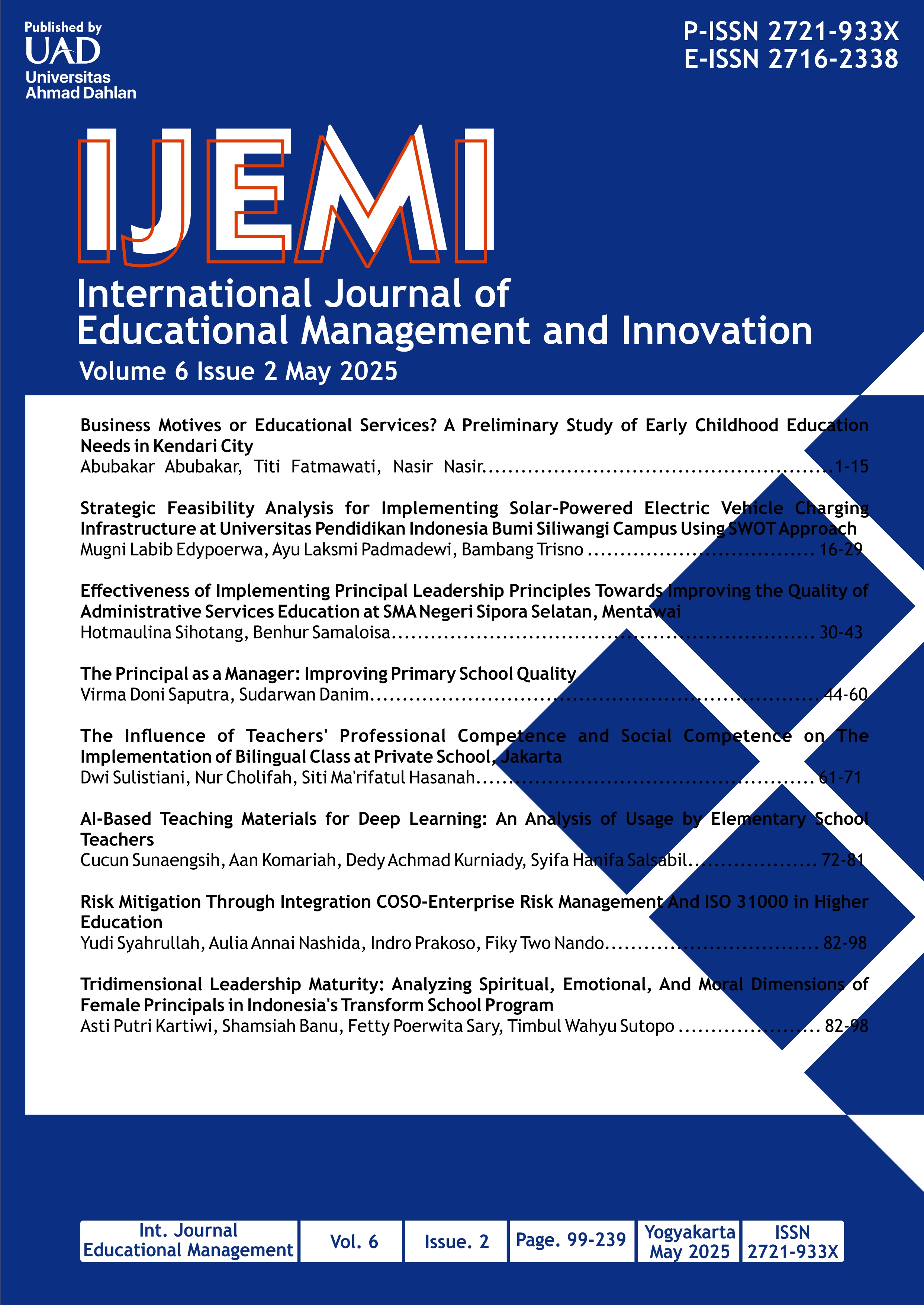
The Influence of Teachers' Professional Competence and Social Competence on The Implementation of Bilingual Class at Private School, Jakarta
DOI:
https://doi.org/10.12928/ijemi.v6i2.12138Keywords:
Bilingual Class, Teacher Competence, Teacher Professional Competence, Teacher Social CompetenceAbstract
Background/Purpose: Improving the quality of education indeed cannot be separated from the critical role of a teacher. A teacher must have and hone competencies to realize national education goals. This study aims to determine the influence of teachers' professional and social competence on implementing bilingual classes in ND schools. Materials/Methods: The method used in this study is a quantitative approach with a survey method. The respondents in this study are teachers in the elementary and junior high units of ND schools. The number of respondents in this study was 32 teachers. This study uses a questionnaire instrument with the Likert model and multiple linear regression analysis. This study explores the influence of teachers’ professional and social competence on implementing bilingual classes at ND Puri Indah School, Jakarta. This research used a quantitative approach with regression analysis to examine the influence of teachers’ professional and social competence on implementing bilingual classes.
Results: The professional competence has a minimal adverse effect on bilingual class implementation (regression coefficient = -0.011), while social competence contributes positively (regression coefficient = 0.176), accounting for 37.6% of the variance. Combined, both competences explain 74% of the effectiveness in implementing bilingual education.
Conclusion: The results underscore the greater role of social competence in supporting successful bilingual classroom practices
References
Akbar, A. (2021). Pentingnya Kompetensi Pedagogik Guru. JPG: Jurnal Pendidikan Guru, 2(1), 23. https://doi.org/10.32832/jpg.v2i1.4099
Alam, S., & Nur Zuama, S. (2019). Profesionalisme Guru Seni Budaya Di Sekolah. GETER : Jurnal Seni Drama, Tari Dan Musik, 2(2), 12–21. https://doi.org/10.26740/geter.v2n2.p12-21
Álvarez-Cofiño, A. (2019). El Enfoque metodológico CLIL (Content and Language Integrated Learning) en la Enseñanza Primaria: Estudio Comparativo de su Implementación en un Centro Bilingüe y en un Centro con Sección Bilingüe. Revista Nebrija de Lingüística Aplicada a la Enseñanza de Lenguas, 13(27), 32-54. https://doi.org/10.26378/rnlael1327335
Amalia, I., & Marzuki, A. G. (2023). The Implementation of Bilingual Class Program in an Islamic Elementary School. Al-Ta Lim Journal, 30(1), 74–84. https://doi.org/10.15548/jt.v30i1.738
Anwar, B. (2019). Kompetensi Pedagogik Sebagai Agen Pembelajaran. Shaut Al Arabiyyah, 6(2), 114. https://doi.org/10.24252/saa.v6i2.7129
Anh, H. T., & Huertas-Abril, C. A. (2022). Teachers’ Perspectives of Bilingual Education in Primary Schools in Vietnam: A Qualitative Study. English as a Foreign Language International Journal, 2(2), 30–50.
Asrifan, A. (2015). Analysis of English Students’ Learning Style in Bilingual Class. International Journal of Literature and Arts, 3(4), 34.
Bialystok, E. (2018). Bilingual education for young children: Review of the effects and consequences. International journal of bilingual education and bilingualism, 21(6), 666–679.
Campbell, S., Greenwood, M., Prior, S., Shearer, T., Walkem, K., Young, S., Bywaters, D., & Walker, K. (2020). Purposive sampling: complex or simple? Research case examples. Journal of Research in Nursing, 25(8), 652–661. https://doi.org/10.1177/1744987120927206
Faridah, S., Djatmika, E. T., & Utaya, S. (2020). Kompetensi Profesional dan Pedagogik Guru Dalam Pengelolaan Pembelajaran di Sekolah Dasar. Jurnal Pendidikan: Teori, Penelitian, Dan Pengembangan, 5(9), 1359. https://doi.org/10.17977/jptpp.v5i9.14059
Febriana, R. (2021). Kompetensi Guru (B. S. Fatmawati (ed.); 1st ed.). https://play.google.com/books/reader?id=vp5OEAAAQBAJ&pg=GBS.PR3&hl=en
Hafsah M. Nur, & Nurul Fatonah. (2023). Paradigma Kompetensi Guru. Jurnal PGSD UNIGA, 2(1), 12–16. https://journal.uniga.ac.id/index.php/JPGSDU/about
Hayudiyani, M., Saputra, B. R., Adha, M. A., & Ariyanti, N. S. (2020). Strategi kepala sekolah meningkatkan mutu pendidikan melalui program unggulan sekolah. Jurnal Akuntabilitas Manajemen Pendidikan, 8(1), 89–95. https://doi.org/10.21831/jamp.v8i1.30131
Hidalgo, D. R., & Ortega-Sánchez, D. (2023). CLIL (Content and Language Integrated Learning) Methodological Approach in the Bilingual Classroom: A Systematic Review1. International Journal of Instruction, 16(3), 915-934.
Ilyas, I. (2022). Strategi Peningkatan Kompetensi Profesional Guru. Jurnal Inovasi, Evaluasi Dan Pengembangan Pembelajaran (JIEPP), 2(1), 34–40. https://doi.org/10.54371/jiepp.v2i1.158
Ismail, I., Ali, H., & Anwar Us, K. (2022). Factors Affecting Critical and Holistic Thinking in Islamic Education in Indonesia: Self-Concept, System, Tradition, Culture. (Literature Review of Islamic Education Management). Dinasti International Journal of Management Science, 3(3), 407–437. https://doi.org/10.31933/dijms.v3i3.1088
Isroani, F., Jaafar, N., & Muflihaini, M. (2022). Effectiveness of E-Learning Learning to Improve Student Learning Outcomes at Madrasah Aliyah. International Journal of Science Education and Cultural Studies, 1(1), 42–51.
Marwiyah, M., Arti, P. P., & Hidayat, T. (2022). An Analysis of Online Transportation Applications Between Gojek and Grab for Students. International Journal of Science Education and Cultural Studies, 1(1), 52–64
Mayudho, I., Prestiadi, D., & Imron, A. (2021). Educational Supervision in Improving Teacher Competence. 7th International Conference on Education and Technology (ICET 2021), 601(Icet), 105–108.
Meyerhöffer, N., & Dreesmann, D. C. (2019). English-bilingual biology for standard classes: development, implementation, and evaluation of an English-bilingual teaching unit in standard German high school classes. International Journal of Science Education, 41(10), 1366-1386.
Mukni’ah, M. (2021). Kecerdasan Verbal Linguistik Pada Penerapan Dua Bahasa Dalam Pembelajaran Di Sekolah Dasar Nahdlatul Ulama Kraton Kencong Jember. Jurnal Asy-Syukriyyah, 22(1), 35–51. https://doi.org/10.36769/asy.v22i1.136
Murkatik, K., Harapan, E., & Wardiah, D. (2020). The Influence of Professional and Pedagogic Competence on Teachers’ Performance. Journal of Social Work and Science Education, 1(1), 58–69. https://doi.org/10.52690/jswse.v1i1.10
MOET. (2018). Circular No. 32/2018/TT-BGDĐT. https://bit.ly/3y7LcV8
Nguyen, T. T. L. (2016). Reconsidering the first steps of CLIL implementation in Vietnam. European Journal of Language Policy, 8(1), 29–55. doi: 10.3828/ejlp.2016.4
Prastania, M. S., & Sanoto, H. (2021). Korelasi antara Supervisi Akademik dengan Kompetensi Profesional Guru di Sekolah Dasar. Jurnal Basicedu, 5(2), 861–868. https://doi.org/10.31004/basicedu.v5i2.834
Rahman, A. (2022). Analisis Pentingnya Pengembangan Kompetensi Guru. Jurnal Pendidikan Tambusai, 6(1), 8455–8466. https://doi.org/10.36050/ngabdimas.v2i1.224
Republik Indonesia, P. (2005). UU 14-2005 Guru dan Dosen.pdf (p. 17).
Ruaya, P. P., Kang, H. X., Reader, S., & Hidayat, T. (2022). Role of teacher competence to implement the independent curriculum. International Journal of Science Education and Cultural Studies, 1(2), 94–108.
Rochaendi, E., Wahyudi, A., & Perdana, R. (2021). Kompetensi Teknologi, Pedagogi, dan Konten Guru SD Negeri dan Swasta di Kota Cimahi, Jawa Barat. JPDI (Jurnal Pendidikan Dasar Indonesia), 6(1), 1. https://doi.org/10.26737/jpdi.v6i1.2222
Rombeallo, F., Limbong, M., & Sunaryo, T. (2021). Pengaruh Kompetensi Pendidik terhadap Kinerja Pendidik pada SMK di Toraja Utara. Jurnal Pendidikan Tambusai, 5(1), 1363–1379.
Saputra, A. H., Mardiana, A., & Teguh, T. (2019). Pengembangan Topik Modul Kompetensi Pedagogik Mahasiswa PGSD Universitas Terbuka di Kota Palembang. DWIJA CENDEKIA: Jurnal Riset Pedagogik, 3(2), 113. https://doi.org/10.20961/jdc.v3i2.34666
Sari, D. P. (2020). Penerapan Manajemen Program Kelas Bilingual Cambridge Primary Curriculum Framework. Media Manajemen Pendidikan, 2(3), 419. https://doi.org/10.30738/mmp.v2i3.6785
Septiyaningrum, A. (2024). Minat Belajar dan Wawasan Anak Usia Dini Pada Pembelajaran Bilingual. Cendikia Jurnal Pendidikan Dan Pengajaran, 2(2), 292–304.
Shabrina, F. B., & Amrullah, M. (2021). Application of Bilingual Classroom Learning to English Language Skills at SD Muhammadiyah 1 Gempol Elementary School Students. Proceedings of The ICECRS, 10. https://doi.org/10.21070/icecrs20211151
Sihotang, H., Limbong, M., Simbolon, B. R., Tampubolon, H., & Silalahi, M. (2019). Peningkatan Kompetensi Guru Dalam Mengimlementasikan Kurikulum 2013 Dalam Education 4.0. JURNAL Comunità Servizio : Jurnal Terkait Kegiatan Pengabdian Kepada Masyarakat, Terkhusus Bidang Teknologi, Kewirausahaan Dan Sosial Kemasyarakatan, 1(2), 223–234. https://doi.org/10.33541/cs.v1i2.1305
Siri, A., Supartha, I. W. G., Sukaatmadja, I. P. G., & Rahyuda, A. G. (2020). Does teacher competence and commitment improve teachers’ professionalism? Cogent Business and Management, 7(1). https://doi.org/10.1080/23311975.2020.1781993
Sharma, Payal Jagwinder Singh Pandher (2018). "Quality of teachers in technical higher education institutions in India", Higher Education, Skills and Work-Based Learning, Vol. 8 Issue: 4, pp. 511–526. Podungge, R., Rahayu, M., Setiawan, M., & Sudiro, A. (2020, June). Teacher competence and student academic achievement. In 23rd Asian Forum of Business Education (AFBE 2019) (pp. 69–74). Atlantis Press.
Sofia, A., & Syafrudin, U. (2020). Pemahaman Guru Tentang Metode Sosiodrama Terhadap Kompetensi Sosial. Aulad : Journal on Early Childhood, 2(3), 105–112. https://doi.org/10.31004/aulad.v2i3.39
Sulaiman, J., & Ismail, S. N. (2020). Teacher competence and 21st century skills in transformation schools 2025 (TS25). Universal Journal of Educational Research, 8(8), 3536–3544. https://doi.org/10.13189/ujer.2020.080829
Sulastri, S., Fitria, H., & Martha, A. (2020). Kompetensi Profesional Guru dalam Meningkatkan Mutu Pendidikan. Journal of Education Research, 1(3), 258–264. https://doi.org/10.37985/jer.v1i3.30
Supriyono, A. (2017). Pengaruh Kompetensi Pedagogik, Profesional, Dan Motivasi Kerja Terhadap Kinerja Guru Sekolah Dasar. Jurnal Pendidikan, 18(2), 1–12. https://doi.org/10.33830/jp.v18i2.269.2017
Suwanarak, K. (2013, December). Bilingual learning and its effects on students’ communicative competence. In The International Conference on Language and Communication 2013: Innovative Inquiries and Emerging Paradigms in Language, Media and Communication (p. 179). National Institute of Development Administration.
Tampubolon, M., Daniel, & Sihotang, H. (2019). Hubungan Antara Kompetensi Manajerial Kepala Sekolah Dan Iklim Sekolah Dengan Kinerja Guru. Jurnal Manajemen Pendidikan, 8(2), 169–188. https://doi.org/10.33541/jmp.v8i2.2978
Tim Buku Kurikulum Sekolah Notre Dame. (2023). Membangun Karakter Menajamkan Mata Nalar Panduan Kurikulum Sekolah Notre Dame (V. M. Murwaningsih (ed.); 1st ed.). PT Kanisisus.
Tobari, Kristiawan, M., & Asvio, N. (2018). The strategy of headmaster on upgrading educational quality in asean economic community (AEC) era. International Journal of Scientific and Technology Research, 7(4), 72–79.
Downloads
Published
How to Cite
Issue
Section
License
Copyright (c) 2025 Ruth Laurentia Bawole, Mesta Limbong

This work is licensed under a Creative Commons Attribution-ShareAlike 4.0 International License.
The copyright to this article is transferred to Universitas Ahmad Dahlan (UAD) if and when the article is accepted for publication. The undersigned hereby transfers any rights in and to the paper including without limitation all copyrights to UAD. The undersigned hereby represents and warrants that the paper is original and that he/she is the author of the paper, except for material that is identified as to its source, with permission notices from the copyright owners where required. The undersigned represents that he/she has the power and authority to make and execute this assignment.
We declare that:
This paper has not been published in the same form elsewhere.
It will not be submitted anywhere else for publication before acceptance/rejection by this Journal.
Copyright permission is obtained for materials published elsewhere and which require this permission for reproduction.
Furthermore, I/We hereby transfer the unlimited rights of publication of the above-mentioned paper in whole to UAD. The copyright transfer covers the exclusive right to reproduce and distribute the article, including reprints, translations, photographic reproductions, microform, electronic form (offline, online), or any other reproductions of similar nature.
The corresponding author signs for and accepts responsibility for releasing this material on behalf of any and all co-authors. This agreement is to be signed by at least one of the authors who have obtained the assent of the co-author(s) where applicable. After submission of this agreement signed by the corresponding author, changes of authorship or in the order of the authors listed will not be accepted.
Retained Rights/Terms and Conditions
Authors retain all proprietary rights in any process, procedure, or article of manufacture described in the Work.
Authors may reproduce or authorize others to reproduce the Work or derivative works for the authors' personal use or for company use, provided that the source and the UAD copyright notice are indicated, the copies are not used in any way that implies UAD endorsement of a product or service of any employer, and the copies themselves are not offered for sale.
Although authors are permitted to re-use all or portions of the Work in other works, this does not include granting third-party requests for reprinting, republishing, or other types of re-use.