Language variation and social class: Code switching in “My Fair Lady”
DOI:
https://doi.org/10.26555/jg.v7i2.13864Keywords:
Code-Switching, Language Variation , My Fair Lady , Social Class , SociolinguisticsAbstract
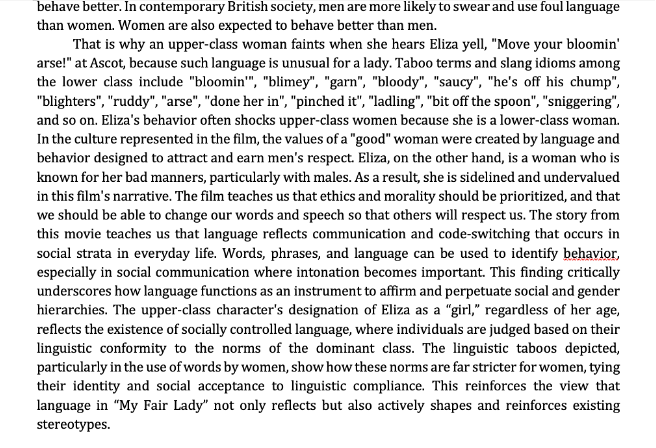
This study aims to examine the relationship between language variation and social class through the phenomenon of code-switching in the film My Fair Lady. Language is positioned as a marker of social identity, where differences in dialect and speech patterns indicate the class stratification of the characters. The characters in this movie show linguistic differences that represent their class, such as the difference between upper-class and lower-class speech patterns. The purpose of this study is to analyze the role of code-switching in reflecting social class differences through the characters' language use. Data collection was conducted through a literature review using documentation techniques on the dialogue transcripts in the film. Furthermore, the data was analyzed qualitatively using a sociolinguistic and pragmatic approach to reveal the form and function of code-switching and the social context behind it. The results of the study show that code-switching is a linguistic strategy used by the main character to navigate and form a new social identity. Language, in this case, acts as a tool for social mobility as well as a mirror of prevailing class norms. This study contributes to sociolinguistic research, particularly in understanding the dynamics of language as a representation of symbolic power and class identity. Additionally, these findings are practically relevant in language education, especially in teaching language variation and social awareness in language use.
References
Anita. (2019). Analyzing code switching in George Bernard Shaw’s Pygmalion. ELITE Journal, 1(2), 133–140. https://elitejournal.org/index.php/ELITE/article/view/19 SciSpace
Berchez, M. P. R. (2024). Intersectional oppressions through language: Case studies in race, gender and class in To Kill a Mockingbird and My Fair Lady. Estudos Literários, 17(47), 44–59. https://doi.org/10.30681/rln.v17i47.12057AcademiaResearchGate
Chaer, A., & Agustina, L. (2004). Sosiolinguistik: Perkenalan awal. PT Asdi Mahasatya.
Dan, J., & Rui, L. (2017). A study of linguistic behavior from the perspective of sociolinguistic—Taking My Fair Ladyas an example. Studies in Linguistics and Literature, 1(2), 162– ? (volume/page unclear). https://doi.org/10.22158/sll.v1n2p162
Gumperz, J. J. (1982). Discourse strategies. Cambridge University Press.
Gumperz, J. J. (1986). Directions in sociolinguistics: The ethnography of communication. Blackwell Publishing.
Kim, Y. (2006). Code switching in bilingual Navajo English discourse. [Doctoral dissertation, University of Arizona].
Mahsun. (2005). Metode penelitian bahasa. PT Raja Grafindo Persada.
Mohd. Don, Z. (n.d.). Language dialect code switching among Malaysian students: Structural and functional constraints. [Unpublished manuscript].
Nababan, P. W. J. (1984). Sosiolinguistik: Suatu pengantar. PT Gramedia Pustaka.
Octawidyanata, A. Q. (2016). Studi deskriptif mengenai identitas sosial anggota KBPP yang bergabung ke dalam kelompok geng motor Brigez di Sukabumi [Undergraduate thesis, Universitas Islam Bandung].
Rahardi, R. K. (2001). Sosiolinguistik, kode dan alih kode. Pustaka Pelajar. https://books.google.co.id/books?id=xTJlAAAACAAJ
Saddhono, K. (2009). Oreng Madure dan Wong Solo: Fenomena integrasi linguistik kultural. Sebelas Maret University Press & Departemen Pendidikan Nasional.
Saleh, M., & M. (2006). Sosiolinguistik. Badan Penerbit UNM.
Samjaya, P. (2017). Analysis of code switching in Tetangga Masa Gitu? ENGLiterature. https://ejournal3.undip.ac.id/index.php/engliterature/article/view/16865/16197
Sudaryanto. (2015). Metode dan aneka teknik analisis bahasa: Pengantar penelitian wahana kebudayaan secara linguistis. Sanata Dharma University Press.
Suryawati, N. (2013). An analysis of code switching occurred in a puppet show. Anglicist, 2(1), 41–51. doi unavailable journal.unair.ac.idjournal.unair.ac.id
Suryawati, N. (2023). Code switching in a Javanese puppet show: Situational and metaphorical switches. [Unpublished or in press]. (DOI tidak ditemukan).
Suwito. (1983). Sosiolinguistik: Teori dan problem (U. Mataram, Ed.). [Publisher not specified].
Tajfel, H., & Turner, J. C. (1979). An integrative theory of social conflict. In W. Austin & S. Worchel (Eds.), The Social Psychology of Intergroup Relations (pp. ?). Brooks/Cole. (Halaman tidak tersedia).
Trudgill, P. (2000). Sociolinguistics: An introduction to language and society. Penguin Books.
Wang, D. (2024). Sociolinguistic perspectives on English phonetic dialects: A case study of My Fair Lady. International Journal of Linguistics, Literature and Translation (IJLLT), 7(12), 215–218. https://doi.org/10.32996/ijllt
Wardaugh, R. (1993). An introduction to sociolinguistics. Blackwell Publishers.
Wardaugh, R. (2005). An introduction to sociolinguistics (5th ed.). Blackwell Publishing.
Yuliani, W. (2023). Code switching in the novel 9 Summers 10 Autumns: Functions and types. [Unpublished or in press].
Downloads
Published
Issue
Section
License
Copyright (c) 2025 Indah Yana Aulia, Oktivia Hery Chandra

This work is licensed under a Creative Commons Attribution-ShareAlike 4.0 International License.

This work is licensed under a Creative Commons Attribution-ShareAlike 4.0 International License.