Sensitivity-Guided Distributed Generation Planning for Improved Voltage Performance in Distribution Networks
DOI:
https://doi.org/10.12928/biste.v8i5.17538Keywords:
Distribution Networks, Distributed Generation, Voltage Sensitivity, Particle Swarm Optimization, Optimal Placement And Sizing, Radial Distribution NetworksAbstract
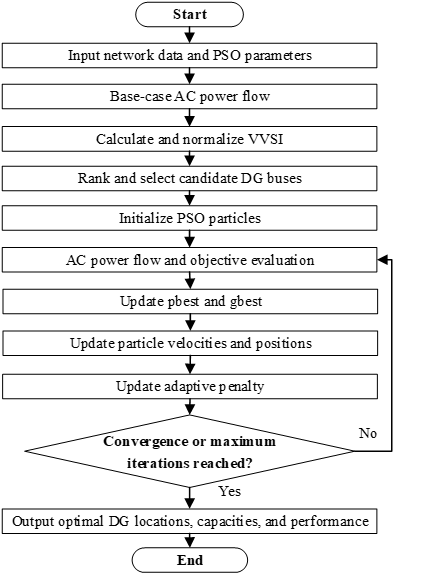
Optimal distributed generation (DG) planning is essential for reducing power losses and improving voltage performance in radial distribution networks (DNs). This paper proposes a voltage vulnerability sensitivity index (VVSI)-guided particle swarm optimization (PSO) framework for optimal DG placement and sizing. The VVSI quantifies local steady-state voltage sensitivity to small active-power injection variations and is integrated into both candidate-bus screening and the composite optimization objective. An adaptive penalty mechanism is employed to handle network operating constraints. The proposed framework is evaluated on the 33-bus and 69-bus radial DNs and compared with conventional PSO and genetic algorithm (GA) approaches. For the 33-bus system, active power loss decreases from 210.98 to 98.45 kW (53.3%), the minimum voltage improves from 0.903 to 0.967 p.u., and normalized VVSI decreases from 1.00 to 0.51. For the 69-bus system, power loss decreases from 224.90 to 85.30 kW (62.1%), the minimum voltage improves from 0.909 to 0.972 p.u., and normalized VVSI decreases to 0.48. The results demonstrate improved network efficiency, voltage profiles, and local steady-state voltage sensitivity under the investigated operating conditions. The proposed framework provides a sensitivity-informed approach to DG planning without modifying the conventional PSO update mechanism.
References
H. H. H. Mousa, K. Mahmoud, and M. Lehtonen, “A comprehensive review on recent developments of hosting capacity estimation and optimization for active distribution networks,” IEEE Access, vol. 12, pp. 18545–18593, 2024, https://doi.org/10.1109/ACCESS.2024.3359431.
A. Haleem, M. Ibrahim, and S. Member, “Incipient fault detection in power distribution networks: Review, analysis, challenges, and future directions,” IEEE Access, vol. 12, pp. 112822–112838, 2024, https://doi.org/10.1109/ACCESS.2024.3443252.
R. Shaikh, A. Stojcevski, M. Seyedmahmoudian, and J. Chandran, “A multi-objective approach for optimal sizing and placement of distributed generators and distribution static compensators in a distribution network using the black widow optimization algorithm,” Sustainability, vol. 16, no. 11, p. 4577, 2024, https://doi.org/10.3390/su16114577.
A. Owosuhi, Y. Hamam, and J. Munda, “A new framework for active loss reduction and voltage profile enhancement in a distributed generation-dominated radial distribution network,” Appl. Sci., vol. 14, no. 3, p. 1077, 2024, https://doi.org/10.3390/app14031077.
A. Jain and S. C. Gupta, “Optimal placement of distributed generation in power distribution system and evaluating the losses and voltage using machine learning algorithms,” Front. Energy Res., vol. 12, p. 1378242, 2024, https://doi.org/10.3389/fenrg.2024.1378242.
I. U. Salam, M. Yousif, M. Numan, K. Zeb, and M. Billah, “Optimizing distributed generation placement and sizing in distribution systems: A multi-objective analysis of power losses, reliability, and operational constraints,” Energies, vol. 16, no. 16, p. 5907, 2023, https://doi.org/10.3390/en16165907.
T. N. Ton, P. M. Le, L. H. Pham, and T. M. Le, “Bi-level DG optimization in distribution networks with TOU pricing and demand response using MPA,” ECTI Trans. Electr. Eng. Electron. Commun., vol. 23, no. 3, pp. 1–10, 2025, https://doi.org/10.37936/ecti-eec.2525231.259805.
B. K. Malika et al., “A quasi oppositional forensic based investigation algorithm for optimizing distributed generation placement and sizing in power distribution systems,” Sci. Rep., vol. 15, Art. no. 16471, pp. 1–34, 2025, https://doi.org/10.1038/s41598-025-01378-4.
K. R. K. V. Prasad, R. Kollu, A. Ramkumar, and A. Ramesh, “A multi-objective strategy for optimal DG and capacitors placement to improve technical, economic, and environmental benefits,” Int. J. Electr. Power Energy Syst., vol. 165, p. 110491, 2025, https://doi.org/10.1016/j.ijepes.2025.110491.
N. Bouchikhi, F. Boussadia, R. Bouddou, and A. O. Salau, “Optimal distributed generation placement and sizing using modified grey wolf optimization and ETAP for power system performance enhancement and protection adaptation,” Sci. Rep., vol. 15, p. 13919, 2025, https://doi.org/10.1038/s41598-025-98012-0.
I. Cetinbas, B. Tamyurek, and M. Demirtas, “The hybrid Harris Hawks Optimizer-Arithmetic Optimization Algorithm: A new hybrid algorithm for sizing optimization and design of microgrids,” IEEE Access, vol. 10, pp. 19254–19283, 2022, https://doi.org/10.1109/ACCESS.2022.3151119.
N. C. Yang, M. J. Liu, K. Y. Lai, and E. W. Adinda, “Three-phase power flow calculations using initial voltage estimation method for unbalanced distribution networks,” IEEE Access, vol. 10, pp. 103705–103717, 2022, https://doi.org/10.1109/ACCESS.2022.3207783.
M. Rizal, A. Azis, and Y. Irwansi, “Analysis of the impact of load imbalance on neutral current and power losses caused by neutral current in transformer 1, 30 MVA, 70/20 kV at Bungaran Substation,” Int. J. Electr. Eng. Math. Comput. Sci., vol. 2, no. 3, pp. 32–54, 2025, https://doi.org/10.62951/ijeemcs.v2i3.318.
P. Rajakumar et al., “Hybrid sensitivity-driven enhanced modified ant lion optimizer framework for multi-distributed generation allocation in radial distribution networks,” Energy Rep., vol. 15, Art. no. 109144, 2026, https://doi.org/10.1016/j.egyr.2026.109144.
P. Rajakumar, P. M. Balasubramaniam, E. Parimalasundar, K. Suresh, and P. Aravind, “Optimized placement and sizing of solar photovoltaic distributed generation using jellyfish search algorithm for enhanced power system performance,” Sci. Rep., vol. 15, no. 1, pp. 1–27, 2025, https://doi.org/10.1038/s41598-025-08227-4.
T. N. Ton, P. M. Le, and T. M. Le, “Multi-objective optimization of distributed generation placement and sizing in active distribution networks considering harmonic distortion,” Int. J. Electr. Comput. Eng., vol. 16, no. 2, pp. 598–607, 2026, https://doi.org/10.11591/ijece.v16i2.pp598-607.
T. N. Ton, T. T. Phan, and L. H. Pham, “Optimal distributed generation planning for loss reduction and phase balancing in unbalanced distribution networks using the INFO algorithm,” ECTI Trans. Electr. Eng. Electron. Commun., vol. 24, no. 2, 2026, https://doi.org/10.37936/ecti-eec.2026242.262002.
A. Dong and S. Lee, “Research on a distributed photovoltaic two-level planning method based on the SCMPSO algorithm,” Energies, vol. 17, no. 13, p. 3251, 2024, https://doi.org/10.3390/en17133251.
S. Adeleke, I. Olajide, O. Bode, A. Kumar, O. Wasiu, and H. Kotb, “Graph theory-enhanced integrated distribution network reconfiguration and distributed generation planning: A comparative techno-economic and environmental impacts analysis,” Clean. Eng. Technol., vol. 22, p. 100808, 2024, https://doi.org/10.1016/j.clet.2024.100808.
S. Mokred, Y. Wang, M. Alruwaili, and M. A. Ibrahim, “A novel approach for voltage stability assessment and optimal siting and sizing of DGs in radial power distribution networks,” Processes, vol. 13, no. 7, pp. 1–26, 2025, https://doi.org/10.3390/pr13072239.
B. Ahmadi, O. Ceylan, A. Ozdemir, and M. Fotuhi-firuzabad, “A multi-objective framework for distributed energy resources planning and storage management,” Appl. Energy, vol. 314, p. 118887, 2022, https://doi.org/10.1016/j.apenergy.2022.118887.
P. Rajakumar, P. M. Balasubramaniam, A. Munimathan, and M. Alwetaishi, “Osprey optimization algorithm for distributed generation integration in a radial distribution system for power loss reduction,” Sci. Rep., vol. 15, no. 1, pp. 1–19, 2025, https://doi.org/10.1038/s41598-025-02411-2.
M. Akanni, O. Mohammed, and T. Raphael, “An improved particle swarm optimisation algorithm for optimum placement and sizing of biogas-fuelled distributed generators for seasonal loads in a radial distribution network,” Energy Rep., vol. 12, pp. 1531–1550, 2024, https://doi.org/10.1016/j.egyr.2024.07.049.
D. A. Mansour, A. N. Tahoon, M. M. Emara, A. L. Elrefai, and T. F. Megahed, “Standardization of hosting capacity: A comprehensive review of limiting factors, assessment methods, enhancement strategies, and standardization gaps,” Sustainability, vol. 18, no. 18, p. 9244, 2026, https://doi.org/10.3390/su18189244.
R. Salgotra, R. Chaudhary, P. Verma, and S. Mirjalili, “The rise of particle swarm optimization: A systematic bibliometric & thematic review (1995–2025),” Arch. Comput. Methods Eng., 2026, https://doi.org/10.1007/s11831-026-10532-8.
M. A. Mossie, T. T. Yetayew, G. T. Bitew, M. G. Yenealem, and T. M. Beza, “Adaptive genetic algorithm and enhanced particle swarm optimization for static voltage stability enhancement in radial distribution systems with distributed generation integration,” Discov. Appl. Sci., vol. 7, p. 1414, 2025, https://doi.org/10.1007/s42452-025-07945-8.
K. Pereira, J. M. Home-ortiz, and E. M. C. Franco, “A multi-objective optimization approach for integrated allocation of distributed generation and protection devices in distribution systems,” IEEE Access, vol. 13, pp. 84139–84152, 2025, https://doi.org/10.1109/ACCESS.2025.3569431.
Y. Wang and J. Wu, “Minimum PV curtailment for distribution networks based on moment difference analysis theory,” Int. J. Electr. Power Energy Syst., vol. 167, p. 110654, 2025, https://doi.org/10.1016/j.ijepes.2025.110654.
A. Fraija, K. Agbossou, N. Henao, S. Kelouwani, M. Fournier, and S. S. Hosseini, “A discount-based time-of-use electricity pricing strategy for demand response with minimum information using reinforcement learning,” IEEE Access, vol. 10, pp. 54018–54028, 2022, https://doi.org/10.1109/ACCESS.2022.3175839.
M. U. Hashmi, A. Koirala, R. Lundholm, H. Ergun, and D. Van Hertem, “Evaluation of voltage magnitude based unbalance metric for low voltage distribution networks,” in 2022 IEEE PES Gen. Meet., pp. 1–16, 2022, https://doi.org/10.1109/PESGM48719.2022.9916772.
L. López, I. López, J. G. Itxaso, and A. Pablo, “Analysis of impact for PV-BES strategies in low-voltage distribution system,” Electr. Eng., vol. 107, no. 2, pp. 2147–2162, 2025, https://doi.org/10.1007/s00202-024-02620-4.
A. Tarraq, F. Elmariami, A. Belfqih, and T. Haidi, “Meta-heuristic optimization methods applied to renewable distributed generation planning: A review,” E3S Web Conf., vol. 234, pp. 1–10, 2021, https://doi.org/10.1051/e3sconf/202123400086.
G. Guo et al., “Research on the three-phase load imbalance control of the active distribution network based on the distributed power flow controller,” Front. Energy Res., vol. 12, p. 1414084, 2024, https://doi.org/10.3389/fenrg.2024.1414084.
L. S. Xuan, T. Juhana, T. Hashim, and M. N. Kamarudin, “Optimal location and sizing of distributed generation to minimize losses using whale optimization algorithm,” Indones. J. Electr. Eng. Comput. Sci., vol. 29, no. 1, pp. 15–23, 2023, https://doi.org/10.11591/ijeecs.v29.i1.pp15-23.
D. Rangel-Martinez, K. D. P. Nigam, and L. A. Ricardez-Sandoval, “Machine learning on sustainable energy: A review and outlook on renewable energy systems, catalysis, smart grid and energy storage,” Chem. Eng. Res. Des., vol. 174, pp. 414–441, 2021, https://doi.org/10.1016/j.cherd.2021.08.013.
E. Fernandez, M. J. Hossain, K. Mahmud, M. S. H. Nizami, and M. Kashif, “A bi-level optimization-based community energy management system for optimal energy sharing and trading among peers,” J. Clean. Prod., vol. 279, p. 123254, 2021, https://doi.org/10.1016/j.jclepro.2020.123254.
N. Du et al., “Hosting capacity assessment in distribution networks considering wind-photovoltaic-load temporal characteristics,” Front. Energy Res., vol. 9, p. 767610, 2021, https://doi.org/10.3389/fenrg.2021.767610.
X. Geng, L. Tong, A. Bhattacharya, B. Mallick, and L. Xie, “Probabilistic hosting capacity analysis via Bayesian optimization,” in IEEE Power Energy Soc. Gen. Meet., pp. 1–16, 2021, https://doi.org/10.1109/PESGM46819.2021.9637907.
P. Rajakumar et al., “Minimizing power loss in radial power distribution networks via optimal DG allocation using sensitivity indices aided hippopotamus optimization algorithm,” Sci. Rep., vol. 16, Art. no. 16801, pp. 1–31, 2026, https://doi.org/10.1038/s41598-026-47563-x.
M. A. Mossie, T. T. Yetayew, and G. T. Bitew, “A computational approach to voltage stability enhancement and loss reduction in distribution systems using PSO-optimized STATCOM and DG,” Sci. Rep., vol. 15, no. 1, p. 45031, 2025, https://doi.org/10.1038/s41598-025-30235-7.
A. K. Karmaker, Y. Du, J. Yang, and M. Jacob, “Challenges and applications of hosting capacity analysis in DER-rich power systems,” Appl. Energy, vol. 407, p. 127323, 2026, https://doi.org/10.1016/j.apenergy.2025.127323.
N. Saxena, M. Pandit, and L. Srivastava, “Multi-objective DG placement in radial distribution systems using the IbI logic algorithm,” Front. Energy Res., vol. 12, p. 1453715, 2024, https://doi.org/10.3389/fenrg.2024.1453715.
F. K. Ariyo, A. P. Adeagbo, O. B. Adewuyi, S. O. Ayanlade, and T. U. Badrudeen, “Advanced particle swarm optimization for efficient coordination of distributed generators in power distribution networks,” J. Electr. Syst. Inf. Technol., vol. 12, Art. no. 39, 2025, https://doi.org/10.1186/s43067-025-00231-y.
A. Demirci, S. M. Tercan, E. E. E. Ahmed, U. Cali, and I. Nakir, “A novel electric vehicle charging management with dynamic active power curtailment framework for PV-rich prosumers,” IEEE Access, vol. 12, pp. 120239–120249, 2024, https://doi.org/10.1109/ACCESS.2024.3450799.
S. Alizadeh, M. Mahdavian, and E. Ganji, “Optimal placement and sizing of photovoltaic power plants in power grid considering multi-objective optimization using evolutionary algorithms,” J. Electr. Syst. Inf. Technol., vol. 10, no. 7, 2023, https://doi.org/10.1186/s43067-023-00073-6.
M. Ayalew et al., “Integration of renewable based distributed generation for distribution network expansion planning,” Energies, vol. 15, no. 4, p. 1378, 2022, https://doi.org/10.3390/en15041378.
F. M. Aboshady, I. Pisica, and F. Ahmed, “Reactive power control of PV inverters in active distribution grids with high PV penetration,” IEEE Access, vol. 11, p. 1, 2023, https://doi.org/10.1109/ACCESS.2023.3299351.
S. P. Somathilaka, N. T. Senarathna, H. M. W. Banda, and K. T. M. U. Hemapala, “Enhanced particle swarm optimization for minimizing governor actuation in hydropower plants under renewable energy intermittency,” IEEE Access, vol. 14, p. 1, 2026, https://doi.org/10.1109/ACCESS.2026.3663494.
T. N. Ton, “Optimal allocation of renewable distributed generation considering harmonic distortion and hosting capacity in active distribution networks,” Thail. Electr. Eng. J., vol. 6, no. 2, pp. 20–27, 2026, https://doi.org/10.14456/teej.2026.5.
K. Wang, Y. Huang, Y. Liu, T. Huang, and S. Zang, “A review of optimization scheduling for active distribution networks with high-penetration distributed generation access,” Energies, vol. 18, no. 15, p. 4119, 2025, https://doi.org/10.3390/en18154119.
Published
How to Cite
Issue
Section
License
Copyright (c) 2026 Trieu Ngoc Ton

This work is licensed under a Creative Commons Attribution-ShareAlike 4.0 International License.
Authors who publish with this journal agree to the following terms:
- Authors retain copyright and grant the journal right of first publication with the work simultaneously licensed under a Creative Commons Attribution License that allows others to share the work with an acknowledgment of the work's authorship and initial publication in this journal.
- Authors are able to enter into separate, additional contractual arrangements for the non-exclusive distribution of the journal's published version of the work (e.g., post it to an institutional repository or publish it in a book), with an acknowledgment of its initial publication in this journal.
- Authors are permitted and encouraged to post their work online (e.g., in institutional repositories or on their website) prior to and during the submission process, as it can lead to productive exchanges, as well as earlier and greater citation of published work (See The Effect of Open Access).

This journal is licensed under a Creative Commons Attribution-ShareAlike 4.0 International License.