Telling Faults from Attacks: Dual-Residual Observer Design for Resilient UAV Flight Dynamics and Control with Guaranteed Detection Bounds
DOI:
https://doi.org/10.12928/biste.v8i5.17456Keywords:
Unmanned Aerial Vehicle, Fault-Attack Discrimination, Residual Generation, Cyber-Physical Security, Guaranteed Detection BoundsAbstract
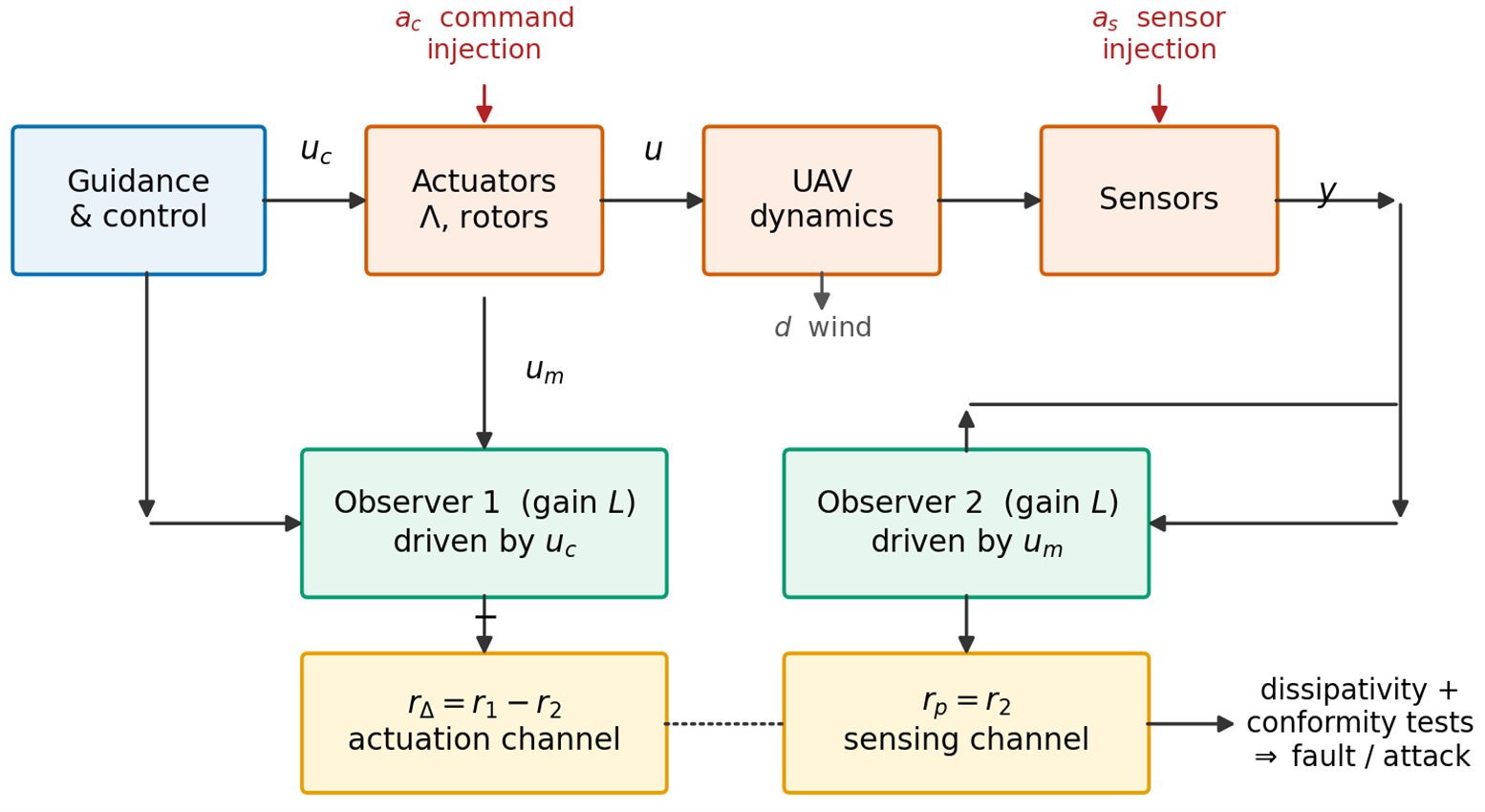
Unmanned aerial vehicles fail for two very different reasons: hardware degrades, and adversaries interfere. Both produce anomalous flight data, but they demand opposite responses, and conventional model-based diagnosis raises a single residual and therefore cannot separate them. The contribution of this research is a dual-residual diagnostic observer that resolves the ambiguity structurally rather than statistically, together with the deterministic detection bounds that accompany it. Two Luenberger observers with identical gains are driven by the commanded and by the measured rotor thrusts. Their difference is proved to be exactly invariant to every sensor-path signal and to depend only on the discrepancy between commanded and delivered actuation, while the second residual is correspondingly blind to actuation-path anomalies; gain matching is shown to be necessary as well as sufficient. A completeness result establishes that an adversary who forges actuator telemetry to silence the first residual necessarily excites the second. Faults are then separated from attacks by physical admissibility: passive degradation can only dissipate thrust and must follow a time-invariant affine law. Peak-gain thresholds give deterministic zero false alarms with closed-form minimum detectable anomalies, and six population-based optimisers tune the 25 design parameters. Across 450 Monte Carlo runs the tuned detector attains zero false alarms, 0.854 balanced accuracy, 0.696 Matthews correlation and 63 ms mean detection delay, with twelve of fifteen anomaly families detected and classified without error. The results show that channel separation, not detection sensitivity, is what distinguishes a fault from an attack, and that the residual blind spot can be stated as a bound rather than discovered in service.
References
J. Burbank, T. Caleb, E. Andam, and N. Kaabouch, “Detection and mitigation of cyber attacks on UAV networks,” Electronics, vol. 15, no. 2, p. 317, 2026, https://doi.org/10.3390/electronics15020317.
K. Osmani and D. Schulz, “Comprehensive investigation of unmanned aerial vehicles (UAVs): An in-depth analysis of avionics systems,” Sensors, vol. 24, no. 10, p. 3064, 2024, https://doi.org/10.3390/s24103064.
M. E. Yiğit, E. Bektaş, F. Korkmaz, and M. Teke, “Hybrid PSO MRFO optimization of PID parameters for real-time PMDC motor speed control,” Ain Shams Eng. J., vol. 17, no. 7, p. 104232, 2026, https://doi.org/10.1016/j.asej.2026.104232.
E. Bektaş and H. Karaca, “GA based selective harmonic elimination for multilevel inverter with reduced number of switches: An experimental study,” Elektron. Elektrotech., vol. 25, no. 3, pp. 10–17, 2019, https://doi.org/10.5755/j01.eie.25.3.23670.
E. Bektaş and H. Karaca, “GA based selective harmonic elimination for five level inverter using cascaded H bridge modules,” Int. J. Intell. Syst. Appl. Eng., vol. 4, no. 2, pp. 29–32, 2016, https://doi.org/10.18201/ijisae.97681.
B. Graziano and A. Sargolzaei, “Cybersecurity of unmanned aerial vehicles from a control systems perspective: A review,” Electronics, vol. 15, no. 1, p. 163, 2026, https://doi.org/10.3390/electronics15010163.
A. A. Alquwayzani and A. A. Albuali, “A systematic literature review of zero trust architecture for military UAV security systems,” IEEE Access, vol. 12, pp. 176033–176056, 2024, https://doi.org/10.1109/ACCESS.2024.3503587.
S. Kim, K.-J. Park, and C. Lu, “A survey on network security for cyber–physical systems: From threats to resilient design,” IEEE Commun. Surv. Tutor., vol. 24, no. 3, pp. 1534–1573, 2022, https://doi.org/10.1109/COMST.2022.3187531.
X. Hu, B. Wang, Y. Shen, Y. Fu, and N. Li, “Disturbance observer-enhanced adaptive fault-tolerant control of a quadrotor UAV against actuator faults and disturbances,” Drones, vol. 7, no. 8, p. 541, 2023, https://doi.org/10.3390/drones7080541.
S. A. Ahmed et al., “Advancements in UAV image semantic segmentation: A comprehensive literature review,” Multidiscip. Rev., vol. 7, no. 6, p. 2024118, 2024, https://doi.org/10.31893/multirev.2024118.
S. A. Ahmed, H. Desa, A.-S. T. Hussain, and T. A. Taha, “Implementation of deep neural networks learning on unmanned aerial vehicle based remote-sensing,” IAES Int. J. Artif. Intell., vol. 13, no. 1, pp. 941–947, 2024, https://doi.org/10.11591/ijai.v13.i1.pp941-947.
S. A. Ahmed, H. Desa, and A.-S. T. Hussain, “Aerial image semantic segmentation based on 3D fits a small dataset of 1D,” IAES Int. J. Artif. Intell., vol. 12, no. 4, pp. 2048–2054, 2023, https://doi.org/10.11591/ijai.v12.i4.pp2048-2054.
S. A. Ahmed, H. Desa, and A.-S. T. Hussain, “Classification of semantic segmentation using fully convolutional networks based unmanned aerial vehicle application,” IAES Int. J. Artif. Intell., vol. 12, no. 2, pp. 641–647, 2023, https://doi.org/10.11591/ijai.v12.i2.pp641-647.
R. Zheng, Q. Zhu, S. Huang, Z. Du, J. Shi, and Y. Lyu, “Extended state observer-based sliding-mode control for aircraft in tight formation considering wake vortices and uncertainty,” Drones, vol. 8, no. 4, p. 165, 2024, https://doi.org/10.3390/drones8040165.
Y. Jing, A. Mirza, R. Sipahi, and J. Martinez-Lorenzo, “Sliding mode controller with disturbance observer for quadcopters; experiments with dynamic disturbances and in turbulent indoor space,” Drones, vol. 7, no. 5, p. 328, 2023, https://doi.org/10.3390/drones7050328.
X. Zhu, Y. Li, G. Yin, and R. J. Patton, “Interval observer-based fault detection and isolation for quadrotor UAV with cable-suspended load,” IEEE Trans. Syst., Man, Cybern., Syst., vol. 54, no. 10, pp. 5876–5888, 2024, https://doi.org/10.1109/TSMC.2024.3411315.
J. Li, Y. Liu, Y. Jiang, Z. Wang, and Y. Li, “Fault detection for autonomous underwater vehicles based on zonotopic set-membership estimation,” IEEE Trans. Ind. Inform., vol. 21, no. 11, pp. 8453–8462, 2025, https://doi.org/10.1109/TII.2025.3582373.
Z. Wang, C. Xu, Z. Liu, and Y. Shen, “Fault detection for satellite reaction wheel based on zonotopic set-membership estimation,” IEEE Trans. Aerosp. Electron. Syst., vol. 61, no. 2, pp. 1577–1588, 2025, https://doi.org/10.1109/TAES.2024.3457745.
S. Zhang, V. Puig, and S. Ifqir, “Robust LPV fault diagnosis using the set-based approach for autonomous ground vehicles,” IEEE Trans. Intell. Transp. Syst., vol. 25, no. 8, pp. 9078–9090, 2024, https://doi.org/10.1109/TITS.2024.3394518.
J. D. Lee, S. Im, L. Kim, H. Ahn, and H. Bang, “Data-driven fault detection and isolation for multirotor system using Koopman operator,” J. Intell. Robot. Syst., vol. 110, p. 128, 2024, https://doi.org/10.1007/s10846-024-02142-y.
Y. Debele, H.-Y. Shi, A. Wondosen, T.-W. Ku, and B.-S. Kang, “Deep learning-based robust actuator fault detection and isolation scheme for highly redundant multirotor UAVs,” Drones, vol. 7, no. 7, p. 437, 2023, https://doi.org/10.3390/drones7070437.
N. Liu, Z. Zhou, L. Zhu, Y. He, and F. Huang, “Fault diagnosis of unmanned aerial systems using the Dempster–Shafer evidence theory,” Actuators, vol. 13, no. 7, p. 264, 2024, https://doi.org/10.3390/act13070264.
W. Wen, W. Zhong, Y. Liu, X. Li, and H. Lan, “Fault diagnosis of UAV rotor systems based on drone nest vibration analysis,” Drones, vol. 10, no. 6, p. 424, 2026, https://doi.org/10.3390/drones10060424.
A. Baldini, R. Felicetti, F. Ferracuti, A. Freddi, S. Iarlori, and A. Monteriù, “Real-time propeller fault detection for multirotor drones based on vibration data analysis,” Eng. Appl. Artif. Intell., vol. 123, p. 106343, 2023, https://doi.org/10.1016/j.engappai.2023.106343.
A. Baldini, R. Felicetti, F. Ferracuti, A. Freddi, and A. Monteriù, “Propeller fault detection and isolation for multirotor drones with adaptation to battery voltage drop,” J. Intell. Robot. Syst., vol. 112, p. 28, 2026, https://doi.org/10.1007/s10846-026-02369-x.
T. Ma, X. Zhang, and Z. Miao, “Detection of UAV GPS spoofing attacks using a stacked ensemble method,” Drones, vol. 9, no. 1, p. 2, 2025, https://doi.org/10.3390/drones9010002.
L. Alhoraibi, D. Alghazzawi, and R. Alhebshi, “Detection of GPS spoofing attacks in UAVs based on adversarial machine learning model,” Sensors, vol. 24, no. 18, p. 6156, 2024, https://doi.org/10.3390/s24186156.
R. Al-Syouf, O. Y. Aljarrah, R. Bani-Hani, and A. Alma’aitah, “Ensemble machine learning models utilizing a hybrid recursive feature elimination (RFE) technique for detecting GPS spoofing attacks against unmanned aerial vehicles,” Sensors, vol. 25, no. 8, p. 2388, 2025, https://doi.org/10.3390/s25082388.
M. Mouzai, M. A. Riahla, A. Keziou, and H. Fouchal, “Exploring multi-channel GPS receivers for detecting spoofing attacks on UAVs using machine learning,” Sensors, vol. 25, no. 13, p. 4045, 2025, https://doi.org/10.3390/s25134045.
K. Radoš, M. Brkić, and D. Begušić, “Recent advances on jamming and spoofing detection in GNSS,” Sensors, vol. 24, no. 13, p. 4210, 2024, https://doi.org/10.3390/s24134210.
A. Mohanty and G. Gao, “A survey of machine learning techniques for improving Global Navigation Satellite Systems,” EURASIP J. Adv. Signal Process., vol. 2024, p. 73, 2024, https://doi.org/10.1186/s13634-024-01167-7.
Y. Sun, M. Yu, L. Wang, T. Li, and M. Dong, “A deep-learning-based GPS signal spoofing detection method for small UAVs,” Drones, vol. 7, no. 6, p. 370, 2023, https://doi.org/10.3390/drones7060370.
G. Wang, J. Ai, L. Mo, X. Yi, P. Wu, X. Wu, and L. Kong, “Anomaly detection for data from unmanned systems via improved graph neural networks with attention mechanism,” Drones, vol. 7, no. 5, p. 326, 2023, https://doi.org/10.3390/drones7050326.
H. Khazane, M. Ridouani, F. Salahdine, and N. Kaabouch, “A holistic review of machine learning adversarial attacks in IoT networks,” Future Internet, vol. 16, no. 1, p. 32, 2024, https://doi.org/10.3390/fi16010032.
T. Talaei Khoei and N. Kaabouch, “A comparative analysis of supervised and unsupervised models for detecting attacks on the intrusion detection systems,” Information, vol. 14, no. 2, p. 103, 2023, https://doi.org/10.3390/info14020103.
K. Pan, Y. Lyu, F. Yang, Z. Tan, and Q. Pan, “Attack detection and security control for UAVs against attacks on desired trajectory,” J. Intell. Robot. Syst., vol. 110, p. 68, 2024, https://doi.org/10.1007/s10846-024-02086-3.
K. Pan, F. Yang, Y. Lyu, M. Ji, and Q. Pan, “Neural observer-based formation for multi-UAVs against deception and desired trajectory attacks,” Neurocomputing, vol. 622, p. 129297, 2025, https://doi.org/10.1016/j.neucom.2024.129297.
M.-Y. Lee, H. Chiu, and B.-S. Chen, “Networked security observer-based reference tracking control of stochastic quadrotor UAV system under cyber-attack: T-S fuzzy approach,” IEEE Access, vol. 10, pp. 30296–30322, 2022, https://doi.org/10.1109/ACCESS.2022.3158345.
W. Xing and J. Shen, “Security control of cyber–physical systems under cyber attacks: A survey,” Sensors, vol. 24, no. 12, p. 3815, 2024, https://doi.org/10.3390/s24123815.
D. Ding, Q.-L. Han, X. Ge, and J. Wang, “Secure state estimation and control of cyber-physical systems: A survey,” IEEE Trans. Syst., Man, Cybern., Syst., vol. 51, no. 1, pp. 176–190, 2021, https://doi.org/10.1109/TSMC.2020.3041121.
Y. K. Shi, Y. Q. Wang, and J. Y. Tuo, “Distributed secure state estimation of multi-agent systems under homologous sensor attacks,” IEEE/CAA J. Autom. Sinica, vol. 10, no. 1, pp. 67–77, 2023, https://doi.org/10.1109/JAS.2022.105920.
X. Feng, X. Li, S. Li, and F. Pan, “Secure state estimation for unmanned aircraft cyber-physical systems under multiple attacks,” Asian J. Control, vol. 24, no. 2, pp. 818–833, 2022, https://doi.org/10.1002/asjc.2757.
L. Xu, Y. Zhu, Z. Li, and Q. Zhang, “Safety control for cyber–physical systems under false data injection attacks,” Electronics, vol. 14, no. 6, p. 1103, 2025, https://doi.org/10.3390/electronics14061103.
Y. Chen, Z. Liang, and L. Zhang, “Sliding mode control strategy based on intermediate variable observer for cyber-physical systems under false data injection attack,” Proc. Inst. Mech. Eng., Part I: J. Syst. Control Eng., vol. 239, no. 6, pp. 1132–1142, 2025, https://doi.org/10.1177/09596518241302480.
J. Ouyang, Y. Chen, Y. Diao, and F. Huang, “Modeling and recognition of latent false data injection attacks on distributed cluster control of distribution network,” Electronics, vol. 14, no. 9, p. 1761, 2025, https://doi.org/10.3390/electronics14091761.
J. Hu, X. Yang, and L.-X. Yang, “A framework for detecting false data injection attacks in large-scale wireless sensor networks,” Sensors, vol. 24, no. 5, p. 1643, 2024, https://doi.org/10.3390/s24051643.
B. Yang, L. Xin, and Z. Long, “Research on secure state estimation and recovery control for CPS under stealthy attacks,” Actuators, vol. 12, no. 11, p. 427, 2023, https://doi.org/10.3390/act12110427.
Q. Li, D. Song, Y. Wang, D. Wang, W. Tao, and Q. Ai, “Defense strategy against false data injection attacks on cyber–physical system for vehicle–grid based on KNN-GAE,” Energies, vol. 18, no. 19, p. 5215, 2025, https://doi.org/10.3390/en18195215.
H. Yang, Z. Yu, and Y. Zhang, “Observer-based adaptive resilient fault-tolerant cooperative control for multiple fixed-wing UAVs subject to cyberattacks and actuator faults,” IEEE Internet Things J., vol. 13, no. 3, pp. 5179–5192, 2026, https://doi.org/10.1109/JIOT.2025.3642912.
Y. Hu, X. Dai, D. Cui, and T. Chai, “Detection and identification of cyberattacks and physical faults in multi-agent systems: A distributed disturbance decoupling observer,” IEEE Trans. Ind. Inform., vol. 20, no. 2, pp. 2991–3001, 2024, https://doi.org/10.1109/TII.2023.3299622.
K. Zhang, C. Keliris, T. Parisini, and M. M. Polycarpou, “Identification of sensor replay attacks and physical faults for cyber-physical systems,” IEEE Control Syst. Lett., vol. 6, pp. 1178–1183, 2022, https://doi.org/10.1109/LCSYS.2021.3089674.
M. Badr, H. A. Talebi, and M. A. Khosravi, “Enhanced stochastic coding framework for discriminating faults and cyber incidents in hybrid systems,” IET Control Theory Appl., vol. 18, no. 17, pp. 2410–2421, 2024, https://doi.org/10.1049/cth2.12744.
L. Sheng, S. Wu, and Z. Lv, “Modified grey wolf optimizer and application in parameter optimization of PI controller,” Appl. Sci., vol. 15, no. 8, p. 4530, 2025, https://doi.org/10.3390/app15084530.
Published
How to Cite
Issue
Section
License
Copyright (c) 2026 Mohammed Jasim Mohammed

This work is licensed under a Creative Commons Attribution-ShareAlike 4.0 International License.
Authors who publish with this journal agree to the following terms:
- Authors retain copyright and grant the journal right of first publication with the work simultaneously licensed under a Creative Commons Attribution License that allows others to share the work with an acknowledgment of the work's authorship and initial publication in this journal.
- Authors are able to enter into separate, additional contractual arrangements for the non-exclusive distribution of the journal's published version of the work (e.g., post it to an institutional repository or publish it in a book), with an acknowledgment of its initial publication in this journal.
- Authors are permitted and encouraged to post their work online (e.g., in institutional repositories or on their website) prior to and during the submission process, as it can lead to productive exchanges, as well as earlier and greater citation of published work (See The Effect of Open Access).

This journal is licensed under a Creative Commons Attribution-ShareAlike 4.0 International License.