A Hybrid Benchmark Framework for Metaheuristic Optimization across Cloud, Edge, Internet-of-Things, and Sixth-Generation Communication Networks
DOI:
https://doi.org/10.12928/biste.v8i5.16930Keywords:
Metaheuristic Optimization, Hybrid Benchmark Framework, Cloud–Edge–IoT Continuum, 6G Resource Allocation, ReproducibilityAbstract
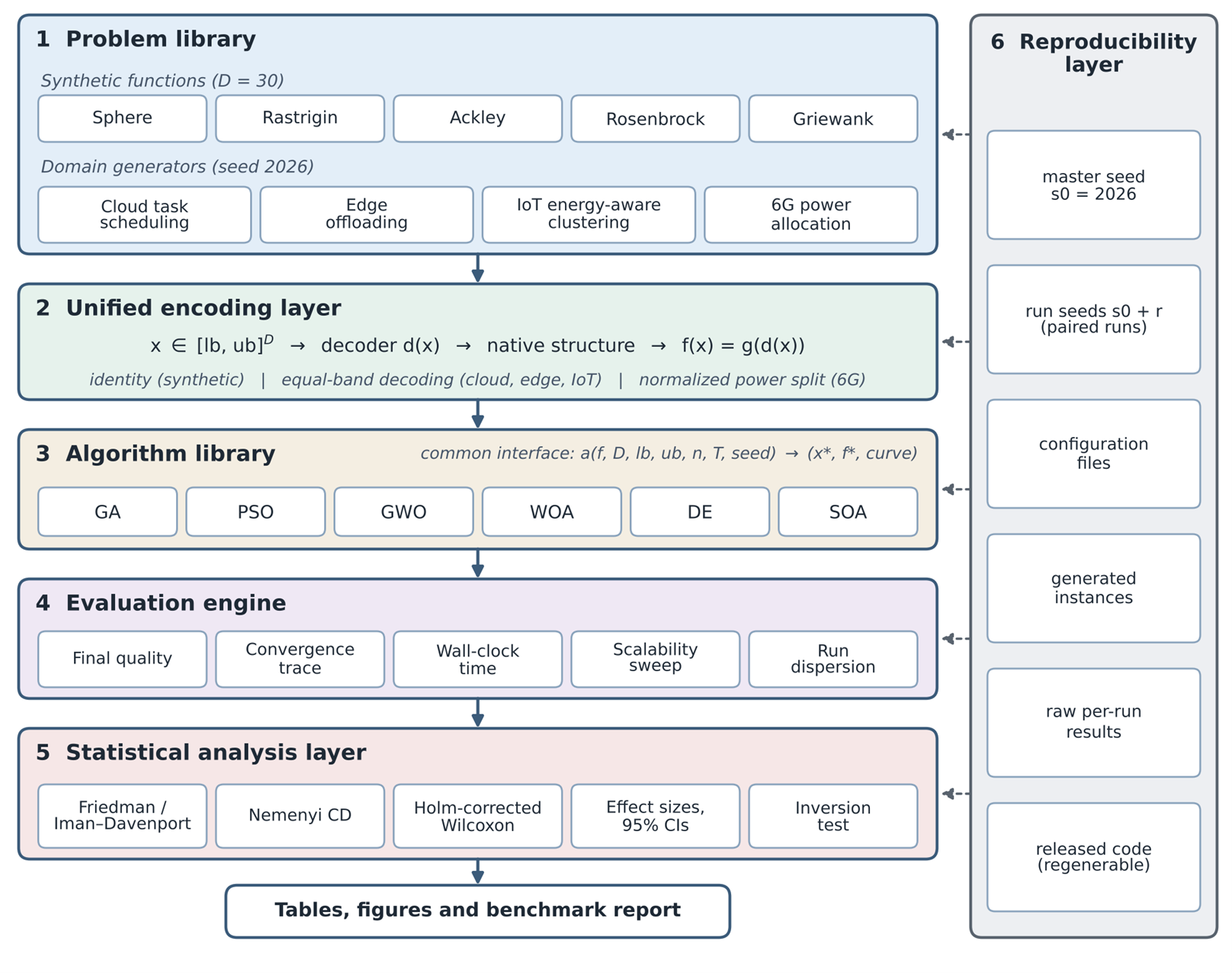
Metaheuristics are the standard tool for NP-hard resource management across the cloud–edge–Internet-of-Things (IoT)–sixth-generation (6G) continuum, yet they are usually ranked on synthetic functions or a single application, so whether rankings transfer between problem classes is unknown. The research contribution is the Hybrid Benchmark Framework (HBF), a seeded engine that, unlike synthetic-only platforms such as the CEC suites, COCO/BBOB and IOHprofiler, places synthetic functions and communication–computing models behind a single continuous-encoding interface and statistical protocol, with a permutation test that quantifies ranking inversion. Five synthetic functions are combined with four seeded models of cloud scheduling, edge offloading, IoT clustering and 6G power allocation. Six optimizers (GA, PSO, GWO, WOA, DE and the 2026 Secant Optimization Algorithm) were run 20 times per problem with 9,030 evaluations each and compared with non-parametric tests, effect sizes and 95% confidence intervals. WOA and GWO hold the top two ranks on all five synthetic functions. On the three models that become categorical after decoding, the order reverses: the GA, last on the synthetic block, attains the best mean on all three, clearly on edge offloading (Hedges' g = 0.98, p < 0.001), whereas WOA falls to ranks 6, 6 and 4. Synthetic and categorical rankings are negatively correlated (Spearman ρ = −0.66, exact permutation p = 0.018), so pooled Friedman ranks cancel (p = 0.22). On the 6G model, which stays continuous after decoding, all optimizers lie within 0.028%. Optimizer rankings depend on the decoded objective's structure, so synthetic-suite results should be verified before discrete deployment.
References
A. M. Rahmani, A. Haider, P. Khoshvaght, F. S. Gharehchopogh, K. Moghaddasi, S. Rajabi, and M. Hosseinzadeh, “Optimizing task offloading with metaheuristic algorithms across cloud, fog, and edge computing networks: A comprehensive survey and state-of-the-art schemes,” Sustainable Computing: Informatics and Systems, vol. 45, p. 101080, 2025, https://doi.org/10.1016/j.suscom.2024.101080.
C. Sharanya, M. P. Lakshmi, P. S. Velumani, S. Perumalla, S. Lakshmanaprakash, M. T. Jagtap, A. Choudhary, and P. Ramesh, “Network slicing concurrent resource allocation for improving service response of 6G network using a novel cycle-consistent spatial frequency self-attention network with Tasmanian devil optimization,” Int. J. Commun. Syst., vol. 38, no. 12, p. e70156, 2025, https://doi.org/10.1002/dac.70156.
X. Ni, Z. Dong, and X. Rong, “Innovative application of 6G network slicing driven by artificial intelligence in the Internet of Vehicles,” Int. J. Netw. Manage., vol. 35, no. 2, p. e70004, 2025, https://doi.org/10.1002/nem.70004.
A. Satouf, A. Hamidoğlu, Ö. M. Gül, A. Kuusik, L. Durak Ata, and S. Kadry, “Metaheuristic-based task scheduling for latency-sensitive IoT applications in edge computing,” Cluster Comput., vol. 28, no. 2, p. 143, 2025, https://doi.org/10.1007/s10586-024-04878-6.
A. A. Abba Ari, F. Samafou, A. N. Njoya, A. C. Djedouboum, M. Aboubakar, and A. Mohamadou, “IoT-5G and B5G/6G resource allocation and network slicing orchestration using learning algorithms,” IET Netw., vol. 14, no. 1, p. e70002, 2025, https://doi.org/10.1049/ntw2.70002.
S. Katoch, S. S. Chauhan, and V. Kumar, “A review on genetic algorithm: Past, present, and future,” Multimed. Tools Appl., vol. 80, no. 5, pp. 8091–8126, 2021, https://doi.org/10.1007/s11042-020-10139-6.
J. Kennedy and R. Eberhart, “Particle swarm optimization,” in Proc. ICNN'95 – Int. Conf. Neural Networks, vol. 4, pp. 1942–1948, 1995, https://doi.org/10.1109/ICNN.1995.488968.
S. Mirjalili, S. M. Mirjalili, and A. Lewis, “Grey wolf optimizer,” Adv. Eng. Softw., vol. 69, pp. 46–61, 2014, https://doi.org/10.1016/j.advengsoft.2013.12.007.
S. Mirjalili and A. Lewis, “The whale optimization algorithm,” Adv. Eng. Softw., vol. 95, pp. 51–67, 2016, https://doi.org/10.1016/j.advengsoft.2016.01.008.
R. Storn and K. Price, “Differential evolution – A simple and efficient heuristic for global optimization over continuous spaces,” J. Global Optim., vol. 11, no. 4, pp. 341–359, 1997, https://doi.org/10.1023/A:1008202821328.
M. Dehghani, Z. Montazeri, E. Trojovská, and P. Trojovský, “Coati optimization algorithm: A new bio-inspired metaheuristic algorithm for solving optimization problems,” Knowledge-Based Syst., vol. 259, p. 110011, 2023, https://doi.org/10.1016/j.knosys.2022.110011.
S. Zhao, T. Zhang, S. Ma, and M. Chen, “Dandelion optimizer: A nature-inspired metaheuristic algorithm for engineering applications,” Eng. Appl. Artif. Intell., vol. 114, p. 105075, 2022, https://doi.org/10.1016/j.engappai.2022.105075.
B. Abdollahzadeh, F. S. Gharehchopogh, N. Khodadadi, and S. Mirjalili, “Mountain gazelle optimizer: A new nature-inspired metaheuristic algorithm for global optimization problems,” Adv. Eng. Softw., vol. 174, p. 103282, 2022, https://doi.org/10.1016/j.advengsoft.2022.103282.
M. H. Amiri, N. Mehrabi Hashjin, M. Montazeri, S. Mirjalili, and N. Khodadadi, “Hippopotamus optimization algorithm: A novel nature-inspired optimization algorithm,” Sci. Rep., vol. 14, no. 1, p. 5032, 2024, https://doi.org/10.1038/s41598-024-54910-3.
W. Zhao, L. Wang, Z. Zhang, H. Fan, J. Zhang, S. Mirjalili, N. Khodadadi, and Q. Cao, “Electric eel foraging optimization: A new bio-inspired optimizer for engineering applications,” Expert Syst. Appl., vol. 238, p. 122200, 2024, https://doi.org/10.1016/j.eswa.2023.122200.
M. Q. Ibrahim, M. Qaraad, N. K. Hussein, M. A. Farag, and D. Guinovart, “Secant optimization algorithm for efficient global optimization,” Sci. Rep., vol. 16, no. 1, p. 6659, 2026, https://doi.org/10.1038/s41598-026-36691-z.
T. Ivanovski, M. Brkić Bakarić, and M. Matetić, “Recent advances in metaheuristic algorithms,” Algorithms, vol. 19, no. 1, p. 19, 2026, https://doi.org/10.3390/a19010019.
W. F. Mbasso, A. Harrison, Z. Liu, Z. Mamadiyarov, S. F. Al-Gahtani, and Z. M. S. Elbarbary, “How do metaheuristics exploit? A particle-level behavioral study across the CEC 2025 benchmark functions,” Evolutionary Intelligence, vol. 19, no. 3, p. 77, 2026, https://doi.org/10.1007/s12065-026-01190-7.
K. Rajwar, K. Deep, and S. Das, “An exhaustive review of the metaheuristic algorithms for search and optimization: Taxonomy, applications, and open challenges,” Artif. Intell. Rev., vol. 56, no. 11, pp. 13187–13257, 2023, https://doi.org/10.1007/s10462-023-10470-y.
A. P. Piotrowski, J. J. Napiorkowski, and A. E. Piotrowska, “Choice of benchmark optimization problems does matter,” Swarm Evolutionary Comput., vol. 83, p. 101378, 2023, https://doi.org/10.1016/j.swevo.2023.101378.
M. Z. Naser, M. K. Al-Bashiti, A. Teymori Gharah Tapeh, A. Naser, V. Kodur, R. Hawileh, J. Abdalla, N. Khodadadi, A. H. Gandomi, and A. Dadras Eslamlou, “A review of benchmark and test functions for global optimization algorithms and metaheuristics,” WIREs Comput. Stat., vol. 17, no. 2, p. e70028, 2025, https://doi.org/10.1002/wics.70028.
D. H. Wolpert and W. G. Macready, “No free lunch theorems for optimization,” IEEE Trans. Evol. Comput., vol. 1, no. 1, pp. 67–82, 1997, https://doi.org/10.1109/4235.585893.
H. Mikram and S. El Kafhali, “Optimizing workflow scheduling for efficient resource utilization in scalable cloud computing data centers,” Simulation, vol. 101, no. 11, pp. 1133–1151, 2025, https://doi.org/10.1177/00375497251356490.
A. LaTorre, D. Molina, E. Osaba, J. Poyatos, J. Del Ser, and F. Herrera, “A prescription of methodological guidelines for comparing bio-inspired optimization algorithms,” Swarm Evolutionary Comput., vol. 67, p. 100973, 2021, https://doi.org/10.1016/j.swevo.2021.100973.
E. Osaba, E. Villar-Rodriguez, J. Del Ser, A. J. Nebro, D. Molina, A. LaTorre, P. N. Suganthan, C. A. Coello Coello, and F. Herrera, “A tutorial on the design, experimentation and application of metaheuristic algorithms to real-world optimization problems,” Swarm Evolutionary Comput., vol. 64, p. 100888, 2021, https://doi.org/10.1016/j.swevo.2021.100888.
J. Derrac, S. García, D. Molina, and F. Herrera, “A practical tutorial on the use of nonparametric statistical tests as a methodology for comparing evolutionary and swarm intelligence algorithms,” Swarm Evolutionary Comput., vol. 1, no. 1, pp. 3–18, 2011, https://doi.org/10.1016/j.swevo.2011.02.002.
N. Hansen, A. Auger, R. Ros, O. Mersmann, T. Tušar, and D. Brockhoff, “COCO: A platform for comparing continuous optimizers in a black-box setting,” Optimization Methods Software, vol. 36, no. 1, pp. 114–144, 2021, https://doi.org/10.1080/10556788.2020.1808977.
H. Wang, D. Vermetten, F. Ye, C. Doerr, and T. Bäck, “IOHanalyzer: Detailed performance analyses for iterative optimization heuristics,” ACM Trans. Evol. Learn. Optim., vol. 2, no. 1, pp. 1–29, 2022, https://doi.org/10.1145/3510426.
N. Van Thieu and S. Mirjalili, “MEALPY: An open-source library for latest meta-heuristic algorithms in Python,” J. Syst. Archit., vol. 139, p. 102871, 2023, https://doi.org/10.1016/j.sysarc.2023.102871.
B. Huang, R. Cheng, Z. Li, Y. Jin, and K. C. Tan, “EvoX: A distributed GPU-accelerated framework for scalable evolutionary computation,” IEEE Trans. Evol. Comput., vol. 29, no. 5, pp. 1649–1662, 2025, https://doi.org/10.1109/TEVC.2024.3388550.
J. Kudela, “A critical problem in benchmarking and analysis of evolutionary computation methods,” Nat. Mach. Intell., vol. 4, no. 12, pp. 1238–1245, 2022, https://doi.org/10.1038/s42256-022-00579-0.
F. A. Hashim, E. H. Houssein, K. Hussain, M. S. Mabrouk, and W. Al-Atabany, “Honey badger algorithm: New metaheuristic algorithm for solving optimization problems,” Mathematics and Computers in Simulation, vol. 192, pp. 84–110, 2022, https://doi.org/10.1016/j.matcom.2021.08.013.
F. A. Hashim and A. G. Hussien, “Snake optimizer: A novel meta-heuristic optimization algorithm,” Knowledge-Based Syst., vol. 242, p. 108320, 2022, https://doi.org/10.1016/j.knosys.2022.108320.
L. Abualigah, M. Abd Elaziz, P. Sumari, Z. W. Geem, and A. H. Gandomi, “Reptile search algorithm (RSA): A nature-inspired meta-heuristic optimizer,” Expert Syst. Appl., vol. 191, p. 116158, 2022, https://doi.org/10.1016/j.eswa.2021.116158.
J. O. Agushaka, A. E. Ezugwu, and L. Abualigah, “Dwarf mongoose optimization algorithm,” Comput. Methods Appl. Mech. Eng., vol. 391, p. 114570, 2022, https://doi.org/10.1016/j.cma.2022.114570.
H. Su, D. Zhao, A. A. Heidari, L. Liu, X. Zhang, M. Mafarja, and H. Chen, “RIME: A physics-based optimization,” Neurocomputing, vol. 532, pp. 183–214, 2023, https://doi.org/10.1016/j.neucom.2023.02.010.
M. Abdel-Basset, R. Mohamed, and M. Abouhawwash, “Crested porcupine optimizer: A new nature-inspired metaheuristic,” Knowledge-Based Syst., vol. 284, p. 111257, 2024, https://doi.org/10.1016/j.knosys.2023.111257.
M. Hubálovská, Š. Hubálovský, and P. Trojovský, “Botox optimization algorithm: A new human-based metaheuristic algorithm for solving optimization problems,” Biomimetics, vol. 9, no. 3, p. 137, 2024, https://doi.org/10.3390/biomimetics9030137.
M. Hubalovska and S. Major, “A new human-based metaheuristic algorithm for solving optimization problems based on technical and vocational education and training,” Biomimetics, vol. 8, no. 6, p. 508, 2023, https://doi.org/10.3390/biomimetics8060508.
I. Ahmadianfar, A. A. Heidari, S. Noshadian, H. Chen, and A. H. Gandomi, “INFO: An efficient optimization algorithm based on weighted mean of vectors,” Expert Syst. Appl., vol. 195, p. 116516, 2022, https://doi.org/10.1016/j.eswa.2022.116516.
C. L. Camacho-Villalón, M. Dorigo, and T. Stützle, “Exposing the grey wolf, moth-flame, whale, firefly, bat, and antlion algorithms: Six misleading optimization techniques inspired by bestial metaphors,” Int. Trans. Oper. Res., vol. 30, no. 6, pp. 2945–2971, 2023, https://doi.org/10.1111/itor.13176.
C. Aranha, C. L. Camacho Villalón, F. Campelo, M. Dorigo, R. Ruiz, M. Sevaux, K. Sörensen, and T. Stützle, “Metaphor-based metaheuristics, a call for action: The elephant in the room,” Swarm Intell., vol. 16, no. 1, pp. 1–6, 2022, https://doi.org/10.1007/s11721-021-00202-9.
F. K. Karim, S. Ghorashi, S. Alkhalaf, S. H. A. Hamza, A. Ben Ishak, and S. Abdel-Khalek, “Optimizing makespan and resource utilization in cloud computing environment via evolutionary scheduling approach,” PLOS ONE, vol. 19, no. 11, p. e0311814, 2024, https://doi.org/10.1371/journal.pone.0311814.
R. Sandhu, M. Faiz, H. Kaur, A. Srivastava, and V. Narayan, “Enhancement in performance of cloud computing task scheduling using optimization strategies,” Cluster Comput., vol. 27, no. 5, pp. 6265–6288, 2024, https://doi.org/10.1007/s10586-023-04254-w.
N. Nujhat, F. H. Shanta, S. Sarker, P. Roy, M. A. Razzaque, M. Mamun-Or-Rashid, M. M. Hassan, and G. Fortino, “Task offloading exploiting grey wolf optimization in collaborative edge computing,” J. Cloud Comput., vol. 13, no. 1, p. 23, 2024, https://doi.org/10.1186/s13677-023-00570-z.
C. Kurangi, K. K. Paidipati, A. S. K. Reddy, J. Uthayakumar, G. Kadiravan, and S. Parveen, “Metaheuristic optimization-based clustering with routing protocol in wireless sensor networks,” Int. J. Commun. Syst., vol. 37, no. 16, p. e5914, 2024, https://doi.org/10.1002/dac.5914.
R. Priyadarshi, “Energy-efficient routing in wireless sensor networks: A meta-heuristic and artificial intelligence-based approach: A comprehensive review,” Arch. Comput. Methods Eng., vol. 31, no. 4, pp. 2109–2137, 2024, https://doi.org/10.1007/s11831-023-10039-6.
M. M. Shwaysh, A.-S. T. Hussain, S. Q. Salih, T. A. Almulaisi, A. D. Radhi, H. S. Majdi, and H. Desa, “Adaptive hybrid information gain and autoencoder-based feature selection with ensemble recurrent extreme learning machine for enhanced network intrusion detection systems,” J. Network Syst. Manage., vol. 34, no. 1, p. 11, 2025, https://doi.org/10.1007/s10922-025-09976-3.
F. H. Taha, S. H. Hussein, M. T. Yaseen, H. A. Fadhil, S. A. Assi, H. Desa, A. I. Imran, A. D. Radhi, and T. Almulaisi, “Investigation and design of high efficiency quadrature power amplifier for 5G applications,” Int. J. Robot. Control Syst., vol. 5, no. 2, pp. 1481–1497, 2025, https://doi.org/10.31763/ijrcs.v5i2.1881.
F. N. Hasoon, H. A. Fadhil, A.-S. T. Hussain, H. A. Kazem, and T. Almulaisi, “Development of new hybrid optical CDMA COARSE radio over fiber for 5G capacity improvement,” Int. J. Electron. Commun. Eng., vol. 13, no. 4, pp. 233–238, 2026, https://doi.org/10.14445/23488549/ijece-v13i4p119.
S. A. Ahmed, M. R. B. Agha, Z. A. Abbood, A. H. Salih, M. A. Arif, A. D. Sallibi, A. M. Hussein, S. K. Mukhlif, and T. Almulaisi, “Anomaly detection in renewable energy SCADA systems using explainable AI techniques,” in 2026 2nd Int. Symp. AI-Driven Engineering Systems (ISADES), pp. 1–6, 2026, https://doi.org/10.1109/isades69945.2026.11608103.
M. U. F. Qaisar, W. Yuan, O. Günlü, T. Riihonen, Y. Cui, L. Zhang, N. Gonzalez-Prelcic, M. Di Renzo, and Z. Han, “The role of ISAC in 6G networks: Enabling next-generation wireless systems,” IEEE Trans. Netw. Sci. Eng., vol. 13, pp. 7825–7861, 2026, https://doi.org/10.1109/TNSE.2026.3666665.
S. Sikkanan, C. Kumar, P. Manoharan, and S. Ravichandran, “Exploring the potential of 5G uplink communication: Synergistic integration of joint power control, user grouping, and multi-learning grey wolf optimizer,” Sci. Rep., vol. 14, no. 1, p. 21406, 2024, https://doi.org/10.1038/s41598-024-71751-2.
M. Becerra-Rozas, J. Lemus-Romani, F. Cisternas-Caneo, B. Crawford, R. Soto, G. Astorga, C. Castro, and J. García, “Continuous metaheuristics for binary optimization problems: An updated systematic literature review,” Mathematics, vol. 11, no. 1, p. 129, 2023, https://doi.org/10.3390/math11010129.
J. Lemus-Romani, B. Crawford, F. Cisternas-Caneo, R. Soto, and M. Becerra-Rozas, “Binarization of metaheuristics: Is the transfer function really important?” Biomimetics, vol. 8, no. 5, p. 400, 2023, https://doi.org/10.3390/biomimetics8050400.
Published
How to Cite
Issue
Section
License
Copyright (c) 2026 Hilal A. Fadhil, Shouket A. Ahmed, Maha I. Raheem, Mustafa Mohammed Al-Tuhafi, Ahmed Dheyaa Radhi, Taha Almulaisi

This work is licensed under a Creative Commons Attribution-ShareAlike 4.0 International License.
Authors who publish with this journal agree to the following terms:
- Authors retain copyright and grant the journal right of first publication with the work simultaneously licensed under a Creative Commons Attribution License that allows others to share the work with an acknowledgment of the work's authorship and initial publication in this journal.
- Authors are able to enter into separate, additional contractual arrangements for the non-exclusive distribution of the journal's published version of the work (e.g., post it to an institutional repository or publish it in a book), with an acknowledgment of its initial publication in this journal.
- Authors are permitted and encouraged to post their work online (e.g., in institutional repositories or on their website) prior to and during the submission process, as it can lead to productive exchanges, as well as earlier and greater citation of published work (See The Effect of Open Access).

This journal is licensed under a Creative Commons Attribution-ShareAlike 4.0 International License.