Wearable Sensor-Based Sport Activity Recognition Using Machine Learning Classification Techniques
DOI:
https://doi.org/10.12928/biste.v8i5.16855Keywords:
Sport Activity Recognition, Wearable Sensors, Machine Learning Classification, Support Vector Machine (SVM), Sensor Data FusionAbstract
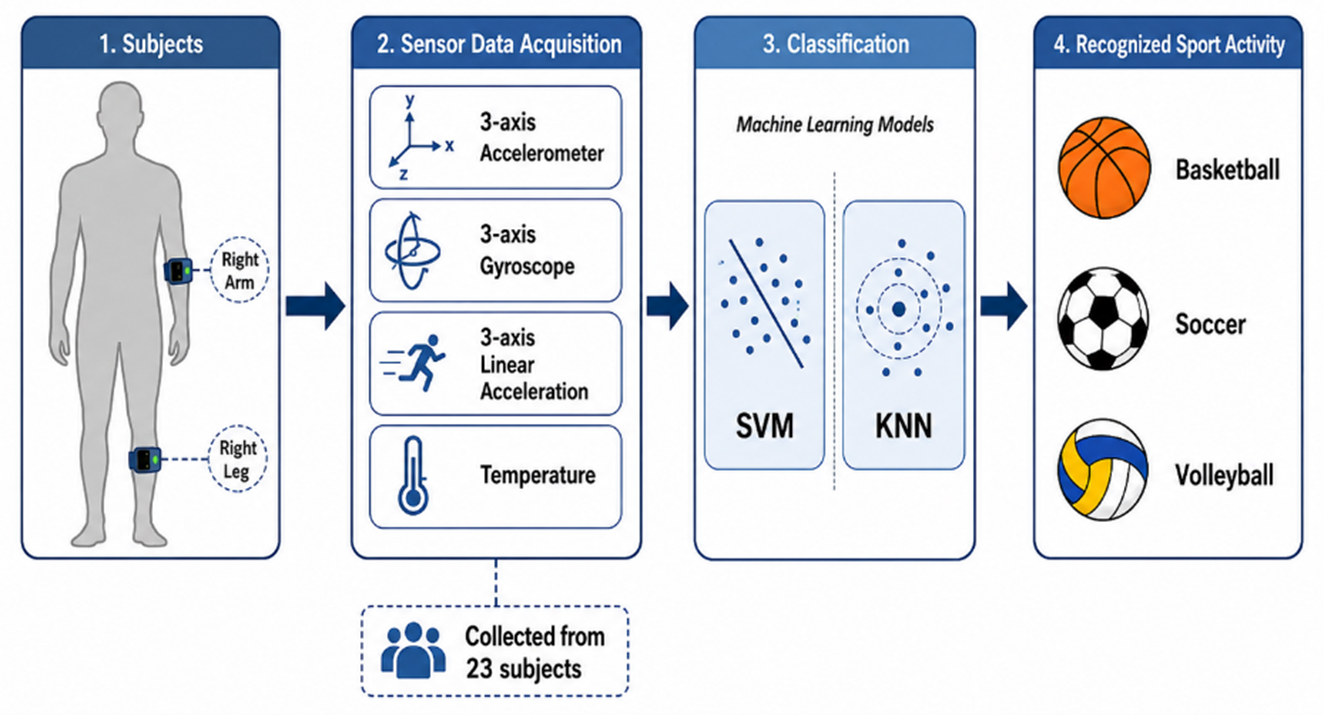
Sport activity recognition using wearable sensors is important for monitoring human movement and supporting sport-performance analysis. This study presents a machine-learning framework for recognizing basketball, soccer, and volleyball activities using wearable sensor data collected from 23 subjects. Sensors were placed on the right arm and right leg to record accelerometer, gyroscope, linear acceleration, and temperature signals representing upper- and lower-body movements. Several supervised machine-learning classifiers were evaluated using cross-validation and standard classification metrics. The results showed that Support Vector Machine (SVM) achieved the best overall performance, with an accuracy of 84.796%, macro-precision of 0.84827, macro-recall of 0.84796, and macro-F1 score of 0.84795. K-Nearest Neighbors (KNN) achieved the second-highest accuracy of 81.344%, followed by the Ensemble classifier with 78.180%. The findings indicate that SVM is more effective in separating the partially overlapping and nonlinear motion patterns associated with the selected sport activities. Beyond classifier comparison, the study demonstrates the effectiveness of dual-location multimodal wearable sensing and comprehensive model evaluation for distinguishing sport activities with partially overlapping movement patterns.
References
H. A. Imran, Q. Riaz, M. Hussain, H. Tahir, andR. Arshad, “Smart-wearable sensors and CNN-BiGRU model: A powerful combination for human activity recognition,” IEEE Sens. J., vol. 24, no. 2, pp. 1963–1974, 2024, https://doi.org/10.1109/JSEN.2023.3338264.
S. Wang, Y. Sun, Y. Sha, G. Yang, D. Cheng, L. Zhang, H. Wu, and A. Song, “Robust human activity recognition via wearable sensors using dynamic Gaussian kernel learning,” IEEE Sens. J., vol. 24, no. 6, pp. 8265–8280, 2024, https://doi.org/10.1109/JSEN.2024.3355704.
Y. Albadawi and T. Shanableh, “Hand-crafted features with a simple deep learning architecture for sensor-based human activity recognition,” IEEE Sens. J., vol. 24, no. 17, pp. 28300–28313, 2024, https://doi.org/10.1109/JSEN.2024.3422272.
Q. Teng, Y. Tang, and G. Hu, “Large receptive field attention: An innovation in decomposing large-kernel convolution for sensor-based activity recognition,” IEEE Sens. J., vol. 24, no. 8, pp. 13488–13499, 2024, https://doi.org/10.1109/JSEN.2024.3364187.
X. Yu and M. A. A. Al-qaness, “Human activity recognition using deep residual convolutional network based on wearable sensors,” IEEE J. Biomed. Health Inform., vol. 29, no. 3, pp. 1950–1958, 2025, https://doi.org/10.1109/JBHI.2024.3510860.
I. Kim, J. Lim, and J. Lee, “Human activity recognition via temporal fusion contrastive learning,” IEEE Access, vol. 12, pp. 20854–20866, 2024, https://doi.org/10.1109/ACCESS.2024.3357143.
A. S. M. Miah, Y. S. Hwang, and J. Shin, “Sensor-based human activity recognition based on multi-stream time-varying features with ECA-Net dimensionality reduction,” IEEE Access, vol. 12, pp. 151649–151668, 2024, https://doi.org/10.1109/ACCESS.2024.3473828.
N. A. Choudhury and B. Soni, “KNEE-HAR: A ConvLSTM-based lightweight hybrid deep learning model for human activity recognition with knee abnormalities using raw physiological sensor data,” IEEE Sens. J., vol. 25, no. 7, pp. 12399–12406, 2025, https://doi.org/10.1109/JSEN.2025.3540903.
P. Lalwani and G. Ramasamy, “Human activity recognition using a multi-branched CNN-BiLSTM-BiGRU model,” Appl. Soft Comput., vol. 154, p. 111344, 2024, https://doi.org/10.1016/j.asoc.2024.111344.
J. Liang, L. Zhang, C. Bu, G. Yang, H. Wu, and A. Song, “Plug-and-play multi-dimensional attention module for accurate human activity recognition,” Comput. Netw., vol. 244, p. 110338, 2024, https://doi.org/10.1016/j.comnet.2024.110338.
M. H. Khan, H. Shafiq, M. S. Farid, and M. Grzegorzek, “Encoding human activities using multimodal wearable sensory data,” Expert Syst. Appl., vol. 261, p. 125564, 2025, https://doi.org/10.1016/j.eswa.2024.125564.
A. Dahal, S. Moulik, and R. Mukherjee, “Stack-HAR: Complex human activity recognition with stacking-based ensemble learning framework,” IEEE Sens. J., vol. 25, no. 9, pp. 16373–16380, 2025, https://doi.org/10.1109/JSEN.2025.3549311.
X. Zhou, J. Yuan, L. Fan, X. Niu, K. Zha, and X. Liu, “MSMFT: Multi-stream multimodal factorized transformer for human activity recognition,” IEEE Sens. J., vol. 25, no. 6, pp. 10402–10416, 2025, https://doi.org/10.1109/JSEN.2025.3529889.
Z. Chen, H. Zou, L. Wang, B. Wang, F. Zhang, S. Ma, et al., “Eff-WHAR: A lightweight design for efficient wearable sensor-based human activity recognition,” IEEE Sens. J., vol. 25, no. 2, pp. 3935–3948, 2025, https://doi.org/10.1109/JSEN.2024.3509961.
I. Charabi, M. B. Abidine, B. Fergani, and M. Oussalah, “DeepF-SVM: A new hybrid deep learning model for enhanced sensor-based human activity recognition,” Cluster Comput., vol. 28, p. 910, 2025, https://doi.org/10.1007/s10586-025-05636-y.
X. Long, P. Wang, F. Gu, C. Chen, and S. Guo, “Accurate and efficient human activity recognition through semi-supervised deep learning,” IEEE Sens. J., vol. 25, no. 12, pp. 23105–23116, 2025, https://doi.org/10.1109/JSEN.2025.3561418.
M. Refat, M. Hossain, M. Islam, et al., “A hybrid LSTM CNN model with efficient channel attention for enhanced human activity recognition using wearable sensors,” Discov. Appl. Sci., vol. 8, p. 113, 2026, https://doi.org/10.1007/s42452-025-07896-0.
R. Bodhe, S. Sivakumar, G. Sakarkar, F. H. Juwono, and C. Apriono, “Outdoor activity classification using smartphone based inertial sensor measurements,” Multimed. Tools Appl., vol. 83, pp. 76963–76989, 2024, https://doi.org/10.1007/s11042-024-18599-w.
A. Barua, X. Jiang, and D. Fuller, “The effectiveness of simple heuristic features in sensor orientation and placement problems in human activity recognition using a single smartphone accelerometer,” BioMed. Eng. OnLine, vol. 23, p. 21, 2024, https://doi.org/10.1186/s12938-024-01213-3.
M. Yao, L. Zhang, D. Cheng, L. Qin, X. Liu, Z. Fu, H. Wu, and A. Song, “Revisiting large-kernel CNN design via structural re-parameterization for sensor-based human activity recognition,” IEEE Sens. J., vol. 24, no. 8, pp. 12863–12876, 2024, https://doi.org/10.1109/JSEN.2024.3371462.
Y. Tian, D. Hettiarachchi, H. Yu, and S. Kamijo, “Complex human activity recognition based on spatial LSTM and deep residual convolutional network using wearable motion sensors,” IEEE Sens. J., vol. 24, no. 14, pp. 23183–23196, 2024, https://doi.org/10.1109/JSEN.2024.3404777.
H. Park, G. H. Lee, J. Han, and J. K. Choi, “Multiclass autoencoder-based active learning for sensor-based human activity recognition,” Future Gener. Comput. Syst., vol. 151, pp. 71–84, 2024, https://doi.org/10.1016/j.future.2023.09.029.
S. I. Khan, H. Dawood, M. A. Khan, G. F. Issa, A. Hussain, M. M. Alnfiai, and K. M. Adnan, “Transition-aware human activity recognition using an ensemble deep learning framework,” Comput. Human Behav., vol. 162, p. 108435, 2025, https://doi.org/10.1016/j.chb.2024.108435.
S. Li, T. Zhu, F. Duan, L. Chen, H. Ning, C. Nugent, and Y. Wan, “HARMamba: Efficient and lightweight wearable sensor human activity recognition based on bidirectional Mamba,” IEEE Internet Things J., vol. 12, no. 3, pp. 2373–2384, 2025, https://doi.org/10.1109/JIOT.2024.3463405.
P. Tokas, V. B. Semwal, and S. Jain, “A lightweight and explainable hybrid deep learning model for wearable sensor-based human activity recognition,” IEEE Sens. J., vol. 25, no. 12, pp. 22618–22628, 2025, https://doi.org/10.1109/JSEN.2025.3564045.
J. Zhang and S.-S. Oh, “An interpretable deep learning framework for human activity recognition in smart sport using wearable devices,” Int. J. Comput. Intell. Syst., vol. 19, p. 170, 2026, https://doi.org/10.1007/s44196-026-01196-0.
T. H. Vuong, T. Doan, and A. Takasu, “MLConvTrans: Multi-level convolutional transformer for wearable sensor based human activity recognition,” Neural Process. Lett., vol. 58, p. 40, 2026, https://doi.org/10.1007/s11063-026-11854-1.
H. Zhang and L. Xu, “Multi-STMT: Multi-level network for human activity recognition based on wearable sensors,” IEEE Trans. Instrum. Meas., vol. 73, pp. 1–12, 2024, https://doi.org/10.1109/TIM.2024.3365155.
S. B. Yussif, N. Xie, Y. Yang, Y. Huang, G. Wang, and Z. Du, “EGTCN: An efficient graph and temporal convolution network for sensor-based human activity recognition in federated learning,” IEEE Sens. J., vol. 24, no. 21, pp. 34892–34906, 2024, https://doi.org/10.1109/JSEN.2024.3446290.
J. Yu, L. Zhang, D. Cheng, C. Bu, H. Wu, and A. Song, “RepMobile: A MobileNet-like network with structural reparameterization for sensor-based human activity recognition,” IEEE Sens. J., vol. 24, no. 15, pp. 24224–24237, 2024, https://doi.org/10.1109/JSEN.2024.3412736.
V. Bijalwan, A. M. Khan, H. Baek, S. Jeon, and Y. Kim, “Interpretable human activity recognition with temporal convolutional networks and model-agnostic explanations,” IEEE Sens. J., vol. 24, no. 17, pp. 27607–27617, 2024, https://doi.org/10.1109/JSEN.2024.3418496.
T. Meena and K. Sarawadekar, “An eXplainable self-attention-based spatial–temporal analysis for human activity recognition,” IEEE Sens. J., vol. 24, no. 1, pp. 635–644, 2024, https://doi.org/10.1109/JSEN.2023.3335449.
Y. Zhu, H. Luo, R. Chen, and F. Zhao, “DiamondNet: A neural-network-based heterogeneous sensor attentive fusion for human activity recognition,” IEEE Trans. Neural Netw. Learn. Syst., vol. 35, no. 11, pp. 15321–15331, 2024, https://doi.org/10.1109/TNNLS.2023.3285547.
Y. Zhou, J. Xie, X. Zhang, W. Wu, and S. Kwong, “Energy-efficient and interpretable multisensor human activity recognition via deep fused lasso net,” IEEE Trans. Emerg. Topics Comput. Intell., vol. 8, no. 5, pp. 3576–3588, 2024, https://doi.org/10.1109/TETCI.2024.3430008.
N. A. Choudhury, S. Singh, and B. Soni, “An efficient ensemble framework for human gait recognition using CNN-LSTM with extra tree classifier and smartphone sensors in real-world environment,” IEEE Sens. Lett., vol. 8, no. 9, pp. 1–4, 2024, https://doi.org/10.1109/LSENS.2024.3435719.
M. A. A. Al-qaness, A. Dahou, N. T. Trouba, M. Abd Elaziz, and A. M. Helmi, “TCN-Inception: Temporal convolutional network and Inception modules for sensor-based human activity recognition,” Future Gener. Comput. Syst., vol. 160, pp. 375–388, 2024, https://doi.org/10.1016/j.future.2024.06.016.
K. Liu, C. Gao, B. Li, and W. Liu, “Human activity recognition through deep learning: Leveraging unique and common feature fusion in wearable multi-sensor systems,” Appl. Soft Comput., vol. 151, p. 111146, 2024, https://doi.org/10.1016/j.asoc.2023.111146.
Y.-C. Lai, Y.-C. Kan, K.-C. Hsu, and H.-C. Lin, “Multiple inputs modeling of hybrid convolutional neural networks for human activity recognition,” Biomed. Signal Process. Control, vol. 92, p. 106034, 2024, https://doi.org/10.1016/j.bspc.2024.106034.
Z. Yang, K. Li, and Z. Huang, “MFCANN: A feature diversification framework based on local and global attention for human activity recognition,” Eng. Appl. Artif. Intell., vol. 133, p. 108110, 2024, https://doi.org/10.1016/j.engappai.2024.108110.
A. Trotta, F. Montori, L. Ciabattini, G. Billi, L. Bononi, and M. Di Felice, “Edge human activity recognition using federated learning on constrained devices,” Pervasive Mobile Comput., vol. 104, p. 101972, 2024, https://doi.org/10.1016/j.pmcj.2024.101972.
A. Vettoruzzo, M.-R. Bouguelia, and T. Rögnvaldsson, “Efficient few-shot human activity recognition via meta-learning and data augmentation,” Neural Comput. Appl., vol. 37, no. 23, pp. 19461–19477, 2025, https://doi.org/10.1007/s00521-025-11408-x.
P. Krishnaleela and R. Meena Prakash, “CNN-SLSTM framework for human activity recognition using wearable sensor data,” Neural Comput. Appl., vol. 37, no. 23, pp. 19501–19522, 2025, https://doi.org/10.1007/s00521-025-11410-3.
D.-A. Nguyen, C. Pham, and N.-A. Le-Khac, “Virtual Fusion with Contrastive Learning for Single-Sensor-Based Activity Recognition,” IEEE Sens. J., vol. 24, no. 15, pp. 24786–24798, 2024, https://doi.org/10.1109/JSEN.2024.3412397.
S. Ur Rehman, A. Ali, A. Mehmood Khan, and C. Okpala, “Human Activity Recognition: A Comparative Study of Validation Methods and Impact of Feature Extraction in Wearable Sensors,” Algorithms, vol. 17, no. 12, p. 556, 2024, https://doi.org/10.3390/a17120556.
S. Farrokhi, W. Dargie, and C. Poellabauer, “Human Activity Recognition Based on Wireless Electrocardiogram and Inertial Sensors,” IEEE Sens. J., vol. 24, no. 5, pp. 6490–6499, 2024, https://doi.org/10.1109/JSEN.2023.3338748.
N. Gaud, M. Rathore, and U. Suman, “MHCNLS-HAR: Multi-Headed CNN-LSTM Based Human Activity Recognition Leveraging a Novel Wearable Edge Device for Elderly Health Care,” IEEE Sens. J., vol. 24, no. 21, pp. 35394–35405, 2024, https://doi.org/10.1109/JSEN.2024.3450499.
P. Guo and M. Nakayama, “Towards User-Generalizable Wearable-Sensor-Based Human Activity Recognition: A Multi-Task Contrastive Learning Approach,” Sensors, vol. 25, no. 22, p. 6988, 2025, https://doi.org/10.3390/s25226988.
S.-U. Kim and J.-Y. Kim, “Improving Human Activity Recognition Through 1D-ResNet: A Wearable Wristband for 14 Workout Movements,” Processes, vol. 13, no. 1, p. 207, 2025, https://doi.org/10.3390/pr13010207.
E. El-Adawi, E. Essa, M. Handosa, and S. Elmougy, “Wireless Body Area Sensor Networks Based Human Activity Recognition Using Deep Learning,” Sci. Rep., vol. 14, p. 2702, 2024, https://doi.org/10.1038/s41598-024-53069-1.
B. Jaishankar, D. Sobya, V. Porkodi, and V. Govindaraj, “Wearable Sensor Network-Driven Human Activity Recognition via Philippine Eagle Optimized Statistics-Infused Neural Network,” Int. J. Commun. Syst., vol. 38, no. 16, p. e70260, 2025, https://doi.org/10.1002/dac.70260.
Published
How to Cite
Issue
Section
License
Copyright (c) 2026 Safaa Albasri, Ammar Ali Sahrab

This work is licensed under a Creative Commons Attribution-ShareAlike 4.0 International License.
Authors who publish with this journal agree to the following terms:
- Authors retain copyright and grant the journal right of first publication with the work simultaneously licensed under a Creative Commons Attribution License that allows others to share the work with an acknowledgment of the work's authorship and initial publication in this journal.
- Authors are able to enter into separate, additional contractual arrangements for the non-exclusive distribution of the journal's published version of the work (e.g., post it to an institutional repository or publish it in a book), with an acknowledgment of its initial publication in this journal.
- Authors are permitted and encouraged to post their work online (e.g., in institutional repositories or on their website) prior to and during the submission process, as it can lead to productive exchanges, as well as earlier and greater citation of published work (See The Effect of Open Access).

This journal is licensed under a Creative Commons Attribution-ShareAlike 4.0 International License.