Heart Disease Classification Using CatBoost Tuned by Harris Hawks Optimization
DOI:
https://doi.org/10.12928/biste.v8i6.16831Keywords:
Heart Disease Classification, CatBoost, Harris Hawks Optimization, Hyperparameter Tuning, Machine LearningAbstract
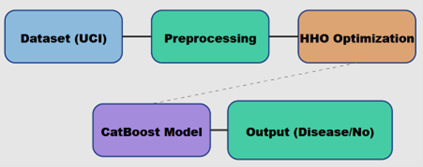
Reliable heart-disease classification remains an important biomedical engineering problem because performance on small structured medical datasets is sensitive to preprocessing, validation design, class distribution, and hyperparameter selection. This study aims to develop a leakage-safe framework for binary heart-disease classification using the processed Cleveland subset of the UCI Heart Disease dataset. The research contribution is the integration of CatBoost with Harris Hawks Optimization to tune discrete and continuous hyperparameters while preserving strict separation between model selection and final testing. The framework also provides an explicit workflow to improve transparency and reproducibility. The dataset contains 303 patient records and 13 predictive attributes and was divided using an 80:20 stratified train-test split. Five-fold stratified cross-validation was applied only within the training subset to evaluate candidate configurations. Missing-value handling, categorical-feature processing, and class-weight optimization were restricted to training data, while the held-out test subset remained isolated until final evaluation. The optimized model achieved 97.12% accuracy, 96.80% precision, 97.35% recall, 96.90% specificity, a 97.07% F1-score, and a 98.40% area under the receiver operating characteristic curve. It produced higher point estimates than the evaluated conventional classifiers, default CatBoost, random-search CatBoost, and grid-search CatBoost. However, the 1.22-percentage-point accuracy improvement over grid-search CatBoost represents a numerical benchmark advantage rather than statistically confirmed superiority. These findings indicate that Harris Hawks Optimization can improve CatBoost configuration for structured cardiovascular data. Nevertheless, external multi-center validation, repeated statistical evaluation, calibration analysis, and prospective clinical assessment are required before practical deployment.
References
S. Emmons-Bell, C. Johnson, and G. Roth, “Prevalence, incidence and survival of heart failure: A systematic review,” Heart, vol. 108, no. 17, pp. 1351–1360, 2022, https://doi.org/10.1136/heartjnl-2021-320131.
G. Savarese, P. M. Becher, L. H. Lund, P. Seferovic, G. M. C. Rosano, and A. J. S. Coats, “Global burden of heart failure: A comprehensive and updated review of epidemiology,” Cardiovasc. Res., vol. 118, no. 17, pp. 3272–3287, 2022, https://doi.org/10.1093/cvr/cvac013.
A. Norhammar, J. Bodegard, M. Vanderheyden, N. Tangri, and A. Karasik, “Prevalence, outcomes and costs of a contemporary, multinational population with heart failure,” Heart, vol. 109, no. 7, pp. 548–556, 2023, https://doi.org/10.1136/heartjnl-2022-321702.
V. L. Roger, “Epidemiology of heart failure,” Circ. Res., vol. 128, no. 10, pp. 1421–1434, 2021, https://doi.org/10.1161/CIRCRESAHA.121.318172.
J. G. F. Cleland, “The struggle towards a Universal Definition of Heart Failure—how to proceed?” Eur. Heart J., vol. 42, no. 24, pp. 2331–2343, 2021, https://doi.org/10.1093/eurheartj/ehab082.
R. Nakanishi, “Machine learning adds to clinical and CAC assessments in predicting 10-year CHD and CVD deaths,” JACC: Cardiovasc. Imaging, vol. 14, no. 3, pp. 615–625, 2021, https://doi.org/10.1016/j.jcmg.2020.08.024.
B. K. Tamarappoo, “Machine learning integration of circulating and imaging biomarkers for explainable patient-specific prediction of cardiac events: A prospective study,” Atherosclerosis, vol. 318, pp. 76–82, 2021, https://doi.org/10.1016/j.atherosclerosis.2020.11.008.
M. Hamid, F. Hajjej, A. S. Alluhaidan, and N. W. bin Mannie, “Fine tuned CatBoost machine learning approach for early detection of cardiovascular disease through predictive modeling,” Sci. Rep., vol. 15, no. 1, p. 13790, 2025, https://doi.org/10.1038/s41598-025-13790-x.
M. D. Teja and G. M. Rayalu, “Optimizing heart disease diagnosis with advanced machine learning models: A comparison of predictive performance,” BMC Cardiovasc. Disord., vol. 25, no. 1, p. 4627, 2025, https://doi.org/10.1186/s12872-025-04627-6.
L. T. Nalasari, S. Anam, and N. Shofianah, “Liver cirrhosis classification using Extreme Gradient Boosting Classifier and Harris Hawk Optimization as hyperparameter tuning,” J. Electron. Electromed. Eng. Med. Inform., vol. 7, no. 2, pp. 508–519, 2025, https://doi.org/10.35882/jeeemi.v7i2.730.
A. K. A. Kahraman, “Machine learning techniques for improved prediction of cardiovascular diseases using integrated healthcare data,” Front. Artif. Intell., vol. 8, p. 1694450, 2025, https://doi.org/10.3389/frai.2025.1694450.
Z. Qiu, Y. Qiao, W. Shi, and X. Liu, “A robust framework for enhancing cardiovascular disease risk prediction using an optimized category boosting model,” Math. Biosci. Eng., vol. 21, no. 2, pp. 2943–2969, 2024, https://doi.org/10.3934/mbe.2024131.
N. A. Baghdadi, S. M. Farghaly Abdelaliem, A. Malki, I. Gad, A. Ewis, and E. Atlam, “Advanced machine learning techniques for cardiovascular disease early detection and diagnosis,” J. Big Data, vol. 10, no. 1, p. 817, 2023, https://doi.org/10.1186/s40537-023-00817-1.
K. V. Tompra, G. Papageorgiou, and C. Tjortjis, “Strategic machine learning optimization for cardiovascular disease prediction and high-risk patient identification,” Algorithms, vol. 17, no. 5, p. 178, 2024, https://doi.org/10.3390/a17050178.
N. Nissa, S. Jamwal, and M. Neshat, “A technical comparative heart disease prediction framework using boosting ensemble techniques,” Computation, vol. 12, no. 1, p. 15, 2024, https://doi.org/10.3390/computation12010015.
S. Ahmed, “Prediction of cardiovascular disease on self-augmented datasets of heart patients using multiple machine learning models,” J. Sens., vol. 2022, p. 3730303, 2022, https://doi.org/10.1155/2022/3730303.
O. Taylan, A. S. Alkabaa, H. S. Alqabbaa, E. Pamukcu, and V. Leiva, “Early prediction in classification of cardiovascular diseases with machine learning, neuro-fuzzy and statistical methods,” Biology, vol. 12, no. 1, p. 117, 2023, https://doi.org/10.3390/biology12010117.
G. N. Ahmad, H. Fatima, S. Ullah, and A. S. Saidi, “Efficient medical diagnosis of human heart diseases using machine learning techniques with and without GridSearchCV,” IEEE Access, vol. 10, pp. 80151–80173, 2022, https://doi.org/10.1109/ACCESS.2022.3165792.
A. Saboor, M. Usman, S. Ali, A. Samad, M. F. Abrar, and N. Ullah, “A method for improving prediction of human heart disease using machine learning algorithms,” Mobile Inf. Syst., vol. 2022, pp. 1–9, 2022, https://doi.org/10.1155/2022/1410169.
M. Singh, “Artificial intelligence for cardiovascular disease risk assessment in personalised framework: A scoping review,” eClinicalMedicine, vol. 73, p. 102660, 2024, https://doi.org/10.1016/j.eclinm.2024.102660.
S. Dhanka and S. Maini, “A hybridization of XGBoost machine learning model by Optuna hyperparameter tuning suite for cardiovascular disease classification,” Int. J. Cardiol., vol. 420, p. 132757, 2025, https://doi.org/10.1016/j.ijcard.2024.132757.
S. Dhanka, V. K. B., and S. Maini, “Comprehensive analysis of supervised algorithms for coronary artery heart disease detection,” Expert Syst., vol. 40, no. 7, p. e13300, 2023, https://doi.org/10.1111/exsy.13300.
Y. Rimal and N. Sharma, “Hyperparameter optimization: A comparative machine learning model analysis for enhanced heart disease prediction accuracy,” Multimed. Tools Appl., vol. 83, no. 18, pp. 55091–55107, 2024, https://doi.org/10.1007/s11042-023-17273-x.
D. P. Mishra, H. K. Gupta, G. Saajith, and R. Bag, “Optimizing heart disease prediction model with GridsearchCV for hyperparameter tuning,” in Proc. 2024 1st Int. Conf. Cogn., Green Ubiquitous Comput. (IC-CGU), 2024, https://doi.org/10.1109/IC-CGU58078.2024.10530772.
K. A. Barry, Y. Manzali, R. Flouchi, and M. Elfar, “Heart disease approach using modified random forest and particle swarm optimization,” IAES Int. J. Artif. Intell., vol. 14, no. 2, pp. 1242–1251, 2025, https://doi.org/10.11591/ijai.v14.i2.pp1242-1251.
K. Sumwiza, C. Twizere, G. Rushingabigwi, P. Bakunzibake, and P. Bamurigire, “Enhanced cardiovascular disease prediction model using random forest algorithm,” Informat. Med. Unlocked, vol. 41, p. 101316, 2023, https://doi.org/10.1016/j.imu.2023.101316.
B. Paul and B. Karn, “Heart disease prediction using scaled conjugate gradient backpropagation of artificial neural network,” Soft Comput., vol. 27, no. 10, pp. 6687–6702, 2023, https://doi.org/10.1007/s00500-022-07649-w.
M. G. El-Shafiey, A. Hagag, E. S. A. El-Dahshan, and M. A. Ismail, “A hybrid GA and PSO optimized approach for heart-disease prediction based on random forest,” Multimed. Tools Appl., vol. 81, no. 13, pp. 18155–18179, 2022, https://doi.org/10.1007/s11042-022-12425-x.
S. Dhanka and S. Maini, “Random Forest for heart disease detection: A classification approach,” in Proc. 2021 IEEE 2nd Int. Conf. Electr. Power Energy Syst. (ICEPES), 2021, https://doi.org/10.1109/ICEPES52894.2021.9699506.
M. Pal and S. Parija, “Prediction of heart diseases using Random Forest,” J. Phys.: Conf. Ser., vol. 1817, p. 012009, 2021, https://doi.org/10.1088/1742-6596/1817/1/012009.
D. Badvath, A. S. Miriyala, S. C. K. Gunupudi, and P. V. K. Kuricheti, “ONBLR: An effective optimized ensemble ML approach for classifying liver cirrhosis disease,” Biomed. Signal Process. Control, vol. 89, p. 105882, 2024, https://doi.org/10.1016/j.bspc.2023.105882.
K. K. Baseer, “Healthcare diagnostics with an adaptive deep learning model integrated with the Internet of Medical Things (IoMT) for predicting heart disease,” Biomed. Signal Process. Control, vol. 92, p. 105988, 2024, https://doi.org/10.1016/j.bspc.2024.105988.
M. Shehab, “Harris Hawks Optimization algorithm: Variants and applications,” Arch. Comput. Methods Eng., vol. 29, no. 7, pp. 5579–5603, 2022, https://doi.org/10.1007/s11831-022-09780-1.
P. K. P., M. A. B. V., and G. G. Nair, “An efficient classification framework for breast cancer using hyper parameter tuned Random Decision Forest Classifier and Bayesian Optimization,” Biomed. Signal Process. Control, vol. 68, p. 102682, 2021, https://doi.org/10.1016/j.bspc.2021.102682.
C. M. Rahman and T. A. Rashid, “A new evolutionary algorithm: Learner performance based behavior algorithm,” Egypt. Inform. J., vol. 22, no. 2, pp. 213–223, 2021, https://doi.org/10.1016/j.eij.2020.08.003.
M. Daviran, M. Shamekhi, R. Ghezelbash, and A. Maghsoudi, “Landslide susceptibility prediction using artificial neural networks, SVMs and random forest: Hyperparameters tuning by genetic optimization algorithm,” Int. J. Environ. Sci. Technol., vol. 20, pp. 259–276, 2023, https://doi.org/10.1007/s13762-022-03956-x.
A. A. Abdullah, A. Aldhahab, and H. M. Al Abboodi, “Detection and classification of eye diseases using hybrid deep features with Decision Tree algorithm,” in Proc. 2024 3rd Int. Conf. Adv. Eng. Sci. Technol. (AEST), pp. 1–6, 2024, https://doi.org/10.1109/AEST63017.2024.10960200.
A. A. Abdullah, A. Aldhahab, and H. M. Al Abboodi, “Eye disease classification based on hybrid deep features with principal component analysis and blending ensemble learning,” Int. J. Intell. Eng. Syst., vol. 18, no. 6, 2025, https://doi.org/10.22266/ijies2025.0731.12.
X. Wei, C. Rao, X. Xiao, L. Chen, and M. Goh, “Risk assessment of cardiovascular disease based on SOLSSA-CatBoost model,” Expert Syst. Appl., vol. 219, p. 119648, 2023, https://doi.org/10.1016/j.eswa.2023.119648.
A. A. Abdullah and M. Q. Hatem, “Audio transmission through Li-Fi technology,” Int. J. Civ. Eng. Technol., vol. 9, no. 7, pp. 853–859, 2018, https://iaeme.in/Home/article_id/IJCIET_09_07_088.
A. A. Abdullah, H. S. Hussein, and L. A. Abdul-Rahaim, “Robust brain tumor MRI classification through MobileNetV3 deep feature fusion and principal component analysis enhanced AdaBoost learning,” J. Electron. Electromed. Eng. Med. Inform., vol. 8, no. 2, pp. 730–750, 2026, https://doi.org/10.35882/jeeemi.v8i2.1462.
A. A. Abdullah and S. A. Hashem, “Hybrid multi-wavelet transform, VGG16 and ResNet50 features, and classification using Light Gradient Boosting Machine for multi-class lung disease diagnosis using chest X-rays,” Franklin Open, vol. 10, p. 100639, 2026, https://doi.org/10.1016/j.fraope.2026.100639.
University of California Irvine Machine Learning Repository, “Heart disease dataset,” 2026, https://doi.org/10.24432/C52P4X.
C. H. Bhavani and A. Govardhan, “Cervical cancer prediction using stacked ensemble algorithm with SMOTE and RFERF,” Mater. Today: Proc., vol. 80, pp. 3451–3457, 2023, https://doi.org/10.1016/j.matpr.2021.07.269.
E. C. Gok and M. O. Olgun, “SMOTE-NC and gradient boosting imputation based random forest classifier for predicting severity level of COVID-19 patients with blood samples,” Neural Comput. Appl., vol. 33, no. 22, pp. 15693–15707, 2021, https://doi.org/10.1007/s00521-021-06189-y.
P. Zhang, Y. Jia, and Y. Shang, “Research and application of XGBoost in imbalanced data,” Int. J. Distrib. Sens. Netw., vol. 18, no. 6, p. 15501329221106935, 2022, https://doi.org/10.1177/15501329221106935.
J. J. Tanimu, M. Hamada, M. Hassan, H. A. Kakudi, and J. O. Abiodun, “A machine learning method for classification of cervical cancer,” Electronics, vol. 11, no. 3, p. 463, 2022, https://doi.org/10.3390/electronics11030463.
K. M. M. Uddin, A. Al Mamun, A. Chakrabarti, R. Mostafiz, and S. K. Dey, “An ensemble machine learning-based approach to predict cervical cancer using hybrid feature selection,” Neurosci. Inform., vol. 4, no. 3, p. 100169, 2024, https://doi.org/10.1016/j.neuri.2024.100169.
K. M. Mohi Uddin, R. Ripa, N. Yeasmin, N. Biswas, and S. K. Dey, “Machine learning-based approach to the diagnosis of cardiovascular vascular disease using a combined dataset,” Intell.-Based Med., vol. 7, p. 100100, 2023, https://doi.org/10.1016/j.ibmed.2023.100100.
G. Narasimhan and A. Victor, “A hybrid approach with metaheuristic optimization and random forest in improving heart disease prediction,” Sci. Rep., vol. 15, p. 10971, 2025, https://doi.org/10.1038/s41598-024-73867-x.
Published
How to Cite
Issue
Section
License
Copyright (c) 2026 Seham Ahmed Hashem, Ahmed Aizaldeen Abdullah, Entidhar Mhawes Zghair

This work is licensed under a Creative Commons Attribution-ShareAlike 4.0 International License.
Authors who publish with this journal agree to the following terms:
- Authors retain copyright and grant the journal right of first publication with the work simultaneously licensed under a Creative Commons Attribution License that allows others to share the work with an acknowledgment of the work's authorship and initial publication in this journal.
- Authors are able to enter into separate, additional contractual arrangements for the non-exclusive distribution of the journal's published version of the work (e.g., post it to an institutional repository or publish it in a book), with an acknowledgment of its initial publication in this journal.
- Authors are permitted and encouraged to post their work online (e.g., in institutional repositories or on their website) prior to and during the submission process, as it can lead to productive exchanges, as well as earlier and greater citation of published work (See The Effect of Open Access).

This journal is licensed under a Creative Commons Attribution-ShareAlike 4.0 International License.