Hybrid Temporal–Spatial Electroencephalographic Classification Using Principal Component Analysis and Ensemble Learning: Epilepsy, Attention-Deficit/Hyperactivity Disorder, and Schizophrenia
DOI:
https://doi.org/10.12928/biste.v8i5.16803Keywords:
EEG Signal Classification, Hybrid Deep Learning, Principal Component Analysis, Ensemble Learning, Biomedical Signal ProcessingAbstract
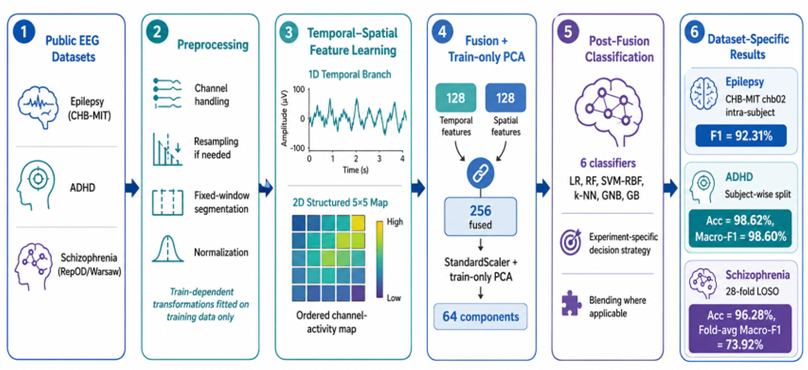
Electroencephalography (EEG) allows noninvasive access to temporal brain activity; however, many EEG classifiers are tailored to a single dataset or disorder and are not easily compared across heterogeneous recording settings. A gap that this study fills is the evaluation of a fixed hybrid temporal–spatial EEG representation pipeline with an identical processing flow on public datasets for epilepsy, attention-deficit/hyperactivity disorder (ADHD), and schizophrenia. Each window passes through a one-dimensional temporal branch and a two-dimensional spatial branch. Their outputs are projected and concatenated into a 256-dimensional fused vector, then standardized and reduced to 64 components by principal component analysis (PCA) fitted only on the training data. The six post-fusion classifiers were tested under dataset-specific validation protocols, with experiment-specific blending applied where applicable, without using held-out test data for scaling, PCA fitting, model selection, threshold adjustment, or blending. Subject-wise ADHD classification achieved around 98.62% accuracy and approximately 98.60% macro-F1. Under 28-fold leave-one-subject-out evaluation, schizophrenia classification yielded an aggregated segment-level accuracy of 96.28% and a fold-averaged macro-F1 score of 73.92%. The selected intra-subject CHB-MIT chb02 experiment attained a seizure-class F1 of 92.31%. The internal four-class experiment was considered exploratory feature-space analysis rather than evidence of dataset-independent clinical diagnosis, as the classes were drawn from disparate datasets and acquisition conditions. The results provide a consistent engineering baseline across the investigated protocols and may inform future EEG decision-support studies, although broader clinical interpretation requires harmonized cohorts, broader multi-subject evaluation, and external validation.
References
R. Lyu, "Deep learning approaches for EEG-based healthcare applications: a comprehensive review," Frontiers in Human Neuroscience, vol. 19, p. 1689073, 2026, https://doi.org/10.3389/fnhum.2025.1689073.
J. Guttag, "CHB-MIT Scalp EEG Database," PhysioNet, Version 1.0.0, Jun. 2010, https://doi.org/10.13026/C2K01R.
G. Brookshire, J. Kasper, N. M. Blauch, Y. C. Wu, R. Glatt, D. A. Merrill, S. Gerrol, K. J. Yoder, C. Quirk, and C. Lucero, "Data leakage in deep learning studies of translational EEG," Frontiers in Neuroscience, vol. 18, p. 1373515, 2024, https://doi.org/10.3389/fnins.2024.1373515.
M. Feng and J. Xu, "Electroencephalogram-based ConvMixer architecture for recognizing attention deficit hyperactivity disorder in children," Brain Sciences, vol. 14, no. 5, p. 469, 2024, https://doi.org/10.3390/brainsci14050469.
L. Li, X. Guo, Z. Yang, Y. Zhao, X. Liu, J. Yang, Y. Chen, X. Peng, and L. Han, "ADHD detection from EEG signals using GCN based on multi-domain features," Frontiers in Neuroscience, vol. 19, p. 1561994, 2025, https://doi.org/10.3389/fnins.2025.1561994.
J. Rahul, D. Sharma, L. D. Sharma, U. Nanda, and A. K. Sarkar, "A systematic review of EEG based automated schizophrenia classification through machine learning and deep learning," Frontiers in Human Neuroscience, vol. 18, p. 1347082, 2024, https://doi.org/10.3389/fnhum.2024.1347082.
R. Mourad, A. Diab, Z. Merhi, M. Khalil, and R. Le Bouquin Jeannes, "Machine and deep learning methods for epileptic seizure recognition using EEG data: A systematic review," Brain Research, vol. 1864, p. 149797, 2025, https://doi.org/10.1016/j.brainres.2025.149797.
K. Slama, A. Yahyaouy, J. Riffi, M. A. Mahraz, and H. Tairi, "Comprehensive review of machine learning and deep learning techniques for epileptic seizure detection and prediction based on neuroimaging modalities," Visual Computing for Industry, Biomedicine, and Art, vol. 8, p. 27, 2025, https://doi.org/10.1186/s42492-025-00208-8.
Y. Lin, L. Dong, Y. Jiang, and J. Lian, "Epileptic EEG classification via deep learning-based strange attractor," Biomedical Signal Processing and Control, vol. 100, p. 106965, 2025, https://doi.org/10.1016/j.bspc.2024.106965.
J. Su, Z. Huang, Y. Ma, H. Shi, Y. Yang, M. Xi, and B. Li, "A model for epileptic EEG detection and recognition based on Multi-Attention mechanism and Spatiotemporal," Scientific Reports, vol. 15, p. 31993, 2025, https://doi.org/10.1038/s41598-025-17256-y.
O. K. Cura, A. Akan, and S. K. Atli, "Detection of Attention Deficit Hyperactivity Disorder based on EEG feature maps and deep learning," Biocybernetics and Biomedical Engineering, vol. 44, no. 3, pp. 450-460, 2024, https://doi.org/10.1016/j.bbe.2024.07.003.
Y. Mao, X. Qi, L. He, S. Wang, Z. Wang, and F. Wang, "Advanced machine learning techniques reveal multidimensional EEG abnormalities in children with ADHD: a framework for automatic diagnosis," Frontiers in Psychiatry, vol. 16, p. 1475936, 2025, https://doi.org/10.3389/fpsyt.2025.1475936.
E. Sathiya, T. D. Rao, and T. S. Kumar, "Gabor filter-based statistical features for ADHD detection," Frontiers in Human Neuroscience, vol. 18, p. 1369862, 2024, https://doi.org/10.3389/fnhum.2024.1369862.
H. Li, C. Wang, L. Ma, C. Xu, and H. Li, "EEG analysis in patients with schizophrenia based on microstate semantic modeling method," Frontiers in Human Neuroscience, vol. 18, p. 1372985, 2024, https://doi.org/10.3389/fnhum.2024.1372985.
A. Al Mazroa, M. M. Eltahir, S. A. Ebad, F. A. Alotaibi, K. Venkatachalam, and J. Cho, "EEG-based schizophrenia diagnosis using deep learning with multi-scale and adaptive feature selection," PeerJ Computer Science, vol. 11, p. e2811, 2025, https://doi.org/10.7717/peerj-cs.2811.
W. Mai, F. Wu, and X. Mai, "Learning spatial-spectral-temporal EEG representations with dual-stream neural networks for motor imagery," Biomedical Signal Processing and Control, vol. 92, p. 106003, 2024, https://doi.org/10.1016/j.bspc.2024.106003.
Y. Song, Q. Zheng, B. Liu, and X. Gao, "EEG Conformer: convolutional transformer for EEG decoding and visualization," IEEE Transactions on Neural Systems and Rehabilitation Engineering, vol. 31, pp. 710-719, 2023, https://doi.org/10.1109/TNSRE.2022.3230250.
Y. Ding, Y. Li, H. Sun, R. Liu, C. Tong, C. Liu, X. Zhou, and C. Guan, "EEG-Deformer: a dense convolutional transformer for brain-computer interfaces," IEEE Journal of Biomedical and Health Informatics, vol. 29, no. 3, pp. 1909-1918, 2025, https://doi.org/10.1109/JBHI.2024.3504604.
A. Keutayeva, N. Fakhrutdinov, and B. Abibullaev, "Compact convolutional transformer for subject-independent motor imagery EEG-based BCIs," Scientific Reports, vol. 14, p. 25775, 2024, https://doi.org/10.1038/s41598-024-73755-4.
J. Zhang, K. Li, B. Yang, and X. Han, "Local and global convolutional transformer-based motor imagery EEG classification," Frontiers in Neuroscience, vol. 17, p. 1219988, 2023, https://doi.org/10.3389/fnins.2023.1219988.
W. Jia, M. Sun, J. Lian, and S. Hou, "Feature dimensionality reduction: a review," Complex & Intelligent Systems, vol. 8, pp. 2663-2693, 2022, https://doi.org/10.1007/s40747-021-00637-x.
A. Mohammed and R. Kora, "A comprehensive review on ensemble deep learning: Opportunities and challenges," Journal of King Saud University - Computer and Information Sciences, vol. 35, no. 2, pp. 757-774, 2023, https://doi.org/10.1016/j.jksuci.2023.01.014.
A. Fanizzi et al., "Developing an ensemble machine learning study: insights from a multi-center proof-of-concept study," PLOS ONE, vol. 19, no. 9, p. e0303217, 2024, https://doi.org/10.1371/journal.pone.0303217.
T. Abdallah, N. Jrad, F. Abdallah, A. Humeau-Heurtier, and P. Van Bogaert, "A self-attention model for cross-subject seizure detection," Computers in Biology and Medicine, vol. 165, p. 107427, 2023, https://doi.org/10.1016/j.compbiomed.2023.107427.
S. Ravi and A. Radhakrishnan, "A hybrid 1D CNN-BiLSTM model for epileptic seizure detection using multichannel EEG feature fusion," Biomedical Physics & Engineering Express, vol. 10, no. 3, p. 035040, 2024, https://doi.org/10.1088/2057-1976/ad3afd.
J. Zhang, S. Zheng, W. Chen, G. Du, Q. Fu, and H. Jiang, "A scheme combining feature fusion and hybrid deep learning models for epileptic seizure detection and prediction," Scientific Reports, vol. 14, p. 16916, 2024, https://doi.org/10.1038/s41598-024-67855-4.
O. Atila, E. Deniz, A. Ari, A. Sengur, S. Chakraborty, P. D. Barua, and U. R. Acharya, "LSGP-USFNet: Automated attention deficit hyperactivity disorder detection using locations of Sophie Germain’s primes on Ulam’s spiral-based features with electroencephalogram signals," Sensors, vol. 23, no. 16, p. 7032, 2023, https://doi.org/10.3390/s23167032.
A. Alhussen, A. I. Alutaibi, S. K. Sharma, A. R. Khan, F. Ahmad, and G. G. Tejani, "Early attention-deficit/hyperactivity disorder (ADHD) with NeuroDCT-ICA and rhinofish optimization (RFO) algorithm based optimized ADHD-AttentionNet," Scientific Reports, vol. 15, p. 6967, 2025, https://doi.org/10.1038/s41598-025-90649-1.
J. Bansal, G. Gangwar, M. Aljaidi, A. Alkoradees, and G. Singh, "EEG-based ADHD classification using autoencoder feature extraction and ResNet with double augmented attention mechanism," Brain Sciences, vol. 15, no. 1, p. 95, 2025, https://doi.org/10.3390/brainsci15010095.
A. Alazzawi, S. Aljumaili, A. D. Duru, O. N. Uçan, O. Bayat, P. J. Coelho, and I. M. Pires, "Schizophrenia diagnosis based on diverse epoch size resting-state EEG using machine learning," PeerJ Computer Science, vol. 10, p. e2170, 2024, https://doi.org/10.7717/peerj-cs.2170.
A. Al-Azzawi and O. N. Uçan, "Investigate schizophrenia classification based on EEG electrode reduction using machine learning techniques," Traitement du Signal, vol. 42, no. 3, pp. 1707-1720, 2025, https://doi.org/10.18280/ts.420340.
I. Latreche, S. Slatnia, O. Kazar, S. Harous, and M. A. Khelili, "Identification and diagnosis of schizophrenia based on multichannel EEG and CNN deep learning model," Schizophrenia Research, vol. 271, pp. 28-35, 2024, https://doi.org/10.1016/j.schres.2024.07.015.
M. Alarfaj, M. A. Zeb, M. H. Al-Adhaileh, A. Alhamadi, and N. Ebrahim, "Deep learning approaches for diagnosing seizure based on EEG signal analysis," Frontiers in Human Neuroscience, vol. 19, p. 1669919, 2025, https://doi.org/10.3389/fnhum.2025.1669919.
H. Kashefi Amiri, M. Zarei, and M. R. Daliri, "Epileptic seizure detection from electroencephalogram signals based on 1D CNN-LSTM deep learning model using discrete wavelet transform," Scientific Reports, vol. 15, p. 32820, 2025, https://doi.org/10.1038/s41598-025-18479-9.
L. Bai, G. Litscher, and X. Li, "Epileptic seizure detection using machine learning: a systematic review and meta-analysis," Brain Sciences, vol. 15, no. 6, p. 634, 2025, https://doi.org/10.3390/brainsci15060634.
N. Chugh, S. Aggarwal, and A. Balyan, "The hybrid deep learning model for identification of attention-deficit/hyperactivity disorder using EEG," Clinical EEG and Neuroscience, vol. 55, no. 1, pp. 22-33, 2024, https://doi.org/10.1177/15500594231193511.
S. K. Khare and U. R. Acharya, "An explainable and interpretable model for attention deficit hyperactivity disorder in children using EEG signals," Computers in Biology and Medicine, vol. 155, p. 106676, 2023, https://doi.org/10.1016/j.compbiomed.2023.106676.
A. Belhadi, A. Yazidi, P. G. Lind, and Y. Djenouri, "EEG data classification: review and taxonomy," ACM Transactions on Computing for Healthcare, vol. 6, no. 4, p. 45, pp. 1-29, 2025, https://doi.org/10.1145/3742795.
S. Khalfallah, W. Puech, M. Tlija, and K. Bouallegue, "Exploring the effectiveness of machine learning and deep learning techniques for EEG signal classification in neurological disorders," IEEE Access, vol. 13, pp. 17002-17015, 2025, https://doi.org/10.1109/ACCESS.2025.3532515.
M. Soltani-Nejad, F. Salar-pour, S. A. Rakhshan, and H. Nezamabadi-pour, "Enhanced hybrid deep neural network for EEG-based schizophrenia diagnosis using functional and temporal features," Scientific Reports, vol. 15, p. 42592, 2025, https://doi.org/10.1038/s41598-025-26627-4.
G. Yin, J. Yuan, Y. Chen, G. Guo, D. Shi, L. Wang, Z. Zhao, Y. Zhao, M. Zhang, Y. Dong, B. Wang, and S. Tan, "Schizophrenia recognition based on three-dimensional adaptive graph convolutional neural network," Scientific Reports, vol. 15, p. 4067, 2025, https://doi.org/10.1038/s41598-024-84497-8.
A. Das, S. Singh, J. Kim, T. A. Ahanger, and A. A. Pise, "Enhanced EEG signal classification in brain computer interfaces using hybrid deep learning models," Scientific Reports, vol. 15, p. 27161, 2025, https://doi.org/10.1038/s41598-025-07427-2.
A. Belhadi, P. G. Lind, Y. Djenouri, and A. Yazidi, "Enhanced visibility graph for EEG classification," Frontiers in Neuroscience, vol. 19, p. 1541062, 2025, https://doi.org/10.3389/fnins.2025.1541062.
A. S. Jangde and G. K. Verma, "EEG-based schizophrenia classification using attention-integrated deep convolutional networks," Psychiatry Research: Neuroimaging, vol. 357, p. 112138, 2026, https://doi.org/10.1016/j.pscychresns.2026.112138.
M. Liu, Y. Liu, W. Shi, Y. Lou, Y. Sun, Q. Meng, D. Wang, F. Xu, Y. Zhang, L. Zhang, and J. Leng, "EMPT: a sparsity Transformer for EEG-based motor imagery recognition," Frontiers in Neuroscience, vol. 18, p. 1366294, 2024, https://doi.org/10.3389/fnins.2024.1366294.
W. Zhao, X. Jiang, B. Zhang, S. Xiao, and S. Weng, "CTNet: a convolutional transformer network for EEG-based motor imagery classification," Scientific Reports, vol. 14, p. 20237, 2024, https://doi.org/10.1038/s41598-024-71118-7.
H. Altaheri, F. Karray, and A.-H. Karimi, "Temporal convolutional transformer for EEG based motor imagery decoding," Scientific Reports, vol. 15, p. 32959, 2025, https://doi.org/10.1038/s41598-025-16219-7.
W. Zhao, B. Zhang, H. Zhou, D. Wei, C. Huang, and Q. Lan, "Multi-scale convolutional transformer network for motor imagery brain-computer interface," Scientific Reports, vol. 15, p. 12935, 2025, https://doi.org/10.1038/s41598-025-96611-5.
J. Luo, Y. Wang, S. Xia, N. Lu, X. Ren, Z. Shi, and X. Hei, "A shallow mirror transformer for subject-independent motor imagery BCI," Computers in Biology and Medicine, vol. 164, p. 107254, 2023, https://doi.org/10.1016/j.compbiomed.2023.107254.
S. Sartipi and M. Cetin, "Subject-independent deep architecture for EEG-based motor imagery classification," IEEE Transactions on Neural Systems and Rehabilitation Engineering, vol. 32, pp. 718-727, 2024, https://doi.org/10.1109/TNSRE.2024.3360194.
H. Wu, Q. Xie, Z. Yu, J. Zhang, S. Liu, and J. Long, "Unsupervised heterogeneous domain adaptation for EEG classification," Journal of Neural Engineering, vol. 21, no. 4, p. 046018, 2024, https://doi.org/10.1088/1741-2552/ad5fbd.
Published
How to Cite
Issue
Section
License
Copyright (c) 2026 Dawood S. Hasan, Qais Al-Gayem, Hilal Al-Libawy

This work is licensed under a Creative Commons Attribution-ShareAlike 4.0 International License.
Authors who publish with this journal agree to the following terms:
- Authors retain copyright and grant the journal right of first publication with the work simultaneously licensed under a Creative Commons Attribution License that allows others to share the work with an acknowledgment of the work's authorship and initial publication in this journal.
- Authors are able to enter into separate, additional contractual arrangements for the non-exclusive distribution of the journal's published version of the work (e.g., post it to an institutional repository or publish it in a book), with an acknowledgment of its initial publication in this journal.
- Authors are permitted and encouraged to post their work online (e.g., in institutional repositories or on their website) prior to and during the submission process, as it can lead to productive exchanges, as well as earlier and greater citation of published work (See The Effect of Open Access).

This journal is licensed under a Creative Commons Attribution-ShareAlike 4.0 International License.