Fuzzy Logic-Based Distributed and Centralized MPPT Architectures for Photovoltaic Systems: A Comparative Study under Dynamic Irradiance and Partial Shading Conditions
DOI:
https://doi.org/10.12928/biste.v8i5.16356Keywords:
Photovoltaic Systems, Maximum Power Point Tracking (MPPT), Fuzzy Logic Control, Distributed MPPT, Centralized MPPT, Partial ShadingAbstract
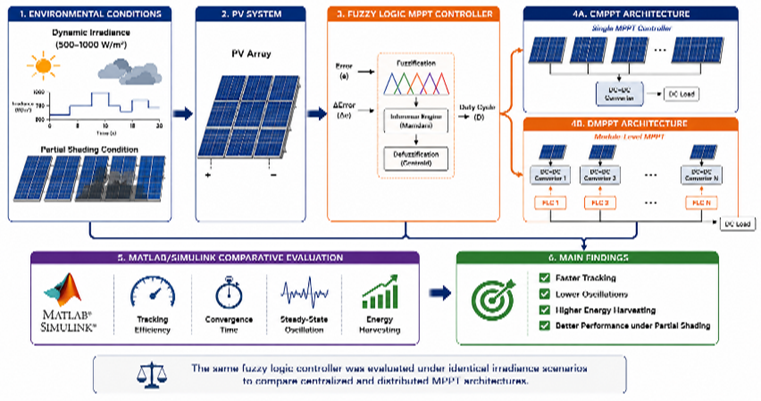
Maximum Power Point Tracking (MPPT) is very important to enhance the energy harvesting capability of photovoltaic (PV) systems under various environmental conditions. But, under dynamic irradiance and partial shading conditions, conventional MPPT architectures may be plagued by poor tracking performance and energy extraction. This study investigates the use of a fuzzy logic controller (FLC) for MPPT and evaluates its performance in both Centralized Maximum Power Point Tracking (CMPPT) and Distributed Maximum Power Point Tracking (DMPPT) architectures. The key outcome of the present study is the comparison of FLC based CMPPT and DMPPT configurations under dynamic irradiance. MATLAB/Simulink based models are established to evaluate the performance measurement with irradiance profiles of 500-1000 W/m2. The assessment included tracking efficiency, convergence behavior, steady state oscillations and recuperating energy capability under various operating scenarios. The simulation results demonstrate that the proposed FLC exhibits a faster response to changes and better tracking capability compared to the baseline MPPT methods considered in this study. The controller achieved tracking performance up to 97% and reduced stable-state oscillations by above 60%. The DMPPT configuration with fuzzy logic control harvested significantly greater amounts of energy than the respective CMPPT configuration under partial shading conditions. The results show that the use of fuzzy logic control with distributed MPPT architectures can improve the robustness and energy harvesting in irregular irradiance conditions, and therefore, this method can be applied to modern photovoltaic systems.
References
T. Zhu, J. Dong, X. Li, and S. Ding, "A Comprehensive Study on Maximum Power Point Tracking Techniques Based on Fuzzy Logic Control for Solar Photovoltaic Systems," Frontiers in Energy Research, vol. 9, p. 727949, 2021, https://doi.org/10.3389/fenrg.2021.727949.
M. Khan et al., "Conventional and artificial intelligence based maximum power point tracking techniques for efficient solar power generation," Engineering Reports, vol. 6, no. 1, p. e12963, 2024, https://doi.org/10.1002/eng2.12963.
L. Guanghua et al., "Maximum power point tracking strategies for solar PV systems: A review of current methods and future innovations," Results in Engineering, vol. 28, p. 107227, 2025, https://doi.org/10.1016/j.rineng.2025.107227.
H. Z. Al Garni, A. Sundaram, A. Awasthi, R. Chandel, S. Tajjour, and S. S. Chandel, "A comprehensive review of most competitive maximum power point tracking techniques for enhanced solar photovoltaic power generation," Journal of Renewable Energy and Environment, vol. 11, no. 3, pp. 60-80, 2024, https://doi.org/10.30501/jree.2024.408699.1638.
A. Verma, S. Chandra, and S. V. A. V. Prasad, "Asymmetrical interval type-2 fuzzy logic control based MPPT tuning for PV system under partial shading condition," ISA Transactions, vol. 100, pp. 251-263, 2020, https://doi.org/10.1016/j.isatra.2020.01.009.
L. Tang, X. Wang, W. Xu, C. Mu, and B. Zhao, "Maximum power point tracking strategy for photovoltaic system based on fuzzy information diffusion under partial shading conditions," Solar Energy, vol. 220, pp. 523-534, 2021, https://doi.org/10.1016/j.solener.2021.03.047.
C. Napole, M. Derbeli, and O. Barambones, "Fuzzy Logic Approach for Maximum Power Point Tracking Implemented in a Real Time Photovoltaic System," Applied Sciences, vol. 11, no. 13, p. 5927, 2021, https://doi.org/10.3390/app11135927.
W. H. Azmi, M. F. N. Tadjuddin, M. Z. Aihsan, and N. M. Noh, "Fuzzy logic control based maximum power point tracking technique in standalone photovoltaic system," International Journal of Power Electronics and Drive Systems, vol. 14, no. 2, pp. 1110-1120, 2023, https://doi.org/10.11591/ijpeds.v14.i2.pp1110-1120.
N. Magaji, M. S. Hassan, and M. W. Mustafa, "Application of type-2 fuzzy for maximum power point tracking in photovoltaic systems," Processes, vol. 10, no. 8, p. 1530, 2022, https://doi.org/10.3390/pr10081530.
R. C. N. Pilawa-Podgurski and D. J. Perreault, "Submodule Integrated Distributed Maximum Power Point Tracking for Solar Photovoltaic Applications," IEEE Transactions on Power Electronics, vol. 28, no. 6, pp. 2957-2967, 2013, https://doi.org/10.1109/TPEL.2012.2220861.
A. Boudia, A. Messai, and A. Mellit, "Type-2 fuzzy logic controller-based maximum power point tracking for photovoltaic systems," Electrical Engineering & Electromechanics, no. 1, pp. 16-22, 2025, https://doi.org/10.20998/2074-272X.2025.1.03.
M. K. Mohaisen, S. S. Mardan, and W. M. Shaher, "A hybrid technique for reducing PAPR in ACO-OFDM systems based on DHT," Journal of Optics, pp. 1-9, 2025, https://doi.org/10.1007/s12596-025-02820-6.
M. Bennoui, A. Boukhari, A. Belkaid, and M. A. Hamida, "Experimental Evaluation of a Hybrid Fuzzy-Gradient MPPT Algorithm under Multiple PV Fault Scenarios and Irradiance Dynamics," e-Prime - Nexus of Electrical, Electronic, and Intelligent Engineering, vol. 15, p. 201203, 2026, https://doi.org/10.1016/j.prime.2026.201203.
T. T. Jara, A. O. Salau, E. D. Markus, C. O. Omeje, and T. T. Tin, "Optimization of a fuzzy-based MPPT controller for a PV water pumping system through a PSO-based approach," Mathematical Modelling of Engineering Problems, vol. 11, no. 9, pp. 2418-2424, 2024, https://doi.org/10.18280/mmep.110914.
R. López-Erauskin, A. González, G. Petrone, G. Spagnuolo, and J. Gyselinck, "Multi-variable Perturb and Observe Algorithm for Grid-Tied PV Systems With Joint Central and Distributed MPPT Configuration," IEEE Transactions on Sustainable Energy, vol. 12, no. 1, pp. 360-367, 2021, https://doi.org/10.1109/TSTE.2020.2996089.
M. N. Gaafar, E. M. Ahmed, M. Orabi, and M. A. Gaafar, "Multi-input transformer-less four-wire microinverter with distributed MPPT for PV systems," International Journal of Circuit Theory and Applications, vol. 49, no. 6, pp. 1704-1725, 2021, https://doi.org/10.1002/cta.2942.
M. E. Başoğlu, "Comprehensive review on distributed maximum power point tracking: Submodule level and module level MPPT strategies," Solar Energy, vol. 241, pp. 85-108, 2022, https://doi.org/10.1016/j.solener.2022.05.039.
S. Barcellona and L. Piegari, "MMC-based PV single-phase system with distributed MPPT," Energies, vol. 13, no. 15, p. 3964, 2020, https://doi.org/10.3390/en13153964.
A. Mohamed et al., "Global MPPT controllers for enhancing dynamic performance of PV systems under partial shading condition," e-Prime - Advances in Electrical Engineering, Electronics and Energy, vol. 9, p. 100638, 2024, https://doi.org/10.1016/j.prime.2024.100638.
V. Samano-Ortega, J. J. Rodriguez-Rivas, V. M. Hernandez-Guzman, and R. V. Carrillo-Serrano, "Hardware in the loop platform for testing photovoltaic system control," Applied Sciences, vol. 10, no. 23, p. 8690, 2020, https://doi.org/10.3390/app10238690.
C. González-Castaño, C. Restrepo, S. Kouro, and J. Rodriguez, "Hardware-in-the-loop to test an MPPT technique of solar photovoltaic system: A support vector machine approach," Sustainability, vol. 13, no. 6, p. 3000, 2021, https://doi.org/10.3390/su13063000.
W. M. Shaher, A. Al-Darraji, W. Mahmood, and M. H. Ibrahim, "Comparative Assessment of PV Power Models under Semiarid Conditions," Journal of Renewable Energy and Environment, vol. 13, no. 3, pp. 158-167, 2026, https://doi.org/10.30501/jree.2026.565798.2735.
M. Melhaoui, M. Rhiat, M. Oukili, A. El Aroudi, and E. B. Smail, "Hybrid fuzzy logic approach for enhanced MPPT control in PV systems," Scientific Reports, vol. 15, no. 1, p. 19235, 2025, https://doi.org/10.1038/s41598-025-03154-w.
M. F. El-Khatib, M.-N. Sabry, M. I. Abu El-Sebah, and S. A. Maged, "Hardware-in-the-loop testing of simple and intelligent MPPT control algorithm for an electric vehicle charging power by photovoltaic system," ISA Transactions, vol. 137, pp. 656-669, 2023, https://doi.org/10.1016/j.isatra.2023.01.025.
I. Contreras-Carmona, A. Y. Pineda-Tapia, H. R. Hernandez-De-Leon, and C. A. Torres-Cantero, "A novel strategy for the MPPT in a photovoltaic system via dung beetle optimization algorithm and hardware-in-the-loop plus real-time control," PLOS ONE, vol. 19, no. 7, p. e0311831, 2024, https://doi.org/10.1371/journal.pone.0311831.
K. Ullah, A. Haque, V. S. B. Kurukuru, and M. A. Khan, "Fuzzy-based maximum power point tracking (MPPT) control system for photovoltaic power generation system," Results in Engineering, vol. 20, p. 101466, 2023, https://doi.org/10.1016/j.rineng.2023.101466.
K. Sabri, O. El Maguiri, and A. Farchi, "Comparative study of different MPPT algorithms for photovoltaic systems under partial shading conditions," in Proceedings of the 9th International Renewable and Sustainable Energy Conference (IRSEC), pp. 1-7, 2021, https://doi.org/10.1109/IRSEC53969.2021.9741164.
M. Melhaoui, M. Rhiat, M. Oukili, I. Atmane, K. Hirech, B. Bossoufi, M. M. Almalki, T. A. H. Alghamdi, and M. Alenezi, "Hybrid fuzzy logic approach for enhanced MPPT control in PV systems," Scientific Reports, vol. 15, no. 1, p. 19235, 2025, https://doi.org/10.1038/s41598-025-03154-w.
K. Y. Yap, C. R. Sarimuthu, and J. M.-Y. Lim, "Artificial Intelligence Based MPPT Techniques for Solar Power System: A review," Journal of Modern Power Systems and Clean Energy, vol. 8, no. 6, pp. 1043-1059, 2020, https://doi.org/10.35833/MPCE.2020.000159.
C. H. Hussaian Basha and C. Rani, "Performance Analysis of MPPT Techniques for Dynamic Irradiation Condition of Solar PV," International Journal of Fuzzy Systems, vol. 22, no. 8, pp. 2577-2598, 2020, https://doi.org/10.1007/s40815-020-00974-y.
M. Z. Yousaf, M. A. Koondhar, Z. A. Zaki, E. M. Ahmed, Z. M. Alaas, I. Mahariq, and J. M. Guerrero, "Improved MPPT of solar PV systems under different environmental conditions utilizing a novel hybrid PSO," Renewable Energy, vol. 244, p. 122709, 2025, https://doi.org/10.1016/j.renene.2025.122709.
F. Çakmak, Z. Aydoğmuş, and M. R. Tür, "Analyses of PO-based fuzzy logic-controlled MPPT and incremental conductance MPPT algorithms in PV systems," Energies, vol. 18, no. 2, p. 233, 2025, https://doi.org/10.3390/en18020233.
N. K. Pandey, R. K. Pachauri, S. Choudhury, and R. K. Sahu, "Asymmetrical interval Type-2 Fuzzy logic controller based MPPT for PV system under sudden irradiance changes," Materials Today: Proceedings, vol. 80, pp. 710-716, 2023, https://doi.org/10.1016/j.matpr.2022.11.074.
V. S. Venkatanarayana and A. C. Rosalina, "A new MPPT mechanism based on multi-verse optimization algorithm tuned FLC for photovoltaic systems," Scientific Reports, vol. 14, no. 1, p. 16046, 2024, https://doi.org/10.1038/s41598-024-79554-1.
S. R. Kiran and A. M. Alsaif, "A novel advanced hybrid fuzzy MPPT controllers for renewable energy systems," Scientific Reports, vol. 14, no. 1, p. 21104, 2024, https://doi.org/10.1038/s41598-024-72060-4.
X. Zhang, Y. Wang, Z. Liu, and H. Chen, "An improved RIME optimization algorithm based maximum power point tracking method for photovoltaic system under partially shading condition," Scientific Reports, vol. 15, no. 1, p. 1234, 2025, https://doi.org/10.1038/s41598-025-01586-y.
K. Ding, X. Gao, H. Liu, and T. Peng, "A MATLAB/Simulink-Based PV Module Model and Its Application Under Conditions of Nonuniform Irradiance," IEEE Transactions on Energy Conversion, vol. 27, no. 4, pp. 864-872, 2012, https://doi.org/10.1109/TEC.2012.2216529.
A. R. Atiya, M. A. Naser, and A. A. Kareem, "Integration of fuzzy logic and neural networks for enhanced MPPT in PV systems under partial shading conditions," Iraqi Journal for Electrical and Electronic Engineering, vol. 21, no. 1, pp. 1-15, 2025, https://doi.org/10.37917/ijeee.21.1.1.
N. Hadjidj, A. Chellali, M. A. Kheldoun, and S. Kouro, "Global maximum power point tracking method for photovoltaic systems using Takagi-Sugeno fuzzy models and ANFIS approach," Electrical Engineering & Electromechanics, no. 3, pp. 27-36, 2025, https://doi.org/10.20998/2074-272X.2025.3.04.
A. R. Youssef, M. M. Hefny, and A. I. M. Ali, "Investigation of single and multiple MPPT structures of solar PV-system under partial shading conditions considering direct duty-cycle controller," Scientific Reports, vol. 13, no. 1, p. 19051, 2023, https://doi.org/10.1038/s41598-023-46165-1.
A. A. Al-Samawi, A. S. Atiyah, and A. H. Al-Jrew, "Power optimization of partially shaded PV system using interleaved boost converter-based fuzzy logic method," Eng, vol. 6, no. 8, p. 201, 2025, https://doi.org/10.3390/eng6080201.
Y. Alharbi, A. Darwish, and X. Ma, "A Comprehensive Review of Distributed MPPT for Grid-Tied PV Systems at the Sub-Module Level," Energies, vol. 16, no. 14, p. 5468, 2023, https://doi.org/10.3390/en16145468.
A. Al-Smadi and L. Mahmoud, "Photovoltaic Module Cascaded Converters for Distributed Maximum Power Point Tracking: A Review," IET Renewable Power Generation, vol. 14, no. 16, pp. 3120-3135, 2020, https://doi.org/10.1049/iet-rpg.2020.0582.
J. M. Enrique, J. M. Andújar, and M. A. Bohórquez, "A Reliable, Fast and Low-Cost Maximum Power Point Tracker for Photovoltaic Applications," Solar Energy, vol. 84, no. 1, pp. 79-89, 2010, https://doi.org/10.1016/j.solener.2009.10.011.
S. Qin, S. T. Cady, A. D. Domínguez-García, and R. C. N. Pilawa-Podgurski, "A Distributed Approach to Maximum Power Point Tracking for Photovoltaic Submodule Differential Power Processing," IEEE Transactions on Power Electronics, vol. 30, no. 4, pp. 2024-2040, 2015, https://doi.org/10.1109/TPEL.2014.2330335.
M. S. Endiz and H. Kalay, "A review of traditional and advanced MPPT approaches for photovoltaic systems," Applied Sciences, vol. 15, no. 3, p. 1031, 2025, https://doi.org/10.3390/app15031031.
D. Vinnikov, A. Chub, R. Kosenko, V. Sidorov, and A. Lindvest, "Implementation of Global Maximum Power Point Tracking in Photovoltaic Microconverters: A Survey of Challenges and Opportunities," IEEE Journal of Emerging and Selected Topics in Power Electronics, vol. 11, no. 2, pp. 2259-2280, 2023, https://doi.org/10.1109/JESTPE.2021.3137521.
M. H. Tanha, H. Shad, H. A. Khanavandi, A. Aranizadeh, and B. Vahidi, "Neuro-Fuzzy AC/DC Inverter Control for Power Regulation in Grid-Connected PV Systems Under Dynamic Irradiance Conditions," Solar Energy, vol. 314, p. 114683, 2026, https://doi.org/10.1016/j.solener.2026.114683.
K. Ishaque, Z. Salam, and G. Lauss, "The Performance of Perturb and Observe and Incremental Conductance Maximum Power Point Tracking Method Under Dynamic Weather Conditions," Applied Energy, vol. 119, pp. 228-236, 2014, https://doi.org/10.1016/j.apenergy.2013.12.054.
M. A. Elgendy, B. Zahawi, and D. J. Atkinson, "Assessment of Perturb and Observe MPPT Algorithm Implementation Techniques for PV Pumping Applications," IEEE Transactions on Sustainable Energy, vol. 3, no. 1, pp. 21-33, 2012, https://doi.org/10.1109/TSTE.2011.2168245.
Published
How to Cite
Issue
Section
License
Copyright (c) 2026 Waleed Mahmood Abdullah Al-Darraji, Waladdin Mezher Shaher, Yousif Azzawi Hachim, Abdulbari Talib Naser

This work is licensed under a Creative Commons Attribution-ShareAlike 4.0 International License.
Authors who publish with this journal agree to the following terms:
- Authors retain copyright and grant the journal right of first publication with the work simultaneously licensed under a Creative Commons Attribution License that allows others to share the work with an acknowledgment of the work's authorship and initial publication in this journal.
- Authors are able to enter into separate, additional contractual arrangements for the non-exclusive distribution of the journal's published version of the work (e.g., post it to an institutional repository or publish it in a book), with an acknowledgment of its initial publication in this journal.
- Authors are permitted and encouraged to post their work online (e.g., in institutional repositories or on their website) prior to and during the submission process, as it can lead to productive exchanges, as well as earlier and greater citation of published work (See The Effect of Open Access).

This journal is licensed under a Creative Commons Attribution-ShareAlike 4.0 International License.