BAT-Optimized Adaptive Backstepping Control for a Two-Degree-of-Freedom Prosthetic Knee: Dynamic Modeling and Simulation Study
DOI:
https://doi.org/10.12928/biste.v8i5.15850Keywords:
Prosthetic Knee Control, Backstepping Controller, ABS Controller, BAT Algorithm, Lower Limb Amputation Prosthetic Knee JointAbstract
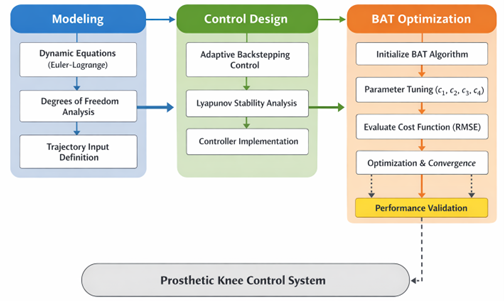
This study addresses mobility limitations experienced by individuals with transfemoral lower-limb amputations, particularly during turning and uneven terrain navigation. A two-degree-of-freedom prosthetic knee mechanism is proposed to enhance internal, external rotation control of the thigh, shank system during both stance and swing phases of gait. The main contribution of this research is the integration of BAT-optimized Adaptive Backstepping control to improve trajectory tracking and robustness under nonlinear dynamics and disturbances. A nonlinear dynamic model of the prosthetic knee is derived using the Euler–Lagrange formulation, which is selected for its suitability in multi-link biomechanical systems. Both Backstepping and Adaptive Backstepping controllers are designed based on Lyapunov stability theory, while the BAT algorithm is employed to automatically tune controller parameters and avoid trial-and-error tuning. Simulation scenarios include sinusoidal reference trajectories with external disturbances and uncertain parameters. The proposed BAT-optimized Adaptive Backstepping controller demonstrates improved performance compared with the optimized Backstepping controller. Quantitative results show a reduction in position tracking error with improvement rates of 11.1% for the thigh and 3.4% for the shank. These findings indicate enhanced robustness and tracking accuracy. The study is limited to simulation-based validation, and future work will focus on experimental implementation and real-time control of prosthetic knee systems.
References
R. Gehlhar, M. Tucker, A. J. Young, and A. D. Ames, “A review of current state-of-the-art control methods for lower-limb powered prostheses,” Annu. Rev. Control, vol. 55, pp. 142–164, 2023, https://doi.org/10.1016/j.arcontrol.2023.03.003.
N. Mitchell, E. Coleman, J. Watson, K. Bell, C. McDaid, C. Barnett, and N. Vanicek, “Self-aligning prosthetic device for older patients with vascular-related amputations: Protocol for a randomised feasibility study (the STEPFORWARD study),” BMJ Open, vol. 9, no. 9, p. e032924, 2019, https://doi.org/10.1136/bmjopen-2019-032924.
B. E. Lawson, J. Mitchell, D. Truex, A. Shultz, E. Ledoux, and M. Goldfarb, “A robotic leg prosthesis: Design, control, and implementation,” IEEE Robot. Autom. Mag., vol. 21, no. 4, pp. 70–81, 2014, https://doi.org/10.1109/MRA.2014.2341734.
M. G. Bernal-Torres, H. I. Medellín-Castillo, and J. C. Arellano-González, “Design and control of a new biomimetic transfemoral knee prosthesis using an echo-control scheme,” J. Healthc. Eng., vol. 2018, Art. no. 8783642, 2018, https://doi.org/10.1155/2018/8783642.
M. R. Tucker et al., “Control strategies for active lower extremity prosthetics and orthotics: A review,” J. NeuroEng. Rehabil., vol. 12, no. 1, pp. 1–30, 2015, https://doi.org/10.1186/1743-0003-12-1.
Z. Li, B. Huang, A. Ajoudani, C. Yang, C. Y. Su, and A. Bicchi, “Asymmetric bimanual control of dual-arm exoskeletons for human-cooperative manipulations,” IEEE Trans. Robot., vol. 34, no. 1, pp. 264–271, 2017, https://doi.org/10.1109/TRO.2017.2765334.
D. S. Pieringer, M. Grimmer, M. F. Russold, and R. Riener, “Review of the actuators of active knee prostheses and their target design outputs for activities of daily living,” in Proc. 2017 Int. Conf. Rehabil. Robot. (ICORR), pp. 1246–1253, 2017, https://doi.org/10.1109/ICORR.2017.8009420.
A. S. Aljuboury, A. H. Hameed, A. R. Ajel, A. J. Humaidi, A. Alkhayyat, and A. K. A. Mhdawi, “Robust adaptive control of knee exoskeleton-assistant system based on nonlinear disturbance observer,” Actuators, vol. 11, no. 3, p. 78, 2022, https://doi.org/10.3390/act11030078.
S. Chen, B. Yao, X. Zhu, Z. Chen, Q. Wang, S. Zhu, and Y. Song, “Adaptive robust backstepping force control of 1-DOF joint exoskeleton for human performance augmentation,” IFAC-PapersOnLine, vol. 48, no. 19, pp. 142–147, 2015, https://doi.org/10.1016/j.ifacol.2015.12.024.
S. Mefoued, “A second order sliding mode control and a neural network to drive a knee joint actuated orthosis,” Neurocomputing, vol. 155, pp. 71–79, 2015, https://doi.org/10.1016/j.neucom.2014.11.036.
F. Yousefi, K. Alipour, B. Tarvirdizadeh, and A. Hadi, “Knee rehabilitation robot control by Sliding-Backstepping and Admittance control,” in 2017 Artificial Intelligence and Robotics (IRANOPEN), pp. 51–57, 2017, https://doi.org/10.1109/IRANOPEN.2017.7937220.
M. Khamar and M. Edrisi, “Designing a backstepping sliding mode controller for an assistant human knee exoskeleton based on nonlinear disturbance observer,” Mechatronics, vol. 54, pp. 121–132, 2018, https://doi.org/10.1016/j.mechatronics.2018.06.004.
S. Mefoued and D. E. C. Belkhiat, “A robust control scheme based on sliding mode observer to drive a knee‐exoskeleton,” Asian J. Control, vol. 21, no. 1, pp. 439–455, 2019, https://doi.org/10.1002/asjc.1836.
K. I. Sherwani, N. Kumar, A. Chemori, M. Khan, and S. Mohammed, “RISE-based adaptive control for EICoSI exoskeleton to assist knee joint mobility,” Robot. Auton. Syst., vol. 124, p. 103354, 2020, https://doi.org/10.1016/j.robot.2019.103354.
X. Liu, S. Zhang, S. Liu, K. Xu, and B. Yao, “Adaptive backstepping sliding mode control for a hydraulic knee exoskeleton robot,” in 2020 2nd Int. Conf. Artificial Intelligence, Robotics and Control (ARIC), pp. 43–48, 2020, https://doi.org/10.1109/ARIC51454.2020.9317103.
A. Rehman, R. Ghias, S. H. Ahmed, and I. Ahmad, “Advanced optimized nonlinear control strategies for prosthetic knee joints,” Biomed. Eng. Lett., vol. 15, no. 2, pp. 291–300, 2025, https://doi.org/10.1007/s13534-024-00447-3.
M. A. Salman and S. K. Kadhim, “Optimal backstepping controller design for prosthetic knee joint,” J. Eur. Syst. Autom., vol. 55, no. 1, pp. 49–59, 2022, https://doi.org/10.18280/jesa.550105.
N. Alawad, A. Humaidi, and A. Alaraji, “Improving active disturbance rejection DRC control for robotics home-based lower extremity rehabilitation care,” J. Eng. Manag. Inf. Technol., vol. 1, no. 2, pp. 67–74, 2023, https://doi.org/10.61552/JEMIT.2023.02.003.
X. Lin, L. Xia, Z. Ruoyi, C. Shieh, and M. Jalalnezhad, “Design of integral backstepping controller-sliding mode along with admittance controller of knee joint robot in the presence of noise,” Proc. Inst. Mech. Eng. C J. Mech. Eng. Sci., p. 09544062241232229, 2023, https://doi.org/10.1177/09544062241232229.
R. Fluit, E. C. Prinsen, S. Wang, and H. van der Kooij, “A comparison of control strategies in commercial and research knee prostheses,” IEEE Trans. Biomed. Eng., vol. 67, no. 1, pp. 277–290, 2020, https://doi.org/10.1109/TBME.2019.2912466.
Y. Sun et al., “Review of recent progress in robotic knee prosthesis related techniques: Structure, actuation and control,” J. Bionic Eng., vol. 18, no. 4, pp. 764–785, 2021, https://doi.org/10.1007/s42235-021-0065-4.
N. A. Alawad, A. J. Humaidi, and A. S. Alaraji, “Sliding mode-based active disturbance rejection control of assistive exoskeleton device for rehabilitation of disabled lower limbs,” Anais Acad. Bras. Ciênc., vol. 95, no. 2, p. e20220680, 2023, https://doi.org/10.1590/0001-3765202320220680.
N. Salman and S. K. Kadhim, “Improving performance and safety in mechanical ventilation: A robust control approach for airway pressure and patient flow,” Buletin Ilmiah Sarjana Teknik Elektro, vol. 7, no. 4, pp. 807–822, 2025, https://doi.org/10.12928/biste.v7i4.13197.
A. K. Abbas and S. K. Kadhim, “Eliminating chattering in prosthetic fingers using classic synergetic control,” J. Eur. Syst. Autom., vol. 58, no. 1, pp. 101–110, 2025, https://doi.org/10.18280/jesa.580109.
N. A. Al-Awad, A. J. Humaidi, and A. S. Al-Araji, “Fractional multi-loop active disturbance rejection control for a lower knee exoskeleton system,” Acta Polytech., vol. 63, no. 3, pp. 158–170, 2023, https://doi.org/10.14311/AP.2023.63.0158.
N. Nikdel, M. A. Badamchizadeh, V. Azimirad, and M. A. Nazari, “Adaptive backstepping control for an n-degree of freedom robotic manipulator based on combined state augmentation,” Robot. Comput.-Integr. Manuf., vol. 44, pp. 129–143, 2017, https://doi.org/10.1016/j.rcim.2016.08.007.
M. A. Salman and S. Khalefa, “Comparative between backstepping and adaptive backstepping control for controlling prosthetic knee,” Iraqi J. Comput. Commun. Control Syst. Eng., vol. 23, no. 1, pp. 10–20, 2023, https://doi.org/10.33103/uot.ijccce.23.1.2.
A. T. Demora and C. M. Abdissa, “Neural network based lower limb prostheses control using super twisting sliding mode control,” IEEE Access, vol. 13, pp. 12450–12462, 2025, https://doi.org/10.1109/ACCESS.2025.3538689.
M. Krstic, P. V. Kokotovic, and I. Kanellakopoulos, Nonlinear and Adaptive Control Design. Hoboken, NJ, USA: John Wiley & Sons, Inc., 1995.
P. Kokotovic and M. Arcak, “Nonlinear and adaptive control: An abbreviated status report,” in Proc. 9th Mediterranean Conf. Control Automation, Dubrovnik, Croatia, 2001, https://doi.org/10.1016/S0005-1098(01)00002-4.
A. Rehman, R. Ghias, S. H. Ahmed, and I. Ahmad, “Advanced optimized nonlinear control strategies for prosthetic knee joints,” Biomed. Eng. Lett., vol. 15, no. 2, pp. 291–300, 2025, https://doi.org/10.1007/s13534-024-00447-3.
P. Gupta, D. K. Pratihar, and K. Deb, “Analysis and optimization of gait cycle of 25-DOF NAO robot using particle swarm optimization and genetic algorithms,” Int. J. Humanoid Robot., vol. 21, no. 2, Art. no. 2350011, 2024, https://doi.org/10.1142/S0219843623500112.
H. Huang and J. Gao, “Backstepping and novel sliding mode trajectory tracking controller for wheeled mobile robots,” Mathematics, vol. 12, no. 10, Art. no. 1458, 2024, https://doi.org/10.3390/math12101458.
M. M. Farzaneh, “A review study on the design of an exoskeleton robot,” Int. J. Sci. Tech. Res. Eng., vol. 6, no. 3, pp. 10–17, 2021.
S. R. Goldberg, S. Õunpuu, and S. L. Delp, “The importance of swing-phase initial conditions in stiff-knee gait,” J. Biomech., vol. 36, no. 8, pp. 1111–1116, 2003, https://doi.org/10.1016/S0021-9290(03)00056-4.
Z. Han, W. Wang, M. Ran, C. Wen, and L. Wang, “Switching-based distributed adaptive secure formation control for mobile robots with denial-of-service attacks,” IEEE Trans. Syst., Man, Cybern., Syst., vol. 54, no. 7, pp. 4126–4138, 2024, https://doi.org/10.1109/TSMC.2023.3245678.
X. S. Yang, “A new metaheuristic bat-inspired algorithm,” in Nature Inspired Cooperative Strategies for Optimization (NICSO 2010), Berlin, Heidelberg: Springer, 2010, pp. 65–74, https://doi.org/10.1007/978-3-642-12538-6_7.
X. S. Yang, “Bat algorithm for multi-objective optimisation,” Int. J. Bio-Inspired Comput., vol. 3, no. 5, pp. 267–274, 2011, https://doi.org/10.1504/IJBIC.2011.042259.
M. Wadi, A. Shobole, W. Elmasry, and I. Kucuk, “Load frequency control in smart grids: A review of recent developments,” Renew. Sustain. Energy Rev., vol. 189, p. 114013, 2024, https://doi.org/10.1016/j.rser.2023.114013.
H. Al-Khazraji, A. M. Abdullah, and H. Dulaimi, “Simulation and evaluation of sliding mode controller for elbow exoskeleton systems,” Int. J. Mechatron. Appl. Mech., vol. 1, no. 22, pp. 200–210, 2025, https://doi.org/10.17683/ijomam/issue22.27.
Y. Tang, G. Zhao, and M. Chen, “Adaptive robust control for prosthetic joint actuators with model uncertainties,” IEEE Trans. Ind. Electron., vol. 68, no. 9, pp. 9062–9071, 2021, https://doi.org/10.1109/TIE.2020.3039612.
H. Liu and Q. Zhou, “Nonlinear adaptive control in biomechatronic systems: A review,” Control Eng. Pract., vol. 89, pp. 191–203, 2019, https://doi.org/10.1016/j.conengprac.2019.05.005.
X. Zhou, H. Zhang, and Y. Li, “Adaptive control strategies for human-robot interaction: A review,” Robot. Auton. Syst., vol. 124, p. 103376, 2020, https://doi.org/10.1016/j.robot.2019.103376.
J. Wang and D. Sun, “Nonlinear control techniques in prosthetic devices: Trends and perspectives,” Biomed. Signal Process. Control, vol. 65, p. 102310, 2021, https://doi.org/10.1016/j.bspc.2020.102310.
A. K. Abbas and S. K. Kadhim, “Dynamic motion control of two-link robots with adaptive synergetic algorithms,” J. Robot. Control, vol. 5, no. 5, pp. 1536–1548, 2024, https://doi.org/10.18196/jrc.v5i5.21834.
I. Geonea, A. Corzanu, C. Copilusi, A. Ionescu, and D. Tarnita, “Integrated design of a modular lower-limb rehabilitation exoskeleton: Multibody simulation, load-driven structural optimization, and experimental validation,” Preprints, p. 2026021647, 2026, https://doi.org/10.20944/preprints202602.1647.v1.
J. Narayan, M. Abbas, and S. K. Dwivedy, “Adaptive backstepping sliding mode subject-cooperative control for a pediatric lower-limb exoskeleton robot,” Trans. Inst. Meas. Control, vol. 47, no. 2, pp. 352–368, 2025, https://doi.org/10.1177/01423312241234567.
B. Brahmi and M. Saad, “Adaptive control for end-effector exoskeleton robots with unknown dynamics and actuator parameters,” IEEE Trans. Syst., Man, Cybern., Syst., vol. 55, no. 4, pp. 2345–2356, 2025, https://doi.org/10.1109/TSMC.2025.1234567.
S. A. Tarapder, “EDGE artificial intelligence based automation for ultra-low-latency control in industrial robotic systems,” Rev. Appl. Sci. Technol., vol. 5, no. 1, pp. 1–37, 2026, https://doi.org/10.12345/rast.v5i1.67890.
Published
How to Cite
Issue
Section
License
Copyright (c) 2026 Mayyasah Ali Salman, Israa Saad Khalid, Rawaa Abdal-Sattar Ali, Hadeel Ghalib Abbas, Zubaida Muhammad Saad Al Din Khalil, Saleem Khalefa Kadhim, Aws M. Abdullah

This work is licensed under a Creative Commons Attribution-ShareAlike 4.0 International License.
Authors who publish with this journal agree to the following terms:
- Authors retain copyright and grant the journal right of first publication with the work simultaneously licensed under a Creative Commons Attribution License that allows others to share the work with an acknowledgment of the work's authorship and initial publication in this journal.
- Authors are able to enter into separate, additional contractual arrangements for the non-exclusive distribution of the journal's published version of the work (e.g., post it to an institutional repository or publish it in a book), with an acknowledgment of its initial publication in this journal.
- Authors are permitted and encouraged to post their work online (e.g., in institutional repositories or on their website) prior to and during the submission process, as it can lead to productive exchanges, as well as earlier and greater citation of published work (See The Effect of Open Access).

This journal is licensed under a Creative Commons Attribution-ShareAlike 4.0 International License.