Design of MMC-STATCOM Controller Using an Adaptive PID Controller Supported by a Grey Model
DOI:
https://doi.org/10.12928/biste.v8i1.15426Keywords:
Multilevel Converter, MATLAB, Simulink, Grey Predictor, THD, Adaptive PID ControlAbstract
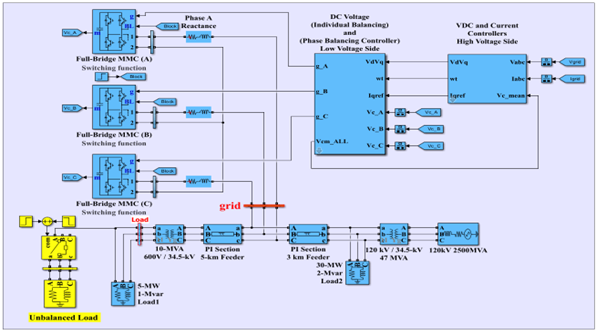
The Static Synchronous Compensator (STATCOM) is recognized as one of the most advanced and effective technologies within the Flexible AC Transmission Systems (FACTS) family, due to its rapid dynamic response and high efficiency in regulating reactive power flow. However, conventional two- and three-level STATCOM topologies suffer from limited scalability and high harmonic distortion. This paper addresses these challenges by employing a STATCOM based on Modular Multilevel Converter (MMC). The significant contribution of this work is the introduction of a novel control strategy for MMC-STATCOM systems which is an adaptive PID controller integrated with a Grey Prediction Model. In the proposed scheme, the PID gains are continuously adapted based on predicted future error values obtained from the GM(1,1) grey model, rather than instantaneous measured errors, enabling proactive compensation under dynamic operating conditions. The performance of the proposed controller is evaluated in MATLAB/Simulink environment and by using a 12 MVA, 34.5 kV MMC-STATCOM system with a full-bridge topology consisting of 22 submodules per phase. Under balanced load condition, the results demonstrated that the adaptive grey-PID controller significantly reduced the total harmonic distortion (THD) of the grid current by 43.75% as compared to conventional PI controller. Under a severe unbalanced load condition, the total harmonic distortion of the grid current is reduced by 33.42%. Furthermore, the proposed controller successfully restored balance to the grid voltage and current and maintained a stable DC-link voltage under unbalanced load conditions. Additionally, the suggested controller achieved a fast-settling time of 0.04 s during transient conditions, this conclusively demonstrates its superior robustness and rapid dynamic response. Despite the additional computational effort introduced by the grey predictor model, it remains suitable for real time implementation due to its low order structure and limited data window.
References
B. R. Andersen and S. L. Nilsson, Flexible AC Transmission Systems (FACTS). Switzerland: Springer Nature, 2020, https://doi.org/10.1007/978-3-030-35386-5.
F. Shahnia, S. Rajakaruna, and A. Ghosh, Eds., Static Compensators (STATCOMs) in Power Systems, vol. 735. Singapore: Springer Singapore, 2015, https://doi.org/10.1007/978-981-287-281-4.
D. Sarathkumar et al., "Power system stability enhancement in two machine system by using fuel cell as STATCOM (static synchronous compensator)," Materials Today: Proceedings, vol. 45, pp. 2130-2138, 2021, https://doi.org/10.1016/j.matpr.2020.09.730.
A. Mandal et al., "A novel architecture of the solid-state unified power flow controller and its integration into the power grid," Electric Power Systems Research, vol. 241, p. 111296, 2025, https://doi.org/10.1016/j.epsr.2024.111296.
V. Shukla, V. Mukherjee, and B. Singh, "Integration of distributed generations and static var compensators with static synchronous compensators to reduce power losses," Engineering Applications of Artificial Intelligence, vol. 126, p. 107208, 2023, https://doi.org/10.1016/j.engappai.2023.107208.
S. M. Lamine, B. Soltane, and N. A. L. Ahmed, "Improved voltage regulation using fuzzy logic-based static synchronous compensator controllers with stacked multi-cell multi-level inverter in modern power grids," Energy Reports, vol. 14, pp. 3286-3297, 2025, https://doi.org/10.1016/j.egyr.2025.10.017.
M. H. Haque, "Damping improvement by FACTS devices: A comparison between STATCOM and SSSC," Electric Power Systems Research, vol. 76, no. 9-10, pp. 865-872, 2006, https://doi.org/10.1016/j.epsr.2005.11.001.
X.-P. Zhang, E. Handschin, and M. Yao, "Multi-control functional static synchronous compensator (STATCOM) in power system steady-state operations," Electric Power Systems Research, vol. 72, no. 3, pp. 269-278, 2004, https://doi.org/10.1016/j.epsr.2004.04.011.
R. O. de Sousa et al., "Life consumption of a MMC-STATCOM supporting wind power plants: Impact of the modulation strategies," Microelectronics Reliability, vol. 88, pp. 1063-1070, 2018, https://doi.org/10.1016/j.microrel.2018.06.111.
K. Xu et al., "Disturbed optimal power flow with renewable source and static synchronous compensator," Expert Systems with Applications, vol. 295, p. 128799, 2025, https://doi.org/10.1016/j.eswa.2025.128799.
J. V. M. Farias et al., "Redundancy design for modular multilevel converter based STATCOMs," Microelectronics Reliability, vol. 100, p. 113471, 2019, https://doi.org/10.1016/j.microrel.2019.06.012.
J. Maeng et al., "A supercapacitor size minimization and energy management strategy for E-STATCOM connected to weak grid," International Journal of Electrical Power & Energy Systems, vol. 172, p. 111174, 2025, https://doi.org/10.1016/j.ijepes.2025.111174.
P. Hu, J. M. Guerrero, and Z. He, "Design and analysis of a transformerless STATCOM based on hybrid cascaded multilevel converter," International Journal of Electrical Power & Energy Systems, vol. 104, pp. 694-704, 2019, https://doi.org/10.1016/j.ijepes.2018.07.059.
Y. Liu et al., "MMC-STATCOM supplementary wide-band damping control to mitigate sub-synchronous control interaction in wind farms," International Journal of Electrical Power & Energy Systems, vol. 141, p. 108171, 2022, https://doi.org/10.1016/j.ijepes.2022.108171.
M. Humayun et al., "Analysis of hybrid switches symmetric flying capacitor multilevel inverter based STATCOM," International Journal of Electrical Power & Energy Systems, vol. 131, p. 107054, 2021, https://doi.org/10.1016/j.ijepes.2021.107054.
S. N. Duarte, P. G. Barbosa, and E. Kabalcı, "STATCOM and DSTATCOM with modular multilevel converters," in Multilevel Inverters: Control Methods and Advanced Power Electronic Applications, p. 209, 2021, https://doi.org/10.1016/B978-0-12-821206-6.00006-X.
R. O. de Sousa et al., "Wear-out failure analysis of modular multilevel converter-based STATCOM: The role of the modulation strategy and IGBT blocking voltage," Microelectronics Reliability, vol. 128, p. 114426, 2022, https://doi.org/10.1016/j.microrel.2021.114426.
K. Sayahi and F. Bacha, "STATCOM-Active power filter improved hysteresis current control for power quality management under unbalanced and distorted grid voltage," Results in Engineering, vol. 27, p. 107064, 2025, https://doi.org/10.1016/j.rineng.2025.107064.
M. L. Srief et al., "A complete control structure based backstepping controller design for stacked multi-cell multi-level SPWM VSC STATCOM," Energy Reports, vol. 12, pp. 687-698, 2024, https://doi.org/10.1016/j.egyr.2024.06.051.
A. A. Z. Diab et al., "Optimal design and control of MMC STATCOM for improving power quality indicators," Applied Sciences, vol. 10, no. 7, p. 2490, 2020, https://doi.org/10.3390/app10072490.
A. Stepanov, H. Saad, and J. Mahseredjian, "Modeling of MMC-based STATCOM with embedded energy storage for the simulation of electromagnetic transients," Electric Power Systems Research, vol. 220, p. 109316, 2023, https://doi.org/10.1016/j.epsr.2023.109316.
F. Eroğlu et al., "Multi-objective control strategy for multilevel converter-based battery D-STATCOM with power quality improvement," Applied Energy, vol. 341, p. 121091, 2023, https://doi.org/10.1016/j.apenergy.2023.121091.
X. Liu et al., "DBS-less MMC-MTDC system integrating large-scale offshore wind power," Electric Power Systems Research, vol. 244, p. 111589, 2025, https://doi.org/10.1016/j.epsr.2025.111589.
R. Raj et al., "Critical review of hybrid modular multilevel converters for HVDC transmission in offshore wind energy," Energy Reports, vol. 14, pp. 1761-1778, 2025, https://doi.org/10.1016/j.egyr.2025.07.017.
A. Bharadwaj and S. Maiti, "Multilevel converter-based STATCOM with hybrid storage system," in Emerging Trends in Energy Storage Systems and Industrial Applications, pp. 521-534, 2023, https://doi.org/10.1016/B978-0-323-90521-3.00012-0.
A. Dekka et al., "Modular multilevel converters," in Multilevel Inverters, pp. 147-179, 2021, https://doi.org/10.1016/B978-0-12-821206-6.00004-6.
S. K. Chaudhary et al., "Benchmarking of modular multilevel converter topologies for ES-STATCOM realization," Energies, vol. 13, no. 13, p. 3384, 2020, https://doi.org/10.3390/en13133384.
S. N. Duarte, P. M. Almeida, and P. G. Barbosa, "Voltage regulation of a remote microgrid bus with a modular multilevel STATCOM," Electric Power Systems Research, vol. 212, p. 108299, 2022, https://doi.org/10.1016/j.epsr.2022.108299.
S. N. Duarte et al., "Experimental evaluation of negative-sequence voltage compensation in distribution networks by a modular multilevel static synchronous compensator," Electric Power Systems Research, vol. 194, p. 107020, 2021, https://doi.org/10.1016/j.epsr.2021.107020.
J. K. Bhutto, “An adaptive controlled STATCOM and SMES for LVRT augmentation of the renewable integrated AC-microgrid,” Heliyon, vol. 11, no. 3, p. e42326, 2025, https://doi.org/10.1016/j.heliyon.2025.e42326.
R. S. Camargo et al., "Novel multilevel STATCOM for power system stability enhancement on DFIG-based wind farms," Electric Power Systems Research, vol. 197, p. 107316, 2021, https://doi.org/10.1016/j.epsr.2021.107316.
J. Inwumoh, C. Baguley, and K. Gunawardane, "A dynamic control methodology for DC fault ride through of modular multilevel converter based high voltage direct current systems," Computers and Electrical Engineering, vol. 100, p. 107940, 2022, https://doi.org/10.1016/j.compeleceng.2022.107940.
A. Bharadwaj et al., "E-STATCOM (energy storage+ STATCOM): A solution to integrate large-scale wind farms into the grid at medium and high-power levels," in Power Quality in Modern Power Systems, pp. 283-310, 2021, https://doi.org/10.1016/B978-0-12-823338-2.00008-5.
P. Sah and B. K. Singh, "Power quality improvement using distribution static synchronous compensator," Computers and Electrical Engineering, vol. 106, p. 108599, 2023, https://doi.org/10.1016/j.compeleceng.2023.108599.
C. Liao et al., "Small-signal model-based stability analysis for single-phase cascaded H-bridge STATCOM considering time delay," International Journal of Electrical Power & Energy Systems, vol. 157, p. 109880, 2024, https://doi.org/10.1016/j.ijepes.2024.109880.
R. C. Panda, Ed., Introduction to PID controllers: theory, tuning and application to frontier areas. InTech, 2012, https://doi.org/10.5772/2422.
K. Chen, B. Xiao, C. Wang, X. Liu, S. Liang, and X. Zhang, “Cuckoo coupled improved grey wolf algorithm for PID parameter tuning,” Applied Sciences, vol. 13, no. 23, p. 12944, 2023, https://doi.org/10.3390/app132312944.
J. Zhang, Y. Qin, X. Zhang, G. Che, X. Sun, and H. Duo, “Application of non-equidistant GM (1, 1) model based on the fractional-order accumulation in building settlement monitoring,” Journal of Intelligent & Fuzzy Systems, vol. 42, no. 3, pp. 1559-1573, 2022, https://doi.org/10.3233/JIFS-210936.
C. C. Tong and E. Barbieri, "Design of refined grey prediction controller," in Proc. IEEE International Conference on Systems, Man and Cybernetics, pp. 1-6, 2006, https://doi.org/10.1109/ICSMC.2006.384351.
L. Hou, X. Li, and M. Wang, "Grey-fuzzy PI optimal control of MMC-HVDC system," in Proc. IEEE 4th Conference on Energy Internet and Energy System Integration (EI2), pp. 1-6, 2020, https://doi.org/10.1109/EI250167.2020.9347162.
C. Hsu et al., "An auto-tuning PID regulator using grey predictor," in Proc. IEEE Conference on Cybernetics and Intelligent Systems, pp. 1-6, 2006, https://doi.org/10.1109/ICCIS.2006.252277.
Q. Li and Y. Lin, "Review paper: A Briefing to Grey Systems Theory," Journal of Systems Science and Information, vol. 2, no. 2, pp. 178-192, 2014, https://doi.org/10.1515/JSSI-2014-0178.
O. Ö. Mengi, "Comparison of MPC based advanced hybrid controllers for STATCOM in medium scale PEM fuel cell systems," International Journal of Hydrogen Energy, vol. 45, no. 43, pp. 23327-23342, 2020, https://doi.org/10.1016/j.ijhydene.2020.06.071.
H. Fretes et al., "Analysis of a delta modular multilevel converter for E-STATCOM applications," IEEE Transactions on Power Delivery, vol. 40, no. 6, pp. 3106-3117, 2025, https://doi.org/10.1109/TPWRD.2025.3606853.
T T. Ahmed, A. Waqar, S. Haider and A. Armghan, "Application of Fixed Frequency Sliding Mode Control for D-STATCOM in Power Systems," 2021 International Bhurban Conference on Applied Sciences and Technologies (IBCAST), Islamabad, Pakistan, 2021, pp. 524-529, 2021, https://doi.org/10.1109/IBCAST51254.2021.9393248.
E. Ramakrishna, J. Gadhamappagari, and P. Sujatha, "Auto tuning of PI Gains using Cuttlefish Optimization for DC Link Voltage Control in a 5-level HB MMC D-STATCOM," Engineering, Technology & Applied Science Research, vol. 13, no. 6, pp. 12086-12091, 2023, https://doi.org/10.48084/etasr.6413.
J. Girona-Badia et al., “Design, control and testing of a modular multilevel converter with a single cell per arm in grid-forming and grid-following operations for scaled-down experimental platformsm,” Energies, vol. 15, no. 5, p. 1819, 2022, https://doi.org/10.3390/en15051819.
I. Y. Fawzy et al., "Deployment of STATCOM with fuzzy logic control for improving the performance of power system under different faults conditions," Journal of Robotics and Control (JRC), vol. 5, no. 3, pp. 636-646, 2024, https://doi.org/10.18196/jrc.v5i3.21558.
Y. Hamad, "Optimization of Controller Parameter Multilevel Converter Based STATCOM for Reactive Power Compensation," Researcher, vol. 4, no. 1, pp. 29-40, 2024, https://izlik.org/JA37PX82CH.
A. Umar, "Stability Improvement of STATCOM System Using Fractional-Order Proportional Integral (FOPI) Based Control Strategies," Bayero Journal of Engineering and Technology, vol. 20, no. 1, pp. 44-53, 2025, https://bjet.ng/index.php/jet/article/view/74.
Published
How to Cite
Issue
Section
License
Copyright (c) 2025 Mohammed Moanes Ezzaldean Ali, Qusay Shebeeb Kadhim

This work is licensed under a Creative Commons Attribution-ShareAlike 4.0 International License.
Authors who publish with this journal agree to the following terms:
- Authors retain copyright and grant the journal right of first publication with the work simultaneously licensed under a Creative Commons Attribution License that allows others to share the work with an acknowledgment of the work's authorship and initial publication in this journal.
- Authors are able to enter into separate, additional contractual arrangements for the non-exclusive distribution of the journal's published version of the work (e.g., post it to an institutional repository or publish it in a book), with an acknowledgment of its initial publication in this journal.
- Authors are permitted and encouraged to post their work online (e.g., in institutional repositories or on their website) prior to and during the submission process, as it can lead to productive exchanges, as well as earlier and greater citation of published work (See The Effect of Open Access).

This journal is licensed under a Creative Commons Attribution-ShareAlike 4.0 International License.