Profiling Digital Competency of Prospective Vocational IT Educators Using Generalized DINA Model: A Cognitive Diagnostic Approach
DOI:
https://doi.org/10.12928/biste.v8i1.15340Keywords:
Digital Competency, Cognitive Diagnostic Models, G-DINA, Vocational IT Education, Pre-Service TeachersAbstract
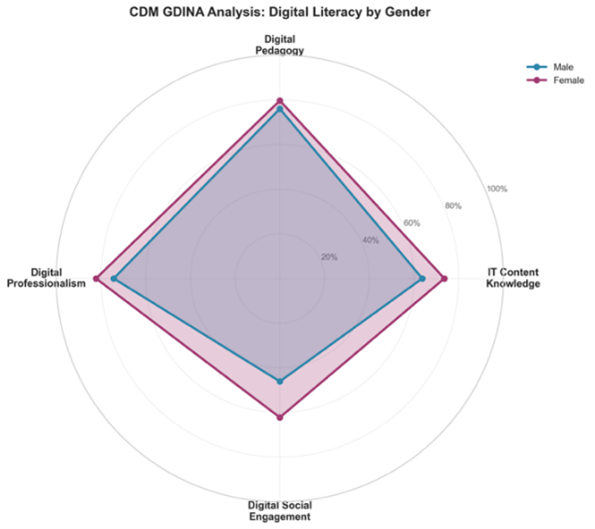
Indonesia faces a significant shortage of digitally competent vocational teachers, yet existing assessment instruments often rely on aggregate scores that fail to diagnose specific cognitive deficits. This study addresses this gap by developing a diagnostic assessment instrument for vocational IT pre-service teachers. The research contribution is the validation of a domain-specific Cognitive Diagnostic Model (CDM) framework that integrates general digital pedagogy with vocational IT technical expertise, enabling precise attribute mastery profiling. The study employed a cross-sectional survey design with a purposive sample of 270 informatics education students. Data were analyzed using a multi-stage psychometric approach, combining Classical Test Theory (CTT), Confirmatory Factor Analysis (CFA), and the Generalized Deterministic Inputs, Noisy "And" Gate (G-DINA) model to determine attribute mastery. The results demonstrated that the 32-item instrument achieved excellent model fit (RMSEA₂=0.011) and outstanding classification accuracy (93.71%). Systematic profiling revealed that female students consistently outperformed males across all dimensions, while a non-linear developmental trajectory was observed with a significant competency decline in the third semester followed by recovery. In conclusion, the G-DINA-based instrument provides a robust diagnostic tool for identifying specific learning needs, suggesting that teacher preparation programs require targeted interventions during critical transition periods to support continuous competency development.
References
J. Haryanto, “Indonesia: Advancing Southeast Asia's Largest Digital Economy,” In The ASEAN Digital Economy, pp. 42-75, 2023, https://doi.org/10.4324/9781003308751-4.
S. C. Vetrivel and T. Mohanasundaram, “Building a Tech-Savvy Workforce: Re-Skilling Strategies for Success,” In Reskilling the Workforce for Technological Advancement, pp. 18-40, 2024, https://doi.org/10.4018/979-8-3693-0612-3.ch002.
A. A. Sihombing and M. Fatra, “Emergency of Indonesian Education System: Conventional, Vulnerable to Crisis, and Ignorant to Digital Learning,” In Resilient and Sustainable Education Futures: Insights from Malaysia and Indonesia's COVID-19 Experience, pp. 183-197, 2025, https://doi.org/10.1007/978-981-96-4971-6_14.
S. Mishra and P. K. Misra, “Open, Distance, and Digital Non-formal Education in Developing Countries,” in Handbook of Open, Distance and Digital Education, pp. 1-17, 2022. https://doi.org/10.1007/978-981-19-0351-9_21-1.
F. Caena and C. Redecker, “Aligning teacher competence frameworks to 21st century challenges: The case for the European Digital Competence Framework for Educators (Digcompedu),” European journal of education, vol. 54, no. 3, pp. 356-369, 2019, https://doi.org/10.1111/ejed.12345.
G. Falloon, “From digital literacy to digital competence: the teacher digital competency (TDC) framework,” Education Tech Research Dev, vol. 68, no. 5, pp. 2449–2472, 2020, https://doi.org/10.1007/s11423-020-09767-4.
F. Caena and C. Redecker, “Aligning teacher competence frameworks to 21st century challenges: The case for the European Digital Competence Framework for Educators (DigCompEdu),” Euro J of Education, vol. 54, no. 3, pp. 356–369, Sep. 2019, https://doi.org/10.1111/ejed.12345.
R. Alarcón, E. Del Pilar Jiménez, and M. I. de Vicente‐Yagüe, “Development and validation of the DIGIGLO, a tool for assessing the digital competence of educators,” British Journal of Educational Technology, vol. 51, no. 6, pp. 2407-2421, 2020, https://doi.org/10.1111/bjet.12919.
E. J. Instefjord and E. Munthe, “Educating digitally competent teachers: A study of integration of professional digital competence in teacher education,” Teaching and Teacher Education, vol. 67, pp. 37–45, Oct. 2017, https://doi.org/10.1016/j.tate.2017.05.016.
F. D. Guillén-Gámez, M. J. Mayorga-Fernández, J. Bravo-Agapito, and D. Escribano-Ortiz, “Analysis of Teachers’ Pedagogical Digital Competence: Identification of Factors Predicting Their Acquisition,” Tech Know Learn, vol. 26, no. 3, pp. 481–498, Sep. 2021, https://doi.org/10.1007/s10758-019-09432-7.
O. E. Hatlevik, “Examining the Relationship between Teachers’ Self-Efficacy, their Digital Competence, Strategies to Evaluate Information, and use of ICT at School,” Scandinavian Journal of Educational Research, vol. 61, no. 5, pp. 555–567, 2017, https://doi.org/10.1080/00313831.2016.1172501.
H. Hidayat, S. Herawati, E. Syahmaidi, A. Hidayati, and Z. Ardi, “Digital literacy of vocational high school teachers in Indonesia,” Journal of Technical Education and Training, vol. 14, no. 1, pp. 107–118, 2022, https://doi.org/10.30880/jtet.2022.14.01.010.
M. Nurtanto, N. Kholifah, A. Masek, P. Sudira, and A. Samsudin, “Digital literacy of Indonesian teachers in vocational education: Comparing between western and eastern Indonesia,” International Journal of Interactive Mobile Technologies, vol. 15, no. 4, pp. 143–158, 2021, https://doi.org/10.3991/ijim.v15i04.18163.
L. Xin, G. Zhao, B. Wu, Y. Wang, and C. Stamov-Roßnagel, “Development and validation of a digital competence scale for Chinese TVET teachers,” PLOS ONE, vol. 19, no. 9, p. e0309494, 2024, https://doi.org/10.1371/journal.pone.0309494.
OECD, OECD Skills Outlook 2023: Skills for a Resilient Green and Digital Transition. in OECD Skills Outlook. OECD Publishing, 2023. https://doi.org/10.1787/27452f29-en.
A. A. P. Cattaneo, C. Antonietti, and M. Rauseo, “How digitalised are vocational teachers? Assessing digital competence in vocational education and looking at its underlying factors,” Computers & Education, vol. 176, p. 104358, 2022, https://doi.org/10.1016/j.compedu.2021.104358.
Y. Zhao, A. M. Pinto Llorente, and M. C. Sánchez Gómez, “Digital competence in higher education research: A systematic literature review,” Computers & Education, vol. 168, p. 104212, 2021, https://doi.org/10.1016/j.compedu.2021.104212.
F. Pettersson, “On the issues of digital competence in educational contexts – a review of literature,” Educ Inf Technol, vol. 23, no. 3, pp. 1005–1021, 2018, https://doi.org/10.1007/s10639-017-9649-3.
M. Lucas, P. Bem-Haja, F. Siddiq, A. Moreira, and C. Redecker, “The relation between in-service teachers’ digital competence and personal and contextual factors: What matters most?,” Computers & Education, vol. 160, p. 104052, 2021, https://doi.org/10.1016/j.compedu.2020.104052.
J. Portillo, U. Garay, E. Tejada, and N. Bilbao, “Self-Perception of the Digital Competence of Educators during the COVID-19 Pandemic: A Cross-Analysis of Different Educational Stages,” Sustainability, vol. 12, no. 23, p. 10128, 2020, https://doi.org/10.3390/su122310128.
M. Ferjan and M. Bernik, “Digital Competencies in Formal and Hidden Curriculum,” Organizacija, vol. 57, no. 3, pp. 261–273, 2024, https://doi.org/10.2478/orga-2024-0019.
V. Patwardhan, J. Mallya, R. Shedbalkar, S. Srivastava, and K. Bolar, “Students’ Digital Competence and Perceived Learning: The mediating role of Learner Agility,” F1000Res, vol. 11, p. 1038, 2023, https://doi.org/10.12688/f1000research.124884.2.
F. Albejaidi, “The Mediating Role Of Ethical Climate Between Organizational Justice And Stress: A Cb-Sem Analysis,” JASEM, vol. 5, no. 1, 2021, https://doi.org/10.47263/JASEM.5(1)04.
F. Gabriel, R. Marrone, Y. Van Sebille, V. Kovanovic, and M. de Laat, “Digital education strategies around the world: practices and policies,” Irish Educational Studies, vol. 41, no. 1, pp. 85-106, 2022, https://doi.org/10.1080/03323315.2021.2022513.
F. Caena and C. Redecker, “Aligning teacher competence frameworks to 21st century challenges: The case for the European Digital Competence Framework for Educators (Digcompedu),” European journal of education, vol. 54, no. 3, pp. 356-369, 2019, https://doi.org/10.1111/ejed.12345.
J. Mattar, D. K. Ramos, and M. R. Lucas, “DigComp-based digital competence assessment tools: Literature review and instrument analysis,” Education and Information Technologies, vol. 27, no. 8, pp. 10843-10867, 2022, https://doi.org/10.1007/s10639-022-11034-3.
P. Svoboda, “Digital Competencies and Artificial Intelligence for Education: Transformation of the Education System,” Int Adv Econ Res, vol. 30, no. 2, pp. 227–230, 2024, https://doi.org/10.1007/s11294-024-09896-z.
J. Geng, M. S.-Y. Jong, and C. S. Chai, “Hong Kong Teachers’ Self-efficacy and Concerns About STEM Education,” Asia-Pacific Edu Res, vol. 28, no. 1, pp. 35–45, 2019, https://doi.org/10.1007/s40299-018-0414-1.
E. Flores, X. Xu, and Y. Lu, “Human Capital 4.0: a workforce competence typology for Industry 4.0,” Journal of Manufacturing Technology Management, vol. 31, no. 4, pp. 687-703, 2020, https://doi.org/10.1108/JMTM-08-2019-0309.
R. Hämäläinen, B. De Wever, K. Nissinen, and S. Cincinnato, “What makes the difference – PIAAC as a resource for understanding the problem-solving skills of Europe’s higher-education adults,” Computers & Education, vol. 129, pp. 27–36, 2019, https://doi.org/10.1016/j.compedu.2018.10.013.
L. K. J. Baartman and E. De Bruijn, “Integrating knowledge, skills and attitudes: Conceptualising learning processes towards vocational competence,” Educational Research Review, vol. 6, no. 2, pp. 125–134, 2011, https://doi.org/10.1016/j.edurev.2011.03.001.
M. J. Koehler, P. Mishra, and W. Cain, “What is Technological Pedagogical Content Knowledge (TPACK)?,” Journal of Education, vol. 193, no. 3, pp. 13–19, 2013, https://doi.org/10.1177/002205741319300303.
T. Valtonen, E. Sointu, J. Kukkonen, S. Kontkanen, M. C. Lambert, and K. Mäkitalo-Siegl, “TPACK updated to measure pre-service teachers’ twenty-first century skills,” AJET, vol. 33, no. 3, 2017, https://doi.org/10.14742/ajet.3518.
J. Tondeur, R. Scherer, F. Siddiq, and E. Baran, “A comprehensive investigation of TPACK within pre-service teachers’ ICT profiles: Mind the gap!,” AJET, vol. 33, no. 3, 2017, https://doi.org/10.14742/ajet.3504.
M. Schmid, E. Brianza, and D. Petko, “Developing a short assessment instrument for Technological Pedagogical Content Knowledge (TPACK.xs) and comparing the factor structure of an integrative and a transformative model,” Computers & Education, vol. 157, p. 103967, 2020, https://doi.org/10.1016/j.compedu.2020.103967.
R. J. Krumsvik, “Teacher educators’ digital competence,” Scandinavian Journal of Educational Research, vol. 58, no. 3, pp. 269–280, May 2014, https://doi.org/10.1080/00313831.2012.726273.
O. Erstad, S. Kjällander, and S. Järvelä, “Facing the challenges of ‘digital competence’ a Nordic agenda for curriculum development for the 21st century,” Nordic Journal of Digital Literacy, vol. 16, no. 2, pp. 77-87, 2021, https://doi.org/10.18261/issn.1891-943x-2021-02-04.
H. Amin and M. S. Mirza, “Comparative study of knowledge and use of Bloom's digital taxonomy by teachers and students in virtual and conventional universities,” Asian Association of Open Universities Journal, vol. 15, no. 2, pp. 223-238, 2020, https://doi.org/10.1108/AAOUJ-01-2020-0005.
I. M. Arievitch, “Reprint of: The vision of Developmental Teaching and Learning and Bloom's Taxonomy of educational objectives,” Learning, culture and social interaction, vol. 27, p. 100473, 2020, https://doi.org/10.1016/j.lcsi.2020.100473.
P. P. Noushad, “Taxonomies of educational objectives,” In Designing and Implementing the Outcome-Based Education Framework: Theory and Practice, pp. 43-82, 2024, https://doi.org/10.1007/978-981-96-0440-1_2.
M. Pavlova, Technology and Vocational Education for Sustainable Development: Empowering Individuals for the Future, vol. 10. in Technical and Vocational Education and Training: Issues, Concerns and Prospects, vol. 10. 2009. https://doi.org/10.1007/978-1-4020-5279-8.
M. Pavlova, “Knowledge and values in technology education,” International Journal of Technology and Design Education, vol. 15, no. 2, pp. 127–147, 2005, https://doi.org/10.1007/s10798-005-8280-6.
O. E. Hatlevik and K.-A. Christophersen, “Digital competence at the beginning of upper secondary school: Identifying factors explaining digital inclusion,” Computers & Education, vol. 63, pp. 240–247, 2013, https://doi.org/10.1016/j.compedu.2012.11.015.
D. Masoumi and O. Noroozi, “Developing early career teachers’ professional digital competence: a systematic literature review,” European Journal of Teacher Education, vol. 48, no. 3, pp. 644–666, 2025, https://doi.org/10.1080/02619768.2023.2229006.
Y. Zhao, M. C. Sánchez-Gómez, A. M. Pinto-Llorente, and R. Sánchez Prieto, “Adapting to crisis and unveiling the digital shift: a systematic literature review of digital competence in education related to COVID-19,” Front. Educ., vol. 10, p. 1541475, 2025, https://doi.org/10.3389/feduc.2025.1541475.
L. Starkey, “A review of research exploring teacher preparation for the digital age,” Cambridge Journal of Education, vol. 50, no. 1, pp. 37–56, 2020, https://doi.org/10.1080/0305764X.2019.1625867.
K. Drossel, B. Eickelmann, and J. Gerick, “Predictors of teachers’ use of ICT in school – the relevance of school characteristics, teachers’ attitudes and teacher collaboration,” Educ Inf Technol, vol. 22, no. 2, pp. 551–573, 2017, https://doi.org/10.1007/s10639-016-9476-y.
W. Admiraal et al., “Preparing pre-service teachers to integrate technology into K–12 instruction: evaluation of a technology-infused approach,” Technology, Pedagogy and Education, vol. 26, no. 1, pp. 105–120, 2017, https://doi.org/10.1080/1475939X.2016.1163283.
R. Scherer, F. Siddiq, and J. Tondeur, “The technology acceptance model (TAM): A meta-analytic structural equation modeling approach to explaining teachers’ adoption of digital technology in education,” Computers & Education, vol. 128, pp. 13–35, 2019, https://doi.org/10.1016/j.compedu.2018.09.009.
T. Teo, “Unpacking teachers’ acceptance of technology: Tests of measurement invariance and latent mean differences,” Computers & Education, vol. 75, pp. 127–135, 2014, https://doi.org/10.1016/j.compedu.2014.01.014.
M. Taimalu and P. Luik, “The impact of beliefs and knowledge on the integration of technology among teacher educators: A path analysis,” Teaching and Teacher Education, vol. 79, pp. 101–110, 2019, https://doi.org/10.1016/j.tate.2018.12.012.
Y. Xin, Y. Tang, and X. Mou, “An empirical study on the evaluation and influencing factors of digital competence of Chinese teachers for TVET,” PLoS ONE, vol. 19, no. 9, p. e0310187, 2024, https://doi.org/10.1371/journal.pone.0310187.
S. Hoidn and V. Šťastný, “Labour market success of initial vocational education and training graduates: A comparative study of three education systems in Central Europe,” Journal of Vocational Education & Training, vol. 75, no. 4, pp. 629-653, 2023, https://doi.org/10.1080/13636820.2021.1931946.
L. Mordhorst and T. Jenert, “Curricular integration of academic and vocational education: a theory-based empirical typology of dual study programmes in Germany,” Higher Education, vol. 85, no. 6, pp. 1257-1279, 2023, https://doi.org/10.1007/s10734-022-00889-7.
E. Wenger, Communities of practice: Learning, meaning, and identity. Cambridge: Cambridge University Press, 1998. https://doi.org/10.1017/CBO9780511803932.
J. Lave and E. Wenger, Situated learning: Legitimate peripheral participation. Cambridge: Cambridge University Press, 1991. https://doi.org/10.1017/CBO9780511815355.
T. Trust, D. G. Krutka, and J. P. Carpenter, “‘Together we are better’: Professional learning networks for teachers,” Computers & Education, vol. 102, pp. 15–34, 2016, https://doi.org/10.1016/j.compedu.2016.06.007.
Anushka, A. Bandopadhyay, and P. K. Das, “Paper based microfluidic devices: a review of fabrication techniques and applications,” The European Physical Journal Special Topics, vol. 232, no. 6, pp. 781-815, 2023, https://doi.org/10.1140/epjs/s11734-022-00727-y.
J. De La Torre and N. Minchen, “Cognitively Diagnostic Assessments and the Cognitive Diagnosis Model Framework,” Psicología Educativa, vol. 20, no. 2, pp. 89–97, 2014, https://doi.org/10.1016/j.pse.2014.11.001.
L. Bradshaw and J. Templin, “Combining Item Response Theory and Diagnostic Classification Models: A Psychometric Model for Scaling Ability and Diagnosing Misconceptions,” Psychometrika, vol. 79, no. 3, pp. 403–425, 2014, https://doi.org/10.1007/s11336-013-9350-4.
J. Sessoms and R. A. Henson, “Applications of Diagnostic Classification Models: A Literature Review and Critical Commentary,” Measurement: Interdisciplinary Research and Perspectives, vol. 16, no. 1, pp. 1–17, 2018, https://doi.org/10.1080/15366367.2018.1435104.
A. Huebner and C. Wang, “A Note on Comparing Examinee Classification Methods for Cognitive Diagnosis Models,” Educational and Psychological Measurement, vol. 71, no. 2, pp. 407–419, 2011, https://doi.org/10.1177/0013164410388832.
J. P. Leighton, M. J. Gierl, and S. M. Hunka, “The Attribute Hierarchy Method for Cognitive Assessment: A Variation on Tatsuoka’s Rule‐Space Approach,” J Educational Measurement, vol. 41, no. 3, pp. 205–237, 2004, https://doi.org/10.1111/j.1745-3984.2004.tb01163.x.
J. Liu, G. Xu, and Z. Ying, “Data-Driven Learning of Q-Matrix,” Applied Psychological Measurement, vol. 36, no. 7, pp. 548–564, 2012, https://doi.org/10.1177/0146621612456591.
J. de la Torre, “The Generalized DINA Model Framework,” Psychometrika, vol. 76, no. 2, pp. 179–199, 2011, https://doi.org/10.1007/s11336-011-9207-7.
P. Nájera, F. J. Abad, C.-Y. Chiu, and M. A. Sorrel, “The Restricted DINA Model: A Comprehensive Cognitive Diagnostic Model for Classroom-Level Assessments,” Journal of Educational and Behavioral Statistics, vol. 48, no. 6, pp. 719–749, 2023, https://doi.org/10.3102/10769986231158829.
W. Ma and J. de la Torre, “GDINA: An R Package for Cognitive Diagnosis Modeling,” Journal of Statistical Software, vol. 93, no. 14, pp. 1–26, 2020, https://doi.org/10.18637/jss.v093.i14.
A. A. Rupp and P. W. W van Rijn, “GDINA and CDM Packages in R,” Measurement, vol. 16, no. 1. pp. 71–77, 2018, https://doi.org/10.1080/15366367.2018.1437243.
A. C. George, A. Robitzsch, T. Kiefer, J. Groß, and A. Ünlü, “The R Package CDM for Cognitive Diagnosis Models,” J. Stat. Soft., vol. 74, no. 2, 2016, https://doi.org/10.18637/jss.v074.i02.
H. Ravand and P. Baghaei, “Diagnostic Classification Models: Recent Developments, Practical Issues, and Prospects,” International Journal of Testing, vol. 20, no. 1, pp. 24–56, 2020, https://doi.org/10.1080/15305058.2019.1588278.
P. Nájera, F. J. Abad, and M. A. Sorrel, “Determining the Number of Attributes in Cognitive Diagnosis Modeling,” Front. Psychol., vol. 12, p. 614470, 2021, https://doi.org/10.3389/fpsyg.2021.614470.
M. Hansen, L. Cai, S. Monroe, and Z. Li, “Limited‐information goodness‐of‐fit testing of diagnostic classification item response models,” Brit J Math & Statis, vol. 69, no. 3, pp. 225–252, 2016, https://doi.org/10.1111/bmsp.12074.
S. Sen and A. S. Cohen, “Sample Size Requirements for Applying Diagnostic Classification Models,” Front. Psychol., vol. 11, p. 621251, 2021, https://doi.org/10.3389/fpsyg.2020.621251.
W. Ma, C. Iaconangelo, and J. De La Torre, “Model Similarity, Model Selection, and Attribute Classification,” Applied Psychological Measurement, vol. 40, no. 3, pp. 200–217, 2016, https://doi.org/10.1177/0146621615621717.
Y. Cui and J. Li, “Evaluating Person Fit for Cognitive Diagnostic Assessment,” Applied Psychological Measurement, vol. 39, no. 3, pp. 223–238, 2015, https://doi.org/10.1177/0146621614557272.
M. A. Sorrel, F. J. Abad, J. Olea, J. De La Torre, and J. R. Barrada, “Inferential Item-Fit Evaluation in Cognitive Diagnosis Modeling,” Applied Psychological Measurement, vol. 41, no. 8, pp. 614–631, 2017, https://doi.org/10.1177/0146621617707510.
J. Sessoms and R. A. Henson, “Applications of Diagnostic Classification Models: A Literature Review and Critical Commentary,” Measurement: Interdisciplinary Research and Perspectives, vol. 16, no. 1, pp. 1–17, 2018, https://doi.org/10.1080/15366367.2018.1435104.
M. K. Aydin, T. Yildirim, and M. Kus, “Teachers’ digital competences: a scale construction and validation study,” Front. Psychol., vol. 15, p. 1356573, 2024, https://doi.org/10.3389/fpsyg.2024.1356573.
O. Diachuk, “Development of digital competence of teachers in vocational education institutions,” sets, vol. 3, no. 1, pp. 77–91, 2024, https://doi.org/10.69587/ss/1.2024.77.
L. A. T. Nguyen and A. Habók, “Tools for assessing teacher digital literacy: a review,” J. Comput. Educ., vol. 11, no. 1, pp. 305–346, 2024, https://doi.org/10.1007/s40692-022-00257-5.
M. J. J. Roll and D. Ifenthaler, “Multidisciplinary digital competencies of pre-service vocational teachers,” Empirical Res Voc Ed Train, vol. 13, no. 1, p. 7, 2021, https://doi.org/10.1186/s40461-021-00112-4.
A. Yue, “From digital literacy to digital citizenship: policies, assessment frameworks and programs for young people in the Asia Pacific,” In Media in Asia, pp. 181-194, 2022, https://doi.org/10.4324/9781003130628-14.
F. Wang et al., "NeuralCD: A General Framework for Cognitive Diagnosis," in IEEE Transactions on Knowledge and Data Engineering, vol. 35, no. 8, pp. 8312-8327, 1 Aug. 2023, https://doi.org/10.1109/TKDE.2022.3201037.
J. L. Templin and L. Bradshaw, “Measuring the reliability of diagnostic classification model examinee estimates,” Journal of Classification, vol. 30, no. 2, pp. 251–275, 2013, https://doi.org/10.1007/s00357-013-9129-4.
W. Ma, N. Minchen, and J. de la Torre, “Choosing between CDM and unidimensional IRT: The proportional reasoning test case,” Measurement: Interdisciplinary Research and Perspectives, vol. 18, no. 2, pp. 87–96, 2020, https://doi.org/10.1080/15366367.2019.1697122.
P. Nájera, M. Á. Ángel Sorrel, J. de la Torre, and F. J. Abad, “Balancing fit and parsimony to improve Q-matrix validation,” British Journal of Mathematical and Statistical Psychology, vol. 74, pp. 110–130, 2021, https://doi.org/10.1111/bmsp.12228.
W. Ma and Z. Jiang, “Estimating Cognitive Diagnosis Models in Small Samples: Bayes Modal Estimation and Monotonic Constraints,” Applied Psychological Measurement, vol. 45, no. 2, pp. 95–111, 2021, https://doi.org/10.1177/0146621620977681.
A. Gutiérrez-Martín, R. Pinedo-González, and C. Gil-Puente, “ICT and media competencies of teachers. convergence towards an integrated MIL-ICT model,” Comunicar: Media Education Research Journal, vol. 30, no. 70, pp. 19-30, 2022, https://doi.org/10.3916/C70-2022-02.
H. Crompton, “Evidence of the ISTE Standards for Educators leading to learning gains,” Journal of Digital Learning in Teacher Education, vol. 39, no. 4, pp. 201–219, 2023, https://doi.org/10.1080/21532974.2023.2244089.
L. R. Aiken, “Content Validity and Reliability of Single Items or Questionnaires,” Educational and Psychological Measurement, vol. 40, no. 4, pp. 955–959,1980, https://doi.org/10.1177/001316448004000419.
L. Hu and P. M. Bentler, “Cutoff criteria for fit indexes in covariance structure analysis: Conventional criteria versus new alternatives,” Structural Equation Modeling: A Multidisciplinary Journal, vol. 6, no. 1, pp. 1–55, 1999, https://doi.org/10.1080/10705519909540118.
R. B. Kline, Beyond significance testing: Statistics reform in the behavioral sciences (2nd ed.). Washington: American Psychological Association, 2013. https://doi.org/10.1037/14136-000.
M. T. Kane, “Validating the Interpretations and Uses of Test Scores,” J Educational Measurement, vol. 50, no. 1, pp. 1–73, 2013, https://doi.org/10.1111/jedm.12000.
M. Balducci, “Linking gender differences with gender equality: A systematic-narrative literature review of basic skills and personality,” Frontiers in Psychology, vol. 14, p. 1105234, 2023, https://doi.org/10.3389/fpsyg.2023.1105234.
D. Voyer and S. D. Voyer, “Gender differences in scholastic achievement: A meta-analysis.,” Psychological Bulletin, vol. 140, no. 4, pp. 1174–1204, 2014, https://doi.org/10.1037/a0036620.
A. J. Martin, “Examining a multidimensional model of student motivation and engagement using a construct validation approach,” Brit J of Edu Psychol, vol. 77, no. 2, pp. 413–440, Jun. 2007, https://doi.org/10.1348/000709906X118036.
V. Venkatesh and H. Bala, “Technology Acceptance Model 3 and a Research Agenda on Interventions,” Decision Sciences, vol. 39, no. 2, pp. 273–315, 2008, https://doi.org/10.1111/j.1540-5915.2008.00192.x.
J. Kruger and D. Dunning, “Unskilled and unaware of it: How difficulties in recognizing one’s own incompetence lead to inflated self-assessments.,” Journal of Personality and Social Psychology, vol. 77, no. 6, pp. 1121–1134, 1999, https://doi.org/10.1037/0022-3514.77.6.1121.
Q. Huang, X. Wang, Y. Ge, and D. Cai, “Relationship between self-efficacy, social rhythm, and mental health among college students: a 3-year longitudinal study,” Current Psychology, vol. 42, no. 11, pp. 9053-9062, 2023, https://doi.org/10.1007/s12144-021-02160-1.
Published
How to Cite
Issue
Section
License
Copyright (c) 2025 I Nyoman Indhi Wiradika, Samsul Hadi, Mohammad Khairudin, Syarief Fajaruddin

This work is licensed under a Creative Commons Attribution-ShareAlike 4.0 International License.
Authors who publish with this journal agree to the following terms:
- Authors retain copyright and grant the journal right of first publication with the work simultaneously licensed under a Creative Commons Attribution License that allows others to share the work with an acknowledgment of the work's authorship and initial publication in this journal.
- Authors are able to enter into separate, additional contractual arrangements for the non-exclusive distribution of the journal's published version of the work (e.g., post it to an institutional repository or publish it in a book), with an acknowledgment of its initial publication in this journal.
- Authors are permitted and encouraged to post their work online (e.g., in institutional repositories or on their website) prior to and during the submission process, as it can lead to productive exchanges, as well as earlier and greater citation of published work (See The Effect of Open Access).

This journal is licensed under a Creative Commons Attribution-ShareAlike 4.0 International License.