Enhancing Federated Learning for Imbalanced Medical Image Classification through Adaptive Tuning and Autoencoder-Based Reconstruction
DOI:
https://doi.org/10.12928/biste.v8i3.15266Keywords:
Federated Learning, Class Imbalance, Medical Image Classification, Adaptive Tuning, AutoencoderAbstract
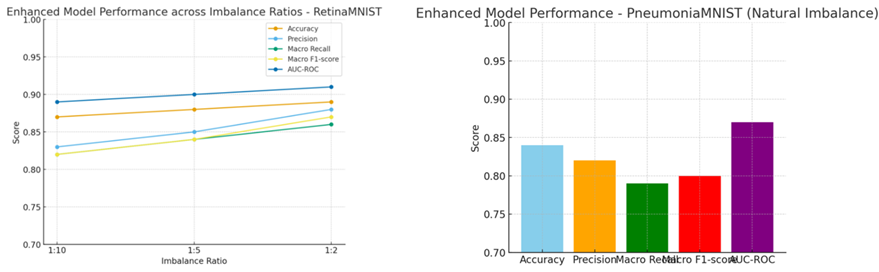
Medical image classification has advanced significantly through deep learning techniques, yet its performance remains limited by class imbalance and decentralized data silos commonly found in healthcare settings. These issues reduce model sensitivity to rare but clinically important cases, and standard Federated Learning (FL) further struggles under non-independent and identically distributed (non-IID) data. To address this, an enhanced federated model integrating unsupervised autoencoder-based reconstruction and adaptive tuning is proposed. The research contribution is an enhanced FL model that improves minority-class detection and overall classification performance under imbalanced medical image distributions, while remaining applicable across decentralized healthcare data sources. The method incorporates an autoencoder to compute reconstruction error, enabling emphasis on underrepresented samples, while adaptive tuning dynamically adjusts local hyperparameters and global aggregation weights based on sample difficulty. This integration strengthens minority-class learning without requiring additional labels or altering the decentralized structure. Experimental evaluations were conducted using two benchmark medical image datasets across three induced imbalance ratios (1:10, 1:5, 1:2) for RetinaMNIST and naturally induced imbalance for PneumoniaMNIST dataset. Results show that under severe imbalance (1:10), the enhanced model improves minority-class recall by 59.6%, F1-score by 33.9%, and AUC-ROC by 13.3% compared to standard FL. At 1:5 imbalance, recall increases by 41.3% and F1-score by 26.5%, with accuracy gains up to 6.0%. Even under mild imbalance (1:2), the model maintains consistent improvements, achieving a 26.4% recall gain and 18.9% increase in F1-score. The performance of the enhanced model was further evaluated against three baseline FL models such as standard federated learning (FedAvg), FL with GAN augmentation, and FL with standalone autoencoder-based reconstruction. The results consistently confirm that federated learning integrating adaptive tuning and autoencoder-based reconstruction outperform the three baselines FL-models for accuracy, recall, and F1-score. These findings also demonstrate that the enhanced model provides scalable, coordination-free improvement in imbalanced federated medical image classification, offering stronger performance and stability across real-world heterogeneous settings.
References
S. Kothawade, A. Savarkar, V. Iyer, L. Tamil, G. Ramakrishnan, and R. Iyer, “CLINICAL: Targeted Active Learning for Imbalanced Medical Image Classification,” In Workshop on Medical Image Learning with Limited and Noisy Data, pp. 119-129, 2022, https://doi.org/10.1007/978-3-031-16760-7_12.
J. X. Zhuang, J. Cai, J. Zhang, W. S. Zheng, and R. Wang, “Class attention to regions of lesion for imbalanced medical image recognition,” Neurocomputing, vol. 555, p. 126577, 2023, https://doi.org/10.1016/j.neucom.2023.126577.
A. A. Dharmasaputro, N. M. Fauzan, M. Kallista, Ig. P. D. Wibawa, and P. D. Kusuma, “Handling Missing and Imbalanced Data to Improve Generalization Performance of Machine Learning Classifier,” in 2021 International Seminar on Machine Learning, Optimization, and Data Science (ISMODE), pp. 140–145, 2022, https://doi.org/10.1109/ISMODE53584.2022.9743022.
B. Qi, W. Gong, and L. Li, “Probability Distribution Learning and Its Application in Deep Learning,” arXiv preprint arXiv:2406.05666, 2024, https://doi.org/10.48550/arXiv.2406.05666.
M. Li, P. Xu, J. Hu, Z. Tang, and G. Yang, “From challenges and pitfalls to recommendations and opportunities: Implementing federated learning in healthcare,” Medical image analysis, vol. 101, p. 103497, 2025, https://doi.org/10.1016/j.media.2025.103497.
S. Li et al., “Federated Learning in Healthcare: A Benchmark Comparison of Engineering and Statistical Approaches for Structured Data Analysis,” Health Data Science, vol. 4, p. 0196, 2024, https://doi.org/10.34133/hds.0196.
S. R. Abbas, Z. Abbas, A. Zahir, and S. W. Lee, “Federated Learning in Smart Healthcare: A Comprehensive Review on Privacy, Security, and Predictive Analytics with IoT Integration,” In Healthcare, vol. 12, no. 24, p. 2587, 2024, https://doi.org/10.3390/healthcare12242587.
H. Chung and J. S. Lee, “Federated influencer learning for secure and efficient collaborative learning in realistic medical database environment,” Sci. Rep., vol. 14, no. 1, p. 22729, 2024, https://doi.org/10.1038/s41598-024-73863-1.
H. Byeon, A. Ullah, Z. Syed, A. Siddiqui, A. Aftab, and M. Sarfaraz, “Image Classification Using Federated Learning,” In International Conference on Recent Trends in Image Processing and Pattern Recognition, pp. 66-75, 2023, https://doi.org/10.1007/978-3-031-53082-1_6.
S. Ren, Y. Hu, S. Chen, and G. Wang, “Federated Distillation for Medical Image Classification: Towards Trustworthy Computer-Aided Diagnosis,” arXiv preprint arXiv:2407.02261, 2024, https://doi.org/10.48550/arXiv.2407.02261.
Y. Zhao, M. Li, L. Lai, N. Suda, D. Civin, and V. Chandra, “Federated Learning with Non-IID Data,” arXiv preprint arXiv:1806.00582, 2018, https://doi.org/10.48550/arXiv.1806.00582.
S. Laridi, G. Palmer, and K.-M. M. Tam, “Enhanced Federated Anomaly Detection Through Autoencoders Using Summary Statistics-Based Thresholding,” Scientific Reports, vol. 14, no. 1, p. 26704, 2024, https://doi.org/10.1038/s41598-024-76961-2.
M. Babar, B. Qureshi, and A. Koubaa, “Investigating the impact of data heterogeneity on the performance of federated learning algorithm using medical imaging,” PLoS One, vol. 19, no. 5, 2024, https://doi.org/10.1371/journal.pone.0302539.
B. Van Calster et al., “Performance evaluation of predictive AI models to support medical decisions: Overview and guidance,” arXiv preprint arXiv:2412.10288, 2024, https://doi.org/10.48550/arXiv.2412.10288.
M. Haller, C. Lenz, R. Nachtigall, F. M. Awayshehl, and S. Alawadi, “Handling Non-IID Data in Federated Learning: An Experimental Evaluation Towards Unified Metrics,” in 2023 IEEE Intl Conf on Dependable, Autonomic and Secure Computing, Intl Conf on Pervasive Intelligence and Computing, Intl Conf on Cloud and Big Data Computing, Intl Conf on Cyber Science and Technology Congress (DASC/PiCom/CBDCom/CyberSciTech), pp. 0762–0770, 2023, https://doi.org/10.1109/DASC/PiCom/CBDCom/Cy59711.2023.10361408.
F. Saile, J. Thomas, D. Kaaser, and S. Schulte, “Client-Side Adaptation to Concept Drift in Federated Learning,” in 2024 2nd International Conference on Federated Learning Technologies and Applications (FLTA), pp. 71–78, 2024, https://doi.org/10.1109/FLTA63145.2024.10840058.
G. Long, M. Xie, T. Shen, T. Zhou, X. Wang, and J. Jiang, “Multi-center federated learning: clients clustering for better personalization,” World Wide Web, vol. 26, no. 1, pp. 481–500, 2023, https://doi.org/10.1007/s11280-022-01046-x.
Y. -A. Chen and G. -L. Chen, "An Adaptive Clustering Scheme for Client Selections in Communication-Efficient Federated Learning," 2023 VTS Asia Pacific Wireless Communications Symposium (APWCS), pp. 1-3, 2023, https://doi.org/10.1109/APWCS60142.2023.10234043.
A. El-Niss, A. Alzu’Bi, A. Abuarqoub, M. Hammoudeh and A. Muthanna, "SimProx: A Similarity-Based Aggregation in Federated Learning With Client Weight Optimization," in IEEE Open Journal of the Communications Society, vol. 5, pp. 7806-7817, 2024, https://doi.org/10.1109/OJCOMS.2024.3513816.
X. Li, Z. Qu, B. Tang and Z. Lu, "FedLGA: Toward System-Heterogeneity of Federated Learning via Local Gradient Approximation," in IEEE Transactions on Cybernetics, vol. 54, no. 1, pp. 401-414, 2024, https://doi.org/10.1109/TCYB.2023.3247365.
C. Fan and P. Liu, “Federated Generative Adversarial Learning,” In Chinese Conference on Pattern Recognition and Computer Vision (PRCV), pp. 3-15, 2020, https://doi.org/10.1007/978-3-030-60636-7_1.
J. Zhang, L. Zhao, K. Yu, G. Min, A. Y. Al-Dubai and A. Y. Zomaya, "A Novel Federated Learning Scheme for Generative Adversarial Networks," in IEEE Transactions on Mobile Computing, vol. 23, no. 5, pp. 3633-3649, 2024, https://doi.org/10.1109/TMC.2023.3278668.
A. Triastcyn and B. Faltings, "Federated Generative Privacy," in IEEE Intelligent Systems, vol. 35, no. 4, pp. 50-57, 2020, https://doi.org/10.1109/MIS.2020.2993966.
S. Kumari, C. Prabha, A. Karim, M. M. Hassan, and S. Azam, “A Comprehensive Investigation of Anomaly Detection Methods in Deep Learning and Machine Learning: 2019–2023,” IET Information Security, vol. 2024, no. 1, p. 8821891, 2024, https://doi.org/10.1049/2024/8821891.
S. Schneider, D. Antensteiner, D. Soukup and M. Scheutz, "Autoencoders - A Comparative Analysis in the Realm of Anomaly Detection," 2022 IEEE/CVF Conference on Computer Vision and Pattern Recognition Workshops (CVPRW), pp. 1985-1991, 2022, https://doi.org/10.1109/CVPRW56347.2022.00216.
C. Zhang, G. Shan, and B. Roh, “Communication-efficient federated multi-domain learning for network anomaly detection,” Digital Communications and Networks, 2024, https://doi.org/10.1016/j.dcan.2024.11.014.
K. M. M. Dolaat, A. Erbad, and M. Ibrar, “Enhancing Global Model Accuracy: Federated Learning for Imbalanced Medical Image Datasets,” in 2023 International Symposium on Networks, Computers and Communications (ISNCC), pp. 1–4, 2023, https://doi.org/10.1109/ISNCC58260.2023.10323682.
H. Guan and M. Liu, “Federated Learning for Medical Image Analysis: A Survey,” Pattern recognition, vol. 151, p. 110424, 2024, https://doi.org/10.1016/j.patcog.2024.110424.
L. I. Barona López and T. Borja Saltos, “Heterogeneity Challenges of Federated Learning for Future Wireless Communication Networks,” Journal of Sensor and Actuator Networks, vol. 14, no. 2, p. 37. 2025, https://doi.org/10.3390/jsan14020037.
E. Diao, J. Ding, and V. Tarokh, “Heterofl: Computation and communication efficient federated learning for heterogeneous clients,” arXiv preprint arXiv:2010.01264, 2020, https://doi.org/10.48550/arXiv.2010.01264.
L. U. Khan et al., “Federated Learning for Edge Networks: Resource Optimization and Incentive Mechanism,” IEEE Communications Magazine, vol. 58, no. 10, pp. 88–93, 2020, https://doi.org/10.1109/MCOM.001.1900649.
J. Konečný, H. B. McMahan, F. X. Yu, P. Richtárik, A. T. Suresh, and D. Bacon, “Federated Learning: Strategies for Improving Communication Efficiency,” arXiv preprint arXiv:1610.05492, 2016, https://doi.org/10.48550/arXiv.1610.05492.
F. Sattler, S. Wiedemann, K. R. Muller, and W. Samek, “Robust and Communication-Efficient Federated Learning from Non-i.i.d. Data,” IEEE Trans. Neural Netw. Learn. Syst., vol. 31, no. 9, pp. 3400–3413, 2020, https://doi.org/10.1109/TNNLS.2019.2944481.
M. Zhu, “Solving Class Imbalance in Medical Image Classification Based on Federated Learning,” in Proceedings of the 2025 2nd International Conference on Generative Artificial Intelligence and Information Security, GAIIS 2025, pp. 546–550, 2025, https://doi.org/10.1145/3728725.3728811.
X. Wei et al., "Breaking Data Efficiency Dilemma: A Federated and Augmented Learning Framework for Alzheimer’s Disease Detection Via Speech," ICASSP 2026 - 2026 IEEE International Conference on Acoustics, Speech and Signal Processing (ICASSP), pp. 19147-19151, 2026, https://doi.org/10.1109/ICASSP55912.2026.11463930.
J. Yang et al., “MedMNIST v2 -- A large-scale lightweight benchmark for 2D and 3D biomedical image classification,” Scientific data, vol. 10, no. 1, p. 41, 2023, https://doi.org/10.1038/s41597-022-01721-8.
X. Xia et al., “Benchmarking deep models on retinal fundus disease diagnosis and a large-scale dataset,” Signal Process. Image Commun., vol. 127, p. 117151, 2024, https://doi.org/10.1016/j.image.2024.117151.
A. Mabrouk, R. P. D. Redondo, A. Dahou, M. A. Elaziz, and M. Kayed, “Pneumonia Detection on chest X-ray images Using Ensemble of Deep Convolutional Neural Networks,” Applied Sciences, vol. 12, no. 13, p. 6448, 2022, https://doi.org/10.3390/app12136448.
G. Dlamini and M. Fahim, “DGM: a data generative model to improve minority class presence in anomaly detection domain,” Neural Comput. Appl., vol. 33, no. 20, pp. 13635–13646, 2021, https://doi.org/10.1007/s00521-021-05993-w.
J. Kong, W. Kowalczyk, S. Menzel, and T. Bäck, “Improving imbalanced classification by anomaly detection,” In International conference on parallel problem solving from nature, pp. 512–523, 2020, https://doi.org/10.1007/978-3-030-58112-1_35.
J. Stefanowski, “Overlapping, Rare Examples and Class Decomposition in Learning Classifiers from Imbalanced Data,” In Emerging paradigms in machine learning, pp. 277–306, 2013, https://doi.org/10.1007/978-3-642-28699-5_11.
G. Pang, C. Shen, L. Cao, and A. Van Den Hengel, “Deep Learning for Anomaly Detection: A Review,” ACM computing surveys (CSUR), vol. 54, no. 2, pp. 1-38, 2021, https://doi.org/10.1145/3439950.
M. Lübbering, R. Ramamurthy, M. Gebauer, T. Bell, R. Sifa, and C. Bauckhage, “From Imbalanced Classification to Supervised Outlier Detection Problems: Adversarially Trained Auto Encoders,” In International Conference on Artificial Neural Networks, pp. 27–38, 2020, https://doi.org/10.1007/978-3-030-61609-0_3.
M. C. Massi, F. Ieva, F. Gasperoni, and A. M. Paganoni, “Feature Selection for Imbalanced Data with Deep Sparse Autoencoders Ensemble,” Statistical Analysis and Data Mining: The ASA Data Science Journal, vol. 15, no. 3, pp. 376-395, 2022, https://doi.org/10.1002/sam.11567.
V. Mothukuri, P. Khare, R. M. Parizi, S. Pouriyeh, A. Dehghantanha and G. Srivastava, "Federated-Learning-Based Anomaly Detection for IoT Security Attacks," in IEEE Internet of Things Journal, vol. 9, no. 4, pp. 2545-2554, 2022, https://doi.org/10.1109/JIOT.2021.3077803.
R. Alhammadi, A. Gawanmeh, S. Atalla, M. Q. Alkhatib and W. Mansoor, "Performance Evaluation of Federated Learning for Anomaly Network Detection," 2023 Congress in Computer Science, Computer Engineering, & Applied Computing (CSCE), pp. 116-122, 2023, https://doi.org/10.1109/CSCE60160.2023.00024.
L. Li, Y. Fan, M. Tse, and K. Y. Lin, “A review of applications in federated learning,” Computers & Industrial Engineering, vol. 149, p. 106854, 2020, https://doi.org/10.1016/j.cie.2020.106854.
N. Yang, X. Chen, C. Z. Liu, D. Yuan, W. Bao, and L. Cui, “FedMAE: Federated Self-Supervised Learning with One-Block Masked Auto-Encoder,” arXiv preprint arXiv:2303.11339, 2023, https://doi.org/10.48550/arXiv.2303.11339.
Y. Wu et al., “Federated Self-Supervised Contrastive Learning and Masked Autoencoder for Dermatological Disease Diagnosis,” arXiv preprint arXiv:2208.11278, 2022, https://doi.org/10.48550/arXiv.2208.11278.
M. Nardi, L. Valerio and A. Passarella, "Anomaly Detection Through Unsupervised Federated Learning," 2022 18th International Conference on Mobility, Sensing and Networking (MSN), pp. 495-501, 2022, https://doi.org/10.1109/MSN57253.2022.00085.
A. Anwar et al., "FedAD-Bench: A Unified Benchmark for Federated Unsupervised Anomaly Detection in Tabular Data," 2024 2nd International Conference on Federated Learning Technologies and Applications (FLTA), pp. 115-122, 2024, https://doi.org/10.1109/FLTA63145.2024.10839838.
Y. Huh, B. Kim, and W. Choi, “Federated Learning Enhanced by Feature Reconstruction for Semantic Communication Module Updates of Agents,” arXiv preprint arXiv:2508.02048, 2025, https://doi.org/10.48550/arXiv.2508.02048.
F. Angiulli, F. Fassetti, and L. Ferragina, “Reconstruction Error-based Anomaly Detection with Few Outlying Examples,” Neurocomputing, vol. 675, p. 133002, 2026, https://doi.org/10.1016/j.neucom.2026.133002.
M. A. Rassam, “Autoencoder-Based Neural Network Model for Anomaly Detection in Wireless Body Area Networks,” Internet of Things, vol. 5, no. 4, pp. 852–870, 2024, https://doi.org/10.3390/iot5040039.
Y. Liu, S. Rini and J. Chen, "GCFed: Exploiting Gradient Correlation for Client Selection and Rate Allocation in Federated Learning," in IEEE Internet of Things Journal, 2026, https://doi.org/10.1109/JIOT.2026.3687127.
Y. Zeng et al., “Adaptive Federated Learning With Non-IID Data,” The Computer Journal, vol. 66, no. 11, pp. 2758–2772, 2023, https://doi.org/10.1093/comjnl/bxac118.
M. Yashwanth, G. K. Nayak, A. Singh, Y. Simmhan, and A. Chakraborty, “Adaptive Self-Distillation for Minimizing Client Drift in Heterogeneous Federated Learning,” arXiv preprint arXiv:2305.19600, 2023, https://doi.org/10.48550/arXiv.2305.19600.
X. Chen, Y. Liu, H. Du, M. Wang, and Y. Zhao, “Taming Gradient Variance in Federated Learning with Networked Control Variates,” arXiv preprint arXiv:2310.17200, 2023, https://doi.org/10.48550/arXiv.2310.17200.
R. Niu, Y. Wang, C. Yang, and X. Cao, “CAAFL: A Client-Level Adaptive Acceletative Federated Learning Optimization Algorithm for Heterogeneous Data Scenarios,” in Proceedings of the 36th Chinese Control and Decision Conference, CCDC 2024, pp. 3859–3864, 2024, https://doi.org/10.1109/CCDC62350.2024.10587872.
Published
How to Cite
Issue
Section
License
Copyright (c) 2026 Nadzurah Zainal Abidin, Amelia Ritahani Ismail, Cut Amalia Saffiera, Nurul A. Emran, Zammarah Nuha Abdullah

This work is licensed under a Creative Commons Attribution-ShareAlike 4.0 International License.
Authors who publish with this journal agree to the following terms:
- Authors retain copyright and grant the journal right of first publication with the work simultaneously licensed under a Creative Commons Attribution License that allows others to share the work with an acknowledgment of the work's authorship and initial publication in this journal.
- Authors are able to enter into separate, additional contractual arrangements for the non-exclusive distribution of the journal's published version of the work (e.g., post it to an institutional repository or publish it in a book), with an acknowledgment of its initial publication in this journal.
- Authors are permitted and encouraged to post their work online (e.g., in institutional repositories or on their website) prior to and during the submission process, as it can lead to productive exchanges, as well as earlier and greater citation of published work (See The Effect of Open Access).

This journal is licensed under a Creative Commons Attribution-ShareAlike 4.0 International License.