Implementation of East Javanese Local Culture in Graphic Design Elements in Students’ Final Projects: A Literature Review
DOI:
https://doi.org/10.12928/biste.v7i4.14932Keywords:
Graphic Design, Local Wisdom, East Javanese Culture, Literature Reviews, Final ProjectAbstract
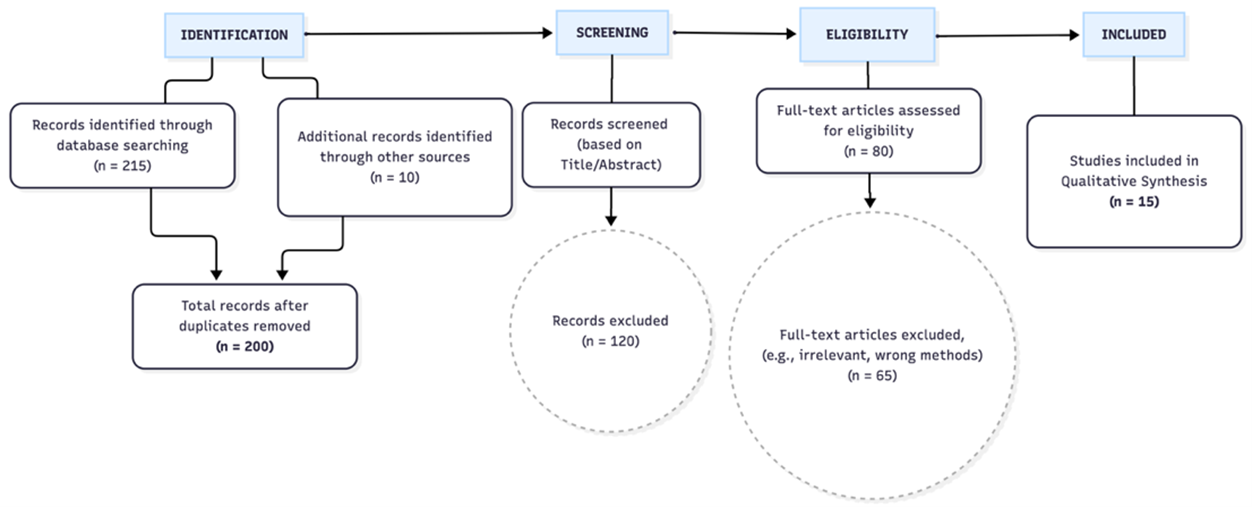
The background of this research departs from the challenges of globalization that cause visual homogenization and erode local cultural identity. Graphic design is a strategic medium in bridging tradition with modernity, by adapting cultural elements such as batik motifs, Javanese script typography, to cultural icons Reog and Karapan Sapi. This study aims to analyze the integration of East Java local wisdom values in contemporary graphic design through a literature study approach and descriptive qualitative analysis. The research method was carried out by reviewing 215 articles selected using the PRISMA protocol until there were 15 relevant main sources. The results of the study show that there are four main trends in graphic design based on local wisdom, namely the symbolization of performance culture and language (30%), culinary branding and local products (29%), the revitalization of cultural narratives on digital platforms (22%), and the abstraction of traditional crafts into visual assets (18%). The value of the interconnectedness between keywords shows that graphic design is now strongly integrated with interactive technology, education, and the creative economy. In conclusion, the application of East Java's local wisdom in graphic design not only strengthens the region's visual identity but also opens up opportunities for sustainable creative economy innovation.
References
H. Habeeb and A. A. R. M. Hamid, “Exploring the relationship between identity orientation and symptoms of depression among third culture kids college students,” International Journal of Instruction, vol. 14, no. 3, pp. 999–1010, 2021, https://doi.org/10.29333/iji.2021.14358a.
F. Li and Y. Wang, “Research on multiple teaching models of Chinese culture integration in English translation course based on web technology,” Applied Mathematics and Nonlinear Sciences, vol. 9, no. 1, 2024, https://doi.org/10.2478/amns-2024-0101.
H. Santosa, A. Yudono, and M. S. Adhitama, “The digital management system of the tangible culture heritage for enhancing historic building governance in Malang, Indonesia,” in IOP Conference Series: Earth and Environmental Science, 2021, https://doi.org/10.1088/1755-1315/738/1/012056.
A. I. Viswamohan and C. M. Wilkinson, “Stardom in contemporary Hindi cinema: Celebrity and fame in globalized times,” 2020, https://doi.org/10.1007/978-981-15-0191-3.
D. P. Danilaev and N. N. Malivanov, “Technological education and engineering pedagogy,” Obrazovanie i Nauka, vol. 22, no. 3, pp. 55–82, 2020, https://doi.org/10.17853/1994-5639-2020-3-55-82.
H. Santosa, A. Yudono, and M. S. Adhitama, “The digital management system of the tangible culture heritage for enhancing historic building governance in Malang, Indonesia,” in IOP Conference Series: Earth and Environmental Science, 2021,https://doi.org/10.1088/1755-1315/738/1/012056.
I. I. Addaviqi and A. Prapanca, “Metabharata game based on Javanese Wayang art using Unity,” Vokasi Unesa Bulletin of Engineering, Technology and Applied Science, pp. 38-45, 2024, https://doi.org/10.26740/vubeta.v1i1.34034.
C. Wagner. Visualizations of urban space: Digital age, aesthetics, and politics. Routledge. 2022, https://doi.org/10.4324/9781003314943.
Aliyu Musa Kid, M. Z. Ahmed, Abdulkadir Hamidu Alkali, Jafaru Usman, and Aisha Hassan Abdalla Hashim, “Real-time energy demand forecasting and adaptive demand response optimization for IoT-enabled smart grids,” Vokasi Unesa Bulletin of Engineering, Technology and Applied Science, vol. 2, no. 2, pp. 366–375, 2025, https://doi.org/10.26740/vubeta.v2i2.36818.
G. Oise, C. Nwabuokei, R. Igbunu, and P. Ejenarhome, “Revisiting parasitic computing: ethical and technical dimensions in resource optimization,” Vokasi Unesa Bulletin of Engineering, Technology and Applied Science, vol. 2, no. 3, pp. 376–386, 2025, https://doi.org/10.26740/vubeta.v2i3.38786.
N. A. Salim, M. Zaibi, M. Brantasari, M. Ikhsan, and A. Aslindah, “Islamic boarding school leadership innovation: from traditional to modernization of education,” Munaddhomah, vol. 5, no. 4, pp. 447–460, 2024, https://doi.org/10.31538/munaddhomah.v5i4.1392.
I. Ikaputra and D. T. Widyastuti, “Marginalized modern architectural heritage in Indonesia: The case of transformator huisje (gardu listrik) architecture of the Nederlandsche Indisch era,” Frontiers of Architectural Research, vol. 14, no. 3, pp. 596–613, 2025, https://doi.org/10.1016/j.foar.2024.10.005.
C. Xu, Y. Huang, and B. J. Dewancker, “Art inheritance: An education course on traditional pattern morphological generation in architecture design based on digital sculpturism,” Sustainability (Switzerland), vol. 12, no. 9, 2020, https://doi.org/10.3390/su12093752.
W. R. Williams, “Examining Studio Ghibli’s animated films: a study of students’ viewing paths and creative projects,” Journal of Adolescent and Adult Literacy, vol. 63, no. 6, pp. 639–650, 2020, https://doi.org/10.1002/jaal.1043.
P. U. Pramesti, M. I. Hasan, and M. Ramandhika, “Locality values in thermal comfort embodied in traditional Indonesian houses: A literature review,” in IOP Conference Series: Earth and Environmental Science, vol. 894, no. 1, p. 012009, 2021, https://doi.org/10.1088/1755-1315/894/1/012009.
Y. Rahmawati and P. C. Taylor, “Integrating STEM and local wisdom in science education in Indonesia: A cultural synergy,” Cult Stud Sci Educ, vol. 15, pp. 275–291, 2020, https://doi.org/10.1007/s11422-019-09936-y.
F. Brunetti, D. T. Matt, A. Bonfanti, A. de Longhi, G. Pedrini, and G. Orzes, “Digital transformation challenges: strategies emerging from a multi-stakeholder approach,” TQM Journal, vol. 32, no. 4, pp. 697–724, 2020, https://doi.org/10.1108/TQM-12-2019-0309.
S. Chrétien-Ichikawa and K. Pawlik. Creative industries and digital transformation in China. 2022. https://doi.org/10.1007/978-981-19-3049-2.
S. C. Rea, “Teaching and confronting digital extremism: contexts, challenges and opportunities,” Information and Learning Science, vol. 123, no. 1–2, pp. 7–25, 2022, https://doi.org/10.1108/ILS-08-2021-0065.
Patria, A. S., Kristiana, N., Martadi, M., Anggalih, N. N., Carreca, I. N., Laksmi, A. A., & Nurcahyanie, Y. D. “Introduction Indonesian culture for early age children through wooden educational toys,” Multidisciplinary Science Journal, vol. 7, no. 12, pp. 2025574-2025574. 2025, https://doi.org/10.31893/multiscience.2025574.
J. Wilson, On the capabilities of hip hop-inspired design research: An annotated syllabus, 2021. https://doi.org/10.4324/9780429355875-16.
Z. Chu, “Effects of digital media integrated reciprocal teaching on students’ reading ability and motivation,” Revista de Cercetare si Interventie Sociala, vol. 73, pp. 299–311, 2021, https://doi.org/10.33788/rcis.73.19.
M. M. Mansour, A. M. Lafta, A. M. Salman, and H. S. Salman, “Exploring the impact of AI and IoT on production efficiency, quality precision, and environmental sustainability in manufacturing,” Vokasi Unesa Bulletin of Engineering, Technology and Applied Science, vol. 2, no. 2, pp. 342–355, 2025, https://doi.org/10.26740/vubeta.v2i2.38200.
I. İ. Budakoǧlu, Ö. Coşkun, and V. Ozeke, “e-PBL with multimedia animations: a design-based research,” BMC Med Educ, vol. 23, no. 1, 2023, https://doi.org/10.1186/s12909-023-04298-x.
S. Ratna, S. Saide, H. Herzavina, and D. Muwardi, “A preliminary model analysis of knowledge management design: spiritual leadership on knowledge worker productivity,” Technol Anal Strateg Manag, vol. 35, no. 3, pp. 270–285, 2023, https://doi.org/10.1080/09537325.2021.1973665.
V. Bagnolo, R. Argiolas, and S. Cera, “Digital Translations of Paper Architectures; Traduzioni digitali di architetture di carta,” Disegno, vol. 2022, no. 10, pp. 95–106, 2022, https://doi.org/10.26375/disegno.10.2022.11.
H. Habiddin, M. Ashar, A. Hamdan, and K. R. Nasir, “Digital comic media for teaching secondary school science,” International Journal of Interactive Mobile Technologies, vol. 16, no. 3, pp. 159–166, 2022, https://doi.org/10.3991/IJIM.V16I03.28967.
R. Sharma and V. Kukreja, “Deciphering emotions in comics: analysis of emotion classification of comic characters via attention-based deep learning models,” Multimed Tools Appl, pp. 1-33, 2025, https://doi.org/10.1007/s11042-025-21017-4.
J. Lyu, Q. Xu, C. Hu, and M. Chen, “Digital empowerment: the sustainable development of Chengdu lacquerware’s colors and decorations,” Applied Sciences (Switzerland), vol. 15, no. 9, 2025, https://doi.org/10.3390/app15095065.
S. J. Marshall, “Augmented reality’s application in education and training,” Springer Handbook of Augmented Reality, pp. 335-353, 2023. https://doi.org/10.1007/978-3-030-67822-7_13.
A. Ohlei, T. Schumacher, and M. Herczeg, “An Augmented Reality Tour Creator for Museums with Dynamic Asset Collections,” In International Conference on Augmented Reality, Virtual Reality and Computer Graphics, pp. 15-31, 2020, https://doi.org/10.1007/978-3-030-58468-9_2.
A. K. Peters et al., “Sustainability in Computing Education: A Systematic Literature Review,” ACM Transactions on Computing Education, vol. 24, no. 1, 2024, https://doi.org/10.1145/3639060.
U. Hasanah, “Key definitions of STEM education: Literature review,” Interdisciplinary Journal of Environmental and Science Education, vol. 16, no. 3, p. e2217, 2020, https://doi.org/10.29333/ijese/8336.
L. Terán, J. Pincay, I. Wallimann-Helmer, and E. Portmann, “A Literature Review on Digital Ethics from a Humanistic and Sustainable Perspective,” in ACM International Conference Proceeding Series, pp. 57–64, 2021, https://doi.org/10.1145/3494193.3494295.
M. S. Rana, M. N. Nobi, B. Murali, and A. H. Sung, “Deepfake Detection: A Systematic Literature Review,” IEEE Access, vol. 10, pp. 25494–25513, 2022, https://doi.org/10.1109/ACCESS.2022.3154404.
F. C. Carletto, L. O. Ferriani, and D. A. Silva, “Sustainability in food service: A systematic review,” Waste Management and Research, vol. 41, no. 2, pp. 285–302, 2023, https://doi.org/10.1177/0734242X221122604.
A. S. Khalid, G. Farid, and K. Mahmood, “Sustainable development challenges in libraries: A systematic literature review (2000–2020),” Journal of Academic Librarianship, vol. 47, no. 3, 2021, https://doi.org/10.1016/j.acalib.2021.102347.
X. Wu, “Design of Taijiquan multimedia distance teaching system based on ASP technology,” In EAI International Conference, BigIoT-EDU, pp. 146-155, 2023, https://doi.org/10.1007/978-3-031-23947-2_16.
F. Tang, “An Empirical Analysis of Interactive Advertising Design Teaching Based on Web3D,” IEEE Explore, pp. 564–567, 2020, https://doi.org/10.1109/ICICTA51737.2020.00124.
X. Yuan, “Design and implementation of art teaching system based on B/S structure,” in ACM International Conference Proceeding Series, pp. 316–323, 2022, https://doi.org/10.1145/3568739.3568793.
R. van Beek et al., “Guidelines to support the design, selection and appraisal of multimedia teaching aids for microbiology education,” Microb Biotechnol, vol. 17, no. 8, 2024, https://doi.org/10.1111/1751-7915.14553.
X. Meng, S. Wang, and L. Wang, “Design of Multimedia Teaching Software Based on Distributed Network Architecture,” International Journal of High Speed Electronics and Systems, vol. 34, no. 1, 2025, https://doi.org/10.1142/S0129156425401305.
S. Cao and H. Wang, “Research on the Design of Web Platform for Distance PE Teaching,” In Proceeding of the 2024 International Conference on Artificial Intelligence and Future Education, pp. 78–82, 2024, https://doi.org/10.1145/3708394.3708409.
K. Fibrianto, S. Hastuti, H. Harijono, E. S. Murtini, and A. Akbar, “Textural optimization of Ledre: Indonesian crepes-like snack,” Advances in Food Science, Sustainable Agriculture and Agroindustrial Engineering (AFSSAAE), pp. 11-18, 2023, https://afssaae.ub.ac.id/index.php/afssaae/article/view/1832.
A. Christianna, “Preservation of Damar Kurung through jewelry design,” Productum: Jurnal Desain Produk (Pengetahuan dan Perancangan Produk), vol. 3, no. 7, pp. 247-254, 2020, https://doi.org/10.24821/productum.v3i7.3343.
S. A. Masruroh, “Wayang Potehi at Hong San Kiong Temple in Gudo, Jombang, Indonesia: An effort to preserve the culture and religious moderation,” Walisongo: Jurnal Penelitian Sosial Keagamaan, vol. 31, no. 2, pp. 259-282, 2023, https://doi.org/10.21580/ws.31.2.19429.
G. Atmadiredja, D. K. Marjanto, I. Ulumuddin, and U. Sudrajat, “Preservation of Reog Ponorogo in Contemporary Society,” In Proceedings of the International Conference on Multidisciplinary Studies (ICoMSi 2023), vol. 829, p. 229, 2024, https://doi.org/10.2991/978-2-38476-228-6_19.
Y. Choi, J. Han, J. Park, S. Lee, J. Choi, J. E. Sung, and S. Choi, “Illustration Design to Derive Storytelling for the Elderly in South Korea:(Traditional folklore of Heungbu and Nolbu),” Archives of Design Research, vol. 35, no. 2, pp. 155-165, 2022, https://doi.org/10.15187/adr.2022.05.35.2.155.
M. Iskandar and S. Nurusholih, “Designing Visual Assets Illustration of Covid-19 Prevention Socialization for Children Aged 7-12 Years,” In Proceeding International Conference on Information Technology, Multimedia, Architecture, Design, and E-Business, vol. 1, pp. 443-451, 2020, https://eprosiding.idbbali.ac.id/index.php/imade/article/view/456.
E. D. Pramesti, “Reog Ponorogo Museum with Historical Approach in Sampung Ponorogo Village,” TAMA: Journal of Visual Arts, vol. 2, no. 2, 2024, https://doi.org/10.61405/w6xj5559.
S. Sutrisno, S. Supartono, D. Hadayanti, and A. Bahar, “Rebranding MSME Products as a visual identity in increasing brand awareness through SWOT Analysis,” Jurnal Ekonomi, vol. 12, no. 01, pp. 1322-1326, https://ejournal.seaninstitute.or.id/index.php/Ekonomi/article/view/1365.
M. Martadi and M. B. T. Sampurno, “Culturally sustaining pedagogy through Banyuwangi arts in elementary education,” Harmonia: Journal of Arts Research and Education, vol. 25, no. 1, pp. 44–58, 2025, https://doi.org/10.15294/harmonia.v25i1.17020.
M. Boucher, M. Alkadi, B. Bach, and W. Aigner, “Instructional comics for self-paced learning of data visualization tools and concepts,” Computer Graphics Forum, vol. 44, no. 3, 2025, https://doi.org/10.1111/cgf.70130.
P. B. Saptono et al., “Flourishing MSMEs: The role of innovation, creative compliance, and tax incentives,” Journal of Risk and Financial Management, vol. 17, no. 12, 2024, https://doi.org/10.3390/jrfm17120532.
S. Noviarto and P. L. Samputra, “MSME’s sustainable economic behavior for struggling poverty: Agency theory vs. bounded rationality theory,” in IOP Conference Series: Earth and Environmental Science, vol. 716, no. 1, p. 012120, 2021, https://doi.org/10.1088/1755-1315/716/1/012120.
Y. Wang et al., “Serving the National Cultural Strategy: Promoting the Creative Development of Cultural Resources in Libraries, Archives, and Museums,” Journal of Agricultural Library and Information Science, vol. 34, no. 12, pp. 4-32, 2022, https://doi.org/10.13998/j.cnki.issn1002-1248.22-0900.
J. A. Sudarmanto, “Exploring the intersection of Al and creativity in the local Indonesian graphic designers’ perspective,” Journal of Graphic Engineering and Design, vol. 16, no. 2, pp. 27–35, 2025, https://doi.org/10.24867/JGED-2025-2-027.
V. Fabelina, I. B. Tuhenay, and Christian, “The Influence of TikTok as a marketing tool for MSMEs on public buyer interest,” in Proceedings of the International Conference on Electrical Engineering and Informatics, pp. 158–163, 2024, https://doi.org/10.1109/ICELTICs62730.2024.10776124.
L. Zhang et al., “BANG: Dividing 3D assets via generative exploded dynamics,” ACM Trans Graph, vol. 44, no. 4, 2025, https://doi.org/10.1145/3730840.
M. Hammou et al., “Huldra: A framework for collecting crowdsourced feedback on multimedia assets,” In Proceedings of the 13th ACM Multimedia Systems Conference, pp. 203-209 2022, https://doi.org/10.1145/3524273.3532887.
S. Naritomi and K. Yanai, "Pop’n Food: 3D Food Model Estimation System from a Single Image," 2021 IEEE 4th International Conference on Multimedia Information Processing and Retrieval (MIPR), pp. 223-226, 2021, https://doi.org/10.1109/MIPR51284.2021.00041.
F. C. Carletto, L. O. Ferriani, and D. A. Silva, “Sustainability in food service: A systematic review,” Waste Management and Research, vol. 41, no. 2, pp. 285–302, 2023, https://doi.org/10.1177/0734242X221122604.
H. Tian and Y. Rugwongwan, “Research progress, hotspots, and trend analysis of emotional design based on bibliometrics,” Pak J Life Soc Sci, vol. 22, no. 2, pp. 5016–5028, 2024, https://doi.org/10.57239/PJLSS-2024-22.2.00373.
H. Zhao, Y. Wang, Y. Zou, and Y. Zhou, “Preserving traditional handicrafts: a novel surface flattening algorithm of 3d curved patterns for cylindrical porcelain,” Journal on Computing and Cultural Heritage, vol. 18, no. 3, 2025, https://doi.org/10.1145/3737678.
A. S. Nanang et al., “The Impact of Online Purchasing on Healthy Food Consumption in East Java, Indonesia,” Research on World Agricultural Economy, vol. 6, no. 1, pp. 423–434, 2025, https://doi.org/10.36956/rwae.v6i1.1443.
M. A. Cheema, M. Hanif, O. Albalawi, E. E. Mahmoud, and M. Nabi, “Evaluating water-related health risks in East and Central Asian Islamic Nations using predictive models (2020–2030),” Sci Rep, vol. 14, no. 1, 2024, https://doi.org/10.1038/s41598-024-67775-3.
M. A. Y. Asiri, C. Liu, X. Liu, and E. Sumarliah, “How foreign direct investment and other Belt and Road Initiative aspects shape sustainable economic development in Middle East Nations,” Journal of Industrial Integration and Management, vol. 8, no. 3, pp. 387–412, 2023, https://doi.org/10.1142/S2424862223500161.
E. Freedman. Artificial intelligence and playable media. Routledge. 2022. https://doi.org/10.4324/9781003225072.
A. Dewdney and K. Sluis. The networked image in post-digital culture. London and New York: Routledge. 2022. https://doi.org/10.4324/9781003095019.
M. C. Arroyo, “The emergence of a visual culture from software portability in an architectural education context,” IEEE 1st International Conference on Advanced Learning Technologies on Education & Research (ICALTER), pp. 1-4, 2021, https://doi.org/10.1109/ICALTER54105.2021.9675131.
J. M. Cruz, N. Bruhis, N. N. Kellam, and S. Jayasuriya, “Students’ implicit epistemologies when working at the intersection of engineering and the arts,” Int J STEM Educ, vol. 8, no. 1, 2021, https://doi.org/10.1186/s40594-021-00289-w.
N. A. Streitz and S. I. Konomi, Distributed, Ambient and Pervasive Interactions. Smart Living, Learning, Well-being and Health, Art and Creativity: 10th International Conference, DAPI 2022, Held as Part of the 24th HCI International Conference, HCII 2022, Virtual Event, June 26–July 1, 2022, Proceedings, Part II, vol. 13326, 2022, https://doi.org/10.1007/978-3-031-05431-0.
C. Stephanidis, M. Antona, S. Ntoa, and G. Salvendy, HCI International 2025 Posters: 27th International Conference on Human-Computer Interaction, HCII 2025, Gothenburg, Sweden, June 22–27, 2025, Proceedings, Part VIII, vol. 2529, 2025, https://doi.org/10.1007/978-3-031-94171-9.
Published
How to Cite
Issue
Section
License
Copyright (c) 2025 Asidigisianti Surya Patria, Abdul Hafidz, Bayu Dwi Nurwicaksono, Ayusta Lukita Wardani, Arieviana Ayu Laksmi, Yudiyanto Tri Kurniawan, Henny Hidayanti, Mochammad Abdul Machfud, Rizal Sofyana Fatahillah, Junaini Binti Kasdan, Hong Tangkin, Bahalwan Apriyansyah, Hanny Chandra Pratama, David Nugroho

This work is licensed under a Creative Commons Attribution-ShareAlike 4.0 International License.
Authors who publish with this journal agree to the following terms:
- Authors retain copyright and grant the journal right of first publication with the work simultaneously licensed under a Creative Commons Attribution License that allows others to share the work with an acknowledgment of the work's authorship and initial publication in this journal.
- Authors are able to enter into separate, additional contractual arrangements for the non-exclusive distribution of the journal's published version of the work (e.g., post it to an institutional repository or publish it in a book), with an acknowledgment of its initial publication in this journal.
- Authors are permitted and encouraged to post their work online (e.g., in institutional repositories or on their website) prior to and during the submission process, as it can lead to productive exchanges, as well as earlier and greater citation of published work (See The Effect of Open Access).

This journal is licensed under a Creative Commons Attribution-ShareAlike 4.0 International License.