Artificial Intelligence and IoT for Riverine Oil Spill Detection: A Focused Review and Proposed Adaptive Edge Framework
DOI:
https://doi.org/10.12928/biste.v8i1.14677Keywords:
Freshwater Monitoring, Synthetic Aperture Radar (SAR), Multi-Sensor Data Fusion, Federated Learning, Hyperspectral ImagingAbstract
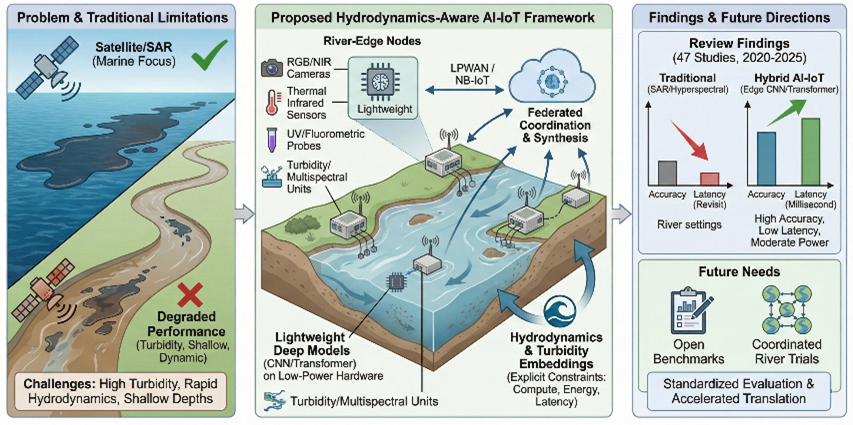
Riverine oil spills are more challenging to detect than marine spills due to shallow depths, high turbidity, and rapidly changing hydrodynamics, which degrade the performance of satellite- and SAR-based detection methods. This review examines how artificial intelligence and the Internet of Things can deliver accurate, low-latency detection in freshwater and defines an AI-IoT system as distributed river-edge nodes with RGB/NIR cameras, thermal infrared sensors, UV/fluorometric probes, and turbidity/multispectral units running lightweight deep models on low-power hardware and networked via LPWAN or NB-IoT with optional federated coordination. The novel contribution is a hydrodynamics-aware, adaptive framework that embeds river flow and turbidity, couples explicit constraints on edge compute, energy, and inference latency, and derives multi-sensor fusion logic from comparative synthesis. Performance is organized along accuracy, decision latency, deployment cost, and environmental adaptability. Using a structured narrative review with scoping elements, the research screened 145 records from major databases. It synthesized 47 peer-reviewed studies (2020-2025), harmonized definitions, and applied descriptive synthesis to manage heterogeneous metrics and protocols. Results show that SAR and hyperspectral methods that excel in marine or controlled settings often degrade in narrow, turbid rivers because of clutter and revisit latency. In contrast, hybrid AI-IoT architectures employing compact CNN/Transformer variants at the edge report high accuracy with millisecond-scale inference and moderate power budgets. Limitations include heterogeneous reporting, non-standard datasets, and limited multi-site validation. The framework and synthesis motivate open benchmarks and coordinated river trials to standardize evaluation and accelerate translation.
References
M. Riazi, "Sources and Causes of Oil Spills," in Oil Spill Occurrence, Simulation, and Behavior, pp. 47-80, 2021, https://doi.org/10.1201/9780429432156-3.
D. Kvoˇcka, D. Žagar, and P. Banovec, "A Review of River Oil Spill Modeling," Water, vol. 13, no. 12, p. 1620, 2021, https://doi.org/10.3390/w13121620.
J. Wang, Y. Zhou, L. Zhuang, L. Shi, and S. Zhang, “Study on the critical factors and hot spots of crude oil tanker accidents,” Ocean & Coastal Management, vol. 217, p. 106010, 2022, https://doi.org/10.1016/j.ocecoaman.2021.106010.
A. Jiang, L. Han, C. Wang, and J. Zhao, "Migration movements of accidentally spilled oil in environmental waters: a review," Water, vol. 15, no. 23, p. 4092, 2023, https://doi.org/10.3390/w15234092.
C. Kang, H. Yang, G. Yu, J. Deng, and Y. Shu, "Simulation of Oil Spills in Inland Rivers," Journal of Marine Science and Engineering, vol. 11, no. 7, p. 1294, 2023, https://doi.org/10.3390/jmse11071294.
X. Wen, A. Fan, J. Wang, Y. Xia, S. Chen, and Y. Yang, "Different Emergency Response Strategies to Oil Spills in Rivers Lead to Divergent Contamination Compositions and Microbial Community Response Characteristics," Microorganisms, vol. 13, no. 6, p. 1193, 2025, https://doi.org/10.3390/microorganisms13061193.
P. Keramea, K. Spanoudaki, G. Zodiatis, G. Gikas, and G. Sylaios, "Oil spill modeling: A critical review on current trends, perspectives, and challenges," Journal of marine science and engineering, vol. 9, no. 2, p. 181, 2021, https://doi.org/10.3390/jmse9020181.
M. Zakzouk, A. M. Abdulaziz, I. Abou El-Magd, A. S. Dahab, and E. M. Ali, "Automated oil spill detection using deep learning and SAR satellite data for the northern entrance of the Suez Canal," Scientific Reports, vol. 15, no. 1, p. 20107, 2025, https://doi.org/10.1038/s41598-025-03028-1.
X. Li et al., "Deep-learning-based information mining from ocean remote-sensing imagery," National Science Review, vol. 7, no. 10, pp. 1584-1605, 2020, https://doi.org/10.1093/nsr/nwaa098.
T. De Kerf, J. Gladines, S. Sels, and S. Vanlanduit, "Oil spill detection using machine learning and infrared images," Remote sensing, vol. 12, no. 24, p. 4090, 2020, https://doi.org/10.3390/rs12244090.
J. Yang, J. Wang, Y. Hu, Y. Ma, Z. Li, and J. Zhang, "Hyperspectral marine oil spill monitoring using a dual-branch spatial–spectral fusion model," Remote Sensing, vol. 15, no. 17, p. 4170, 2023, https://doi.org/10.3390/rs15174170.
J. Yang, Y. Hu, J. Zhang, Y. Ma, Z. Li, and Z. Jiang, "Identification of marine oil spill pollution using hyperspectral combined with thermal infrared remote sensing," Frontiers in Marine Science, vol. 10, p. 1135356, 2023, https://doi.org/10.3389/fmars.2023.1135356.
S. Temitope Yekeen and A.-L. Balogun, "Advances in remote sensing technology, machine learning and deep learning for marine oil spill detection, prediction and vulnerability assessment," Remote Sensing, vol. 12, no. 20, p. 3416, 2020, https://doi.org/10.3390/rs12203416.
Y. Li, Q. Yu, M. Xie, Z. Zhang, Z. Ma, and K. Cao, "Identifying oil spill types based on remotely sensed reflectance spectra and multiple machine learning algorithms," IEEE Journal of Selected Topics in Applied Earth Observations and Remote Sensing, vol. 14, pp. 9071-9078, 2021, https://doi.org/10.1109/JSTARS.2021.3109951.
J. Kang, C. Yang, J. Yi, and Y. Lee, "Detection of Marine Oil Spill from PlanetScope Images Using CNN and Transformer Models," Journal of Marine Science and Engineering, vol. 12, no. 11, p. 2095, 2024, https://doi.org/10.3390/jmse12112095.
M. S. Binetti, C. Massarelli, and V. F. Uricchio, "Machine learning in geosciences: A review of complex environmental monitoring applications," Machine Learning and Knowledge Extraction, vol. 6, no. 2, pp. 1263-1280, 2024, https://doi.org/10.3390/make6020059.
D. Wang et al., "BO-DRNet: An improved deep learning model for oil spill detection by polarimetric features from SAR images," Remote Sensing, vol. 14, no. 2, p. 264, 2022, https://doi.org/10.3390/rs14020264.
Y. Zhang et al., "A novel YOLOv11-driven deep learning algorithm for UAV multispectral oil spill detection in inland lakes," Journal of King Saud University Computer and Information Sciences, vol. 37, no. 5, p. 108, 2025, https://doi.org/10.1007/s44443-025-00117-z.
G. A. Pradana and S. L. Siregar, "Development of An Internet of Things Based Oil Spill Incident Early Warning System," in BIO Web of Conferences, vol. 92, p. 01011, 2024, https://doi.org/10.1051/bioconf/20249201011.
A. Alzahrani, P. Kostkova, H. Alshammari, S. Habibullah, and A. Alzahrani, "Intelligent integration of AI and IoT for advancing ecological health, medical services, and community prosperity," Alexandria Engineering Journal, vol. 127, pp. 522-540, 2025, https://doi.org/10.1016/j.aej.2023.12.032.
J. Roostaei, Y. Z. Wager, W. Shi, T. Dittrich, C. Miller, and K. Gopalakrishnan, "IoT-based edge computing (IoTEC) for improved environmental monitoring," Sustainable computing: informatics and systems, vol. 38, p. 100870, 2023, https://doi.org/10.1016/j.suscom.2023.100870.
R. Al-Ruzouq et al., "Sensors, features, and machine learning for oil spill detection and monitoring: A review," Remote Sensing, vol. 12, no. 20, p. 3338, 2020, https://doi.org/10.3390/rs12203338.
S. Asadzadeh, W. J. de Oliveira, and C. R. de Souza Filho, "UAV-based remote sensing for the petroleum industry and environmental monitoring: State-of-the-art and perspectives," Journal of Petroleum Science and Engineering, vol. 208, p. 109633, 2022, https://doi.org/10.1016/j.petrol.2021.109633.
P. Jiang, S. Tong, Y. Wang, and G. Xu, "Modelling the oil spill transport in inland waterways based on experimental study," Environmental Pollution, vol. 284, p. 117473, 2021, https://doi.org/10.1016/j.envpol.2021.117473.
X. Zhang et al., “Fedyolo: Augmenting federated learning with pretrained transformers,” arXiv preprint arXiv:2307.04905, 2023, https://doi.org/10.48550/arXiv.2307.04905.
M. H. Obaid and A. H. Hamad, "Deep Learning Approach for Oil Pipeline Leakage Detection Using Image-Based Edge Detection Techniques," Journal Européen des Systèmes Automatisés, vol. 56, no. 4, 2023, https://doi.org/10.18280/jesa.560416.
A. El-Hoshoudy, "Application of Artificial Intelligence and Federated Learning in Petroleum Processing," in Artificial Intelligence Using Federated Learning, pp. 134-155, 2025, https://doi.org/10.1201/9781003482000-8.
T. Miller, I. Durlik, E. Kostecka, and A. Puszkarek, "Federated Learning for Environmental Monitoring: A Review of Applications, Challenges, and Future Directions," Applied Sciences, vol. 15, no. 23, p. 12685, 2025, https://doi.org/10.3390/app152312685.
O. Eldirdiry et al., "Using AI-Enhanced UAVs to Detect and Size Marine Contaminations," 2024 2nd International Conference on Unmanned Vehicle Systems-Oman (UVS), pp. 1-6, 2024, https://doi.org/10.1109/UVS59630.2024.10467155.
T. I. Umaha et al., "SpillNet: A modified convolutional neural network model for oil spill detection," Asian Journal of Water, Environment and Pollution, p. 8282, 2025, https://doi.org/10.36922/ajwep.8282.
C. Zhan, K. Bai, B. Tu, and W. Zhang, "Offshore oil spill detection based on CNN, DBSCAN, and hyperspectral imaging," Sensors, vol. 24, no. 2, p. 411, 2024, https://doi.org/10.3390/s24020411.
S. Dehghani-Dehcheshmeh, M. Akhoondzadeh, and S. Homayouni, "Oil spills detection from SAR Earth observations based on a hybrid CNN transformer network," Marine Pollution Bulletin, vol. 190, p. 114834, 2023, https://doi.org/10.1016/j.marpolbul.2023.114834.
Chansi, K. Hadwani, and T. Basu, "Artificial intelligence-, machine learning-and Internet of Things-based sensors for detection of marine pollutants," in Sensors for Marine Biosciences: Next-generation sensing approaches, pp. 6-1-6-33, 2025, https://doi.org/10.1088/978-0-7503-5999-3ch6.
S. Bello, M. D. Amadi, and A. H. Rawayau, "Internet of Things-Based Wireless Sensor Network System for Early Detection and Prevention of Vandalism/Leakage on Pipeline Installations in The Oil and Gas Industry in Nigeria," Fudma journal of sciences, vol. 7, no. 5, pp. 240-246, 2023, https://doi.org/10.33003/fjs-2023-0705-1927.
N. Victor et al., "Federated learning for IoUT: Concepts, applications, challenges and opportunities," arXiv preprint arXiv:2207.13976,2022, https://doi.org/10.1109/IOTM.001.2200067.
S. M. Popescu et al., "Artificial intelligence and IoT driven technologies for environmental pollution monitoring and management," Frontiers in Environmental Science, vol. 12, p. 1336088, 2024, https://doi.org/10.3389/fenvs.2024.1336088.
F. Zhang et al., "Recent methodological advances in federated learning for healthcare," Patterns, vol. 5, no. 6, 2024, https://doi.org/10.1016/j.patter.2024.101006.
A. A. Ali, G. H. Abdul-Majeed, and A. Al-Sarkhi, "Review of multiphase flow models in the petroleum engineering: Classifications, simulator types, and applications," Arabian Journal for Science and Engineering, vol. 50, no. 7, pp. 4413-4456, 2025, https://doi.org/10.1007/s13369-024-09302-0.
M. Nickzamir and S. M. S. A. Gandab, "A Hybrid Random Forest and CNN Framework for Tile-Wise Oil-Water Classification in Hyperspectral Images," arXiv preprint arXiv:2502.00232, 2025, https://doi.org/10.48550/arXiv.2502.00232.
Chansi, K. Hadwani, and T. Basu, "Artificial intelligence, machine learning and Internet of Things-based sensors for detection of marine pollutants," in Sensors for Marine Biosciences: Next-generation sensing approaches, pp. 6-1-6-33, 2025, https://doi.org/10.1088/978-0-7503-5999-3ch6.
R. E. Kalman, "A new approach to linear filtering and prediction problems," Journal of fluids Engineering, vol. 82, no. 1, pp. 35-45,1960, https://doi.org/10.1115/1.3662552.
C. M. Bishop, "Pattern Recognition and Machine Learning," The American Statistical Association, vol. 103, no. 482, pp. 886-887, 2008, https://doi.org/10.1198/jasa.2008.s236.
M. Sivapriya and S. Suresh, "ViT-DexiNet: a vision transformer-based edge detection operator for small object detection in SAR images," International Journal of Remote Sensing, vol. 44, no. 22, pp. 7057-7084, 2023, https://doi.org/10.1080/01431161.2023.2277167.
G. Zhou, J. Yu, and S. Zhou, "LSCB: a lightweight feature extraction block for SAR automatic target recognition and detection," International Journal of Remote Sensing, vol. 44, no. 8, pp. 2548-2572, 2023, https://doi.org/10.1080/01431161.2023.2203342.
J. W. Shim, “Enhancing cross entropy with a linearly adaptive loss function for optimized classification performance,” Scientific Reports, vol. 14, no. 1, p. 27405, 2024, https://doi.org/10.1038/s41598-024-78858-6.
S. Song, K. Chaudhuri, and A. D. Sarwate, "Stochastic gradient descent with differentially private updates," in 2013 IEEE global conference on signal and information processing, pp. 245-248, 2013, https://doi.org/10.1109/GlobalSIP.2013.6736861.
J. Fan and C. Liu, "Multitask gans for oil spill classification and semantic segmentation based on sar images," IEEE Journal of Selected Topics in Applied Earth Observations and Remote Sensing, vol. 16, pp. 2532-2546, 2023, https://doi.org/10.1109/JSTARS.2023.3249680.
N. A. Bui, Y. Oh, and I. Lee, "Oil spill detection and classification through deep learning and tailored data augmentation," International Journal of Applied Earth Observation and Geoinformation, vol. 129, p. 103845, 2024, https://doi.org/10.1016/j.jag.2023.103845.
I. Goodfellow et al., “Generative adversarial networks,” Communications of the ACM, vol. 63, no. 11, pp. 139-144, 2020, https://doi.org/10.1145/3422622.
Z. Chen et al., "An empirical study of latency in an emerging class of edge computing applications for wearable cognitive assistance," in Proceedings of the Second ACM/IEEE Symposium on Edge Computing, pp. 1-14, 2017, https://doi.org/10.1145/3132211.3134458.
V. Gopinath, S. Sachin Kumar, N. Mohan, and K. Soman, "Oil Spill Detection from Images Using Deep Learning," in International Conference on Advances in Data Science and Computing Technologies, pp. 631-639, 2022, https://doi.org/10.1007/978-981-99-3656-4_65.
C. Wang and A. Coulson, "Fine Tuning MobileNet Neural Networks for Oil Spill Detection," I-GUIDE 2023, https://doi.org/10.5703/1288284317671.
M. Khirwar and A. Narang, "GeoViT: versatile vision transformer architecture for geospatial image analysis," 2024 International Conference on Machine Intelligence for GeoAnalytics and Remote Sensing (MIGARS), pp. 1-3, 2024, https://doi.org/10.1109/MIGARS61408.2024.10544759.
M. Dalal, P. Mittal, V. Goyal, R. Updahyay, and N. Sood, “Evaluation of deep learning models for oil tank detection utilizing SPOT imagery,” In Recent Trends in Intelligent Computing and Communication, pp. 794-799, 2025, https://doi.org/10.1201/9781003593089-124.
D. Liu et al., "Assessing Environmental Oil Spill Based on Fluorescence Images of Water Samples and Deep Learning," Journal of Environmental Informatics, vol. 42, no. 1, 2023, https://doi.org/10.3808/jei.202300491.
R. Gong and J. Zhou, "Research on application of deep learning in lithology recognition of oil and gas reservoir," in 2021 IEEE International Conference on Power, Intelligent Computing and Systems (ICPICS), pp. 110-115, 2021, https://doi.org/10.1109/ICPICS52425.2021.9524171.
Y. Wang, C. M. Albrecht, N. A. A. Braham, L. Mou, and X. X. Zhu, "Self-supervised learning in remote sensing: A review," IEEE Geoscience and Remote Sensing Magazine, vol. 10, no. 4, pp. 213-247, 2022, https://doi.org/10.1109/MGRS.2022.3198244.
A. A. Murat and M. S. Kiran, “A comprehensive review on YOLO versions for object detection,” Engineering Science and Technology, an International Journal, vol. 70, p. 102161, 2025, https://doi.org/10.1016/j.jestch.2025.102161.
G. Sangar and V. Rajasekar, “Optimized classification of potato leaf disease using EfficientNet-LITE and KE-SVM in diverse environments,” Frontiers in Plant Science, vol. 16, p. 1499909, 2025, https://doi.org/10.3389/fpls.2025.1499909.
L. Shanwei, S. Caiyi, and W. Dawei, "Experimental scheme design of airborne sar combined thermal infrared and hyperspectral for oil spill detection," Experimental Technology and Management, vol. 41, no. 12, pp. 14-23, 2024, https://www.sciopen.com/article/10.16791/j.cnki.sjg.2024.12.003.
K. R. Sai, P. J. Nayak, K. A. Kumar, and A. D. Dutta, "Oil spill management system based on internet of things," in 2020 IEEE-HYDCON, pp. 1-5, 2020, https://doi.org/10.1109/HYDCON48903.2020.9242823.
S. Z. Ahmad and F. Qamar, "A hybrid AI based framework for enhancing security in satellite based IoT networks using high performance computing architecture," Scientific Reports, vol. 14, no. 1, p. 30695, 2024, https://doi.org/10.1038/s41598-024-78262-0.
G. Dharmarathne, A. Abekoon, M. Bogahawaththa, J. Alawatugoda, and D. Meddage, "A review of machine learning and internet-of-things on the water quality assessment: methods, applications and future trends," Results in Engineering, p. 105182, 2025, doi: https://doi.org/10.1016/j.rineng.2025.105182.
Published
How to Cite
Issue
Section
License
Copyright (c) 2025 Shireen M. AL-Khafahji, Hikmat N. Abdullah

This work is licensed under a Creative Commons Attribution-ShareAlike 4.0 International License.
Authors who publish with this journal agree to the following terms:
- Authors retain copyright and grant the journal right of first publication with the work simultaneously licensed under a Creative Commons Attribution License that allows others to share the work with an acknowledgment of the work's authorship and initial publication in this journal.
- Authors are able to enter into separate, additional contractual arrangements for the non-exclusive distribution of the journal's published version of the work (e.g., post it to an institutional repository or publish it in a book), with an acknowledgment of its initial publication in this journal.
- Authors are permitted and encouraged to post their work online (e.g., in institutional repositories or on their website) prior to and during the submission process, as it can lead to productive exchanges, as well as earlier and greater citation of published work (See The Effect of Open Access).

This journal is licensed under a Creative Commons Attribution-ShareAlike 4.0 International License.