A Novel Approach to Energy Efficient Wireless Communication in Internet of Things Networks
DOI:
https://doi.org/10.12928/biste.v8i1.13868Keywords:
Internet of Things, Wireless Sensor Networks, Energy Efficiency, Machine Learning, Reinforcement Learning, Neural Networks, Clustering Algorithms, Resource Optimization, NS-3 SimulationAbstract
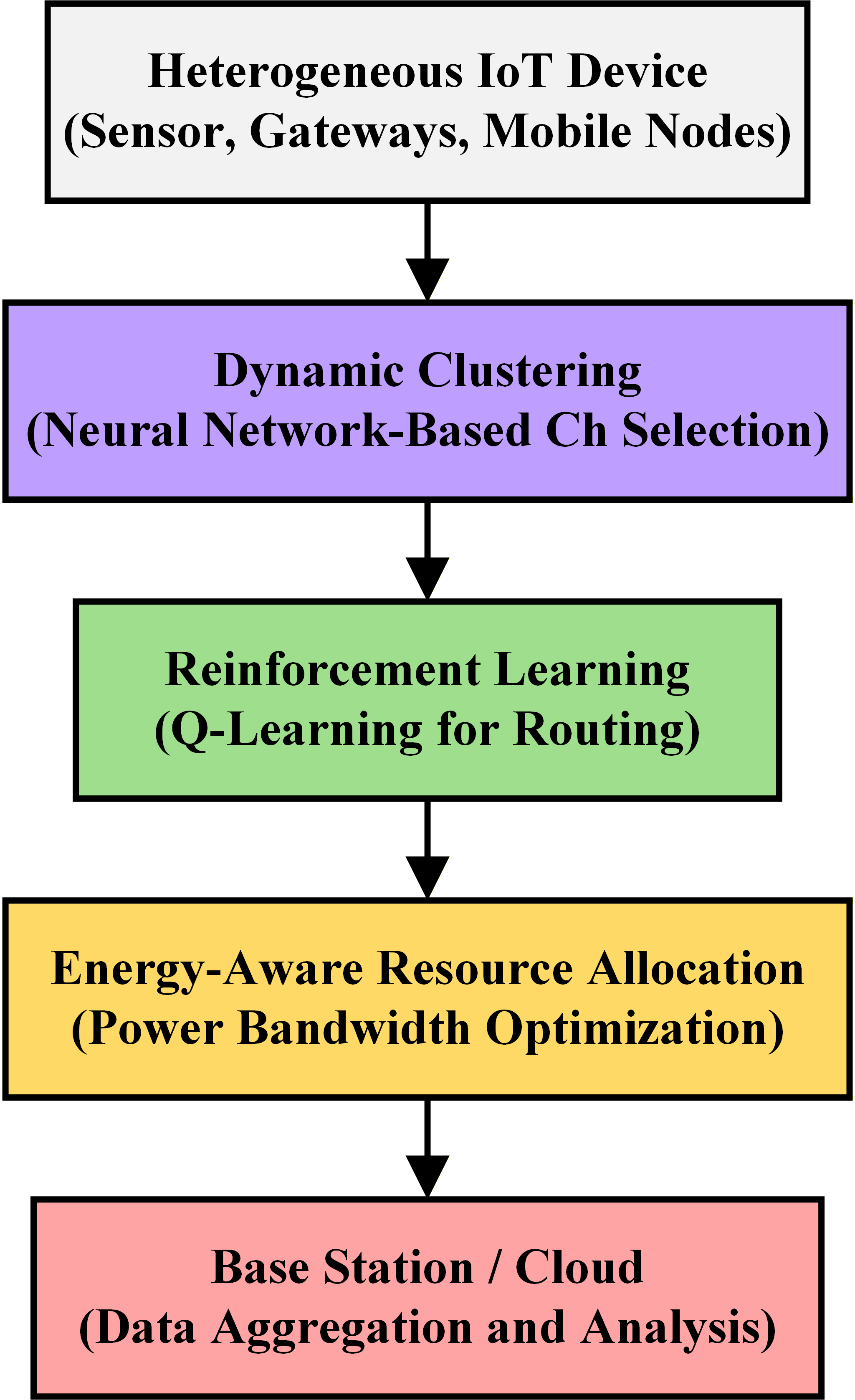
One of the key issues of Internet of Things (IoT)-based wireless sensor networks (WSNs) is energy efficiency because battery-powered nodes have to work within a set of severe resource limitations. Conventional protocols do not always work well in nonhomogeneous dynamic environments and this results in poor performance and longevity. The design and validation of an unified framework that intelligently operates network clustering, routing, and resource allocation with the use of machine learning are the research contributions. The framework is represented through a dynamic clustering scheme based on neural networks, routing scheme based on reinforcement learning (Q-learning) and a scheme of Lagrangian optimization-based resource allocation. MATLAB and NS-3 simulations were run with different sizes of networks (100-500 nodes) and traffic. The flow of methodology has formed a scheme whereby the adaptive decision-making was to be made at several levels of the communication stack. The average power savings, increment in network lifetime, and improvement in the percentage packet delivery ratio of the proposed model was 31, 17.9 and 6.2, respectively, over the classical schemes like LEACH and TEEN. Findings were also uniform at various levels of deployments and statistical validation was made to prove it is significant (p < 0.01). The model exhibits better adaptability and performance aspects in both the case of a static network and dynamic network as compared to the recent machine learning-based approaches. To sum up, the paper provides a scaled, smart communication system of IoT networks. Its applications in a real world can be found in smart farming, industrial IoT, and healthcare. The next steps involve the prototype development and integration of the blockchain based node authentication.
References
S. A. Alabady, M. F. M. Salleh, and F. Al-Turjman, “A novel approach of error detection and correction for efficient energy in wireless networks,” Multimed Tools Appl, vol. 78, no. 2, pp. 1345–1373, 2019, https://doi.org/10.1007/s11042-018-6282-0.
A. W. Y. Nawusu, A. B. Alhassan, and A. M. Salifu, “A new approach to detecting and correcting single and multiple errors in wireless sensor networks,” Journal of Advances in Mathematics and Computer Science, vol. 36, no. 8, pp. 27–43, 2021, https://doi.org/10.9734/jamcs/2021/v36i830388.
R. Dogra, S. Rani, H. Babbar, and D. Krah, “Energy‐Efficient Routing Protocol for Next‐Generation Application in the Internet of Things and Wireless Sensor Networks,” Wirel Commun Mob Comput, vol. 2022, no. 1, p. 8006751, 2022, https://doi.org/10.1155/2022/8006751.
J. A. Ansere, G. Han, L. Liu, Y. Peng, and M. Kamal, “Optimal resource allocation in energy-efficient Internet-of-Things networks with imperfect CSI,” IEEE Internet Things J, vol. 7, no. 6, pp. 5401–5411, 2020, https://doi.org/10.1109/JIOT.2020.2979169.
N. Chouhan, “Artificial intelligence–based energy‐efficient clustering and routing in IoT‐assisted wireless sensor network,” Artificial Intelligence for Renewable Energy Systems, pp. 79–91, 2022, https://doi.org/10.1002/9781119761686.ch3.
N. Subramani, S. K. Perumal, J. S. Kallimani, S. Ulaganathan, S. Bhargava, and S. Meckanizi, “Controlling energy aware clustering and multihop routing protocol for IoT assisted wireless sensor networks,” Concurr Comput, vol. 34, no. 21, p. e7106, 2022, https://doi.org/10.1002/cpe.7106.
M. Asad, M. Aslam, Y. Nianmin, N. Ayoub, K. I. Qureshi, and E. U. Munir, “IoT enabled adaptive clustering based energy efficient routing protocol for wireless sensor networks,” International Journal of Ad Hoc and Ubiquitous Computing, vol. 32, no. 2, pp. 133–145, 2019, https://doi.org/10.1504/IJAHUC.2019.102453.
K. Lakshmanna, N. Subramani, Y. Alotaibi, S. Alghamdi, O. I. Khalafand, and A. K. Nanda, “Improved metaheuristic-driven energy-aware cluster-based routing scheme for IoT-assisted wireless sensor networks,” Sustainability, vol. 14, no. 13, p. 7712, 2022, https://doi.org/10.3390/su14137712.
B. Han, F. Ran, J. Li, L. Yan, H. Shen, and A. Li, “A novel adaptive cluster based routing protocol for energy-harvesting wireless sensor networks,” Sensors, vol. 22, no. 4, p. 1564, 2022, https://doi.org/10.3390/s22041564.
M. Baniata, H. T. Reda, N. Chilamkurti, and A. Abuadbba, “Energy-efficient hybrid routing protocol for IoT communication systems in 5G and beyond,” Sensors, vol. 21, no. 2, p. 537, 2021, https://doi.org/10.3390/s21020537.
S. M. Altowaijri, “Efficient next-hop selection in multi-hop routing for IoT enabled wireless sensor networks,” Future Internet, vol. 14, no. 2, p. 35, 2022, https://doi.org/10.3390/fi14020035.
D. Gupta, S. Wadhwa, S. Rani, Z. Khan, and W. Boulila, “EEDC: an energy efficient data communication scheme based on new routing approach in wireless sensor networks for future IoT applications,” Sensors, vol. 23, no. 21, p. 8839, 2023, https://doi.org/10.3390/s23218839.
M. Shahid et al., “Link-quality-based energy-efficient routing protocol for WSN in IoT,” IEEE Transactions on Consumer Electronics, vol. 70, no. 1, pp. 4645–4653, 2024, https://doi.org/10.1109/TCE.2024.3356195.
A. Thomas Felix, “Calduwel Newton P (2025) Path Quality Aware Energy Efficient Technique to Increase Packet Delivery Ratio in the Internet of Things,” Indian J Sci Technol, vol. 18, no. 15, pp. 1201–1219, 2025, https://doi.org/10.17485/IJST/v18i15.347.
D. Balakrishnan, T. D. Rajkumar, S. Dhanasekaran, and B. S. Murugan, “Secure and energy-efficient data transmission framework for IoT-based healthcare applications using EMCQLR and EKECC,” Cluster Comput, vol. 27, no. 3, pp. 2999–3016, 2024, https://doi.org/10.1007/s10586-023-04130-7.
S. Hudda, K. Haribabu, and R. Barnwal, “Energy efficient data communication for WSN based resource constrained IoT devices,” Internet of Things, vol. 27, p. 101329, 2024, https://doi.org/10.1016/j.iot.2024.101329.
X. Liu, Q. Cao, B. Jin and P. Zhou, "CNCMSA-ERCP: An Innovative Energy-Efficient Clustering Routing Protocol for Improving the Performance of Industrial IoT," in IEEE Internet of Things Journal, vol. 12, no. 9, pp. 11827-11840, 2025, https://doi.org/10.1109/JIOT.2024.3516753.
S. Sennan, S. Ramasubbareddy, R. K. Dhanaraj, A. Nayyar, and B. Balusamy, “Energy-efficient cluster head selection in wireless sensor networks-based internet of things (IoT) using fuzzy-based Harris hawks optimization,” Telecommun Syst, vol. 87, no. 1, pp. 119–135, 2024, https://doi.org/10.1007/s11235-024-01176-9.
Y. Zhang, V. Cheng, D. S. Mallapragada, J. Song, and G. He, “A model-adaptive clustering-based time aggregation method for low-carbon energy system optimization,” IEEE Trans Sustain Energy, vol. 14, no. 1, pp. 55–64, 2022, https://doi.org/10.1109/TSTE.2022.3199571.
N. Ma, H. Zhang, H. Hu, and Y. Qin, “ESCVAD: An energy-saving routing protocol based on Voronoi adaptive clustering for wireless sensor networks,” IEEE Internet Things J, vol. 9, no. 11, pp. 9071–9085, 2021, https://doi.org/10.1109/JIOT.2021.3120744.
S. Ahmad, M. Shafiullah, C. B. Ahmed and M. Alowaifeer, "A Review of Microgrid Energy Management and Control Strategies," in IEEE Access, vol. 11, pp. 21729-21757, 2023, https://doi.org/10.1109/ACCESS.2023.3248511.
J. Lansky et al., “Reinforcement learning-based routing protocols in flying ad hoc networks (FANET): A review,” Mathematics, vol. 10, no. 16, p. 3017, 2022, https://doi.org/10.3390/math10163017.
J. Lansky, A. M. Rahmani, and M. Hosseinzadeh, “Reinforcement learning-based routing protocols in vehicular Ad Hoc Networks for Intelligent Transport System (ITS): A survey,” Mathematics, vol. 10, no. 24, p. 4673, 2022, https://doi.org/10.3390/math10244673.
A. Musaddiq, T. Olsson, and F. Ahlgren, “Reinforcement-Learning-Based Routing and Resource Management for Internet of Things Environments: Theoretical Perspective and Challenges,” Sensors, vol. 23, no. 19, p. 8263, 2023, https://doi.org/10.3390/s23198263.
S. S. Hajam and S. A. Sofi, “Spider monkey optimization based resource allocation and scheduling in fog computing environment,” High-Confidence Computing, vol. 3, no. 3, p. 100149, 2023, https://doi.org/10.1016/j.hcc.2023.100149.
A. Kampmann, M. Lüer, S. Kowalewski, and B. Alrifaee, “Optimization-based Resource Allocation for an Automotive Service-oriented Software Architecture,” in 2022 IEEE Intelligent Vehicles Symposium (IV), IEEE, pp. 678–687, 2022, https://doi.org/10.1109/IV51971.2022.9827429.
I. Brahmi, M. Hamdi, and F. Zarai, “Chaotic grey wolf optimization‐based resource allocation for vehicle‐to‐everything communications,” International Journal of Communication Systems, vol. 34, no. 13, p. e4908, 2021, https://doi.org/10.1002/dac.4908.
J. A. Ansere, M. Kamal, E. Gyamfi, F. Sam, M. Tariq, and A. Mohammed, “Energy efficient resource optimization in cooperative Internet of Things networks,” Internet of Things, vol. 12, p. 100302, 2020, https://doi.org/10.1016/j.iot.2020.100302.
C. Jothikumar, K. Ramana, V. D. Chakravarthy, S. Singh, and I.-H. Ra, “An Efficient Routing Approach to Maximize the Lifetime of IoT‐Based Wireless Sensor Networks in 5G and Beyond,” Mobile Information Systems, vol. 2021, no. 1, p. 9160516, 2021, https://doi.org/10.1155/2021/9160516.
M. Mishra, G. Sen Gupta, and X. Gui, “Network lifetime improvement through energy-efficient hybrid routing protocol for IoT applications,” Sensors, vol. 21, no. 22, p. 7439, 2021, https://doi.org/10.3390/s21227439.
A. Badi and I. Mahgoub, “ReapIoT: Reliable, energy-aware network protocol for large-scale internet-of-things (IoT) applications,” IEEE Internet Things J, vol. 8, no. 17, pp. 13582–13592, 2021, https://doi.org/10.1109/JIOT.2021.3066531.
R. A. Diab, N. Bastaki, and A. Abdrabou, “A survey on routing protocols for delay and energy-constrained cognitive radio networks,” Ieee Access, vol. 8, pp. 198779–198800, 2020, https://doi.org/10.1109/ACCESS.2020.3035325.
H. Gul, S. Ullah, K.-I. Kim, and F. Ali, “A Traffic-Aware and Cluster-Based Energy Efficient Routing Protocol for IoT-Assisted WSNs.,” Computers, Materials & Continua, vol. 80, no. 2, 2024, https://doi.org/10.32604/cmc.2024.052841.
Y. Zhang, Q. Ren, K. Song, Y. Liu, T. Zhang, and Y. Qian, “An energy-efficient multilevel secure routing protocol in IoT networks,” IEEE Internet Things J, vol. 9, no. 13, pp. 10539–10553, 2021, https://doi.org/10.1109/JIOT.2021.3121529.
C. Iwendi, P. K. R. Maddikunta, T. R. Gadekallu, K. Lakshmanna, A. K. Bashir, and M. J. Piran, “A metaheuristic optimization approach for energy efficiency in the IoT networks,” Softw Pract Exp, vol. 51, no. 12, pp. 2558–2571, 2021, https://doi.org/10.1002/spe.2797.
J. O. Ogbebor, A. L. Imoize, and A. A.-A. Atayero, “Energy efficient design techniques in next‐generation wireless communication networks: emerging trends and future directions,” Wirel Commun Mob Comput, vol. 2020, no. 1, p. 7235362, 2020, https://doi.org/10.1155/2020/7235362.
O. A. Khashan, R. Ahmad, and N. M. Khafajah, “An automated lightweight encryption scheme for secure and energy-efficient communication in wireless sensor networks,” Ad Hoc Networks, vol. 115, p. 102448, 2021, https://doi.org/10.1016/j.adhoc.2021.102448.
W. Kim, M. M. Umar, S. Khan, and M. A. Khan, “Novel scoring for energy-efficient routing in multi-sensored networks,” Sensors, vol. 22, no. 4, p. 1673, 2022, https://doi.org/10.3390/s22041673.
A. Faid, M. Sadik, and E. Sabir, “EACA: an energy aware clustering algorithm for wireless IoT sensors,” in 2021 28th International Conference on Telecommunications (ICT), pp. 1–6, 2021, https://doi.org/10.1109/ICT52184.2021.9511518.
P. Singh, M. Khari, and S. Vimal, “EESSMT: an energy efficient hybrid scheme for securing mobile ad hoc networks using IoT,” Wirel Pers Commun, vol. 126, no. 3, pp. 2149–2173, 2022, https://doi.org/10.1007/s11277-021-08764-x.
A. R. Patil and G. M. Borkar, “Node authentication and encrypted data transmission in mobile ad hoc network using the swarm intelligence‐based secure ad‐hoc on‐demand distance vector algorithm,” IET wireless sensor systems, vol. 13, no. 6, pp. 201–215, 2023, https://doi.org/10.1049/wss2.12068.
R. Prasad, “Enhanced energy efficient secure routing protocol for mobile ad-hoc network,” Global Transitions Proceedings, vol. 3, no. 2, pp. 412–423, 2022, https://doi.org/10.1016/j.gltp.2021.10.001.
M. Sivaram, V. Porkodi, A. S. Mohammed, and S. A. Karuppusamy, “Improving energy efficiency in internet of things using artificial Bee colony algorithm,” Recent Patents on Engineering, vol. 15, no. 2, pp. 161–168, 2021, https://doi.org/10.2174/1872212114999200616164642.
S. Bhimshetty and A. V. Ikechukwu, “Energy-efficient deep Q-network: reinforcement learning for efficient routing protocol in wireless internet of things,” Indonesian Journal of Electrical Engineering and Computer Science, vol. 33, no. 2, pp. 971–980, 2024, https://doi.org/10.11591/ijeecs.v33.i2.pp971-980.
Y. Xu and M. Khalilzadeh, “An approach for managing the Internet of things’ resources to optimize the energy consumption using a nature-inspired optimization algorithm and Markov model,” Sustainable Computing: Informatics and Systems, vol. 36, p. 100817, 2022, https://doi.org/10.1016/j.suscom.2022.100817.
S. M. Hussein, J. A. López Ramos, and A. M. Ashir, “A secure and efficient method to protect communications and energy consumption in IoT wireless sensor networks,” Electronics (Basel), vol. 11, no. 17, p. 2721, 2022, https://doi.org/10.3390/electronics11172721.
L. Farhan et al., “Energy efficiency for green internet of things (IoT) networks: A survey,” Network, vol. 1, no. 3, pp. 279–314, 2021, https://doi.org/10.3390/network1030017.
A. Luntovskyy and B. Shubyn, “Energy efficiency for IoT,” in Reliability Engineering and Computational Intelligence, pp. 199–215, 2021, https://doi.org/10.1007/978-3-030-74556-1_12.
G. S. Uthayakumar, B. Jackson, C. R. B. Durai, A. Kalaimani, S. Sargunavathi, and S. Kamatchi, “Systematically efficiency enabled energy usage method for an IOT based WSN environment,” Measurement: Sensors, vol. 25, p. 100615, 2023, https://doi.org/10.1016/j.measen.2022.100615.
K. Gulati, R. S. K. Boddu, D. Kapila, S. L. Bangare, N. Chandnani, and G. Saravanan, “A review paper on wireless sensor network techniques in Internet of Things (IoT),” Mater Today Proc, vol. 51, pp. 161–165, 2022, https://doi.org/10.1016/j.matpr.2021.05.067.
G. Kaur, P. Chanak, and M. Bhattacharya, “Energy-efficient intelligent routing scheme for IoT-enabled WSNs,” IEEE Internet Things J, vol. 8, no. 14, pp. 11440–11449, 2021, https://doi.org/10.1109/JIOT.2021.3051768.
H. Zhao, J. Tang, B. Adebisi, T. Ohtsuki, G. Gui, and H. Zhu, “An adaptive vehicle clustering algorithm based on power minimization in vehicular ad-hoc networks,” IEEE Trans Veh Technol, vol. 71, no. 3, pp. 2939–2948, 2022, https://doi.org/10.1109/TVT.2021.3140085.
A. Kiran, P. Mathivanan, M. Mahdal, K. Sairam, D. Chauhan, and V. Talasila, “Enhancing data security in IoT networks with blockchain-based management and adaptive clustering techniques,” Mathematics, vol. 11, no. 9, p. 2073, 2023, https://doi.org/10.3390/math11092073.
N. Yuvaraj, K. Praghash, and T. Karthikeyan, “Data privacy preservation and trade-off balance between privacy and utility using deep adaptive clustering and elliptic curve digital signature algorithm,” Wirel Pers Commun, vol. 124, no. 1, pp. 655–670, 2022, https://doi.org/10.1007/s11277-021-09376-1.
S. S. Suresh, V. Prabhu, V. Parthasarathy, G. Senthilkumar, and V. Gundu, “Intelligent data routing strategy based on federated deep reinforcement learning for IOT-enabled wireless sensor networks,” Measurement: Sensors, vol. 31, p. 101012, 2024, https://doi.org/10.1016/j.measen.2023.101012.
S. Zhang et al., “Graph neural network and reinforcement learning based routing for mega leo satellite constellations,” in 2023 9th International Conference on Computer and Communications (ICCC), pp. 1–6, 2023, https://doi.org/10.1109/ICCC59590.2023.10507285.
D. K. Bangotra, Y. Singh, A. Selwal, N. Kumar, and P. K. Singh, “A trust based secure intelligent opportunistic routing protocol for wireless sensor networks,” Wirel Pers Commun, vol. 127, no. 2, pp. 1045–1066, 2022, https://doi.org/10.1007/s11277-021-08564-3.
A. Singh et al., “Resilient wireless sensor networks in industrial contexts via energy-efficient optimization and trust-based secure routing,” Peer Peer Netw Appl, vol. 18, no. 3, pp. 1–17, 2025, https://doi.org/10.1007/s12083-025-01946-5.
Y. Han, H. Hu, and Y. Guo, “Energy-aware and trust-based secure routing protocol for wireless sensor networks using adaptive genetic algorithm,” IEEe Access, vol. 10, pp. 11538–11550, 2022, https://doi.org/10.1109/ACCESS.2022.3144015.
N. Shinn, F. Cassano, A. Gopinath, K. Narasimhan, and S. Yao, “Reflexion: Language agents with verbal reinforcement learning,” Adv Neural Inf Process Syst, vol. 36, pp. 8634–8652, 2023, https://proceedings.neurips.cc/paper_files/paper/2023/hash/1b44b878bb782e6954cd888628510e90-Abstract-Conference.html.
Published
How to Cite
Issue
Section
License
Copyright (c) 2025 Noor Nateq Alfaisaly , Elaf A. Saeed, Saad B. Younis, Suhad Qasim Naeem

This work is licensed under a Creative Commons Attribution-ShareAlike 4.0 International License.
Authors who publish with this journal agree to the following terms:
- Authors retain copyright and grant the journal right of first publication with the work simultaneously licensed under a Creative Commons Attribution License that allows others to share the work with an acknowledgment of the work's authorship and initial publication in this journal.
- Authors are able to enter into separate, additional contractual arrangements for the non-exclusive distribution of the journal's published version of the work (e.g., post it to an institutional repository or publish it in a book), with an acknowledgment of its initial publication in this journal.
- Authors are permitted and encouraged to post their work online (e.g., in institutional repositories or on their website) prior to and during the submission process, as it can lead to productive exchanges, as well as earlier and greater citation of published work (See The Effect of Open Access).

This journal is licensed under a Creative Commons Attribution-ShareAlike 4.0 International License.