Adaptive FLC-based Shunt Active Power Filter with a PV-Fed DC Link for Improved Current Compensation and THD Mitigation
DOI:
https://doi.org/10.12928/biste.v7i4.13804Keywords:
Shunt APF, Power Quality, Total Hormonic Distortion, PV System, Adaptive FLCAbstract
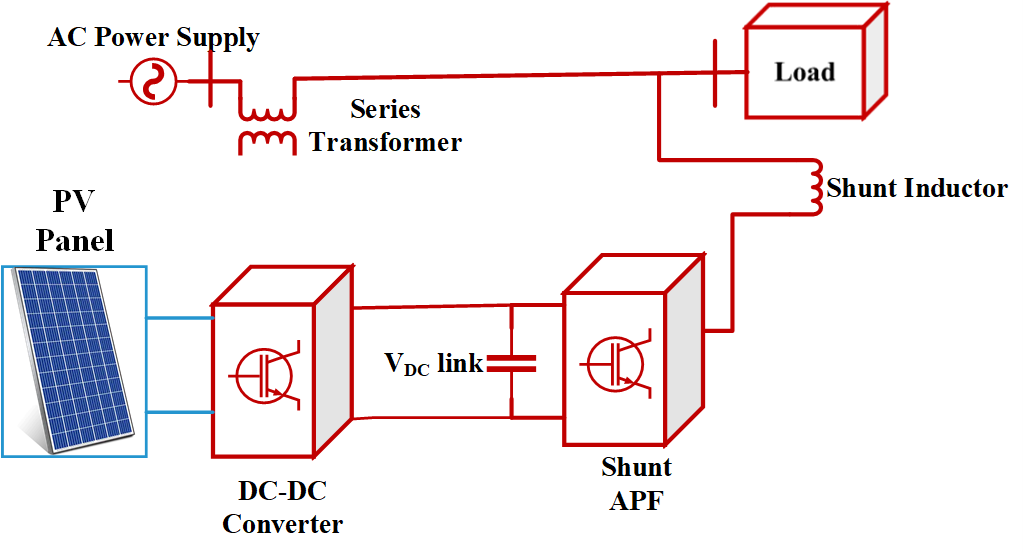
Power quality improvement with traditional controllers (PI, PID, fixed-parameter FLC) is difficult when dealing with nonlinear, time-varying loads and dynamic grid conditions. For microgrids that incorporate renewable energy sources, it is challenging to acquire the precise mathematical models that are necessary for this work. To address power quality challenges, such as distortion of current and Total Harmonic Distortion (THD), produced by nonlinear loads in PV fed systems, such as solar energy conversion, this publication proposes an Adaptive Fuzzy Logic Controller (FLC) based shunt Active Power Filter (APF). An analysis of the power quality enhancement achieved in a distribution power system using a single-stage solar PV integrated shunt APF is presented in this paper. In order to improve load side parameters, such as the elimination of even and odd current harmonics utilizing shunt APF is employed. This filter makes use of a shared DC-link voltage source. In addition, it transfers energy from the PV system's solar panels to the DC link voltage, which is an extra effort. In this paper, It looks at a single-phase inverter that uses an Adaptive FLC to improve parameters on the source and load sides, as well as harmonics, in grid-connected Distributed Generation systems. Also included is a detailed description of the active power filter's chosen current reference generator. Results that have been validated are attained using MATLAB/SIMULINK(R2023b).
References
D. K. Nishad, A. N. Tiwari, S. Khalid, S. Gupta, and A. Shukla, “AI based UPQC control technique for power quality optimization of railway transportation systems,” Sci. Rep., vol. 14, no. 1, p. 17935, 2024, https://doi.org/10.1038/s41598-024-68575-5.
P. Meenalochini, R. Karthick, and E. Sakthivel, “An efficient control strategy for an extended switched coupled inductor quasi-Z-source inverter for 3 Φ grid connected system,” J. Circuits, Syst. Comput., vol. 32, no. 11, p. 2450011, 2023, https://doi.org/10.1142/S0218126624500117.
T. Porselvi, P. Rajesh, and F. H. Shajin, “An intelligent approach for cascaded multi-level inverter (CMLI) with grid-connected adaptive system,” Environ. Dev. Sustain., pp. 1–23, 2024, https://doi.org/10.1007/s10668-023-04432-1.
S. K. Yadav, K. B. Yadav, and A. Priyadarshi, “Performance analysis of three-phase solar PV, BESS, and wind integrated UPQC for power quality improvement,” Comput. Electr. Eng., vol. 116, p. 109230, 2024, https://doi.org/10.1016/j.compeleceng.2024.109230.
L. B. Chilakapati and T. G. Manohar, “Power quality enhancement in a grid-integrated solar-PV system with an adaptive UPQC control strategy,” Solar Energy Sustain. Dev. J., vol. 13, no. 2, pp. 120–137, 2024, https://doi.org/10.51646/jsesd.v13i2.220.
A. Y. Qasim, F. R. Tahir, and A. N. B. Alsammak, “Improving power quality in distribution systems using UPQC: An overview,” J. Eur. Syst. Autom., vol. 57, no. 2, 2024, https://doi.org/10.18280/jesa.570201.
L. Chitra, M. Sridevi, and S. Prakash, “Intelligent MPPT controller for PV with energy storage system fed UPQC system for power quality improvement,” in Proc. 7th Int. Conf. Circuit Power Comput. Technol. (ICCPCT), vol. 1, pp. 1287–1293, 2024, https://doi.org/10.1109/ICCPCT61902.2024.10672830.
D. Sunitha, M. A. Bhaskar, S. V. Anjana, V. S. Kumar and S. S. Dash, "Power Quality Enhancement with Wind Energy Coupled UPQC with Adaptive Controller," 2019 8th International Conference on Renewable Energy Research and Applications (ICRERA), pp. 898-903, 2019, https://doi.org/10.1109/ICRERA47325.2019.8997101.
A. Ranjan and J. Choudhary, “Meta-heuristic-based power quality improvement in UPQC-based grid-connected adaptive renewable energy system,” Multimed. Tools Appl., pp. 1–30, 2024, https://doi.org/10.11591/ehs.v2i1.pp14-29.
C. Shravani and R. L. Narasimham, “UPQC-based power quality improvement in grid-linked PV, battery & wind systems,” in E3S Web Conf., vol. 547, p. 01007, 2024, https://doi.org/10.1051/e3sconf/202454701007.
M. Pandikumar, K. J. Jenisha, M. Baskar, M. Swathi, N. K. Rayaguru, and S. Baskaran, “Optimized power quality enhancement in PV-integrated UPQC systems using chaotic PSO-based MPPT algorithm,” in Proc. Int. Conf. Advancement Renew. Energy Intell. Syst. (AREIS), pp. 1–6, 2024, https://doi.org/10.1109/AREIS62559.2024.10893654.
E. Borkar and N. Singh, “Power quality enhancement by PV-UPQC for non-linear load,” in Artif. Intell. Tech. Power Syst. Oper. Anal., pp. 37–64, 2024, https://doi.org/10.1201/9781003301820-3.
D. Krishna, M. Sasikala, and R. Kiranmayi, “FOPI and FOFL controller based UPQC for mitigation of power quality problems in distribution power system,” Journal of Electrical Engineering & Technology, vol. 17, no. 3, pp. 1543-1554, 2022, https://doi.org/10.1007/s42835-022-00996-6.
D. Krishna, M. Sasikala, and V. Ganesh, “Adaptive FLC-based UPQC in distribution power systems for power quality problems,” International Journal of Ambient Energy, vol. 43, no. 1, pp. 1719-1729, 2022, https://doi.org/10.1080/01430750.2020.1722232.
E. Himabindu, D. Krishna, S. Venkateshwarlu, and K. C. Reddy, “Solar PV fed DC link voltage for fuzzy logic sliding mode controller based UPQC to improve the dynamic performance in power grid,” J. Appl. Sci. Eng., vol. 28, no. 5, pp. 969–978, 2025, http://dx.doi.org/10.6180/jase.202505_28(5).0006.
B. S. Goud, C. N. S. Kalyan, D. Krishna, B. N. Reddy, M. Bajaj, M. F. Ansari, and R. K. Barik, “Novel optimization techniques and controllers for power quality improvement,” in Proc. 1st Int. Conf. Circuits, Power Intell. Syst. (CCPIS), pp. 1–6, 2023, https://doi.org/10.1109/CCPIS59145.2023.10291320.
L. B. Chilakapati, “Power quality improvement in a grid connected solar-PV system with adaptive neuro-fuzzy controller based UPQC,” Int. Res. J. Multidiscip. Technovation, vol. 7, no. 1, pp. 264–279, 2025, https://doi.org/10.54392/irjmt25118.
L. Sahihi and B. Berbaoui, “Hybrid neuro-fuzzy integral sliding mode control technique optimized UPQC for power quality improvement in solar systems,” Iran. J. Fuzzy Syst., vol. 22, no. 1, pp. 147–168, 2025, https://doi.org/10.22111/ijfs.2025.49224.8678.
P. Ray, P. K. Ray, P. S. Puhan, and M. T. K. Liyanage, “Performance improvement of microgrid with strategic control of distributed energy resources integrated UPQC,” IEEE Trans. Ind. Appl., 2025, https://doi.org/10.1109/TIA.2025.3539616.
B. G. Lukka, T. R. S. Reddy, and M. R. Kotapuri, “UPQC with adaptive HBD-SWO optimisation for improving power quality in a grid-connected HRES system,” Int. J. Ind. Syst. Eng., vol. 49, no. 1, pp. 57–95, 2025, https://doi.org/10.1504/IJISE.2025.144088.
B. Aljafari, Y. K. Alapati, K. Srilakshmi, P. K. Balachandran, and S. B. Thanikanti, “An optimized neural network-honey badger based control technique for an adaptive solar PV and battery energy storage fed unified power quality conditioner,” J. Energy Storage, vol. 106, p. 114818, 2025, https://doi.org/10.1016/j.est.2024.114818.
C. Li, K. Song, J. Sun, and B. Huang, “Power quality enhancement of three-phase solar photovoltaic system-based generalized integrator controlled UPQC,” J. Phys.: Conf. Ser., vol. 2917, no. 1, p. 012022, 2024, https://doi.org/10.1088/1742-6596/2917/1/012022.
T. Trivedi, R. Jadeja, P. Bhatt, C. Long, P. Sanjeevikumar, and A. Ved, “Sliding mode-based direct power control of unified power quality conditioner,” Heliyon, vol. 10, no. 20, 2024, https://doi.org/10.1016/j.heliyon.2024.e39597.
T. A. Devi, G. S. Rao, T. A. Kumar, B. S. Goud, C. R. Reddy, M. W. D. Eutyche, F. Aymen, C. Z. El-Bayedh, H. Kraiem, and V. Blazek, “Adaptive optimal-FOPID based UPQC for reducing harmonics and compensate load power in renewable energy sources grid connected system,” PLoS One, vol. 19, no. 5, p. e0300145, 2024, https://doi.org/10.1371/journal.pone.0300145.
R. Simhachalam and A. D. Goswami, “Fuzzy induced controller for optimal power quality improvement with PVA connected UPQC,” Energy Harvest. Syst., vol. 11, no. 1, p. 20220146, 2024, https://doi.org/10.1515/ehs-2022-0146.
Y. Li, H. Yi, F. Zhuo and X. Jiang, "Analysis and Stabilization of APF Systems Considering Dynamic of Nonlinear Loads," in IEEE Transactions on Power Electronics, vol. 39, no. 1, pp. 409-423, 2024, https://doi.org/10.1109/TPEL.2023.3324650.
S. Garlapati and R. Gupta, "Shunt active power filter as front end converter for DC loads," 2012 IEEE 5th India International Conference on Power Electronics (IICPE), pp. 1-6, 2012, https://doi.org/10.1109/IICPE.2012.6450515.
S. S. K. Budi and R. Kiranmayi, "Sinusoidal Subtraction Methods for Enhanced Multilevel Shunt Active Power Filter for Nonlinear Loads," 2024 3rd International Conference for Advancement in Technology (ICONAT), pp. 1-6, 2024, https://doi.org/10.1109/ICONAT61936.2024.10774841.
S. H. S. K. Budi and R. Kiranmayi, “Harmonic reduction of shunt active power filter using SVPWM,” Int. J. Recent Technol. Eng. (IJRTE), vol. 8, no. 2, 2019, https://doi.org/10.35940/ijrte.B1034.0882S819.
P. K. Ray and S. D. Swain, “Performance enhancement of shunt active power filter with the application of an adaptive controller,” IET Gener., Transmiss. Distrib., vol. 14, no. 21, pp. 5134–5142, 2020, https://doi.org/10.1049/iet-gtd.2020.0334.
V. Nageswararao and D. Prasad, “Analysis of modified shunt active power filter based on one cycle control,” in Smart and Sustainable Intelligent Systems, pp. 275–287, 2024, https://doi.org/10.1007/978-981-97-6714-4_24.
P. Patel et al., “Shunt active power filter with MSRF-PI-AHCC technique for harmonics mitigation in a hybrid energy system,” Australas. J. Electr. Electron. Eng., vol. 20, no. 1, pp. 1–10, 2022, https://doi.org/10.1080/1448837X.2022.2114154.
B. Sahoo, M. M. Alhaider, and P. K. Rout, “Power quality and stability improvement of microgrid through shunt active filter control application: An overview,” Renew. Energy Focus, vol. 44, pp. 139–154, 2023, https://doi.org/10.1016/j.ref.2022.12.006.
G. Ambati, M. S. Basha, and R. J. Raja, “Power quality improvement of PV-fed grid connected system using ANN controlled shunt active power filter,” Int. J. Electr. Electron. Res., vol. 12, no. 4, pp. 1701–1707, 2024, https://doi.org/10.37391/IJEER.120421.
M. Al-Gahtani et al., “A developed DQ control method for shunt active power filter to improve power quality in transformers,” ISA Trans., vol. 19, no. 7, p. e0299635, 2024, https://doi.org/10.1016/j.isatra.2024.05.036.
M. -S. Karbasforooshan and M. Monfared, "Adaptive Predictive Deadbeat Current Control of Single-Phase Multi-Tuned Shunt Hybrid Active Power Filters," in IEEE Transactions on Power Delivery, vol. 39, no. 1, pp. 446-454, 2024, https://doi.org/10.1109/TPWRD.2023.3262662.
Y. Li, H. Yi, F. Zhuo and X. Jiang, "Harmonic Oscillation and Stabilization Strategy of Source-Current-Detected Shunt APF Considering Interaction With Nonlinear Load and Grid Impedance," in IEEE Journal of Emerging and Selected Topics in Power Electronics, vol. 12, no. 1, pp. 420-430, 2024, https://doi.org/10.1109/JESTPE.2023.3329171.
B. L. Daouli and H. Mana, “Improving power quality by using active power filter based on DQ frame of reference theory,” in Intelligent Computing and Applications, pp. 375–387, 2025, https://doi.org/10.1007/978-3-031-80301-7_30.
L. Zhou et al., “Hybrid prediction-based deadbeat control for high-performance SAPF,” IEEE Access, vol. 11, pp. 11118–11131, 2023, https://doi.org/10.1109/ACCESS.2023.3241300.
Z. Xiao, H. Xue, T. Liu and G. Zheng, "Research on Control Strategy of Shunt Active Power Filter," 2023 8th Asia Conference on Power and Electrical Engineering (ACPEE), pp. 2377-2382, 2023, https://doi.org/10.1109/ACPEE56931.2023.10135649.
C. R. Rao et al., “Synchronization control techniques for SAPF: An overview,” Bull. Electr. Eng. Inform., vol. 12, no. 1, pp. 465–472, 2023, https://doi.org/10.11591/eei.v12i1.4300.
M. Miletić, K. R. Raguž, V. Zeleničić, I. Erceg and D. Sumina, "Development of Single-Phase Shunt Active Power Filter for Reduction of Current Harmonics in Data Center Power System," 2023 11th International Conference on Smart Grid (icSmartGrid), pp. 1-7, 2023, https://doi.org/10.1109/icSmartGrid58556.2023.10170839.
R. Hou et al., “Oscillation suppression methods in SAPF systems,” Energies, vol. 15, no. 9, p. 3125, 2022, https://doi.org/10.3390/en15093125.
R. K. Nepal et al., “Compensation for reactive power and harmonic current in a PV-micro-hydro grid using SAPF,” arXiv preprint arXiv:2406.05342, 2024, https://arxiv.org/abs/2406.05342.
A. Mishra, “Adaptive fuzzy controlled hybrid SAPF for power quality enhancement,” Neural Comput. Appl., vol. 32, pp. 9805–9816, 2020, https://doi.org/10.1007/s00521-020-05027-x.
S. Sharma et al., “Real-time implementation of SAPF with reduced sensors,” IEEE Trans. Ind. Appl., vol. 56, no. 2, pp. 1850–1861, 2020, https://doi.org/10.1109/TIA.2019.2957734.
M. A. Awan et al., “A simplified model predictive control for three-phase four-wire shunt active power filter,” Energies, vol. 16, no. 10, p. 4080, 2023, https://doi.org/10.3390/en16104080.
M. Khalid et al., “Design of AI-based SAPF for distorted distribution grid connected with renewable energy,” Sustain. Energy, Grids Netw., vol. 34, p. 101048, 2023, https://doi.org/10.1016/j.segan.2023.101048.
Published
How to Cite
Issue
Section
License
Copyright (c) 2025 SH Suresh Kumar Budi, R. Kiranmayi

This work is licensed under a Creative Commons Attribution-ShareAlike 4.0 International License.
Authors who publish with this journal agree to the following terms:
- Authors retain copyright and grant the journal right of first publication with the work simultaneously licensed under a Creative Commons Attribution License that allows others to share the work with an acknowledgment of the work's authorship and initial publication in this journal.
- Authors are able to enter into separate, additional contractual arrangements for the non-exclusive distribution of the journal's published version of the work (e.g., post it to an institutional repository or publish it in a book), with an acknowledgment of its initial publication in this journal.
- Authors are permitted and encouraged to post their work online (e.g., in institutional repositories or on their website) prior to and during the submission process, as it can lead to productive exchanges, as well as earlier and greater citation of published work (See The Effect of Open Access).

This journal is licensed under a Creative Commons Attribution-ShareAlike 4.0 International License.