A Lightweight 1D CNN for Unified Real-Time Communication Signal Classification and Denoising in Low-SNR Edge Environments
DOI:
https://doi.org/10.12928/biste.v7i3.13789Keywords:
Communication Signal Classificationk, Low-Latency Inference, Automatic Modulation Classification, Processing Time, Cognitive Radio SystemsAbstract
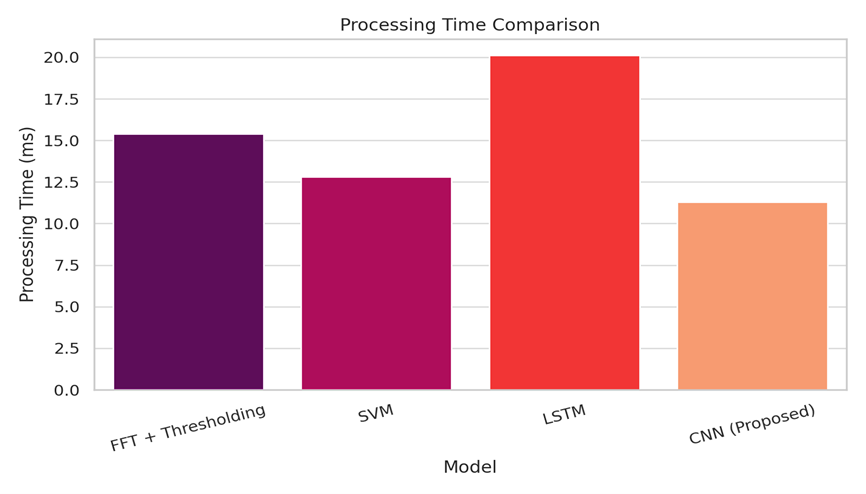
The escalating complexity and pervasive noise in contemporary communication systems have increasingly rendered traditional signal processing methods insufficient for reliable real-time analysis. This research addresses a fundamental void in existing literature by proposing a novel and lightweight deep learning framework, primarily centered on Convolutional Neural Networks (CNNs) for the joint classification and denoising of communication signals. Distinct from prior methodologies that often segregate these crucial tasks our model integrates both objectives within a highly optimized, unified architecture engineered for ultra-low-latency inference, notably achieving a 30–50% reduction in inference time compared to deeper CNN-RNN hybrids or Transformer-based architectures. The framework's effectiveness was comprehensively evaluated using both synthetic and real-world datasets, including RadioML2018.01A which encompasses a diverse range of modulation schemes and signal-to-noise ratio (SNR) levels. Experimental results conclusively demonstrate that the proposed CNN achieved an impressive 96.8% classification accuracy significantly enhanced signal quality to an average of 22.3 dB SNR, and maintained an average processing latency of merely 11.3 ms. These figures consistently demonstrate superior performance compared to traditional baselines including FFT, SVM, and LSTM. Despite these promising results, the current model was primarily trained and evaluated under Additive White Gaussian Noise (AWGN) conditions, and future work will explore its generalization to real-world scenarios involving multipath fading, Doppler shifts, and dynamic channel interference. This study represents a significant leap forward in developing robust, efficient, and intelligent solutions essential for next-generation communication signal processing, particularly for real-time applications in resource-constrained environments.
References
Kumari, D. Patadia, S. Tanwar, G. Pau, F. Alqahtani, and A. Tolba, “CNN-based cancer prediction scheme using 5G-assisted federated learning for healthcare Industry 5.0,” Alexandria Engineering Journal, vol. 126, pp. 131–142, 2025, https://doi.org/10.1016/j.aej.2025.04.043.
W. Xu, D. W. K. Ng, M. Levorato, Y. C. Eldar, and M. Debbah, “Guest Editorial Distributed Signal Processing for Edge Learning in B5G IoT Networks,” IEEE J Sel Top Signal Process, vol. 17, no. 1, pp. 3–8, 2023, https://doi.org/10.1109/JSTSP.2022.3227720.
S. P. V, U. G. S, A. D, S. Karthikeyan, S. Kamatchi, and N. Gopinath, “Revolutionizing connectivity: Unleashing the power of 5G wireless networks enhanced by artificial intelligence for a smarter future,” Results in Engineering, vol. 22, 2024, https://doi.org/10.1016/j.rineng.2024.102334.
S. Ozer, H. E. Ilhan, M. A. Ozkanoglu, and H. A. Cirpan, “Offloading Deep Learning Powered Vision Tasks From UAV to 5G Edge Server With Denoising,” IEEE Trans Veh Technol, vol. 72, no. 6, pp. 8035–8048, 2023, https://doi.org/10.1109/TVT.2023.3243529.
K. Lin, C. Li, D. Tian, A. Ghoneim, M. S. Hossain, and S. U. Amin, “Artificial-intelligence-based data analytics for cognitive communication in heterogeneous wireless networks,” IEEE Wirel Commun, vol. 26, no. 3, pp. 83–89, 2019, https://doi.org/10.1109/MWC.2019.1800351.
M. K. Saini, R. K. Beniwal, and Y. Goswami, “Signal Processing Tool & Artificial Intelligence for Detection & Classification of Voltage Sag,” in Proceedings of the 2016 Sixth Int. Conf. on Advanced Computing and Communication Technologies, pp. 331–337, 2016, https://doi.org/10.3850/978-981-11-0783-2_364.
T. W. Rondeau, “Application of artificial intelligence to wireless communications,” 2007, http://hdl.handle.net/10919/29199.
Y. Pamungkas, S. Pratasik, and N. Crisnapati, “Optimizing Gated Recurrent Unit Architecture for Enhanced EEG-Based Emotion Classification,” Journal of Robotics and Control (JRC), vol. 6, p. 2025, https://doi.org/10.18196/jrc.v6i3.26016.
P. Mohanty et al., “Integrating Multi-Sensors and AI to Develop Improved Surveillance Systems,” Journal of Robotics and Control (JRC), vol. 6, no. 2, pp. 980–994, 2025, https://doi.org/10.18196/jrc.v6i2.25596.
S. Elahian, M. A. A. Atashgah, and I. Suwarno, “Enhancing Autonomous Navigation in GNSS-Denied Environment: Obstacle Avoidance Observability-Based Path Planning for ASLAM,” Journal of Robotics and Control (JRC), vol. 5, no. 6, pp. 2048–2059, 2024, https://doi.org/10.18196/jrc.v5i6.23519.
A. Yousif et al., “Enhancing Large-Scale Network Security with a VGG-Net-Based DCNN: A Deep Learning Approach to Anomaly Detection,” Journal of Robotics and Control (JRC), vol. 6, p. 2025, https://doi.org/10.18196/jrc.v6i3.25169.
Basim, A. Fakhfakh, and A. M. Makhlouf, “A Hybrid Deep Learning Approach for Adaptive Cloud Threat Detection with Integrated CNNs and RNNs in Cloud Access Security Brokers,” Journal of Robotics and Control (JRC), vol. 6, no. 3, pp. 1129–1141, 2025, https://doi.org/10.18196/jrc.v6i3.25618.
P. Chotikunnan et al., “Enhanced Angle Estimation Using Optimized Artificial Neural Networks with Temporal Averaging in IMU-Based Motion Tracking,” Journal of Robotics and Control (JRC), vol. 6, no. 2, pp. 1069–1082, 2025, https://doi.org/10.18196/jrc.v6i2.26345.
M. A. N. Abed, D. S. Shanan, and Z. H. H. Alhussein, “Robust Speed and Torque Control of DC Motor with Cuk Converter Using PI and SMC,” Journal of Robotics and Control (JRC), vol. 6, no. 3, pp. 1216–1226, 2025, https://doi.org/10.18196/jrc.v6i3.25756.
M. A. Najm Abed, A. Abdul Razzaq Altahir, A. O. Hanfesh, and A. Abdulhadi Ahmed, “Performance Evaluation of PMSM and BLDC Motors in Different Operating Scenarios Based Slide Mode Control,” in 2024 4th International Conference on Electrical Machines and Drives, ICEMD 2024, Institute of Electrical and Electronics Engineers Inc., 2024. https://doi.org/10.1109/ICEMD64575.2024.10963593.
M. Albaker Najm Abed, A. Abdul Razzaq Altahir, and A. Ahmed Abdulhadi Ahmed, “A Review of Hybrid Electric Vehicle Configurations: Advances and Challenges,” vol. 04, no. 03, 2024, https://doi.org/10.63463/kjes1155.
H. Ahmadi, S. E. Mahdimahalleh, A. Farahat, and B. Saffari, “Unsupervised Time-Series Signal Analysis with Autoencoders and Vision Transformers: A Review of Architectures and Applications,” Journal of Intelligent Learning Systems and Applications, vol. 17, no. 02, pp. 77–111, 2025, https://doi.org/10.4236/jilsa.2025.172007.
M. A. Wahed, M. Alqaraleh, M. Salem Alzboon, and M. Subhi Al-Batah, “Evaluating AI and Machine Learning Models in Breast Cancer Detection: A Review of Convolutional Neural Networks (CNN) and Global Research Trends,” LatIA, vol. 3, p. 117, 2025, https://doi.org/10.62486/latia2025117.
G. Alotaibi, M. Awawdeh, F. F. Farook, M. Aljohani, R. M. Aldhafiri, and M. Aldhoayan, “Artificial intelligence (AI) diagnostic tools: utilizing a convolutional neural network (CNN) to assess periodontal bone level radiographically—a retrospective study,” BMC Oral Health, vol. 22, no. 1, 2022, https://doi.org/10.1186/s12903-022-02436-3.
O. N. Mohammed, “Enhancing Pulmonary Disease Classification in Diseases: A Comparative Study of CNN and Optimized MobileNet Architectures,” Journal of Robotics and Control (JRC), vol. 5, no. 2, pp. 427–440, 2024, https://doi.org/10.18196/jrc.v5i2.21422.
R. Amin, B. Penta, and S. Derada, “Occurrence and Spatial Extent of HABs on the West Florida Shelf 2002-Present,” IEEE Geoscience and Remote Sensing Letters, vol. 12, no. 10, pp. 2080–2084, 2015, https://doi.org/10.1109/LGRS.2015.2448453.
N. Tawfeeq and J. Harbi, “Advanced Ensemble Deep Learning Framework for Enhanced River Water Level Detection: Integrating Transfer Learning,” Journal of Robotics and Control (JRC), vol. 5, no. 5, pp. 1422–1435, 2024, https://doi.org/10.18196/jrc.v5i5.22291.
Z. Liu, J. Jiang, G. Lei, K. Chen, B. Qin, and X. Zhao, “A Heterogeneous Processor Design for CNN-Based AI Applications on IoT Devices,” in Procedia Computer Science, pp. 2–8, 2020, https://doi.org/10.1016/j.procs.2020.06.048.
R. Azadnia, M. M. Al-Amidi, H. Mohammadi, M. A. Cifci, A. Daryab, and E. Cavallo, “An AI Based Approach for Medicinal Plant Identification Using Deep CNN Based on Global Average Pooling,” Agronomy, vol. 12, no. 11, 2022, https://doi.org/10.3390/agronomy12112723.
A. P. Hermawan, R. R. Ginanjar, D. S. Kim, and J. M. Lee, “CNN-Based automatic modulation classification for beyond 5G communications,” IEEE Communications Letters, vol. 24, no. 5, pp. 1038–1041, 2020, https://doi.org/10.1109/LCOMM.2020.2970922.
Jagannath, J. Jagannath, and T. Melodia, “Redefining wireless communication for 6G: Signal processing meets deep learning with deep unfolding,” IEEE Transactions on Artificial Intelligence, vol. 2, no. 6, pp. 528–536, 2021, https://doi.org/10.1109/TAI.2021.3108129.
H. Ren, H. Yin, H. Zhao, C. Bai, and C. Grebogi, “Artificial intelligence enhances the performance of chaotic baseband wireless communication,” IET Communications, vol. 15, no. 11, pp. 1467–1479, 2021, https://doi.org/10.1049/cmu2.12162.
Y.-S. Jeong and J. H. Park, “Advanced big data analysis, artificial intelligence & communication systems,” Journal of Information Processing Systems, vol. 15, no. 1, pp. 1–6, 2019, https://doi.org/10.3745/JIPS.02.0107.
A. Sharma, A. Jain, A. K. Arya, and M. Ram, Artificial Intelligence for Signal Processing and Wireless Communication. De Gruyter, 2022, https://doi.org/10.1515/9783110734652.
Mohammed Jasim A. Alkhafaji, “QATM-KCNN: Improving Template Matching Performance based on integration of CNNs and with QATM by Kalman Filtering,” Journal of Information Systems Engineering and Management, vol. 10, no. 25s, pp. 93–104, 2025, https://doi.org/10.52783/jisem.v10i25s.3946.
M. J. A. Alkhafaji et al., “Development Of A Method For Managing A Group Of Unmanned Aerial Vehicles Using A Population Algorithm,” Eastern-European Journal of Enterprise Technologies, vol. 6, no. 9(132), pp. 108–116, 2024, https://doi.org/10.15587/1729-4061.2024.318600.
A. Jagannath, J. Jagannath, and T. Melodia, “Redefining Wireless Communication for 6G: Signal Processing Meets Deep Learning With Deep Unfolding,” IEEE Transactions on Artificial Intelligence, vol. 2, no. 6, pp. 528–536, 2021, https://doi.org/10.1109/TAI.2021.3108129.
Jiao, X. Sun, L. Fang, and J. Lyu, “An overview of wireless communication technology using deep learning,” China Communications, vol. 18, no. 12, pp. 1–36, 2021, https://doi.org/10.23919/JCC.2021.12.001.
W. Jiang, “Graph-based deep learning for communication networks: A survey,” Comput Commun, vol. 185, pp. 40–54, 2022, https://doi.org/10.1016/j.comcom.2021.12.015.
W. Yu, F. Sohrabi, and T. Jiang, “Role of Deep Learning in Wireless Communications,” IEEE BITS the Information Theory Magazine, vol. 2, no. 2, pp. 56–72, 2022, https://doi.org/10.1109/MBITS.2022.3212978.
D. Y. Pimenov, A. Bustillo, S. Wojciechowski, V. S. Sharma, M. K. Gupta, and M. Kuntoğlu, “Artificial intelligence systems for tool condition monitoring in machining: analysis and critical review,” J Intell Manuf, vol. 34, no. 5, pp. 2079–2121, 2023, https://doi.org/10.1007/s10845-022-01923-2.
M. A. Najm Abed, A. Abdul Razzaq Altahir, A. O. Hanfesh, and A. Abdulhadi Ahmed, “Performance Evaluation of PMSM and BLDC Motors in Different Operating Scenarios Based Slide Mode Control,” in 2024 4th International Conference on Electrical Machines and Drives (ICEMD), IEEE, pp. 1–7, 2024, https://doi.org/10.1109/ICEMD64575.2024.10963593.
H. Xie, Z. Qin, G. Y. Li, and B.-H. Juang, “Deep Learning Enabled Semantic Communication Systems,” IEEE Transactions on Signal Processing, vol. 69, pp. 2663–2675, 2021, https://doi.org/10.1109/TSP.2021.3071210.
M. Kareem, K. K. Salih, M. Jasim, A. A. Hussein, and S. Muhaisen, “Analysis of the Integration of Artificial Intelligence Technologies in Cloud Computing Management,” Journal of Information Systems Engineering and Management, vol. 10, 2025, https://doi.org/10.52783/jisem.v10i27s.4383.
M. J. A. Alkhafaji, A. F. Aljuboori, and A. A. Ibrahim, “Clean medical data and predict heart disease,” in HORA 2020 - 2nd International Congress on Human-Computer Interaction, Optimization and Robotic Applications, Proceedings, 2020. https://doi.org/10.1109/HORA49412.2020.9152870.
M. J. A. Alkhafaji et al., “The Development Of A Method For Increasing The Reliability Of The Assessment Of The State Of The Object,” Eastern-European Journal of Enterprise Technologies, vol. 5, no. 3–131, pp. 48–54, 2024, https://doi.org/10.15587/1729-4061.2024.313934.
G. Alotaibi, M. Awawdeh, F. F. Farook, M. Aljohani, R. M. Aldhafiri, and M. Aldhoayan, “Artificial intelligence (AI) diagnostic tools: utilizing a convolutional neural network (CNN) to assess periodontal bone level radiographically—a retrospective study,” BMC Oral Health, vol. 22, no. 1, 2022, https://doi.org/10.1186/s12903-022-02436-3.
H. F. Mahdi and B. J. Khadhim, “Enhancing IoT Security: A Deep Learning and Active Learning Approach to Intrusion Detection,” Journal of Robotics and Control (JRC), vol. 5, no. 5, pp. 1525–1535, 2024, https://doi.org/10.18196/jrc.v5i5.22292.
M. Ehsani, K. V. Singh, H. O. Bansal and R. T. Mehrjardi, "State of the Art and Trends in Electric and Hybrid Electric Vehicles," in Proceedings of the IEEE, vol. 109, no. 6, pp. 967-984, 2021, https://doi.org/10.1109/JPROC.2021.3072788.
D. Kim, H. Jung, and I.-H. Lee, “Deep Learning-Based Power Control Scheme With Partial Channel Information in Overlay Device-to-Device Communication Systems,” IEEE Access, vol. 9, pp. 122125–122137, 2021, https://doi.org/10.1109/ACCESS.2021.3109948.
S. Zheng, S. Chen, and X. Yang, “DeepReceiver: A Deep Learning-Based Intelligent Receiver for Wireless Communications in the Physical Layer,” IEEE Trans Cogn Commun Netw, vol. 7, no. 1, pp. 5–20, 2021, https://doi.org/10.1109/TCCN.2020.3018736.
Ho Le, T. Quyen Ngo, N. Duc Toan, C. Cuong Nguyen, and B. Hong Phong, “Integration of Modbus-Ethernet Communication for Monitoring Electrical Power Consumption, Temperature, and Humidity,” Journal of Robotics and Control (JRC), vol. 5, no. 6, p. 2024, https://doi.org/10.18196/jrc.v5i6.22456.
Y. Pamungkas, M. R. N. Ramadani, and E. N. Njoto, “Effectiveness of CNN Architectures and SMOTE to Overcome Imbalanced X-Ray Data in Childhood Pneumonia Detection,” Journal of Robotics and Control (JRC), vol. 5, no. 3, pp. 775–785, 2024, https://doi.org/10.18196/jrc.v5i3.21494.
S. S. Sadiq, “Improving CBIR Techniques with Deep Learning Approach: An Ensemble Method Using NASNetMobile, DenseNet121, and VGG12,” Journal of Robotics and Control (JRC), vol. 5, no. 3, pp. 863–874, 2024, https://doi.org/10.18196/jrc.v5i3.21805.
G. N. P. Pratama, I. Hidayatulloh, H. D. Surjono, and T. Sukardiyono, “Enhance Deep Reinforcement Learning with Denoising Autoencoder for Self-Driving Mobile Robot,” Journal of Robotics and Control (JRC), vol. 5, no. 3, pp. 667–676, 2024, https://doi.org/10.18196/jrc.v5i3.21713.
S. Elahian, M. A. A. Atashgah, and I. Suwarno, “Enhancing Autonomous Navigation in GNSS-Denied Environment: Obstacle Avoidance Observability-Based Path Planning for ASLAM,” Journal of Robotics and Control (JRC), vol. 5, no. 6, pp. 2048–2059, 2024, https://doi.org/10.18196/jrc.v5i6.23519.
S. Hofny, N. M. Ghazaly, A. N. Shmroukh, and M. Abouelsoud, “Predicting SI Engine Performance Using Deep Learning with CNNs on Time-Series Data,” Journal of Robotics and Control (JRC), vol. 5, no. 5, pp. 1457–1469, 2024, https://doi.org/10.18196/jrc.v5i5.22558.
D. Krivoguz et al., “Enhancing Long-Term Air Temperature Forecasting with Deep Learning Architectures,” Journal of Robotics and Control (JRC), vol. 5, no. 3, pp. 706–716, 2024, https://doi.org/10.18196/jrc.v5i3.21716.
P. Miao, W. Yin, H. Peng, and Y. Yao, “Study of the performance of deep learning-based channel equalization for indoor visible light communication systems,” Photonics, vol. 8, no. 10, 2021, https://doi.org/10.3390/photonics8100453.
R. Nambiar and R. Nanjundegowda, “A Comprehensive Review of AI and Deep Learning Applications in Dentistry: From Image Segmentation to Treatment Planning,” Journal of Robotics and Control (JRC), vol. 5, no. 6, pp. 1744-1752, 2024, https://doi.org/10.18196/jrc.v5i6.23056.
J. A. Alkhafaji, M. M. Kassir, and A. Lakizadeh, “A Review on Deep Learning-based Methods for Template Matching : Advancing with QATM-Kalman-CNN Integration,” Machine Learning, vol. 12, no. 1, 2025, https://doi.org/10.36227/techrxiv.175099756.61334996/v1.
A. L. Mohammed Jasim, A. Alkhafaji, and Mohamad Mahdi Kassir, “A Review on Deep Learning-based Methods for Template Matching,” Journal of Electrical Systems, vol. Vol. 20, pp. 8850–8863, 2024, https://doi.org/10.52783/jes.8282.
Mohammed Jasim, A. Alkhafaji, Mohamad Mahdi Kassir, and Amir Lakizadeh, “Qatm-Kcnn: Improving Template Matching Performance Based On Integration Of Convolutional Neural Networks And Kalman Filtering,” Tianjin Daxue Xuebao (Ziran Kexue yu Gongcheng Jishu Ban)/ Journal of Tianjin University Science and Technology, vol. 57, no. 12, pp. 114–127, 2024, https://doi.org/10.5281/zenodo.14325009.
A. Najm Abed, A. Abdul Razzaq Altahir, A. O. Hanfesh, and A. Abdulhadi Ahmed, “Performance Evaluation of PMSM and BLDC Motors in Different Operating Scenarios Based Slide Mode Control,” in 2024 4th International Conference on Electrical Machines and Drives, ICEMD 2024, 2024, https://doi.org/10.1109/ICEMD64575.2024.10963593.
Demiroglu and K. Kayisli, "Energy Management Strategies for Hybrid Electric Vehicles," 2024 13th International Conference on Renewable Energy Research and Applications (ICRERA), Nagasaki, Japan, 2024, pp. 1175-1185, 2024, https://doi.org/10.1109/ICRERA62673.2024.10815513.
M. A. N. Abed, D. S. Shanan, and Z. H. H. Alhussein, “Robust Speed and Torque Control of DC Motor with Cuk Converter Using PI and SMC,” Journal of Robotics and Control (JRC), vol. 6, no. 3, pp. 1216–1226, 2025, https://doi.org/10.18196/jrc.v6i3.25756.
Mohammed Jasim A. Alkhafaji, Mohamad Mahdi Kassir, and Amir Lakizadeh, “Advances And Applications Of Template Matching In Image Analysis,” Tianjin Daxue Xuebao (Ziran Kexue yu Gongcheng Jishu Ban)/ Journal of Tianjin University Science and Technology, vol. 57, no. 12, 2024, https://doi.org/10.5281/zenodo.14324240.
M. J. Abed Alkhafaji et al., “The development of a method for increasing the reliability of the assessment of the state of the object,” Eastern-European Journal of Enterprise Technologies, vol. 5, no. 3 (131), pp. 48–54, 2024, https://doi.org/10.15587/1729-4061.2024.313934.
Published
How to Cite
Issue
Section
License
Copyright (c) 2025 Mohammed Jasim A. Alkhafaji, Rusul Nadhim Mohammed, Hanan Chassab Mohammed, Mohammed Albaker Najm Abed

This work is licensed under a Creative Commons Attribution-ShareAlike 4.0 International License.
Authors who publish with this journal agree to the following terms:
- Authors retain copyright and grant the journal right of first publication with the work simultaneously licensed under a Creative Commons Attribution License that allows others to share the work with an acknowledgment of the work's authorship and initial publication in this journal.
- Authors are able to enter into separate, additional contractual arrangements for the non-exclusive distribution of the journal's published version of the work (e.g., post it to an institutional repository or publish it in a book), with an acknowledgment of its initial publication in this journal.
- Authors are permitted and encouraged to post their work online (e.g., in institutional repositories or on their website) prior to and during the submission process, as it can lead to productive exchanges, as well as earlier and greater citation of published work (See The Effect of Open Access).

This journal is licensed under a Creative Commons Attribution-ShareAlike 4.0 International License.