Solar-Powered EV Charging Using Modified SEPIC-Luo Converter with Recurrent Neural Network Technique
DOI:
https://doi.org/10.12928/biste.v7i3.13675Keywords:
PV System, Solar-powered EV Charging, Renewable Energy Integration, Modified SEPIC-Luo Converter, RNN-MPPT, MBO, Full Bridge Inverter, Interleaved Synchronous RectifierAbstract
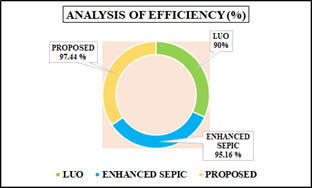
In order to address issues with renewable energy utilization processes and the growing power consumption of Electric Vehicles (EVs) in the near future,a solar powered charging station for EV is developed. Initially, a highly efficient Modified Single Ended Primary Inductor Converter (SEPIC) Luo converter is used to increase a low voltage of the PV system. The maximum power of the Photovoltaic (PV) system is then tracked using the Recurrent Neural Network based Maximum Power Point Tracking (RNN-MPPT), whose parameters are adjusted using the Monarch Butterfly Optimization (MBO) algorithm. Then, the high frequency full bridge inverter effectively transforms the power and isolation transformer is utilized for decreasing electrical noise and interference. Furthermore, the interleaved synchronous rectifier is used for attaining effective charging by reducing conduction losses. The developed work is applied in Matlab/Simulink software, reveals that the developed work attains the converter efficiency of 97.44%when compared to 90% of Luo and 95.16% of Enhanced SEPIC, ensuring the stable and reliable power delivery. Also, The MBO-RNN approach exhibits 98.8% of tracking efficiency and a root mean square error of 0.0125.
References
N. Kumar, H. K. Singh and R. Niwareeba, “Adaptive Control Technique for Portable Solar Powered EV Charging Adapter to Operate in Remote Location”, in IEEE Open Journal of Circuits and Systems, vol. 4, pp. 115-125, 2023, https://doi.org/10.1109/OJCAS.2023.3247573.
S. Zhou, Y. Qiu, F. Zou, D. He, P. Yu, J. Du, X. Luo, C. Wang, Z. Wu, and W. Gu, “Dynamic EV Charging Pricing Methodology for Facilitating Renewable Energy with Consideration of Highway Traffic Flow”, in IEEE Access, vol. 8, pp. 13161-13178, 2020, https://doi.org/10.1109/ACCESS.2019.2958403.
A. K. Karmaker, M. A. Hossain, H. R. Pota, A. Onen and J. Jung, “Energy Management System for Hybrid Renewable Energy-Based Electric Vehicle Charging Station”, in IEEE Access, vol. 11, pp. 27793-27805, 2023, https://doi.org/10.1109/ACCESS.2023.3259232.
B. Singh, A. Verma, A. Chandra and K. Al-Haddad, “Implementation of Solar PV-Battery and Diesel Generator Based Electric Vehicle Charging Station”, in IEEE Transactions on Industry Applications, vol. 56, no. 4, pp. 4007-4016, 2020, https://doi.org/10.1109/TIA.2020.2989680.
G. H. Reddy, S. R. Depuru, S. Gope, B. V. Narayana and M. N. Bhukya, “Simultaneous Placement of Multiple Rooftop Solar PV Integrated Electric Vehicle Charging Stations for Reliability Benefits”, in IEEE Access, vol. 11, pp. 130788-130801, 2023, https://doi.org/10.1109/ACCESS.2023.3335093.
Y. Yang, H. G. Yeh and N. C. T. Dam, “Optimal Infrastructure Design and Power Management for a Photovoltaic and Battery Assisted Electric Vehicle Charging Station in Southern California”, in IEEE Access, vol. 12, pp. 54101-54114, 2024, https://doi.org/10.1109/ACCESS.2024.3386659.
S. Mateen, A. Haque, V. S. B. Kurukuru and M. A. Khan, “Discrete Stochastic Control for Energy Management With Photovoltaic Electric Vehicle Charging Station”, in CPSS Transactions on Power Electronics and Applications, vol. 7, no. 2, pp. 216-225, 2022, https://doi.org/10.24295/CPSSTPEA.2022.00020.
S. Bagherwal and S. Mahapatra, “Enhanced Stability and Control of Solar Powered EV Charging Stations Using Disturbance Observer-Based Adaptive Sliding Mode Control for DC Voltage Stabilization”, in IEEE Access, vol. 12, pp. 183293-183311, 2024, https://doi.org/10.1109/ACCESS.2024.3511637.
K. S. Kavin, P. Subha Karuvelam, M. Devesh Raj, and M. Sivasubramanian, “A Novel KSK Converter with Machine Learning MPPT for PV Applications”, Electric Power Components and Systems, pp. 1-19, 2024, https://doi.org/10.1080/15325008.2024.2346806.
C. H. Lin, M. S. Khan, J. Ahmad, H. D. Liu and T. C. Hsiao, “Design and Analysis of Novel High-Gain Boost Converter for Renewable Energy Systems (RES)”, in IEEE Access, vol. 12, pp. 24262-24273, 2024, https://doi.org/10.1109/ACCESS.2024.3365705.
É. A. Tonolo, J. W. M. Soares, E. F. R. Romaneli and A. A. Badin, “Current Sensorless MPPT With a CCM Interleaved Boost Converter for Renewable Energy System”, in IEEE Transactions on Power Electronics, vol. 37, no. 9, pp. 11296-11304, 2022, https://doi.org/10.1109/TPEL.2022.3166747.
O. Abdel-Rahim, M. L. Alghaythi, M. S. Alshammari and D. S. M. Osheba, “Enhancing Photovoltaic Conversion Efficiency With Model Predictive Control-Based Sensor-Reduced Maximum Power Point Tracking in Modified SEPIC Converters”, in IEEE Access, vol. 11, pp. 100769-100780, 2023, https://doi.org/10.1109/ACCESS.2023.3315150.
F. Ghasemi, M. R. Yazdani and M. Delshad, “Step-Up DC-DC Switching Converter with Single Switch and Multi-Outputs Based on Luo Topology”, in IEEE Access, vol. 10, pp. 16871-16882, 2022, https://doi.org/10.1109/ACCESS.2022.3150316.
K. S. Kavin, P. Subha Karuvelam, Murali Matcha, and Suresh Vendoti, “Improved BRBFNN-based MPPT algorithm for coupled inductor KSK converter for sustainable PV system applications”, Electrical Engineering, pp. 1-23, 2025, https://doi.org/10.1007/s00202-025-02952-9.
N. F. Ibrahim, M. M. Mahmoud, A. M. A. Thaiban, A. B. Barnawi, Z. M. S. Elbarbary, A. I. Omar, and H. Abdelfattah, “Operation of Grid-Connected PV System With ANN-Based MPPT and an Optimized LCL Filter Using GRG Algorithm for Enhanced Power Quality”, in IEEE Access, vol. 11, pp. 106859-106876, 2023, https://doi.org/10.1109/ACCESS.2023.3317980.
A. A. Salem, N. A. N. Aldin, A. M. Azmy and W. S. E. Abdellatif, “Implementation and Validation of an Adaptive Fuzzy Logic Controller for MPPT of PMSG-Based Wind Turbines”, in IEEE Access, vol. 9, pp. 165690-165707, 2021, https://doi.org/10.1109/ACCESS.2021.3134947.
A. Hilali, Y. Mardoude, A. Essahlaoui, A. Rahali, and N. E. Ouanjli, “Migration to solar water pump system: Environmental and economic benefits and their optimization using genetic algorithm Based MPPT”, Energy Reports, vol. 8, pp. 10144-10153, 2022, https://doi.org/10.1016/j.egyr.2022.08.017.
E. S. Wirateruna, and A. F. A. Millenia, “Design of MPPT PV using particle swarm optimization algorithm under partial shading condition”, International Journal of Artificial Intelligence & Robotics (IJAIR), vol. 4, no. 1, pp.24-30, 2022, https://doi.org/10.25139/ijair.v4i1.4327.
Z. B. Bel, H. Salah, S. Krim, M. A. Hajjaji, B. M. Alshammari, K. Alqunun, A. Alzamil, and T. Guesmi, “A new efficient cuckoo search MPPT algorithm based on a super-twisting sliding mode controller for partially shaded standalone photovoltaic system”, Sustainability, vol. 15, no. 12, pp. 9753, 2023, https://doi.org/10.3390/su15129753.
J. Gholami, K. K. A. Ghany, and H. M. Zawbaa, “A novel global harmony search algorithm for solving numerical optimizations”, Soft Computing, vol. 25, pp. 2837-2849, 2021, https://doi.org/10.1007/s00500-020-05341-5.
S. Sivarajeswari, and D. Kirubakaran, “Design and Development of Efficient Luo Converters for DC Micro Grid”, The International Journal of Electrical Engineering & Education, vol. 60, no. 1S, pp. 40-48, 2023, https://doi.org/10.1177/0020720919845152.
S. Esmaeili, M. Shekari, M. Rasouli, S. Hasanpour, A. A. Khan and H. Hafezi, "High Gain Magnetically Coupled Single Switch Quadratic Modified SEPIC DC-DC Converter," in IEEE Transactions on Industry Applications, vol. 59, no. 3, pp. 3593-3604, 2023, https://doi.org/10.1109/TIA.2023.3250405.
P. Manoharan, U. Subramaniam, T. S. Babu, S. Padmanaban, J. B. Holm-Nielsen, M. Mitolo and S. Ravichandran,“Improved perturb and observation maximum power point tracking technique for solar photovoltaic power generation systems”, IEEE Systems Journal, vol. 15, no. 2, pp. 3024-3035, 2020, https://doi.org/10.1109/JSYST.2020.3003255.
E. Mendez, A. Ortiz, P. Ponce, I. Macias, D. Balderas and A. Molina, “Improved MPPT algorithm for photovoltaic systems based on the earthquake optimization algorithm”, Energies, vol. 13, no. 12, pp. 3047, 2020, https://doi.org/10.3390/en13123047.
D. N. Luta and A. K. Raji,“Fuzzy rule-based and particle swarm optimisation MPPT techniques for a fuel cell stack”, Energies, vol. 12, no. 5, pp. 936, 2019, https://doi.org/10.3390/en12050936.
M. A. Salvador, J. M. de Andrade, T. B. Lazzarin, and R. F. Coelho, “Nonisolated high-step-up dc–dc converter derived from switched-inductors and switched-capacitors”, IEEE Transactions on Industrial Electronics, vol. 67, no. 10, pp. 8506–8516, 2020, https://doi.org/10.1109/TIE.2019.2949535.
S. Sadaf, M. S. Bhaskar, M. Meraj, A. Iqbal, and N. Al-Emadi, “A novel modifed switched inductor boost converter with reduced switch voltage stress”, IEEE Transactions on Industrial Electronics, vol. 68, no. 2, pp. 1275–1289, 2021, https://doi.org/10.1109/TIE.2020.2970648.
S. Tangavelu and P. Umapathy, “Design of new high step-up dc-dc converter topology for solar pv applications”, International Journal of Photo energy, vol. 2021, 2021, https://doi.org/10.1155/2021/7833628.
R. Rahimi, S. Habibi, M. Ferdowsi, and P. Shamsi, “Z-source-based high step-up DC–DC converters for photovoltaic applications”, IEEE J. Emerg. Sel. Top. Power Electron. Vol. 10, no. 4, pp. 4783–4796, 2022, https://doi.org/10.1109/JESTPE.2021.3131996.
A. Mahmood, “A non-isolated quasi-Z-source-based high-gain DC–DC converter”, Int. J. Circ. Teor. Appl. vol. 50, no. 2, pp.653–682, 2022, https://doi.org/10.1002/cta.3162.
Published
How to Cite
Issue
Section
License
Copyright (c) 2025 S. L. Sreedevi, B. T. Geetha

This work is licensed under a Creative Commons Attribution-ShareAlike 4.0 International License.
Authors who publish with this journal agree to the following terms:
- Authors retain copyright and grant the journal right of first publication with the work simultaneously licensed under a Creative Commons Attribution License that allows others to share the work with an acknowledgment of the work's authorship and initial publication in this journal.
- Authors are able to enter into separate, additional contractual arrangements for the non-exclusive distribution of the journal's published version of the work (e.g., post it to an institutional repository or publish it in a book), with an acknowledgment of its initial publication in this journal.
- Authors are permitted and encouraged to post their work online (e.g., in institutional repositories or on their website) prior to and during the submission process, as it can lead to productive exchanges, as well as earlier and greater citation of published work (See The Effect of Open Access).

This journal is licensed under a Creative Commons Attribution-ShareAlike 4.0 International License.