Effective Analysis of Machine Learning Algorithms for Breast Cancer Prediction
DOI:
https://doi.org/10.12928/biste.v7i4.13663Keywords:
Breast Cancer, Diagnosis, Data Preprocessing, Classification, SVM, RF, KNNAbstract
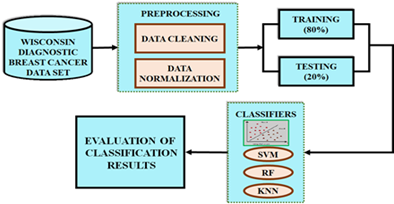
Early prognosis of Breast Cancer (BC) is significantly important to cure the disease easily so it is essential to develop methods that is able to aid doctors to get precise prognosis. Hence, a BC prognosis methodology is proposed utilizing Machine Learning (ML) approaches. The target of this paper is to utilize classification techniques to classify tumor types, or benign and malignant cells, using 569 samples from Wisconsin Diagnostic Breast Cancer (WDBC) database. Initially, preprocessing is employed to enhance the data’s quality, which includes data cleaning and min-max normalization. It improves the input breast cancer data's quality, accuracy, and suitability for further analysis. Followed by preprocessing, the ML approaches such as K-Nearest Neighbour (KNN), Random Forest (RF) and Support Vector Machine (SVM) methods are analyzed for the classification of BC data. Each algorithm offers a distinct approach to classification by capturing local patterns in data and handles high-dimensional spaces along with nonlinear boundaries through kernel tricks. The developed work is implemented in python software and comparative analysis is done with traditional methods. The outcomes demonstrates that the proposed KNN classifier shows better performance interms of precision, recall, F1-score with an accuracy of 96.49%, ensuring the earliest diagnosis of breast cancer compared with SVM and RF. This comparative approach enhances the reliability of the proposed methodology and supports the selection of the best-performing algorithm offering valuable insights for real-world clinical decision support systems.
References
Y. S. Solanki, P. Chakrabarti, M. Jasinski, Z. Leonowicz, V. Bolshev, A. Vinogradov, E. Jasinska, R. Gono, and M. Nami, “A hybrid supervised machine learning classifier system for breast cancer prognosis using feature selection and data imbalance handling approaches,” Electronics, vol. 10, pp. 699, 2021, https://doi.org/10.3390/electronics10060699.
S. Yadav, and M. Shivajirao, “Thermal infrared imaging based breast cancer diagnosis using machine learning techniques,”Multimedia Tools and Applications, vol. 81, pp. 1-19, 2022, https://doi.org/10.1007/s11042-020-09600-3.
K. M. M. Uddin, N. Biswas, S. T. Rikta, and S. K. Dey, “Machine learning-based diagnosis of breast cancer utilizing feature optimization technique,” Computer Methods and Programs in Biomedicine Update, vol. 3, pp. 100098, 2023, https://doi.org/10.1016/j.cmpbup.2023.100098.
A. S. Assiri, S. Nazir, and S. A. Velastin, “Breast tumor classification using an ensemble machine learning method,” Journal of Imaging, vol. 6, pp. 39, 2020, https://doi.org/10.3390/jimaging6060039.
J. Wu, and C. Hicks, “Breast cancer type classification using machine learning,” Journal of personalized medicine, vol. 11, pp. 61, 2021, https://doi.org/10.3390/jpm11020061.
R. Rawal, “Breast cancer prediction using machine learning,” Journal of Emerging Technologies and Innovative Research (JETIR), vol. 13, pp. 7, 2020, https://www.jetir.org/view?paper=JETIR2005145.
M. A. Naji, S. El Filali, K. Aarika, E. H. Benlahmar, R. A. Abdelouhahid, and O. Debauche, “Machine learning algorithms for breast cancer prediction and diagnosis,” Procedia Computer Science, vol. 191, pp. 487-492, 2021, https://doi.org/10.1016/j.procs.2021.07.062.
P. Gupta, and S. Garg, “Breast cancer prediction using varying parameters of machine learning models,”Procedia Computer Science, vol. 171, pp. 593-601, 2020, https://doi.org/10.1016/j.procs.2020.04.064.
A. Khalid, A. Mehmood, A. Alabrah, B.F. Alkhamees, F. Amin, H. AlSalman, and G. S. Choi, “Breast cancer detection and prevention using machine learning,” Diagnostics, vol. 1319, pp. 3113, 2023, https://doi.org/10.3390/diagnostics13193113.
O. Díaz, A. Rodríguez-Ruíz, and I. Sechopoulos, “Artificial Intelligence for breast cancer detection: Technology, challenges, and prospects,” European journal of radiology, vol. 175, pp. 111457, 2024, https://doi.org/10.1016/j.ejrad.2024.111457.
L. Wang, “Mammography with deep learning for breast cancer detection,” Frontiers in oncology, vol. 14, pp. 1281922, 2024, https://doi.org/10.3389/fonc.2024.1281922.
S. Sushanki, A. K. Bhandari, and A. K. Singh “A review on computational methods for breast cancer detection in ultrasound images using multi-image modalities,” Archives of Computational Methods in Engineering, vol. 31, no. 3, pp. 1277-1296, 2024, https://doi.org/10.1007/s11831-023-10015-0.
S. A. Alanazi, M. M. Kamruzzaman, M. N. Islam Sarker, M. ARFuwaili, Y. Alhwaiti, N. Alshammari, and M. H. Siddiqi, “Boosting breast cancer detection using convolutional neural network,” Journal of Healthcare Engineering, vol. 1, pp. 5528622, 2021, https://doi.org/10.1155/2021/5528622.
A. Das, M. N. Mohanty, P. K. Mallick, P. Tiwari, K. Muhammad, and H. Zhu, “Breast cancer detection using an ensemble deep learning method,”Biomedical Signal Processing and Control, vol. 70, pp. 103009, 2021, https://doi.org/10.1155/2021/5528622.
U. Naseem, J. Rashid, L. Ali, J. Kim, Q.E.U. Haq, M.J. Awan, and M. Imran, “An automatic detection of breast cancer diagnosis and prognosis based on machine learning using ensemble of classifiers,” IEEE Access, vol. 10, pp.78242-78252, 2022, https://doi.org/10.1109/ACCESS.2022.3174599.
I. Hirra, M. Ahmad, A. Hussain, M. U. Ashraf, I. A. Saeed, S. F. Qadri, A. M. Alghamdi, and A. S. Alfakeeh, “Breast cancer classification from histopathological images using patch-based deep learning modeling,” IEEE Access, vol. 9, pp. 24273-24287, 2021, https://doi.org/10.1109/ACCESS.2021.3056516.
H. Aljuaid, N. lturki, N. Alsubaie, L. Cavallaro, and A. Liotta, “Computer-aided diagnosis for breast cancer classification using deep neural networks and transfer learning,” Computer Methods and Programs in Biomedicine, vol. 223, pp. 106951, 2022, https://doi.org/10.1016/j.cmpb.2022.106951.
B. O. Macaulay, B. S. Aribisala, S. A. Akande, B. A. Akinnuwesi, and O. A. Olabanjo, “Breast cancer risk prediction in African women using random forest classifier,” Cancer Treatment and Research Communications, vol. 28, pp. 100396, 2021, https://doi.org/10.1016/j.ctarc.2021.100396.
Z. Huang, and D. Chen, “A breast cancer diagnosis method based on VIM feature selection and hierarchical clustering random forest algorithm,” IEEE Access, vol. 10, pp. 3284-3293, 2021, https://doi.org/10.1109/ACCESS.2021.3139595.
P. Manikandan, U. Durga, and C. Ponnuraja, “An integrative machine learning framework for classifying SEER breast cancer,” Scientific Reports, vol. 13, pp. 5362, 2023, https://doi.org/10.1038/s41598-023-32029-1.
M. Liu, L. Hu, Y. Tang, C. Wang, Y. He, C. Zeng, K. Lin, Z. He, and W. Huo, “A deep learning method for breast cancer classification in the pathology images,” IEEE Journal of Biomedical and Health Informatics, vol. 26, pp. 5025-5032, 2022, https://doi.org/10.1109/JBHI.2022.3187765.
R. G. Babu, K. Dhineshkumar, R. Sharma, and R. Krishnamoorthy, “A survey of machine learning techniques using for image classification in home security,” In IOP Conference Series: Materials Science and Engineering, vol. 1055, pp. 012088, 2021, https://doi.org/10.1088/1757-899X/1055/1/012088.
X. Y. Liew, N. Hameed, and J. Clos, “An investigation of XGBoost-based algorithm for breast cancer classification,” Machine Learning with Applications, vol. 6, pp. 100154, 2021, https://doi.org/10.1016/j.mlwa.2021.100154.
K. Satish Kumar, V. V. S. Sasank, K. S. Raghu Praveen, and Y. Krishna Rao, “Multilayer perceptron back propagation algorithm for predicting breast cancer,” In Intelligent System Design. Proceedings of Intelligent System Design, pp. 41-53, 2021, https://doi.org/10.1007/978-981-15-5400-1_5.
Z. Guo, L. Xu, and N. Ali Asgharzadeholiaee, “A homogeneous ensemble classifier for breast cancer detection using parameters tuning of MLP neural network,” Applied Artificial Intelligence, vol. 36, no. 1, pp. 2031820, 2022, https://doi.org/10.1080/08839514.2022.2031820.
M. Mangukiya, A. Vaghani, and M. Savani, “Breast cancer detection with machine learning,” International Journal for Research in Applied Science and Engineering Technology, vol. 10, no. 2, pp. 141-145, 2022, https://doi.org/10.22214/ijraset.2022.40204.
M. A. Elsadig, A. Altigani, and H. T. Elshoush, “Breast cancer detection using machine learning approaches: a comparative study,” International Journal of Electrical & Computer Engineering, vol. 13, no. 1, pp. 2088-8708, 2023, https://doi.org/10.11591/ijece.v13i1.pp736-745.
Y. K. Qawqzeh, A. Alourani, and S. Ghwanmeh, “An improved breast cancer classification method using an enhanced AdaBoost classifier,” International Journal of Advanced Computer Science and Applications, vol. 14, no. 1, 2023, https://doi.org/10.14569/IJACSA.2023.0140151.
M. M. Ghiasi, and S. Zendehboudi, “Application of decision tree-based ensemble learning in the classification of breast cancer,” Computers in biology and medicine, vol. 128, pp. 104089, 2021, https://doi.org/10.1016/j.compbiomed.2020.104089.
S. Gamil, F. Zeng, M. Alrifaey, M. Asim, and N. Ahmad, “An efficient AdaBoost algorithm for enhancing skin cancer detection and classification,” Algorithms, vol. 17, no. 8, pp. 353, 2024, https://doi.org/10.3390/a17080353.
Published
How to Cite
Issue
Section
License
Copyright (c) 2025 Vanitha M, V Anitha, Beulah Jackson, Anne Jenefer F

This work is licensed under a Creative Commons Attribution-ShareAlike 4.0 International License.
Authors who publish with this journal agree to the following terms:
- Authors retain copyright and grant the journal right of first publication with the work simultaneously licensed under a Creative Commons Attribution License that allows others to share the work with an acknowledgment of the work's authorship and initial publication in this journal.
- Authors are able to enter into separate, additional contractual arrangements for the non-exclusive distribution of the journal's published version of the work (e.g., post it to an institutional repository or publish it in a book), with an acknowledgment of its initial publication in this journal.
- Authors are permitted and encouraged to post their work online (e.g., in institutional repositories or on their website) prior to and during the submission process, as it can lead to productive exchanges, as well as earlier and greater citation of published work (See The Effect of Open Access).

This journal is licensed under a Creative Commons Attribution-ShareAlike 4.0 International License.