PHUA: A Phone-handling User Algorithm Inspired by Human Mobile Usage Behavior for Global Optimization
DOI:
https://doi.org/10.12928/biste.v7i2.13407Keywords:
Metaheuristic Algorithm, Mobile Phone Usage Behavior, Global Optimization, Search Strategy, Exploration and ExploitationAbstract
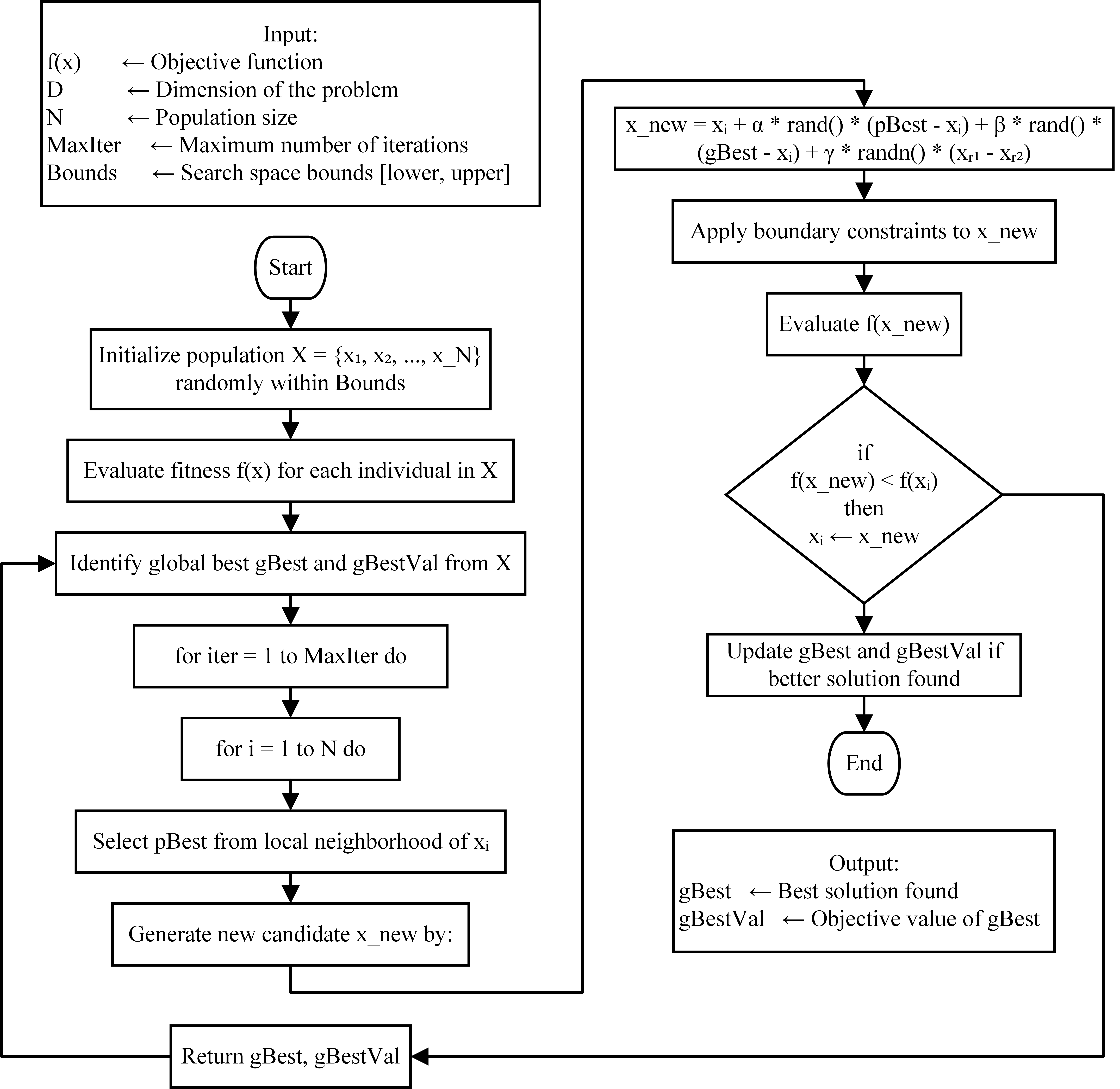
In this paper, we propose a new meta-heuristic algorithm, the Phone Operator User Algorithm (PHUA), based on the behavioral patterns of human mobile phone usage. The algorithm mimics the behavioral strategies that humans use to decide when and how to respond to mobile phone notifications. By simulating strategies such as perception triggering, priority evaluation, delayed response, mandatory inspection, do not disturb, and rest, the balance between exploration and exploitation in the global search process is optimized. We evaluate the performance of PHUA through several standard test function experiments and compare it with other classic optimization algorithms such as genetic algorithms, simulated annealing, and particle swarm optimization. Experimental results show that PHUA has good performance in solving multi-dimensional complex optimization problems. Compared with traditional algorithms, the PHUA algorithm converges faster, has stronger global search capabilities, and is better able to escape local optima. Standard benchmark functions such as Sphere, Rastrigin, and Rosenbrock were used in the experiment, and the performance was compared by indicators such as accuracy and convergence speed. Statistical significance tests (such as t-tests) confirmed the robustness and superiority of the results. The PHUA algorithm is particularly suitable for practical applications such as educational resource scheduling and adaptive learning optimization. Although the PHUA algorithm shows excellent performance, it also has limitations such as moderate computational cost and sensitivity to parameter settings.
References
S. P. Kunsina, A. Maarif, and G. N. P. Pratama, “Optimized Kalman Filter using Genetic Algorithm for IoT Sensor,” in Proc. 2023 10th Int. Conf. Electr. Eng., Comput. Sci. Informatics (EECSI), pp. 499–503, 2023, https://doi.org/10.1109/EECSI59885.2023.10295867.
B. Benaissa, M. Kobayashi, M. Al Ali, T. Khatir, and M. E. A. E. Elmeliani, “Metaheuristic optimization algorithms: An overview,” HCMCOU J. Sci.–Adv. Comput. Struct., pp. 33–61, 2024, https://doi.org/10.46223/HCMCOUJS.acs.en.14.1.47.2024.
O. O. Akinola, A. E. Ezugwu, J. O. Agushaka, R. A. Zitar, and L. Abualigah, “Multiclass feature selection with metaheuristic optimization algorithms: a review,” Neural Comput. Appl., vol. 34, no. 22, pp. 19751–19790, 2022, https://doi.org/10.1007/s00521-022-07705-4.
E. S. Rahayu, A. Ma’arif, and A. Cakan, “Particle swarm optimization (PSO) tuning of PID control on DC motor,” Int. J. Robot. Control Syst., vol. 2, no. 2, pp. 435–447, 2022, https://doi.org/10.31763/ijrcs.v2i2.476.
L. Abualigah et al., “Aquila optimizer: a novel meta-heuristic optimization algorithm,” Comput. Ind. Eng., vol. 157, p. 107250, 2021, https://doi.org/10.1016/j.cie.2021.107250.
O. N. Oyelade, A. E. S. Ezugwu, T. I. Mohamed, and L. Abualigah, “Ebola optimization search algorithm: A new nature-inspired metaheuristic optimization algorithm,” IEEE Access, vol. 10, pp. 16150–16177, 2022, https://doi.org/10.1109/ACCESS.2022.3147821.
P. Sharma and S. Raju, “Metaheuristic optimization algorithms: A comprehensive overview and classification of benchmark test functions,” Soft Comput., vol. 28, no. 4, pp. 3123–3186, 2024.
R. Alayi et al., “Optimization of Renewable energy consumption in charging electric vehicles using intelligent algorithms,” J. Robot. Control (JRC), vol. 3, no. 2, pp. 138–142, 2022, https://doi.org/10.18196/jrc.v3i2.13118.
B. Ma, Y. Hu, P. Lu, and Y. Liu, “Running city game optimizer: A game-based metaheuristic optimization algorithm for global optimization,” J. Comput. Des. Eng., vol. 10, no. 1, pp. 65–107, 2023, https://doi.org/10.1093/jcde/qwac131.
E. S. M. El-Kenawy et al., “Al-Biruni Earth Radius (BER) Metaheuristic Search Optimization Algorithm,” Comput. Syst. Sci. Eng., vol. 45, no. 2, pp. 1917–1934, 2023, https://doi.org/10.32604/csse.2023.032497.
M. M. Eid, F. Alassery, A. Ibrahim, and M. Saber, “Metaheuristic optimization algorithm for signals classification of electroencephalography channels,” Comput. Mater. Continua, vol. 71, no. 3, pp. 4627–4641, 2022, https://doi.org/10.32604/cmc.2022.024043.
M. Pluhacek, A. Kazikova, T. Kadavy, A. Viktorin, and R. Senkerik, “Leveraging large language models for the generation of novel metaheuristic optimization algorithms,” in Proc. Companion Conf. Genet. Evol. Comput., Jul. pp. 1812–1820, 2023, https://doi.org/10.1145/3583133.3596401.
M. Alyami et al., “Application of metaheuristic optimization algorithms in predicting the compressive strength of 3D-printed fiber-reinforced concrete,” Develop. Built Environ., vol. 17, p. 100307, 2024, https://doi.org/10.1016/j.dibe.2023.100307.
M. Cikan and B. Kekezoglu, “Comparison of metaheuristic optimization techniques including Equilibrium optimizer algorithm in power distribution network reconfiguration,” Alexandria Eng. J., vol. 61, no. 2, pp. 991–1031, 2022, https://doi.org/10.1016/j.aej.2021.06.079.
N. T. Ngo et al., “Proposing a hybrid metaheuristic optimization algorithm and machine learning model for energy use forecast in non-residential buildings,” Sci. Rep., vol. 12, no. 1, p. 1065, 2022, https://doi.org/10.1038/s41598-022-04923-7.
H. Tran-Ngoc, S. Khatir, H. Ho-Khac, G. De Roeck, T. Bui-Tien, and M. A. Wahab, “Efficient artificial neural networks based on a hybrid metaheuristic optimization algorithm for damage detection in laminated composite structures,” Composite Structures, vol. 262, p. 113339, 2021, https://doi.org/10.1016/j.compstruct.2020.113339.
J. Zhou, X. Shen, Y. Qiu, X. Shi, and M. Khandelwal, “Cross-correlation stacking-based microseismic source location using three metaheuristic optimization algorithms,” Tunnelling and Underground Space Technology, vol. 126, p. 104570, 2022, https://doi.org/10.1016/j.tust.2022.104570.
E. Altay, O. Altay, and Y. Özçevik, “A comparative study of metaheuristic optimization algorithms for solving real-world engineering design problems,” CMES-Computer Modeling in Engineering and Sciences, vol. 139, no. 1, 2023, https://doi.org/10.32604/cmes.2023.029404.
F. A. Hashim, K. Hussain, E. H. Houssein, M. S. Mabrouk, and W. Al-Atabany, “Archimedes optimization algorithm: A new metaheuristic algorithm for solving optimization problems,” Applied Intelligence, vol. 51, pp. 1531–1551, 2021, https://doi.org/10.1007/s10489-020-01893-z.
F. N. Al-Wesabi, M. Obayya, M. A. Hamza, J. S. Alzahrani, D. Gupta, and S. Kumar, “Energy aware resource optimization using unified metaheuristic optimization algorithm allocation for cloud computing environment,” Sustainable Computing: Informatics and Systems, vol. 35, p. 100686, 2022, https://doi.org/10.1016/j.suscom.2022.100686.
F. A. Hashim, E. H. Houssein, K. Hussain, M. S. Mabrouk, and W. Al-Atabany, “Honey Badger Algorithm: New metaheuristic algorithm for solving optimization problems,” Mathematics and Computers in Simulation, vol. 192, pp. 84–110, 2022, https://doi.org/10.1016/j.matcom.2021.08.013.
I. Matoušová, P. Trojovský, M. Dehghani, E. Trojovská, and J. Kostra, “Mother optimization algorithm: A new human-based metaheuristic approach for solving engineering optimization,” Scientific Reports, vol. 13, no. 1, p. 10312, 2023, https://doi.org/10.1038/s41598-023-37537-8.
A. S. Desuky, M. A. Cifci, S. Kausar, S. Hussain, and L. M. El Bakrawy, “Mud Ring Algorithm: A new meta-heuristic optimization algorithm for solving mathematical and engineering challenges,” IEEE Access, vol. 10, pp. 50448–50466, 2022, https://doi.org/10.1109/ACCESS.2022.3173401.
B. Al-Khateeb, K. Ahmed, M. Mahmood, and D. N. Le, “Rock hyraxes swarm optimization: A new nature-inspired metaheuristic optimization algorithm,” Computational Materials Continua, vol. 68, no. 1, pp. 643–654, 2021, https://doi.org/10.32604/cmc.2021.013648.
S. Ghani and S. Kumari, “Liquefaction behavior of Indo-Gangetic region using novel metaheuristic optimization algorithms coupled with artificial neural network,” Natural Hazards, vol. 111, no. 3, pp. 2995–3029, 2022, https://doi.org/10.1007/s11069-021-05165-y.
T. S. Ayyarao et al., “War strategy optimization algorithm: A new effective metaheuristic algorithm for global optimization,” IEEE Access, vol. 10, pp. 25073–25105, 2022, https://doi.org/10.1109/ACCESS.2022.3153493.
A. Mohammadzadeh, M. Masdari, F. S. Gharehchopogh, and A. Jafarian, “A hybrid multi-objective metaheuristic optimization algorithm for scientific workflow scheduling,” Cluster Computing, vol. 24, pp. 1479–1503, 2021, https://doi.org/10.1007/s10586-020-03205-z.
S. Mahajan, L. Abualigah, A. K. Pandit, M. R. Al Nasar, H. A. Alkhazaleh, and M. Altalhi, “Fusion of modern meta-heuristic optimization methods using arithmetic optimization algorithm for global optimization tasks,” Soft Computing, vol. 26, no. 14, pp. 6749–6763, 2022, https://doi.org/10.1007/s00500-022-07079-8.
K. Veeranjaneyulu, M. Lakshmi, and S. Janakiraman, “Swarm intelligent metaheuristic optimization algorithms-based artificial neural network models for breast cancer diagnosis: Emerging trends, challenges and future research directions,” Archives of Computational Methods in Engineering, vol. 32, no. 1, pp. 381–398, 2025, https://doi.org/10.1007/s11831-024-10142-2.
I. Zelinka et al., “Impact of chaotic dynamics on the performance of metaheuristic optimization algorithms: An experimental analysis,” Information Sciences, vol. 587, pp. 692–719, 2022, https://doi.org/10.1016/j.ins.2021.10.076.
R. Alkanhel et al., “Metaheuristic optimization of time series models for predicting networks traffic,” CMC-Computers, Materials & Continua, vol. 75, no. 1, pp. 427–442, 2023, https://doi.org/10.32604/cmc.2023.032885.
H. L. Minh, T. Sang-To, M. A. Wahab, and T. Cuong-Le, “A new metaheuristic optimization based on K-means clustering algorithm and its application to structural damage identification,” Knowledge-Based Systems, vol. 251, p. 109189, 2022, https://doi.org/10.1016/j.knosys.2022.109189.
M. Dehghani and P. Trojovský, “Osprey optimization algorithm: A new bio-inspired metaheuristic algorithm for solving engineering optimization problems,” Frontiers in Mechanical Engineering, vol. 8, p. 1126450, 2023, https://doi.org/10.3389/fmech.2022.1126450.
D. Chen, Y. Ge, Y. Wan, Y. Deng, Y. Chen, and F. Zou, “Poplar optimization algorithm: A new meta-heuristic optimization technique for numerical optimization and image segmentation,” Expert Systems with Applications, vol. 200, p. 117118, 2022, https://doi.org/10.1016/j.eswa.2022.117118.
L. Abualigah, K. H. Almotairi, and M. A. Elaziz, “Multilevel thresholding image segmentation using meta-heuristic optimization algorithms: Comparative analysis, open challenges and new trends,” Applied Intelligence, vol. 53, no. 10, pp. 11654–11704, 2023, https://doi.org/10.1007/s10489-022-04064-4.
M. Premkumar, R. Sowmya, P. Jangir, K. S. Nisar, and M. Aldhaifallah, “A new metaheuristic optimization algorithms for brushless direct current wheel motor design problem,” Computers, Materials & Continua, vol. 67, no. 2, 2021, https://doi.org/10.32604/cmc.2021.015565.
N. S. Bajaj, A. D. Patange, R. Jegadeeshwaran, S. S. Pardeshi, K. A. Kulkarni, and R. S. Ghatpande, “Application of metaheuristic optimization based support vector machine for milling cutter health monitoring,” Intelligent Systems with Applications, vol. 18, p. 200196, 2023, https://doi.org/10.1016/j.iswa.2023.200196.
S. Barua and A. Merabet, “Lévy arithmetic algorithm: an enhanced metaheuristic algorithm and its application to engineering optimization,” Expert Systems with Applications, vol. 241, p. 122335, 2024, https://doi.org/10.1016/j.eswa.2023.122335.
Y. Fu, D. Liu, J. Chen, and L. He, “Secretary bird optimization algorithm: a new metaheuristic for solving global optimization problems,” Artificial Intelligence Review, vol. 57, no. 5, p. 123, 2024, https://doi.org/10.1007/s10462-024-10729-y.
T. Hamadneh et al., “Orangutan optimization algorithm: an innovative bio-inspired metaheuristic approach for solving engineering optimization problems,” International Journal of Intelligent Engineering and Systems, vol. 18, no. 1, pp. 45–58, 2025, https://doi.org/10.22266/ijies2025.0229.05.
S. Kaur, Y. Kumar, A. Koul, and S. K. Kamboj, “A systematic review on metaheuristic optimization techniques for feature selections in disease diagnosis: open issues and challenges,” Archives of Computational Methods in Engineering, vol. 30, no. 3, pp. 1863–1895, 2023, https://doi.org/10.1007/s11831-022-09853-1.
D. Balderas, A. Ortiz, E. Méndez, P. Ponce, and A. Molina, “Empowering digital twin for Industry 4.0 using metaheuristic optimization algorithms: case study PCB drilling optimization,” The International Journal of Advanced Manufacturing Technology, vol. 113, pp. 1295–1306, 2021, https://doi.org/10.1007/s00170-021-06649-8.
H. Givi and M. Hubalovska, “Skill optimization algorithm: a new human-based metaheuristic technique,” Computers, Materials & Continua, vol. 74, no. 1, 2023, https://doi.org/10.32604/cmc.2023.030379.
D. S. Khafaga et al., “Voting classifier and metaheuristic optimization for network intrusion detection,” Computers, Materials & Continua, vol. 74, no. 2, 2023, https://doi.org/10.32604/cmc.2023.033513.
M., Abd Elaziz, A. Dahou, L. Abualigah, L. Yu, M. Alshinwan, A. M. Khasawneh, and S. Lu, “Advanced metaheuristic optimization techniques in applications of deep neural networks: a review,” Neural Computing and Applications, pp. 1–21, 2021, https://doi.org/10.1007/s00521-021-05960-5.
H. Givi, M. Dehghani, and Š. Hubálovský, “Red panda optimization algorithm: an effective bio-inspired metaheuristic algorithm for solving engineering optimization problems,” IEEE Access, vol. 11, pp. 57203–57227, 2023, https://doi.org/10.1109/ACCESS.2023.3283422.
Y. Che and D. He, “An enhanced seagull optimization algorithm for solving engineering optimization problems,” Applied Intelligence, vol. 52, no. 11, pp. 13043–13081, 2022, https://doi.org/10.1007/s10489-021-03155-y.
M. Dehghani, Z. Montazeri, E. Trojovská, and P. Trojovský, “Coati optimization algorithm: a new bio-inspired metaheuristic algorithm for solving optimization problems,” Knowledge-Based Systems, vol. 259, 110011, 2023, https://doi.org/10.1016/j.knosys.2022.110011.
J. Zhang and J. Zhang, “Classical Dance-Metaheuristic: a metaheuristic optimization algorithm inspired by classical dance,” Control Systems and Optimization Letters, vol. 3, no. 2, pp. 165–173, 2025, https://doi.org/10.59247/csol.v3i2.206.
V. C. SS and A. HS, “Nature inspired metaheuristic algorithms for optimization problems,” Computing, vol. 104, no. 2, pp. 251–269, 2022, https://doi.org/10.1007/s00607-021-00955-5.
P. Agrawal, T. Ganesh, and A. W. Mohamed, “Chaotic gaining sharing knowledge-based optimization algorithm: an improved metaheuristic algorithm for feature selection,” Soft Computing, vol. 25, no. 14, pp. 9505–9528, 2021, https://doi.org/10.1007/s00500-021-05874-3.
Published
How to Cite
Issue
Section
License
Copyright (c) 2025 Jincheng Zhang, Thada Jantakoon, Rukthin Laoha, Potsirin Limpinan

This work is licensed under a Creative Commons Attribution-ShareAlike 4.0 International License.
Authors who publish with this journal agree to the following terms:
- Authors retain copyright and grant the journal right of first publication with the work simultaneously licensed under a Creative Commons Attribution License that allows others to share the work with an acknowledgment of the work's authorship and initial publication in this journal.
- Authors are able to enter into separate, additional contractual arrangements for the non-exclusive distribution of the journal's published version of the work (e.g., post it to an institutional repository or publish it in a book), with an acknowledgment of its initial publication in this journal.
- Authors are permitted and encouraged to post their work online (e.g., in institutional repositories or on their website) prior to and during the submission process, as it can lead to productive exchanges, as well as earlier and greater citation of published work (See The Effect of Open Access).

This journal is licensed under a Creative Commons Attribution-ShareAlike 4.0 International License.