Internalizing ethical and humanistic values in AIK education to foster an anti-bullying culture in Islamic higher education
DOI:
https://doi.org/10.26555/almisbah.v14i1.15051Keywords:
AIK, Ethical Values, Humanistic Values, Anti-Bullying, Islamic Higher EducationAbstract
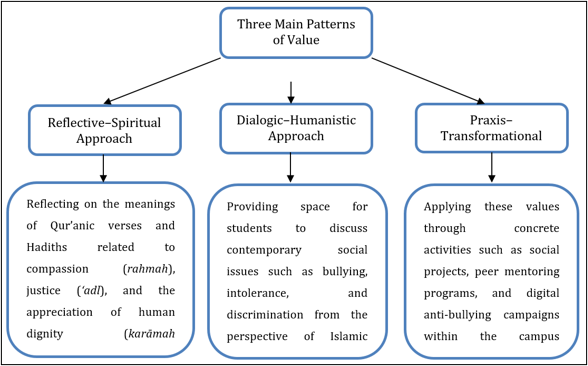
The phenomenon of bullying in higher education has become a serious challenge for the academic environment, including Islamic universities that are fundamentally grounded in moral and humanistic values. This article aims to analyze the process of internalizing ethical and humanistic values in Al-Islam and Kemuhammadiyahan (AIK) education as a strategy to foster an anti-bullying culture in Islamic higher education institutions. This study employs a qualitative-descriptive approach through literature review and observations of AIK learning practices in various Muhammadiyah educational settings. The findings indicate that AIK education plays a significant role in instilling the values of tawhid, justice, empathy, and respect for human dignity, moral foundations essential to creating a civilized campus environment free from social violence. The internalization of these values is carried out through an integrative approach that combines cognitive, affective, and practical dimensions, enabling students not only to understand Islamic teachings theoretically but also to apply them in constructive social behavior. This article concludes that strengthening ethical-humanistic values within AIK education is a strategic step toward building an inclusive academic culture that respects diversity and rejects all forms of bullying in Islamic higher education. The study contributes by offering an integrated framework that connects value-based AIK learning with anti-bullying behavioral outcomes, providing theoretical and practical insights for the development of more effective and humanistic AIK models in Islamic higher education.
References
A. Fauzia and M. Basri. (2020). Humanizing Islamic Education: Integrating Spiritual and Ethical Dimensions in Higher Learning. International Journal of Islamic Pedagogy, 2(3), 77–93.
Creswell, J. W., & Poth, C. N. (2016). Qualitative inquiry and research design: Choosing among five approaches. Sage publications.
Gómez-Galán, J., Lázaro-Pérez, C., & Martínez-López, J. Á. (2021). Trajectories of Victimization and Bullying at University: Prevention for a Healthy and Sustainable Educational Environment. Sustainability, 13(6), 3426. https://doi.org/10.3390/su13063426
Hasanah, N., Putra, D., and Karim, S. (2021). Dialogical-Reflective Learning of AIK and Students’ Empathic Awareness in Islamic Universities. Jurnal Pendidikan Islam Indonesia, 9(No. 2), 150–166.
Ismail, S. K., & Clarita, N. (2024). Peran Pendidikan al-Islam dan Kemuhammadiyaan dalam Membangun Karakter Pribadi Islami Mahasiswa Universitas Muhammadiyah Gorontalo. Kelola: Journal of Islamic Education Management, 2(1), 1–8.
Iwan Sanusi, Andewi Suhartini, Haditsa Qur’ani Nurhakim, Ulvah Nur’aeni, & Giantomi Muhammad. (2024). Konsep Uswah Hasanah dalam Pendidikan Islam. Masagi: Jurnal Pendidikan Karakter, 1(1), 1–12. https://doi.org/10.29313/masagi.v1i1.3523
Kurniawan, M. I., & Mardiana, D. (2026). Meaning and Learning Experiences of Al-Islam and Kemuhammadiyahan (AIK) Among International Students: A Phenomenological Study. Tadrib: Jurnal Pendidikan Agama Islam, 12(4), 520–530.
Lewis, S. (2015). Qualitative Inquiry and Research Design: Choosing Among Five Approaches. Health Promotion Practice, 16(4), 473–475. https://doi.org/10.1177/1524839915580941
Ma, X., Stewin, L. L., & Mah, D. L. (2001). Bullying in school: nature, effects and remedies. Research Papers in Education, 16(3), 247–270. https://doi.org/10.1080/02671520126826
Makmudi, M., Primarni, A., Suryana, A., Althafullaya, M. R., & Arifin, S. (2026). Modeling Anti-Bullying Actions in Islamic Higher Education: A Mixed-Method Study. Lectura : Jurnal Pendidikan, 17(1), 51–63. https://doi.org/10.31849/r13r2c53
Masrizal, & Nurhuda, H. (2026). STAR-AIK Learning for Moral and Spiritual Formation in Islamic Nursing Education. Al-Mudarris (Jurnal Ilmiah Pendidikan Islam), 9(2), 105–122. https://doi.org/10.23971/mdr.v9i2.11436
Menesini, E., & Salmivalli, C. (2017). Bullying in schools: the state of knowledge and effective interventions. Psychology, Health & Medicine, 22(sup1), 240–253. https://doi.org/10.1080/13548506.2017.1279740
Meyer, H. (2025). Navigating Workplace Bullying: A Critical Theory Exploration of Lecturers’ Experiences in a Higher Education Context. Human Resource Development Quarterly. https://doi.org/10.1002/hrdq.70006
Mokhtar, A. B. bin, & Rahman, M. T. (2025). Between Love and Affection: Rahmatan Lil Alamin as a Transformative Axiological Framework in Global Education. FOCUS, 6(1), 37–54. https://doi.org/10.26593/focus.v6i1.9286
Nugraha A., and K. R. (2023). Integrating Ethical and Humanistic Values in Islamic Religious Education: A Strategy for Character Building. Al-Ta’dib Journal of Islamic Education, 16(No. 1), 20–35.
Nugraha, S., Apriliansyah, M. S., Rahman, F., Susilowati, E., & Wulandari, V. P. (2025). Bahaya perundungan ( bullying ) dan cara menghadapinya di smkn 7 kota palangka raya. Jurnal Pengabdian Kepada Masyrakat, 3(Juli), 59–68.
Nuryana, Z. (2017). Revitalisasi Pendidikan Al-Islam Dan Kemuhammadiyahan Pada Perguruan Muhammadiyah. Jurnal Tamaddun, 1(2017: JANUARI), 1–11. http://journal.umg.ac.id/index.php/tamaddun/article/view/87
Nuryana, Z., Somae, E. T., & Nasih, A. M. (2026). Success Story in Life-based Learning: How Pesantren Transforms Real-life Experiences into Educational Gold (pp. 317–329). https://doi.org/10.1007/978-3-032-16731-6_21
Rahmadi Agus Setiawan. (2026). Rahmatan lil ‘Alamin as a Pedagogical Paradigm in Islamic Education: A Literature Review. Jurnal Harmoni Pendidikan, 2(1), 81–96. https://doi.org/10.64845/jhp.v2i1.182
Rahman, N., and Yusof, M. (2020). Humanizing Islamic Education: Moral Transformation in Higher Learning Contexts. Asian Journal of Islamic Studies, 12(No. 3), 210–229.
Rezky, A. M., Mukramin, S., & Ashar, A. (2025). Bullying behavior and its implications for the formation of student character. Harmoni Sosial: Jurnal Pendidikan IPS, 12(1), 37–46. https://doi.org/10.21831/hsjpi.v12i1.85603
Wardi, M. M., & Mappanyompa, M. (2025). Islamic Religious Education Innovation for Preventing Bullying in Higher Education. Halaqa: Islamic Education Journal, 9(1), 62–77. https://doi.org/10.21070/halaqa.v9i1.1720
Downloads
Published
How to Cite
Issue
Section
License
Copyright (c) 2026 Ika Sofia Rizqiani, Khozin, Ishomuddin

This work is licensed under a Creative Commons Attribution-ShareAlike 4.0 International License.
Authors who publish with Al-Misbah agree to the following terms:
- Authors retain copyright and grant the journal right of first publication with the work simultaneously licensed under a Creative Commons Attribution License (CC BY-SA 4.0) that allows others to share the work with an acknowledgment of the work's authorship and initial publication in this journal.
- Authors are able to enter into separate, additional contractual arrangements for the non-exclusive distribution of the journal's published version of the work (e.g., post it to an institutional repository or publish it in a book), with an acknowledgment of its initial publication in this journal.
- Authors are permitted and encouraged to post their work online (e.g., in institutional repositories or on their website) prior to and during the submission process, as it can lead to productive exchanges, as well as earlier and greater citation of published work.

This work is licensed under a Creative Commons Attribution-ShareAlike 4.0 International License.