Relationship between religion, state, and politics: A study of the dynamics of islamic education in Indonesia
DOI:
https://doi.org/10.26555/almisbah.v13i2.14270Keywords:
Religion, State, Politics, Islamic educationAbstract
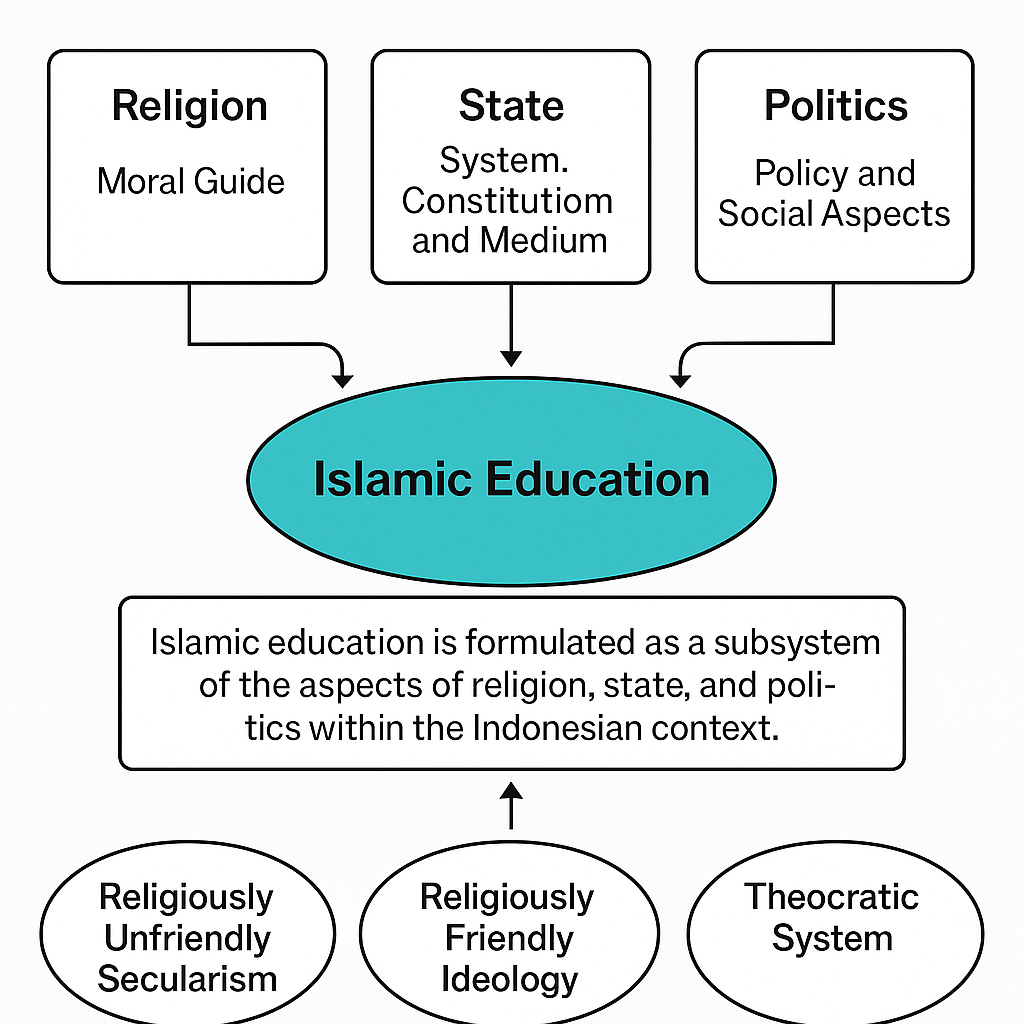
The purpose of this research is to formulate Islamic education within the Indonesian context as a subsystem of the aspects of religion, state, and politics themselves. Therefore, it is essential to reformulate the position of Islamic education in the context of the nation and state as a representation of the aspects of religion, state, and politics. The background of this research is that Islamic education currently experiences a disorientation of purpose and a marginalized dominance of existence. For example, many Islamic educational institutions do not experience a significant increase in student enrollment, which could be due to a lack of contextual Islamic knowledge or unprofessional institutional management systems. Facing such a situation, it is important to find solutions so that Islamic education becomes more responsive to the fields of religion, state, and politics, so that it can adapt to national and state life. This research uses a qualitative method with a literature review type of research and a grounded theory approach. Data collection techniques use literature and documentation from various sources. Data analysis then uses heuristic analysis, verification, interpretation, and synthesis. The results of this research are that initially, there were three types of relationships between religion, state, and politics: religiously unfriendly secularism, religiously friendly ideology, and theocratic system. In the Indonesian context, which refers to a religiously friendly ideology system, Islamic education within the framework of the relationship between religion, state, and politics in Indonesia means that Islamic education about religion serves as a moral guide, Islamic education about the state serves as a system, constitution, and medium, and Islamic education about politics is about policy and social aspects. The conclusion obtained shows that these three aspects, namely religion, state, and politics, in the dynamics of Islamic education in Indonesia are formulated in social, governance, and environmental terms. This means that Islamic education as the basis of religion in Indonesia has a social role to shape the noble character of its society, Islamic education viewed from the perspective of the state is to implement a holistic system so that it can function optimally in society (governance), and Islamic education as politics is to be able to create and form a peaceful and prosperous environment.
References
Abidin, A. A., Fatawi, I., & Kausar, S. (2025). The Values of Islamic Education for Building Tolerance in the Jombang Community: A Qualitative Study of the Role of Religious Harmony Forum. Tafkir: Interdisciplinary Journal of Islamic Education, 6(1), 1–16. https://doi.org/10.31538/tijie.v6i1.1182
Al-Fārābī, A. N. (1993). Kitāb al-Siyāsah al-Madaniyyah. Dār al-Mashriq.
Al-Fārābī, A. N. (1996). Kitāb Arā Ahl al-Madīnah al-Fādilah. Dār al-Mashriq.
Azra, A. (2015). dalam Fikih Kebinekaan Pandangan Islam Indonesia Tentang Umat, Kewargaan, dan Kepemimpinan Non-Muslim. PT Mizan Pustaka.
Corbin, J., & Strauss, A. (2007). Basics of Qualitative Research: Techniques and Procedures for Developing Grounded Theory. Sage.
Hamidi, A., Asasriwarni, A., & Matondang, I. (2022). The Relationship Between Religion and The State in Indonesia, and Its Relation to Islamic Law. NEGREI: Academic Journal of Law and Governance, 2(1), 1. https://doi.org/10.29240/negrei.v2i1.3783
Hanif, M., Mukhroji, Suwito, H., Mubaroq, A. C., & Dharin, A. (2024). Pesantren Resistance to Indonesia’s National Curriculum to Defend Its Curriculum Model. Revista de Gestão Social E Ambiental, 18(7), e05473. https://doi.org/10.24857/rgsa.v18n7-049
Haryatmoko. (2004). Etika Politik dan Kekuasaan. Kompas.
Kuntowijoyo. (2011). Pengantar Ilmu Sejarah. Yayasan Bentang Budaya.
Mohamed, A. E. (2024). The relationship between state-provided Islamic education and Islamism. Politics and Religion, 17(3), 468–493. https://doi.org/10.1017/S1755048324000129
Mohd Zain, F. A., Muhamad, S. F., Abdullah, H., Sheikh Ahmad Tajuddin, S. A. F., & Wan Abdullah, W. A. (2024). Integrating environmental, social and governance (ESG) principles with Maqasid al-Shariah: a blueprint for sustainable takaful operations. International Journal of Islamic and Middle Eastern Finance and Management, 17(3), 461–484. https://doi.org/10.1108/IMEFM-11-2023-0422
Mu’iz, D. H. T., Nasrulloh, N., Marwinata, P., & Mahsunah, M. (2024). Relation of Religious, Politics, and State in Indonesia: A Comparative Study Soekarno and Abdurrahman Wahid. Abdurrauf Journal of Islamic Studies, 3(3), 197–214.
Mustafayeva, A., Paltore, Y., Pernekulova, M., & Meirim, I. (2023). Islamic Higher Education as a Part of Kazakhs’ Cultural Revival. Journal of Ethnic and Cultural Studies, 10(3), 103–127. https://doi.org/10.29333/ejecs/1515
Mustofa, I., Setiawan, W., Maliki, I. A., & Chamdan, U. (2024). The Authority of Texts in the Dynamics of Ijtihad on Fiqh Mu’amalah Among Santri in Indonesia. El-Mashlahah, 14(2), 381–408. https://doi.org/10.23971/el-mashlahah.v14i2.8074
Nawawi, H. (2013). Metode Penelitian Bidang Sosial. Gadjah Mada University Press.
Ongaro, E., & Tantardini, M. (2024). Religion, spirituality, faith and public administration: A literature review and outlook. Public Policy and Administration, 39(4), 531–555. https://doi.org/10.1177/09520767221146866
Plato. (1925). The Republic of Plato, translated by Benjamin Jowett. The Clarendon Press.
Sirojuddin, A., Maskuri, M., & Ghoni, J. (2025). Integration of Higher Education Curriculum With Islamic Boarding Schools From a Multicultural Islamic Education Perspective. Nazhruna: Jurnal Pendidikan Islam, 8(2). https://doi.org/10.31538/nzh.v8i2.163
Syafi’i, I. K. (1997). Ilmu Politik. Rineka Cipta.
Thaba, A. A. (1996). Islam Dan Negara dalam Politik Orde Baru. Gema Insani Press.
Tim Penyusunan Kamus Pusat Pembinaan dan Pengembangan Bahasa Indonesia. (1989). Kamus Besar Bahasa Indonesia. Balai Pustaka.
Watt, W. M. (1956). Muhammad at Medina,. The Clarendon Press.
Yaqin, L. I. K., & Sya’bani, M. A. Y. (2025). Implementasi Metode Iqro’ dalam Pembelajaran Al-Qur`an di TPA Istikmal Dermo Kecamatan Benjeng Kabupaten Gresik. Tamaddun Jurnal Pendidikan Dan Pemikiran Keagamaan, 26(2), 148–156.
Downloads
Published
How to Cite
Issue
Section
License
Copyright (c) 2025 Mohammad Ahyan Yusuf Sya'bani

This work is licensed under a Creative Commons Attribution-ShareAlike 4.0 International License.
Authors who publish with Al-Misbah agree to the following terms:
- Authors retain copyright and grant the journal right of first publication with the work simultaneously licensed under a Creative Commons Attribution License (CC BY-SA 4.0) that allows others to share the work with an acknowledgment of the work's authorship and initial publication in this journal.
- Authors are able to enter into separate, additional contractual arrangements for the non-exclusive distribution of the journal's published version of the work (e.g., post it to an institutional repository or publish it in a book), with an acknowledgment of its initial publication in this journal.
- Authors are permitted and encouraged to post their work online (e.g., in institutional repositories or on their website) prior to and during the submission process, as it can lead to productive exchanges, as well as earlier and greater citation of published work.

This work is licensed under a Creative Commons Attribution-ShareAlike 4.0 International License.