Mapping the Landscape of Technology-Enhanced Misconception Research in Science Education
Trends, Impact, and Future Directions
DOI:
https://doi.org/10.12928/irip.v8i1.15336Keywords:
Bibliometrics, Educational technology, Misconceptions, Science, VOSviewerAbstract
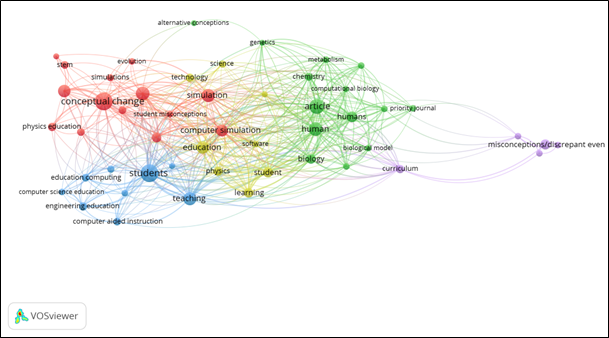
This study uses a quantitative bibliometric approach to map trends, collaborations, and research directions in the field of technology-based misconception remediation in science education. Data were extracted from the Scopus database using keyword searches related to misconceptions, educational technology, and science learning from 2000 to 2024. After filtering, 280 documents were analyzed using VOSviewer to explore publication patterns, author collaboration networks, and conceptual connections through co-authorship, co-word, and co-citation analysis. Network map visualizations provide an overview of key actors, popular topics, and emerging thematic clusters. The study results indicate significant growth in publications and international collaboration, while also identifying potential research gaps. These findings are expected to serve as a strategic reference for researchers and policymakers in directing technology-based pedagogical research and innovation to address misconceptions in science education.
References
M. I. Sukarelawan, S. Sriyanto, A. D. Puspitasari, D. Sulisworo, and U. N. Hikmah, “Four-Tier Heat and Temperature Diagnostic Test (4T-HTDT) to Identify Student Misconceptions,” JIPFRI (Jurnal Inov. Pendidik. Fis. dan Ris. Ilmiah), vol. 5, no. 1, pp. 1–8, Jul. 2021, doi: 10.30599/jipfri.v5i1.856.
F. Guerra-Reyes, E. Guerra-Dávila, M. Naranjo-Toro, A. Basantes-Andrade, and S. Guevara-Betancourt, “Misconceptions in the Learning of Natural Sciences: A Systematic Review,” Educ. Sci., vol. 14, no. 5, p. 497, May 2024, doi: 10.3390/educsci14050497.
T. T. Fuchs, K. M. Bonney, and M. Arsenault, “Leveraging Student Misconceptions to Improve Teaching of Biochemistry & Cell Biology,” Am. Biol. Teach., vol. 83, no. 1, pp. 5–11, Jan. 2021, doi: 10.1525/abt.2021.83.1.5.
H. Ma, H. Yang, C. Li, S. Ma, and G. Li, “The Effectiveness and Sustainability of Tier Diagnostic Technologies for Misconception Detection in Science Education: A Systematic Review,” Sustainability, vol. 17, no. 7, p. 3145, Apr. 2025, doi: 10.3390/su17073145.
S. Soeharto and B. Csapó, “Exploring Indonesian student misconceptions in science concepts,” Heliyon, vol. 8, no. 9, p. e10720, Sep. 2022, doi: 10.1016/j.heliyon.2022.e10720.
A.-S. Härmälä-Braskén, K. Hemmi, and B. Kurtén, “Misconceptions in chemistry among Finnish prospective primary school teachers – a long-term study,” Int. J. Sci. Educ., vol. 42, no. 9, pp. 1447–1464, Jun. 2020, doi: 10.1080/09500693.2020.1765046.
C. Nascimento and F. Abdulkader, “Identification of misconceptions on membrane physiology,” Physiology, vol. 38, no. S1, May 2023, doi: 10.1152/physiol.2023.38.S1.5735003.
A. I. Morales López and P. Tuzón Marco, “Misconceptions, Knowledge, and Attitudes Towards the Phenomenon of Radioactivity,” Sci. Educ., vol. 31, no. 2, pp. 405–426, Apr. 2022, doi: 10.1007/s11191-021-00251-w.
J. Jumadi, M. I. Sukarelawan, and H. Kuswanto, “An investigation of item bias in the four-tier diagnostic test using Rasch model,” Int. J. Eval. Res. Educ., vol. 12, no. 2, p. 622, Jun. 2023, doi: 10.11591/ijere.v12i2.22845.
T. K. Indratno, M. I. Sukarelawan, A. D. Puspitasari, and S. Soeharto, “Students are Not Sure about Their Conceptual Understanding: A Comparative Study of the Level of Conceptual Understanding and the Level of Confidence Using Rasch Modeling,” Indones. Rev. Phys., vol. 6, no. 2, pp. 1–23, 2023, doi: 10.12928/irip.v6i2.6901.
E. B. Lewis, A. M. Rivero, L. L. Lucas, A. A. Musson, and B. A. Helding, “Setting empirically informed content knowledge policy benchmarks for physical science teaching,” J. Res. Sci. Teach., vol. 58, no. 8, pp. 1238–1277, Oct. 2021, doi: 10.1002/tea.21709.
P. Potvin, G. Malenfant-Robichaud, C. Cormier, and S. Masson, “Coexistence of Misconceptions and Scientific Conceptions in Chemistry Professors: A Mental Chronometry and fMRI Study,” Front. Educ., vol. 5, p. 542458, Sep. 2020, doi: 10.3389/feduc.2020.542458.
M. A. A. Bahtaji, “Examining the Physics Conceptions, Science Engagement and Misconceptions of Undergraduate Students In STEM,” J. Balt. Sci. Educ., vol. 22, no. 1, pp. 10–19, Feb. 2023, doi: 10.33225/jbse/23.22.10.
N. Hermita, E. Erlisnawati, J. A. Alim, Z. H. Putra, I. Mahartika, and U. Sulistiyo, “Hybrid learning, blended learning or face-to-face learning: which one is more effective in remediating misconception?,” Qual. Assur. Educ., vol. 32, no. 1, pp. 64–78, Jan. 2024, doi: 10.1108/QAE-02-2023-0019.
J. Siantuba, L. Nkhata, and T. de Jong, “The impact of an online inquiry-based learning environment addressing misconceptions on students’ performance,” Smart Learn. Environ., vol. 10, no. 1, p. 22, Mar. 2023, doi: 10.1186/s40561-023-00236-y.
A. Halim, E. Mahzum, M. Yacob, I. Irwandi, and L. Halim, “The Impact of Narrative Feedback, E-Learning Modules and Realistic Video and the Reduction of Misconception,” Educ. Sci., vol. 11, no. 4, p. 158, Mar. 2021, doi: 10.3390/educsci11040158.
M. A. Alkhateeb, “Correcting Misconceptions in Fractions Using Interactive Technological Learning Activities,” Int. J. Learn. Teach. Educ. Res., vol. 19, no. 4, pp. 291–308, Apr. 2020, doi: 10.26803/ijlter.19.4.17.
N. Belova and C. Zowada, “Innovating Higher Education via Game-Based Learning on Misconceptions,” Educ. Sci., vol. 10, no. 9, p. 221, Aug. 2020, doi: 10.3390/educsci10090221.
J. N. Twahirwa and C. Ntivuguruzwa, “Enhancing teachers’ and students’ conceptual understanding of physics through smart classrooms and comprehensive assessment management information system,” Cogent Educ., vol. 11, no. 1, Dec. 2024, doi: 10.1080/2331186X.2024.2365108.
A. Desstya, Ika Candra Sayekti, M. Abduh, and Sukartono, “Development of a four-tier diagnostic test for misconceptions in natural science of primary school pupils,” J. Turkish Sci. Educ., vol. 22, no. 2, pp. 338–353, Jun. 2025, doi: 10.36681/tused.2025.017.
E. Istiyono, W. S. B. Dwandaru, K. Fenditasari, M. R. S. S. N. Ayub, and D. Saepuzaman, “The Development of a Four-Tier Diagnostic Test Based on Modern Test Theory in Physics Education,” Eur. J. Educ. Res., vol. 12, no. 1, pp. 371–385, Jan. 2023, doi: 10.12973/eu-jer.12.1.371.
T. Taban and S. A. Kiray, “Determination of Science Teacher Candidates’ Misconceptions on Liquid Pressure with Four-Tier Diagnostic Test,” Int. J. Sci. Math. Educ., vol. 20, no. 8, pp. 1791–1811, Dec. 2022, doi: 10.1007/s10763-021-10224-8.
K. B. Putica, “Identification of High-School Students’ Conceptual Challenges Related to Alcohols and Carbonyl Compounds by Means of a Four-Tier Diagnostic Test,” J. Chem. Educ., vol. 101, no. 4, pp. 1442–1456, Apr. 2024, doi: 10.1021/acs.jchemed.3c01343.
K. Fongsamut, M. Tanasittikosol, and M. Phaksunchai, “Effectiveness of the simulation-based learning (SBL) assisted with scaffolding approach to address students’ misconceptions about projectile motion,” Phys. Educ., vol. 58, no. 2, p. 025002, Mar. 2023, doi: 10.1088/1361-6552/aca57d.
F. Mufit, F. Festiyed, A. Fauzan, and L. Lufri, “The Effect of Cognitive Conflict-Based Learning (CCBL) Model on Remediation of Misconceptions,” J. Turkish Sci. Educ., vol. 20, no. 1, pp. 26–49, Mar. 2023, doi: 10.36681/tused.2023.003.
M. Z. Bin Amiruddin, A. Samsudin, A. Suhandi, B. Coştu, and B. K. Prahani, “Scientific mapping and trend of conceptual change: A bibliometric analysis,” Soc. Sci. Humanit. Open, vol. 11, p. 101208, 2025, doi: 10.1016/j.ssaho.2024.101208.
H. Ş. KIZILCIK, “A Bibliometric Analysis of Articles on Physics Education in Turkey Between 2010 and 2020,” Hacettepe Univ. J. Educ., vol. 38, no. 3, pp. 347–366, Jul. 2023, doi: 10.16986/HUJE.2023.493.
M. A. Kurtuluş and N. Tatar, “An Analysis of Scientific Articles on Science Misconceptions: A Bibliometric Research,” Elem. Educ. Online, vol. 20, no. 1, pp. 192–207, Jan. 2021, doi: 10.17051/ilkonline.2021.01.022.
S. Li and J. Zheng, “The relationship between self-efficacy and self-regulated learning in one-to-one computing environment: The mediated role of task values,” Asia-Pacific Educ. Res., vol. 27, no. 6, pp. 455–463, 2018, doi: 10.1007/s40299-018-0405-2.
B. J. Zimmerman and A. R. Moylan, “Self-regulation: where metacognition and motivation intersect,” in Handbook of Metacognition in Education, 2009, pp. 299–315.
P. R. Pintrich, D. A. F. Smith, T. Duncan, and W. Mckeachie, A manual for the use of the motivated strategies for learning questionnaire (MSLQ). Ann Arbor, Michigan, 1991.
J. Roick and T. Ringeisen, “Students’ math performance in higher education: examining the role of self-regulated learning and self-efficacy,” Learn. Individ. Differ., vol. 65, pp. 148–158, 2018.
G. Ocak and A. Yamaç, “Examination of the relationships between fifth graders’ self-regulated learning strategies, motivational beliefs, attitudes, and achievement,” Educ. Sci. Theory Pract., vol. 13, no. 1, pp. 380–387, 2013.
M. Pressley and C. B. McCormick, Advanced educational psychology for educators, researchers, and policymakers. New York, USA: HarperCollins College Publishers, 1995.
A. Bandura, Prentice-Hall series in social learning theory. Social foundations of thought and action: A social cognitive theory. Prentice-Hall, Inc., 1985.
A. L. Dent and A. C. Koenka, “The relation between self-regulated learning and academic achievement across childhood and adolescence: a meta-analysis,” Educ. Psychol. Rev., vol. 28, no. 3, pp. 425–474, 2015, doi: 10.1007/s10648-015-9320-8.
T. J. Cleary and A. Kitsantas, “Motivation and self-regulated learning influences on middle school mathematics achievement,” School Psych. Rev., vol. 46, no. 1, pp. 88–107, 2017.
P. R. Pintrich, “Chapter 14 - The Role of Goal Orientation in Self-Regulated Learning,” in Handbook of Self-Regulation, San Diego, California: Academic Press, 2000, pp. 451–502. doi: 10.1016/B978-012109890-2/50043-3.
H. Vonkova and J. Hrabak, “The (in) comparability of ICT knowledge and skill self-assessments among upper secondary school students: The use of the anchoring vignette method,” Comput. Educ., vol. 85, pp. 191–202, 2015, doi: 10.1016/j.compedu.2015.03.003.
O. Öztürk, R. Kocaman, and D. K. Kanbach, “How to design bibliometric research: an overview and a framework proposal,” Rev. Manag. Sci., vol. 18, no. 11, pp. 3333–3361, Nov. 2024, doi: 10.1007/s11846-024-00738-0.
W. Hassan and A. E. Duarte, “Bibliometric analysis: A few suggestions,” Curr. Probl. Cardiol., vol. 49, no. 8, p. 102640, Aug. 2024, doi: 10.1016/j.cpcardiol.2024.102640.
A. Kirby, “Exploratory Bibliometrics: Using VOSviewer as a Preliminary Research Tool,” Publications, vol. 11, no. 1, p. 10, Feb. 2023, doi: 10.3390/publications11010010.
P. C. Ezeh and K. Dube, “Trends and development in green and sustainability marketing: a bibliometrics analysis using VOSviewer,” Discov. Sustain., vol. 6, no. 1, p. 324, Apr. 2025, doi: 10.1007/s43621-025-01159-z.
P. M. Ibna Seraj, B. Klimova, and R. Khan, “Visualizing Research Trends in English Language Teaching (ELT) From 2013 to 2022: A Bibliometric Analysis,” Sage Open, vol. 14, no. 2, Apr. 2024, doi: 10.1177/21582440241251998.
X. Fu and X. Dai, “Stimulating interest in learning: a bibliometric review from 2014 to 2024,” J. Furth. High. Educ., vol. 49, no. 5, pp. 613–626, May 2025, doi: 10.1080/0309877X.2025.2479765.
M. S. Palmer and J. A. Giering, “Characterizing Pedagogical Innovation in Higher Education,” Innov. High. Educ., vol. 49, no. 3, pp. 453–473, Jun. 2024, doi: 10.1007/s10755-023-09681-6.
A. C. Atmaca Aksoy and S. Erten, “A Four-Tier Diagnostic Test to Determine Pre-Service Science Teachers’ Misconception about Global Warming,” J. Balt. Sci. Educ., vol. 21, no. 5, pp. 747–761, Oct. 2022, doi: 10.33225/jbse/22.21.747.
E. Aini, E. Evendi, A. Halim, M. Syukri, and Y. Yusrizal, “Relationship between Misconceptions and Students’ Scientific Literacy Abilities on Global Warming Material,” J. Penelit. Pendidik. IPA, vol. 9, no. 10, pp. 8051–8058, Oct. 2023, doi: 10.29303/jppipa.v9i10.5156.
G. Tibaná-Herrera, M.-T. Fernández-Bajón, and F. De-Moya-Anegón, “Output, collaboration and impact of e-learning research: Bibliometric analysis and visualizations at the country and institutional level (Scopus 2003-2016),” El Prof. la Inf., vol. 27, no. 5, p. 1082, Sep. 2018, doi: 10.3145/epi.2018.sep.12.
J. M. Merigó and J. Yang, “Accounting Research: A Bibliometric Analysis,” Aust. Account. Rev., vol. 27, no. 1, pp. 71–100, Mar. 2017, doi: 10.1111/auar.12109.
K. Tanaka and I. Sakata, “New bibliometric analysis of research institutions network,” in 2016 Portland International Conference on Management of Engineering and Technology (PICMET), Sep. 2016, pp. 429–439. doi: 10.1109/PICMET.2016.7806730.
B. Zhao and J. Zhou, “Research hotspots and trends in digitalization in higher education: A bibliometric analysis,” Heliyon, vol. 10, no. 21, p. e39806, Nov. 2024, doi: 10.1016/j.heliyon.2024.e39806.
Y.-S. Su, C.-L. Lin, S.-Y. Chen, and C.-F. Lai, “Bibliometric study of social network analysis literature,” Libr. Hi Tech, vol. 38, no. 2, pp. 420–433, Dec. 2019, doi: 10.1108/LHT-01-2019-0028.
F. C. Wibowo, A. Suhandi, D. Rusdiana, Y. Ruhiat, D. R. Darman, and A. Samsudin, “Effectiveness of Microscopic Virtual Simulation (MVS) for Conceptualizing Students’ Conceptions on Phase Transitions,” Adv. Sci. Lett., vol. 23, no. 2, pp. 839–843, Feb. 2017, doi: 10.1166/asl.2017.7542.
F. Vizzarri, “Network Perspective: Benefits of International Scientific Collaboration,” Slovak J. Anim. Sci., vol. 57, no. 2, pp. 1–2, Jun. 2024, doi: 10.36547/sjas.923.
E. Kurniati, H. Suwono, I. Ibrohim, A. Suryadi, and M. Saefi, “International Scientific Collaboration and Research Topics on STEM Education: A Systematic Review,” Eurasia J. Math. Sci. Technol. Educ., vol. 18, no. 4, p. em2095, Mar. 2022, doi: 10.29333/ejmste/11903.
C. S. Wagner, T. A. Whetsell, and L. Leydesdorff, “Growth of international collaboration in science: revisiting six specialties,” Scientometrics, vol. 110, no. 3, pp. 1633–1652, Mar. 2017, doi: 10.1007/s11192-016-2230-9.
D. A. Muller, J. Bewes, M. D. Sharma, and P. Reimann, “Saying the wrong thing: improving learning with multimedia by including misconceptions,” J. Comput. Assist. Learn., vol. 24, no. 2, pp. 144–155, Apr. 2008, doi: 10.1111/j.1365-2729.2007.00248.x.
M. Yukselen, A. Mutlu, and P. Karagoz, “Predicting the Trending Research Topics by Deep Neural Network Based Content Analysis,” IEEE Access, vol. 10, pp. 90887–90902, 2022, doi: 10.1109/ACCESS.2022.3202654.
A. F. Al Barra, D. R. S. Saputro, and P. Widianingsih, “Bibliometric Analysis of Spline Regression Model for Trend Mapping and Strategy Development Research Using Vosviewer,” NUCLEUS, vol. 5, no. 02, pp. 74–81, Nov. 2024, doi: 10.37010/nuc.v5i02.1760.
M. M. Shin, S. Jung, and J. S. Rha, “Study on Business Ecosystem Research Trend Using Network Text Analysis,” Sustainability, vol. 13, no. 19, p. 10727, Sep. 2021, doi: 10.3390/su131910727.
Downloads
Published
Issue
Section
License
Copyright (c) 2025 aden Oktova; Moh. Irma Sukarelawan

This work is licensed under a Creative Commons Attribution-ShareAlike 4.0 International License.
Authors who publish in IRiP agree to the following terms: Authors retain copyright and grant the IRiP right of first publication with the work simultaneously licensed under a Creative Commons Attribution License (CC BY-SA 4.0) that allows others to share (copy and redistribute the material in any medium or format) and adapt (remix, transform, and build upon the material) the work for any purpose, even commercially with an acknowledgment of the work's authorship and initial publication in IRiP. Authors are able to enter into separate, additional contractual arrangements for the non-exclusive distribution of the journal's published version of the work (e.g., post it to an institutional repository or publish it in a book), with an acknowledgment of its initial publication in IRiP. Authors are permitted and encouraged to post their work online (e.g., in institutional repositories or on their website) prior to and during the submission process, as it can lead to productive exchanges, as well as earlier and greater citation of published work (See The Effect of Open Access).