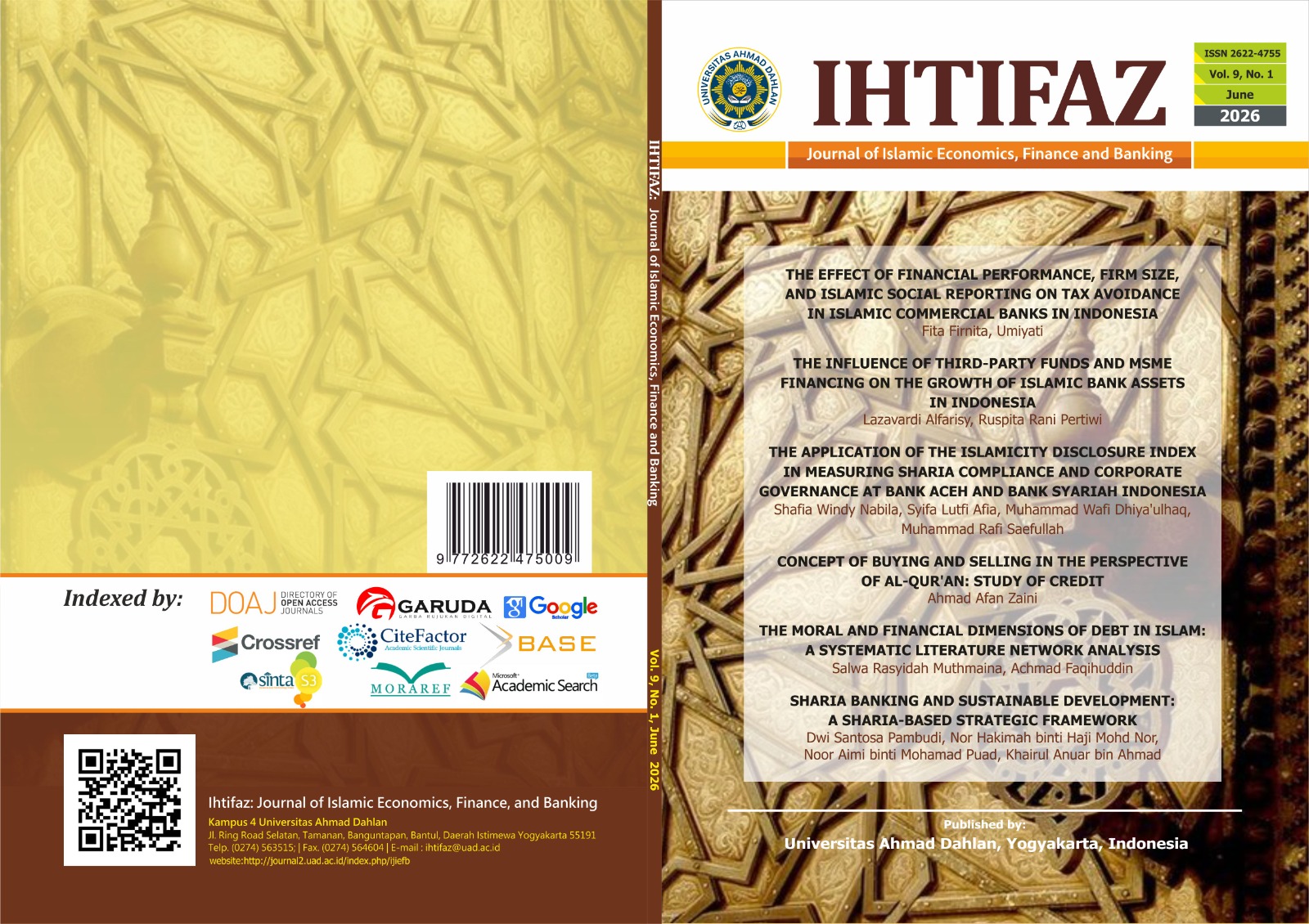
Sharia Banking and Sustainable Development: A Sharia-Based Strategic Framework
DOI:
https://doi.org/10.12928/ijiefb.v9i1.16949Keywords:
Islamic banking, sustainable development goals, maqashid shariah, sustainable finance, Islamic economic law, Yogyakarta.Abstract
Introduction to The Problem
Amid growing global momentum toward the Sustainable Development Goals (SDGs), Islamic financial institutions face intensifying pressure to anchor their operations within Sharia principles and corporate social responsibility frameworks. This alignment is theoretically synchronized; yet, in practice, the operational integration of SDGs and maqashid al-shari'ah (the objectives of Islamic law) within the banking sector remains structurally fragmented. This disconnect is particularly pronounced at the regional level, where localized economic policies often eclipse systemic sustainability mandates
Purpose/Objective Study
This study investigates the strategic nexus between Islamic banking operations and the realization of Sustainable Development Goals (SDGs) within the Special Region of Yogyakarta. Specifically, it evaluates the empirical efficacy of these institutions' contributions while critically identifying the systemic challenges that hinder their optimal performance. By addressing these operational bottlenecks, this research ultimately formulates a novel, maqashid-based strategic framework designed to fortify the sector's long-term role in fostering sustainable developmen
Design/Methodology/Approach:
Methodologically, this study adopts a qualitative design anchored in a document-based research approach. To ensure data triangulation and analytical depth, empirical materials were systematically harvested from multifaceted institutional outputs, including corporate annual and sustainability reports, regulatory framework papers, and strategic policy documents issued by the Financial Services Authority (OJK) and the National Committee for Islamic Economy and Finance (KNEKS). This internal corporate data is further complemented by publications from industry associations and peer-reviewed academic literature. Subsequently, the gathered qualitative data underwent a rigorous thematic content analysis, executed through a structured five-stage process: data familiarization, initial coding, theme development, conceptual review, and contextual interpretation.
Findings:
Empirical findings demonstrate that Islamic banking actively drives SDG acceleration through a multifaceted approach: scaling productive financing, expanding financial inclusion, bolstering Micro, Small, and Medium Enterprises (MSMEs), and mobilizing Islamic social finance instruments. Although these channels yield measurable benefits for poverty alleviation, inclusive economic growth, and social welfare, several operational bottlenecks persist. Specifically, the overall developmental efficacy is hindered by the superficial integration of sustainability indicators into institutional performance matrices, weak social impact assessment tools, and fragmented stakeholder cooperation. To resolve these issues, this study introduces a maqashid-based strategic framework that focuses on intensifying sustainability governance, hardcoding SDGs into financing policies, expanding multi-stakeholder networks, and advancing impact-measurement frameworks.
By doing so, this research significantly enriches the existing literature, offering a functional framework that synthesizes SDGs with maqashid al-shari'ah within banking operations. Beyond its theoretical merits, the study provides strategic, actionable blueprints for regulators, policymakers, and corporate executives seeking to propel sustainable finance within the Islamic financial ecosystem.
References
Ainun Nisa, Arina Rizqi Al’haq, Umi Nur Mardliyyah, Ni’amillah, Muhammad Ridho Saputra, Nana Yunisa, N. H. (2026). ANALISIS KINERJA KEUANGAN MELALUI PENDEKATAN RASIO SOLVABILITAS : STUDI KASUS PADA KB BANK SYARIAH PERIODE 2022-2024. Jurnal Ekonomi Manajemen Dan Bisnis, 3(5), 161–168. https://doi.org/https://doi.org/10.62017/jemb
Basri, R., Abdullah, S., Mamun, A., & Aktar, A. (2026). ESG Disclosure Practices and Performance of Islamic Banks : Moderating Roles of Board Independence , Gender Diversity , and Institutional Ownership. 0–14. https://doi.org/10.20944/preprints202602.1632.v1
Dusuki, A. W., & Abozaid, A. (2021). A critical appraisal on the challenges of realizing. IIUM Journal of Economics and Management, 2(2), 143–165.
Hikmah, L., Hafizhah, N. Z., & Rusgianto, S. (2025). Islamic Banking and Economic Growth : A Case Study in Indonesia. Jurnal MEDIASAS: Media Ilmu Syari’ah Dan Ahwal Al-Syakhsiyyah, 8(1), 111–123. https://doi.org/10.58824/mediasas.v8i1.307
Islam, U., & Alauddin, N. (2024). Maqashid Al-Shariah : Kerangka Adaptif Hukum Islam untuk Menjawab Tantangan Kontemporer. Journal of Dual Legal System, 1(2), 103–117. https://doi.org/10.58824/jdls.v1i2.226
M Rehan Kurniawan, M. I. P. N. (2025). Tata Kelola Data dalam Manajemen Syariah : Tantangan dan Dampak terhadap Efisiensi Operasional. Jurnal Sains Student Research, 3(4), 700–705. https://doi.org/https://doi.org/10.61722/jssr.v3i4.5436
Marzadi, H., Katazon, Y. T., & Bengkulu, U. M. (2025). STUDI LITERATUR : PENERAPAN PRINSIP SYARIAH DALAM. Journal of Islamic Economics and Finance, 2(2), 343–356.
Nilna, N. F., Rahmawati, A., Putri, D. I., Rahmadhani, V. B., Hidayati, A. N., Islam, U., Sayyid, N., Rahmatullah, A., & Tulungagung, K. (2025). IMPLEMENTASI GREEN BANKING PADA BANK UMUM SYARIAH DI INDONESIA : TANTANGAN DAN STRATEGI IMPLEMENTASI GREEN BANKING PADA BANK UMUM SYARIAH DI INDONESIA : TANTANGAN DAN STRATEGI. JURNAL MEDIA AKADEMIK (JMA), 3(12). https://doi.org/10.62281
Nisa, R. S. (2025). KONTRIBUSI PERBANKAN SYARIAH TERHADAP STABILITAS EKONOMI DAN PENCAPAIAN SUSTAINABLE DEVELOPMENT GOALS (SDGS) MELALUI PEMBIAYAAN SYARIAH. 3(12), 122–131. https://doi.org/https://doi.org/10.61722/jiem.v3i12.7369
Putri, N., Penelitian, J., & Bank, I. (2025). Evaluasi kinerja maqasid syariah terhadap oprasional bank syariah di era digitalisasi. Jurnal Penelitian, Karya Ilmiah Dan Pengembangan (Islamic Science), 186–207.
Rahawati, F. T. (2025). Sinergi Maqashid Syariah dan SDGs : Model Pembangunan Berkelanjutan Berbasis Nilai-Nilai Islam. Jurnal Ilmiah Ekonomi Manajemen Bisnis Dan Akuntansi, 2(6), 745–756. https://doi.org/https://doi.org/10.61722/jemba.v2i6.1691
Salsabila, B., & Alifa, N. L. (2025). Advokasi dan Kolaborasi Akademik dalam Penguatan Kelembagaan Ekonomi Syariah : Sinergi Ilmu , Etika dan Kebijakan. Jurnal Ekonomi Islam, 3, 87–104. https://doi.org/https://doi.org/10.56184/jeijournal.v3i2.533
Sari, D. P., Fitri, A. O., & Fasa, M. I. (2025). Implementasi Prinsip Maqashid Syariah Dalam Operasional Perbankan Syariah. Inflasi : Jurnal Ekonomi, Manajemen Dan Perbankan, 2, 50–57.
Sari, K., Ismail, M., & Ekawaty, M. (2020). Bank Syariah : peran sosial dalam kerangka maqashid syariah dan profitabilitas di negara Qatar dan Indonesia. Journal of Business and Banking, 9(2), 179–196. https://doi.org/10.14414/jbb.v9i2.1834
Sithole, A. (2025). Choosing a Qualitative Research Paradigm for Social Sciences : A Literature Review for Educational Researchers . INTERNATIONAL JOURNAL OF RESEARCH AND INNOVATION IN SOCIAL SCIENCE (IJRISS), VIII(2454), 3945–3954. https://doi.org/10.47772/IJRISS
Siti Nurain Muhmad, Rusnah Muhamad, F. S. (2021). Sustainable Development Goals and Islamic Finance : An Integrated Approach for Islamic Financial Institutions. Indonesian Journal of Sustainability Accounting and Management, 5(1), 123–136. https://doi.org/10.28992/ijsam.v5i1.286
Wakhidah, L. M. N. (2025). Peran Ekonomi Syariah dalam Mendukung Sustainable Development Goals (SDGs). Journal of Sharia Economics Journal of Sharia Economics, 7(1), 15–28.
Wardiman, J., Hidayat, M. T., & Afdal, Z. (2024). Integration of ESG ( Environmental , Social , Governance) Criteria in Islamic Finance : A Systematic Review. Laa Maisyir, Jurnal Ekonomi Islam, 344–363.
Y Sirilakshmi, Ashwini T, Bidyut P Gogoi, Neelakshi Bhuyan, R. C. B. (2024). CONTENT ANALYSIS IN QUALITATIVE RESEARCH: IMPORTANCE AND APPLICATION. Exploring Narratives: A Guide to Qualitative Research Methods.
Downloads
Published
Issue
Section
License
Copyright (c) 2026 Universitas Ahmad Dahlan

This work is licensed under a Creative Commons Attribution-NonCommercial-ShareAlike 4.0 International License.
License and Copyright Agreement
In submitting the manuscript to the journal, the authors certify that:
- They are authorized by their co-authors to enter into these arrangements.
- The work described has not been formally published before, except in the form of an abstract or as part of a published lecture, review, thesis, or overlay journal. Please also carefully read Ihtifaz, Journal of Islamic Economics, Finance, and Banking Posting Your Article Policy at http://journal2.uad.ac.id/index.php/ijiefb/about/submissions#onlineSubmissions
- That it is not under consideration for publication elsewhere,
- That its publication has been approved by all the author(s) and by the responsible authorities “tacitly or explicitly“ of the institutes where the work has been carried out.
- They secure the right to reproduce any material that has already been published or copyrighted elsewhere.
- They agree to the following license and copyright agreement.
Copyright
Authors who publish with Ihtifaz, Journal of Islamic Economics, Finance, and Banking agree to the following terms:
- Authors retain copyright and grant the journal right of first publication with the work simultaneously licensed under a Creative Commons Attribution License (CC BY-SA 4.0) that allows others to share the work with an acknowledgment of the work's authorship and initial publication in this journal.
- Authors are able to enter into separate, additional contractual arrangements for the non-exclusive distribution of the journal's published version of the work (e.g., post it to an institutional repository or publish it in a book), with an acknowledgment of its initial publication in this journal.
- Authors are permitted and encouraged to post their work online (e.g., in institutional repositories or on their website) prior to and during the submission process, as it can lead to productive exchanges, as well as earlier and greater citation of published work.
_1.png)