Artefact-to-Legal Element Mapping in iOS-Based Web Gambling Cases: A Cross-Source Correlation Framework under KUHP and ITE Law
DOI:
https://doi.org/10.12928/mf.v8i2.15926Keywords:
Digital Forensics, Online Gambling, iOS Artefacts, Magnet AXIOM, LawAbstract
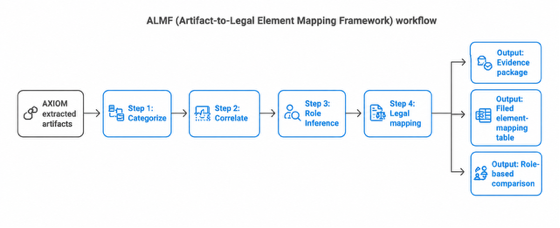
The widespread use of web-based online gambling through mobile browsers and instant messaging applications has made digital traces increasingly difficult to interpret as legally admissible evidence. Previous forensic research primarily concentrated on artefact recovery from dedicated gambling applications, leaving limited attention to systematic approaches for associating web-based traces with legal elements. This study examined the identification, classification, and legal mapping of web-based gambling artefacts using the proposed Artefact-to-Legal Element Mapping Framework (ALMF). A real-case evidence set acquired from an Apple iPhone XR was analysed with Magnet AXIOM Process v9.4.0.44917, generating Quick Image and Decrypted evidence for extraction and correlation. The analysis identified four major artefact categories, including web browsing traces, credential and persistence artefacts, WhatsApp communication records, and visual media files. Browser artefacts reflected intentional discovery and access to gambling websites, whereas credential artefacts indicated recurring or sustained access. WhatsApp conversations provided the strongest evidence of promotional activities through shared links, invitations, and dissemination patterns. Visual artefacts further strengthened the gambling context by revealing website interfaces and financial indicators. Cross-source correlation differentiated player activities from promoter or distributor behaviour. The mapped evidence supported KUHP Article 303 and UU ITE Article 27(2). The findings demonstrated that contextual interpretation across multiple artefact sources produced stronger evidential value than analysing individual artefacts separately.
References
A. E. Saragih, N. Christian, and P. Khoirunisa, “Analisis Penggunaan Barang Bukti Digital di Dalam Sistem Hukum di Indonesia (Studi Kasus Putusan Nomor 3 K/PID.SUS/2019),” Media Hukum Indonesia (MHI), vol. 2, no. 2, Jun. 2024, doi: 10.5281/zenodo.12082755.
S. Marsela, A. Syifa, F. D. Pratama, and R. A. Muqfi, “Persoalan Penjudi dan Jud%i Online dalam Analisa Teori Etika Utilitarianisme,” Das Sollen: Jurnal Kajian Kontemporer Hukum Dan Masyarakat, vol. 1, no. 2, 2023.
Y. Gao, H. Wang, L. Li, X. Luo, G. Xu, and X. Liu, “Demystifying Illegal Mobile Gambling Apps,” in Proceedings of the Web Conference 2021, Ljubljana Slovenia: ACM, Apr. 2021, pp. 1447–1458. doi: 10.1145/3442381.3449932.
T. A. Maryam, M. A. Maharani, T. A. Fahrezi, and A. A. Nugroho, “Peran Digital Forensik Dalam Pengumpulan Bukti Pada Kasus Jud%i Online di Kabupaten Demak,” KONSENSUS : Jurnal Ilmu Pertahanan, Hukum dan Ilmu Komunikasi, vol. 1, no. 3, Jun. 2024.
A. Sitanggang, B. P. Sari, E. D. Sidabutar, Halimah, M. Cahya, and R. Y. Nababan, “Penegakan Undang-Undang ITE Terhadap Kasus Jud%i Online,” MJOL, vol. 2, no. 4, pp. 16–22, Dec. 2023, doi: 10.51178/mjol.v2i4.1620.
A. T. Sowakil, S. Paparang, and H. A. Mau, “Rekonstruksi Pembuktian Tindak Pidana Perjudian Media Online dalam Sistem Peradilan Pidana Indonesia,” Inovasi Global Jurnal, vol. 2, no. 9, pp. 1278–1291, Sep. 2024, doi: 10.58344/jig.v2i9.171.
Wijaya and T. Oktavia, “Factors Influencing Online Gambling Discontinuance Intentions: An SOR Analysis,” ICIC Express Letters, vol. 19, no. 11, 2025, doi: 10.24507/icicel.19.11.1191.
N. Parmar and N. Chaudhary, “Exploring the Future of Drone Forensics: A Systematic Study of Methods and Applications,” in Information Security, Privacy and Digital Forensics, vol. 1456, N. K. Chaudhary, S. S. Iyengar, C. Modi, and S. J. Patel, Eds., in Lecture Notes in Electrical Engineering, vol. 1456. , Singapore: Springer Nature Singapore, 2026, pp. 95–137. doi: 10.1007/978-981-95-2196-8_7.
P. D. Nigroho and Mu. N. Al-Azhar, “IT : Digital Forensic,” 1, vol. 5, no. 1, Jun. 2017, doi: 10.58217/ipsikom.v5i1.31.
A. FFaizal and A. Luthfi, “Comparison Study of NIST SP 800-86 and ISO/IEC 27037 Standards as A Framework for Digital Forensic Evidence Analysis,” journalisi, vol. 6, no. 2, pp. 701–718, Jun. 2024, doi: 10.51519/journalisi.v6i2.717.
I. K. Kawi Arta and I. G. A. Wira Sena, “Perbedaan Makna Frasa Kata Jud%i online dengan Game Online dari Perspektif peraturan Perundang-undangan.,” KW, vol. 13, no. 1, pp. 49–69, Aug. 2025, doi: 10.37637/kw.v13i1.2496.
N. Maryani and U. Sastradipraja, “Peranan Audit Investigatif dalam menjadikan Bukti Audit sebagai Bukti Hukum untuk Pembuktian Tindak Pidana Korupsi,” 1, vol. 17, no. 2, pp. 116–147, 2020, doi: 10.26874/portofolio.v17i2.199.
A. A. Shetty and P. Trevorrow, “Digital Forensic Investigation of Wearable Android Fitness Applications,” Journal of Applied Security Research, vol. 21, no. 1, pp. 35–59, Jan. 2026, doi: 10.1080/19361610.2025.2562398.
K. Schmid, K. Bayreuther, and F. Freiling, “Limits to the Forensic Analysis of Container Applications in Cloud Environments,” Digital Threats, vol. 6, no. 4, pp. 1–20, Dec. 2025, doi: 10.1145/3765629.
M. Y. Halim, F. W. Giffary, Y. Prayudi, M. F. Ramadhan, and I. V. Paputungan, “Cryptanalysis of Encrypted Drone Device Manager Log Extracted From Android Using Static Method,” in 2025 10th International Conference on Information Technology and Digital Application (ICITDA), Yogyakarta, Indonesia: IEEE, Nov. 2025, pp. 1–7. doi: 10.1109/ICITDA68167.2025.11332242.
Novianti, “Pemberantasan Konten Jud%i Online dalam Perspektif Undang-Undang Informasi dan Transaksi Elektronik (UU ITE),” 2022.
A. Ahmadi, T. Akbar, and H. M. Putra, “Perbandingan Hasil Tool Forensik Pada File Image Smartphone Android Menggunakan Metode NIST,” JIKO, vol. 4, no. 2, pp. 92–97, Aug. 2021, doi: 10.33387/jiko.v4i2.2812.
M. F. Ramadhan, Y. Prayudi, E. Ramadhani, and M. Y. Halim, “Design of an Alexiou Principle Guided Large Language Model Framework for Digital Forensic Investigation,” in 2025 10th International Conference on Information Technology and Digital Application (ICITDA), Yogyakarta, Indonesia: IEEE, Nov. 2025, pp. 1–6. doi: 10.1109/ICITDA68167.2025.11332241.
G. Waney, “Kajian Hukum terhadap Tindak Pidana Perjudian (Penerapan Pasal 303, 303 BIS KUHP),” Lex Crimen, vol. 5, no. 3, 2016.
R. R. Chand, N. A. Sharma, and M. A. Kabir, “Advancing Web Browser Forensics: Critical Evaluation of Emerging Tools and Techniques,” SN COMPUT. SCI., vol. 6, no. 4, p. 355, Apr. 2025, doi: 10.1007/s42979-025-03921-6.
S. Pirzada, N. H. Ab Rahman, N. D. W. Cahyani, and M. F. Othman, “A Framework of Forensic Analysis and Visualization: Using WhatsApp Chat Data as a Case Study,” JOIV : Int. J. Inform. Visualization, vol. 8, no. 3–2, p. 1834, Nov. 2024, doi: 10.62527/joiv.8.3-2.2868.
M. F. M. Nahdli, M. K. Biddinika, and I. Riadi, “Forensic Analysis of the WhatsApp Application Using the National Institute of Justice Framework,” International Journal of Advances in Data and Information Systems, vol. 5, no. 2, Sep. 2024, doi: 10.59395/ijadis.v5i2.1328.
Z. R. Likumahua, N. D. W. Cahyani, and E. M. Jadied, “Digital Forensics and Its Challenges in Investigating Online Gambling Cases,” in 2024 12th International Conference on Information and Communication Technology (ICoICT), Bandung, Indonesia: IEEE, Aug. 2024, pp. 108–114. doi: 10.1109/ICoICT61617.2024.10698693.
Downloads
Published
Issue
Section
License
Copyright (c) 2026 Sudirman Sudirman, Yudi Prayudi

This work is licensed under a Creative Commons Attribution-ShareAlike 4.0 International License.
Start from 2019 issues, authors who publish with JURNAL MOBILE AND FORENSICS agree to the following terms:
- Authors retain copyright and grant the journal right of first publication with the work simultaneously licensed under a Creative Commons Attribution License (CC BY-SA 4.0) that allows others to share the work with an acknowledgment of the work's authorship and initial publication in this journal.
- Authors are able to enter into separate, additional contractual arrangements for the non-exclusive distribution of the journal's published version of the work (e.g., post it to an institutional repository or publish it in a book), with an acknowledgment of its initial publication in this journal.
- Authors are permitted and encouraged to post their work online (e.g., in institutional repositories or on their website) prior to and during the submission process, as it can lead to productive exchanges, as well as earlier and greater citation of published work.

This work is licensed under a Creative Commons Attribution-ShareAlike 4.0 International License.